49 works in this view — arrow keys or swipe to move between them.
Dance in Art · 1874
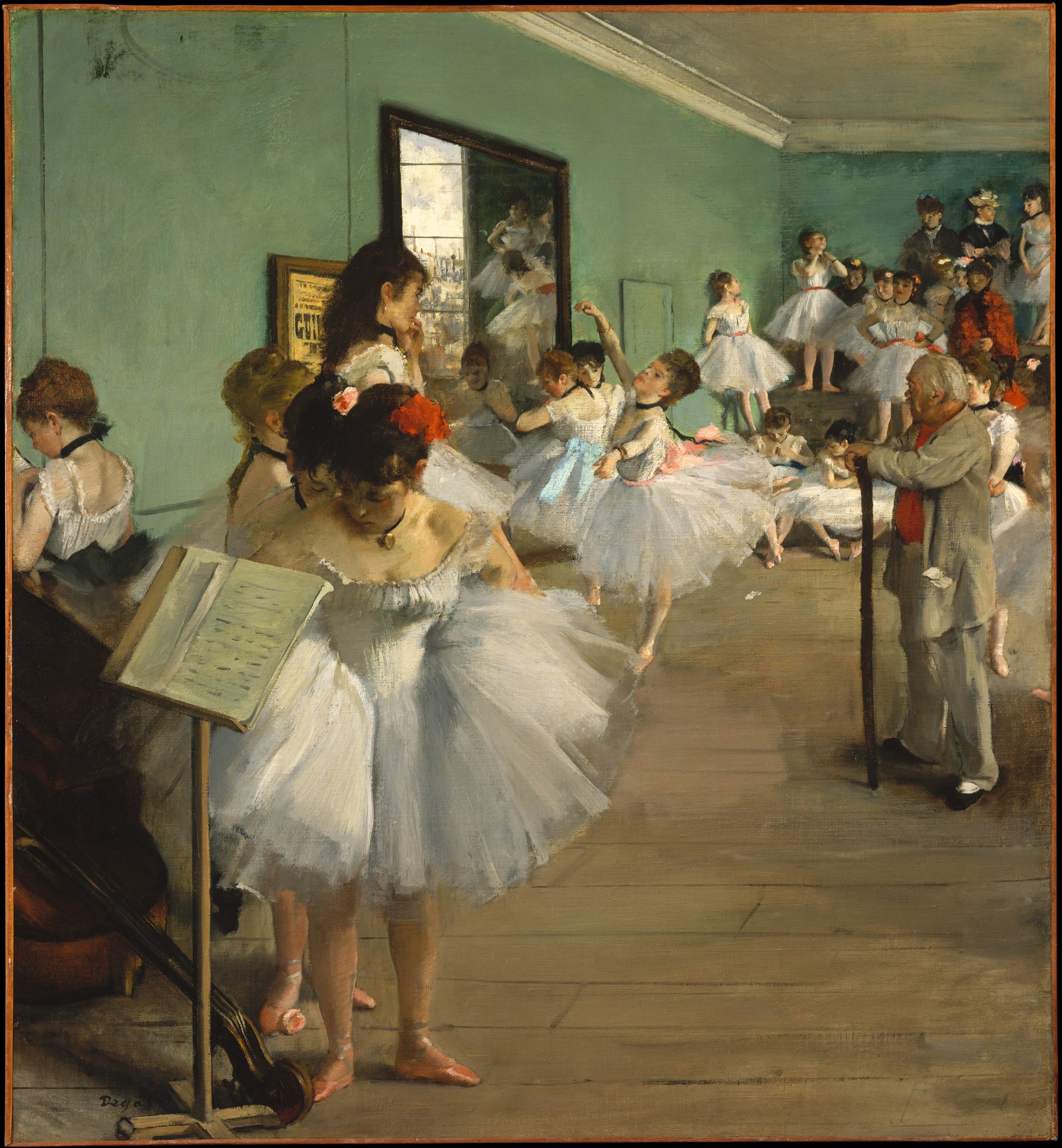
The Dance Class MET DT46
Edgar Degas
- Medium:
- Oil Painting
- Dance:
- Ballet
- Era:
- Late 1800s (Victorian Ballroom)
- Source:
- Wikimedia Commons
- Rights:
- Public domain — free to use, share and adapt.
- Recorded as:
- CC0
Degas was obsessed with the ballet class as a subject because it allowed him to observe the human body in disciplined, repetitive motion without the artifice of performance. This painting is one of his most complete records of the teaching of classical ballet, showing both the formal technique and the lived reality of the studio. For historians and dancers, it is evidence of how ballet instruction was structured and conducted in one of the world's premier ballet institutions.
What you are looking at
A ballet instructor in a grey suit conducts a class of young female dancers in a large, light-filled studio with pale green walls. The dancers wear white tutus and pointe shoes, positioned at various stages of an exercise or combination. The nearest dancer, in the foreground left, holds a sheet of music and stands in profile; others are scattered across the studio floor in attitudes of attention or mid-movement. An older woman in dark dress stands beside the instructor. The composition is asymmetrical and intimate despite the number of figures, with cool northern light streaming in from tall windows, creating soft shadows across the wooden floor. The painting captures a moment of instruction rather than performance—a teaching environment in which the dancers are absorbed in learning rather than presenting.
The dancing
The dancers stand in varied positions suggesting different moments within a single exercise. Several adopt the classical turned-out stance of ballet, with upright torsos and elongated necks. The foreground dancer holds her music with both hands at chest height, a practical detail suggesting this is a study class. The instructor's body is relaxed but commanding, his gaze directed toward the students. The poses are fundamentally upright and controlled; there is no wild extension or dramatic gesture, only the sustained alignment required of classical technique.
The dance depicted
This is almost certainly a ballet class, specifically a training session for young dancers (likely students at an academic institution rather than a performance). The white tutus, pointe shoes, and the classical upright carriage of the students confirm the genre. The presence of a conductor or maître de ballet overseeing the lesson indicates formal academic ballet instruction of the late nineteenth century. The informal setting—students holding music, various positions of readiness—shows ballet as a discipline learned in the studio rather than a finished spectacle on stage.
How it was made
This is an oil painting, executed with loose brushwork and a restricted palette dominated by cool greys, greens, and flesh tones. Degas has built the composition with rapid, visible strokes—particularly in the tutus and background figures—that convey movement and light rather than precise detail. The technique allows him to capture the transient quality of a teaching moment; the brushwork itself suggests the fluidity of motion. The painting would have circulated among collectors and academies interested in dance documentation and the aesthetics of the atelier.
About this work
This is one of Degas's recurring subjects: the ballet class as a space of work, discipline, and human relationship. The painting documents a teaching moment in late nineteenth-century Paris, where academic ballet training was centralized in institutions such as the Opéra. Unlike narrative or performance paintings, this work is fundamentally sociological—it shows ballet as a profession and a pedagogy, observed with the close attention Degas brought to his studies of dancers in practice. The work belongs in a dance gallery because it is one of the most important visual records of how ballet students actually trained, and because it established a genre—the studio scene—that became central to artistic representations of dance.
How to look at it
Attend to the varied states of the dancers' bodies—some are held in formal positions, others are caught between moments, one is consulting music. Notice how Degas has positioned the instructor not at the centre but to the right, suggesting that the class is not a formal performance for the viewer but a scene happening incidentally. The light from the windows is crucial: it is cool and even, the light of a working studio rather than a theatre. The painting asks you to look at ballet as labour and craft, not as spectacle.
The artist
Edgar Degas (1834–1917) made the ballet studio one of his primary subjects from the 1870s onward, executing hundreds of paintings, pastels, and prints of dancers in class, in rehearsal, and backstage. He had privileged access to the Opéra as a subscriber and observer, and he was fascinated by the geometry of the body in motion and the social hierarchies of the theatre. Unlike many of his contemporaries, Degas was less interested in the spectacle of ballet than in the labour behind it: the répétition, the fatigue, the discipline. His dance works span multiple media and range from rapid compositional studies to highly finished salon paintings.
The period
In the 1870s, ballet in Paris was undergoing institutional consolidation and academic systematization. The ballet class itself—the daily training of dancers—was increasingly seen as a subject worthy of artistic attention, both as a scientific study of human motion and as a scene of social life. Degas's interest in the studio coincided with a broader artistic turn toward modern life and labour; the ballet class was neither historical nor mythological, but contemporary, urban, and accessible to the artist. At the same time, Romanticism in ballet was fading in favour of a more technical, academic aesthetic, which is reflected in the precise postures of Degas's dancers.
Where it lives
The painting is recorded as held in an unspecified collection according to the catalogue record. The work is sourced from Wikimedia Commons, which typically hosts images of works in public or well-documented collections.
Dance in this work
Questions about this work
How do I know this is really a Degas?
The catalogue record attributes it to Degas and it is accessible via Wikimedia Commons, which generally hosts images of authenticated works held in established institutions. The painting's style—the compositional method, the handling of light, the subject matter—is entirely consistent with Degas's known practice in the 1870s. The work is recognisable as one of his major ballet class paintings.
What is the name of the dance these students are learning?
The painting does not show a named dance in the theatrical sense; it shows a training exercise or combination (enchaînement) as part of a ballet class. The specific steps are not legible. This is normal for Degas's studio scenes—he was more interested in the posture and discipline than in documenting particular techniques.
Why did Degas paint ballet so much?
Degas was drawn to ballet because it combined several of his interests: the human figure in motion, the geometry of the body, modern urban life, and a world he had rare access to. He was also fascinated by the gap between the spectacle audiences saw and the labour, discipline, and ordinary moments that made it possible. The ballet studio was a laboratory for studying the body.
What does the music sheet mean?
The foreground dancer is holding sheet music, indicating that students learned combinations by reading notation or by receiving direct instruction from the conductor. This detail documents the pedagogical method: dancers relied on both visual correction from the maître de ballet and on their ability to coordinate with the music.
More Ballet artwork