47 works in this view — arrow keys or swipe to move between them.
Dance in Art · 1883
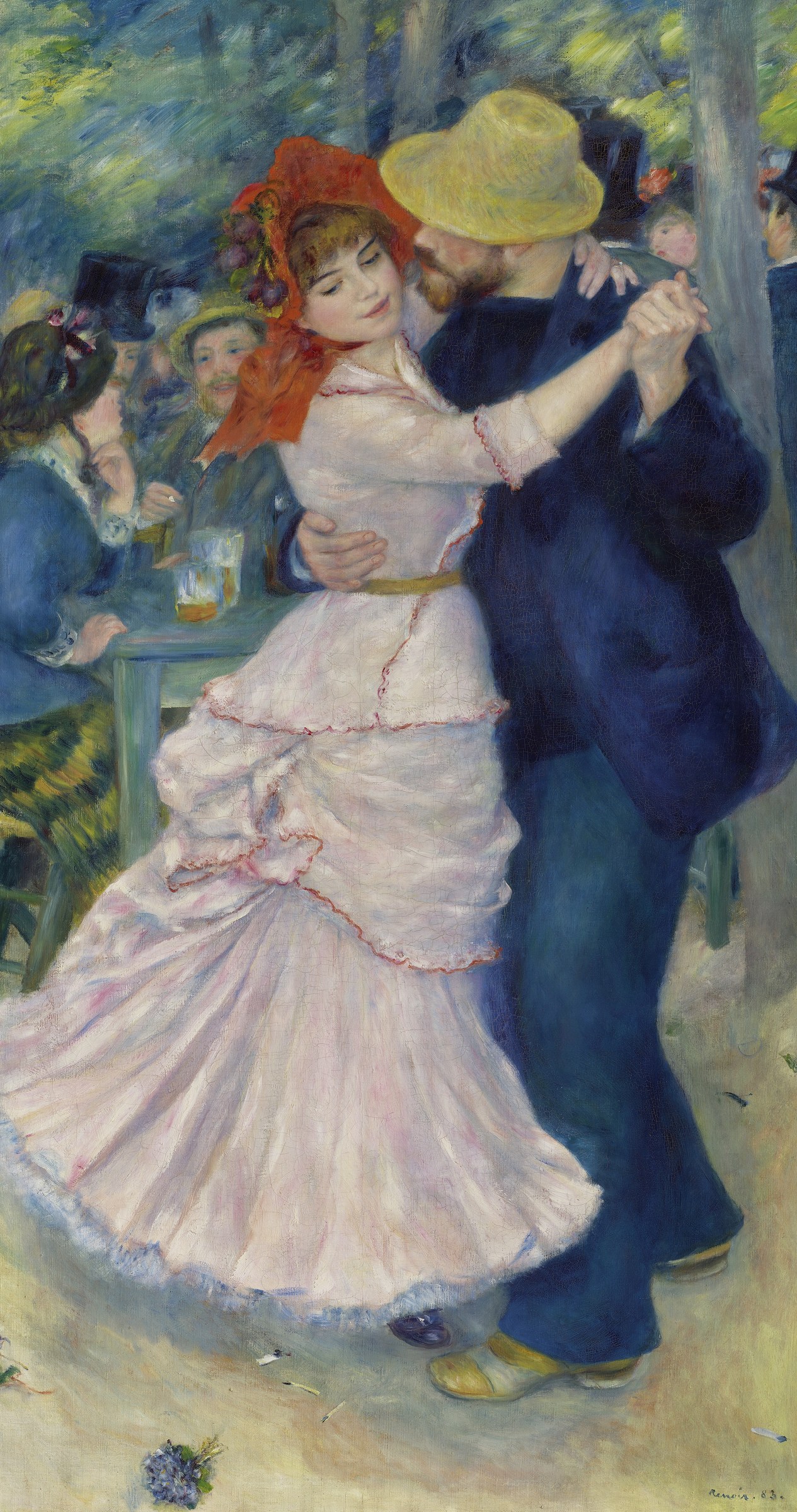
Dance-At-Bougival
Pierre-Auguste Renoir
- Medium:
- Oil Painting
- Dance:
- Waltz
- Era:
- Late 1800s (Victorian Ballroom)
- Source:
- Wikimedia Commons
- Rights:
- Public domain — free to use, share and adapt.
- Recorded as:
- Public Domain
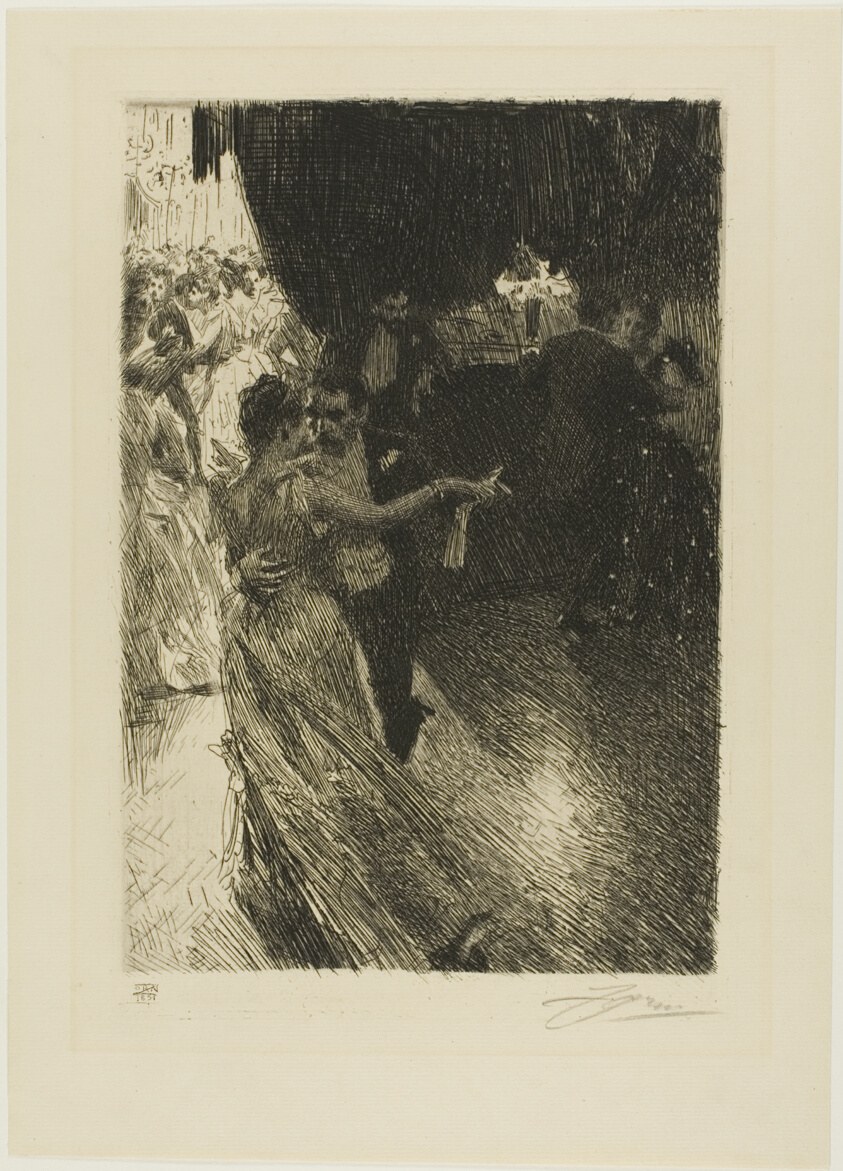
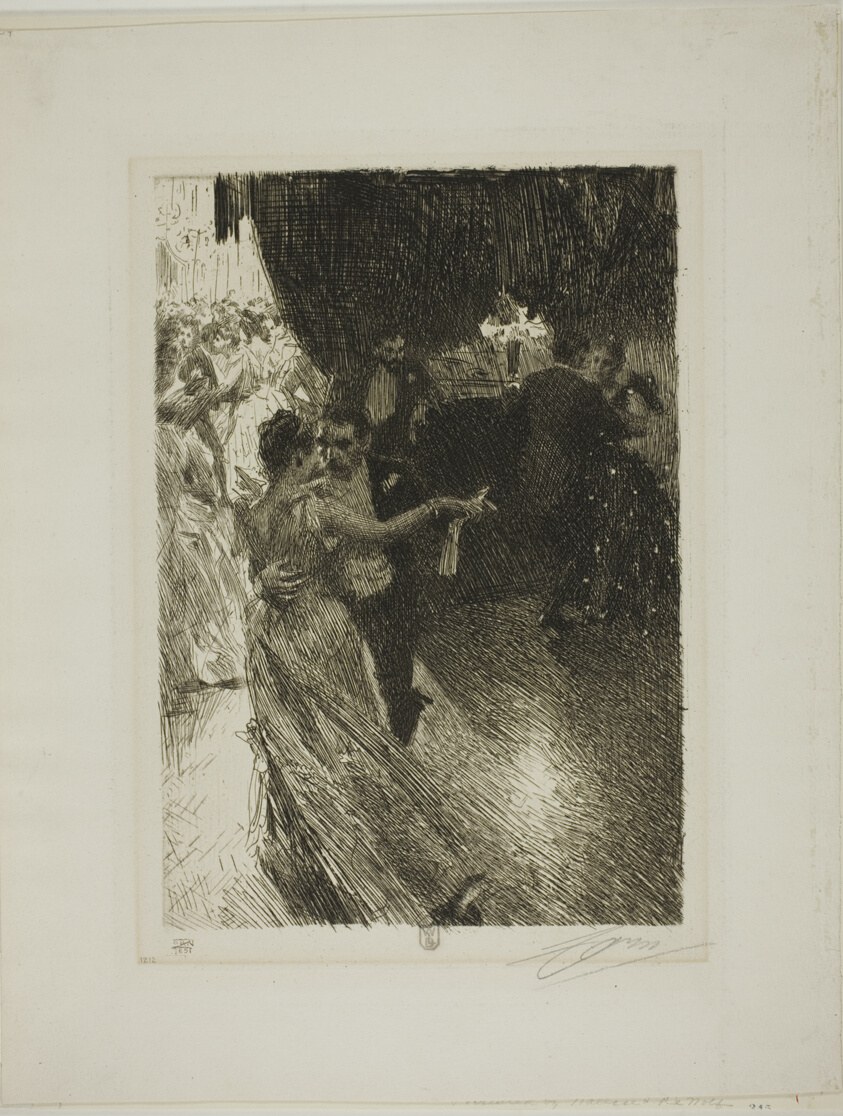
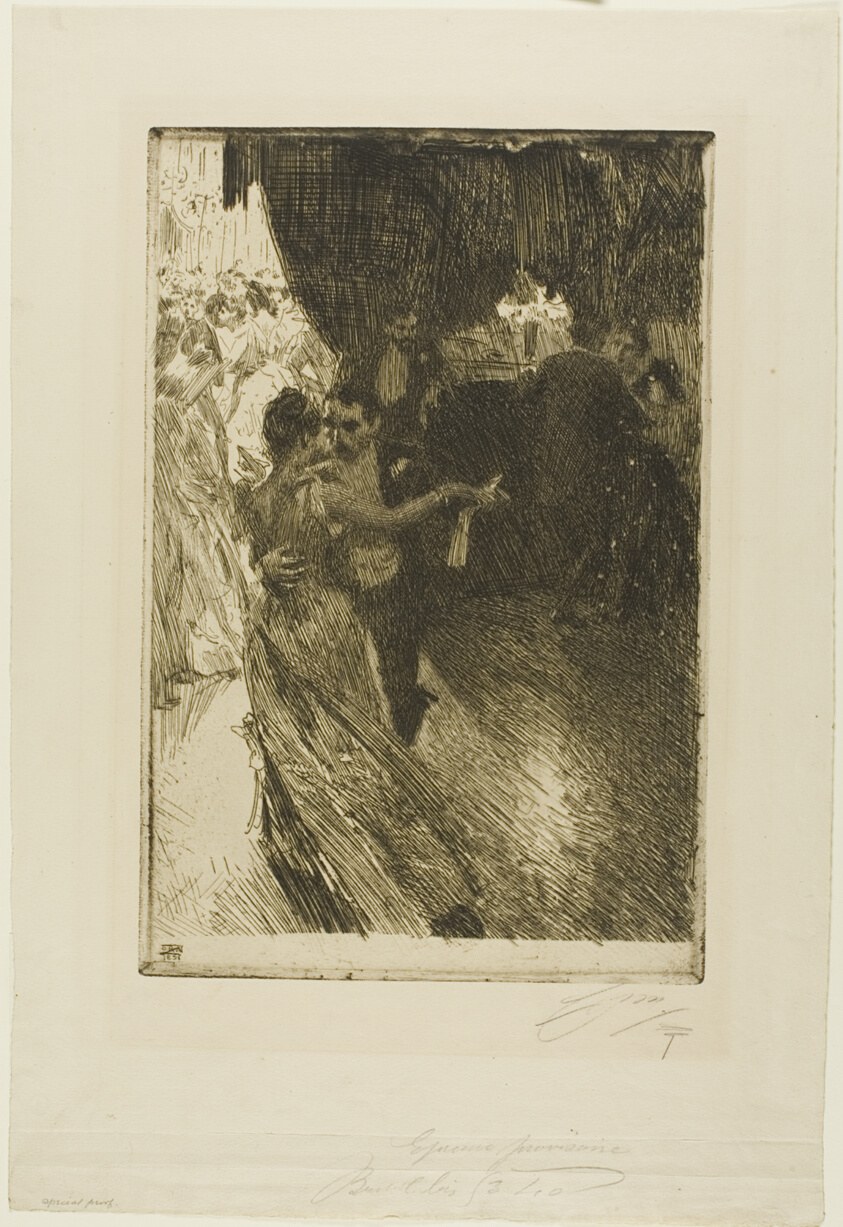
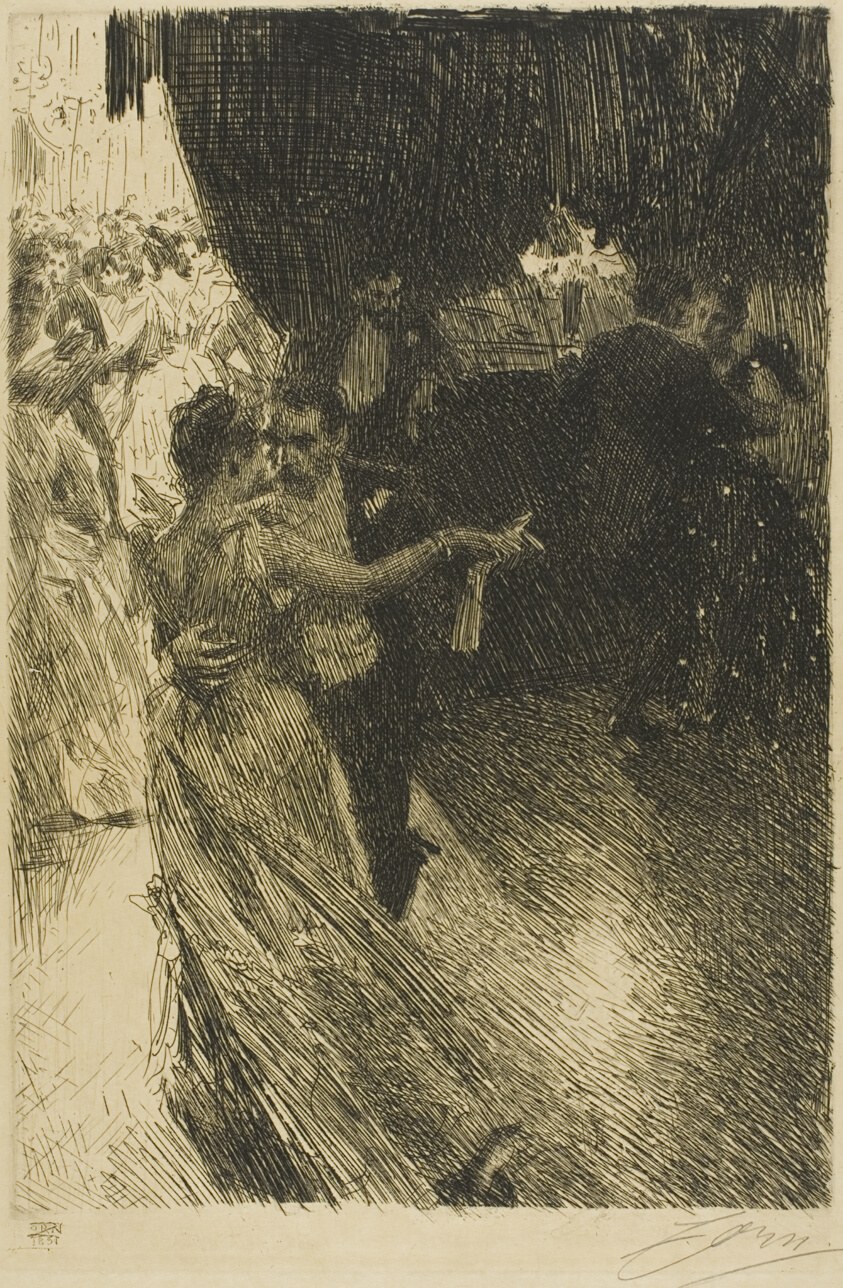
This painting is one of the most celebrated treatments of the waltz in 19th-century art, valued both for its technical mastery and for its sociological insight: it shows the waltz not as a technique but as a social ritual and a site of gender relations, attraction, and public identity. For historians of dance, it provides an invaluable record of how the waltz looked, was dressed, and was experienced in the 1880s, when it had become fully naturalised as the primary ballroom dance of European and American society.
What you are looking at
A couple dances in the foreground of a sunlit garden or outdoor leisure space, the woman in a white dress with a red bonnet, the man in a dark suit and straw hat. The brushwork is loose and impressionistic, capturing dappled light filtering through trees above; the background dissolves into blue-green foliage with other figures visible among the vegetation—some seated at tables, others standing or walking. The composition suggests a public dance garden or summer entertainment venue, a fashionable gathering place of the Gilded Age. The painting emphasizes the moment of connection between the couple, their bodies close and engaged, while the setting evokes leisure, courtship, and social pleasure.
The dancing
The male dancer supports his partner in what appears to be a closed ballroom hold, his right arm around her waist, her left hand resting on his shoulder. Her right arm extends upward and outward in a graceful arc. Both figures lean slightly into one another; their posture is upright but relaxed, suggesting forward motion. The woman's full skirt, gathered at the waist with visible decorative trim, suggests rotational movement caught mid-turn. The positioning and frame are consistent with late-19th-century salon dancing—intimate but proper, with clear lead and follow.
The dance depicted
This depicts a waltz, the dominant social dance of the 1880s among the middle and upper classes. The closed position, the woman's raised arm, the curved torso, and the implied circular motion all confirm the waltz frame. The garden setting and fashionable dress place this squarely in the social waltz tradition of the Gilded Age—not theatrical, but the ballroom waltz as performed at public venues and private gatherings. The painting captures the dance as a site of courtship and social display rather than technical virtuosity.
How it was made
Oil on canvas, painted with the loose, broken brushwork characteristic of Impressionism. Renoir uses dabs and strokes of colour to suggest form rather than define it precisely; the foliage is rendered in a symphony of greens and blues that recede optically. This technique was suited to capturing the effects of natural light and the spontaneous pleasure of the moment—a modern subject in a modern idiom. The painting would have been a salon piece, accessible to collectors of contemporary taste, and helped establish the Impressionist interest in leisure and social life.
About this work
This 1883 oil painting by Pierre-Auguste Renoir depicts a couple waltzing in an open-air garden or dance hall, surrounded by other pleasureseekers. The work is a quintessential Impressionist treatment of modern leisure: the subject is the social waltz as a vehicle for courtship and display, rendered in broken colour and light that emphasises the sensory and emotional mood of the moment. Renoir's composition places the couple at the narrative and visual centre but embeds them in a busy social landscape, suggesting that the dance is both intimate and public, both personal and conventional. The work exemplifies how Impressionism elevated the everyday social practices of the middle and upper classes—including dance—into subjects worthy of serious artistic attention.
How to look at it
The viewer should attend to the precise moment Renoir has chosen: the woman is caught mid-turn, her skirt swirling, her body twisted away from the man even as he leads her forward. This freeze-frame captures the dynamism of the waltz—its continuous rotation and the constant small adjustments of balance and direction that keep two bodies moving as one. The painter has also lavished attention on the play of light on the woman's white dress and the contrast between the couple's focused, intimate connection and the bright, loose brushwork of the surrounding scene, which is rendered almost as an atmospheric effect rather than as precisely defined figures and trees.
The artist
Pierre-Auguste Renoir (1841–1919) was a founder of Impressionism and one of the movement's most committed chroniclers of leisure and social life. He trained as a porcelain painter before joining the Impressionist circle in the 1870s, and retained throughout his career an interest in decorative beauty, luminosity, and the pleasures of sociability. Renoir frequently painted dance scenes, outdoor gatherings, and scenes of courtship; the waltz and the dance garden recur in his work as metaphors for happiness, vitality, and the harmonies of modern bourgeois life. He was less interested in the mechanics of dance than in its emotional and social resonance.
The period
The 1880s saw the waltz at the height of its social dominance in Europe and America, no longer controversial but fully established as the respectable dance of the ballroom. The rise of public dance gardens and outdoor entertainment venues—part of the commercialisation of leisure in industrial cities—created new contexts for social dancing beyond the aristocratic salon. Impressionism was at this moment consolidating its position in the avant-garde, and scenes of modern leisure (including dance) were central to its agenda. Renoir's painting sits at the intersection of these trends: it treats a conventional social practice with the technical innovation of high modernism, validating both the dance and the painter's interest in capturing transient light and emotion.
Where it lives
Sourced from Wikimedia Commons. The holding collection is not recorded in the catalogue.
Dance in this work
Questions about this work
How do we know this is a waltz and not another dance?
The closed ballroom hold, the upright frame, the rotation, and the woman's arm position are all characteristic of the waltz. The garden setting and fashion also place it in the period (1880s) when the waltz was the dominant social dance. The title also confirms it.
Was this a real place?
The painting is likely inspired by real Parisian outdoor dance venues such as the Bal de l'Opéra or the Moulin Rouge, which opened in 1889, though the title 'Dance at Bougival' suggests a more specific location. Bougival was a riverside village near Paris popular with painters and pleasure-seekers.
Why does the background look so blurry?
Renoir is using Impressionist technique to capture the effect of bright sunlight and atmospheric haze. The soft focus in the background also draws the eye toward the couple, making them the emotional centre of the scene while embedding them in a social milieu.
What is the dress code telling us?
The woman's white dress with red trim and the man's dark suit and boater hat are the fashionable outdoor dress of the 1880s upper and middle classes. The formality of the clothes, even for a casual garden dance, indicates that this is a respectable social occasion—not a working-class dance hall, but a bourgeois leisure space.
More Waltz artwork