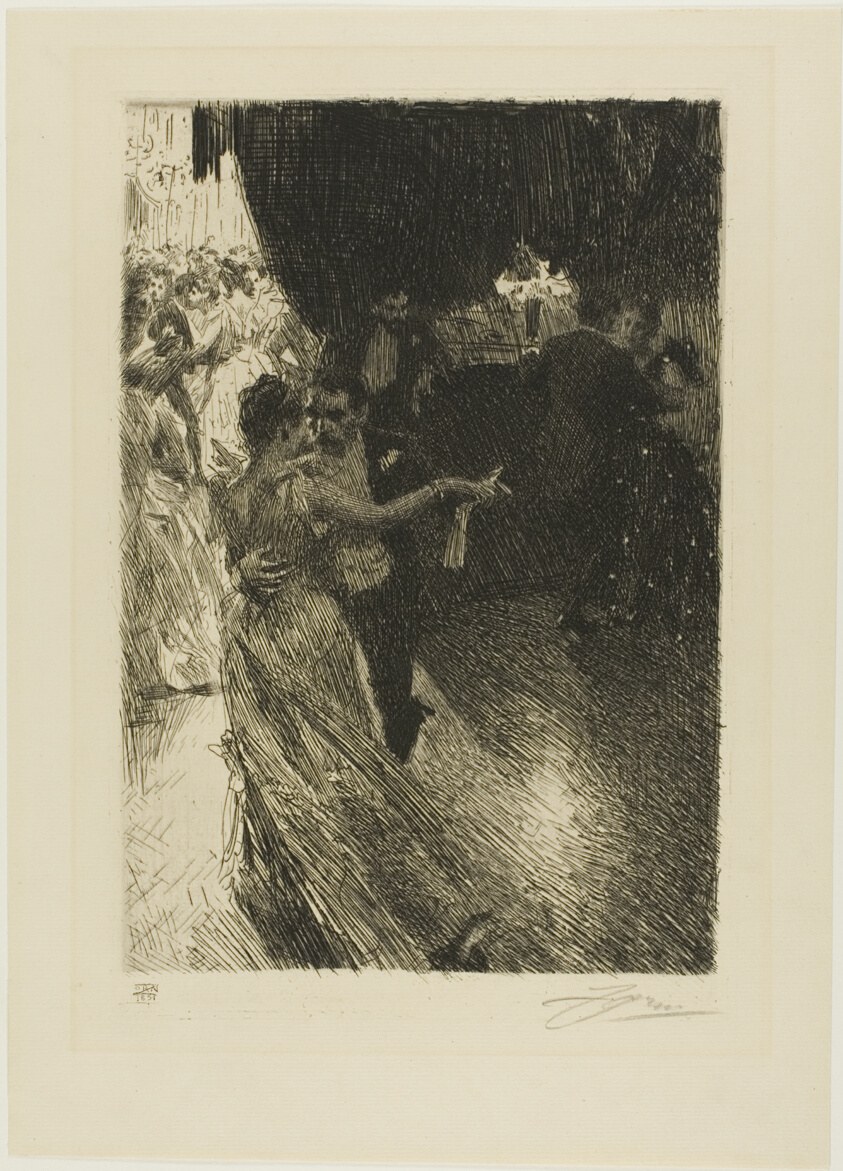
46 works in this view — arrow keys or swipe to move between them.
Dance in Art · 1893
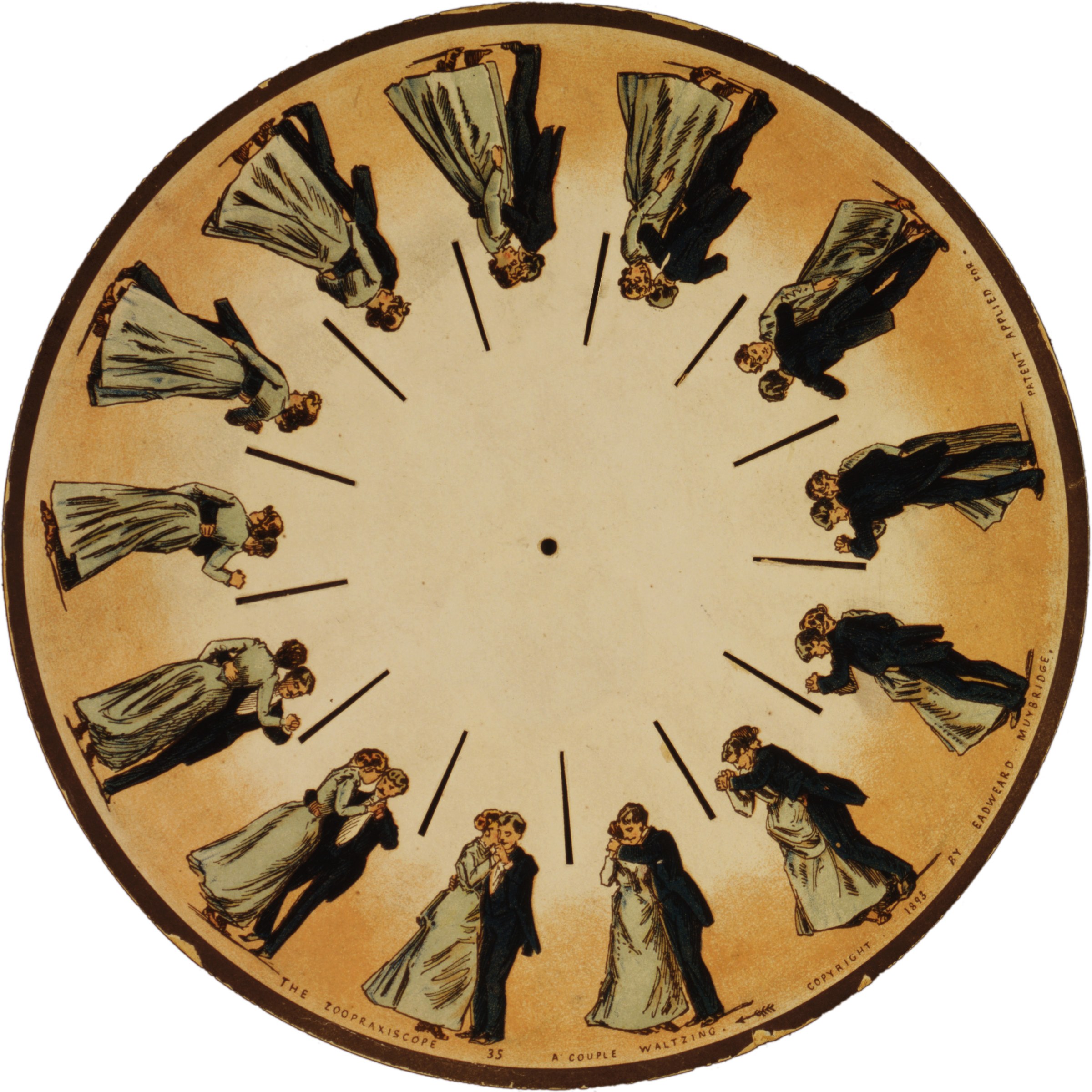
Eadweard Muybridge's phenakistoscope, 1893
Eadweard Muybridge
- Medium:
- Oil Painting
- Dance:
- Waltz
- Era:
- Late 1800s (Victorian Ballroom)
- Source:
- Wikimedia Commons
- Rights:
- Public domain — free to use, share and adapt.
- Recorded as:
- Public Domain
Muybridge's phenakistoscopes are among the first systematic visual records of human social dance in motion, predating film. They demonstrate that the waltz was not a static pose but a continuous, flowing rotational action with specific weight transfer and body lean—information that would otherwise have been lost to history. For a dancer or choreographer studying the historical waltz, this disc preserves evidence of authentic performance technique from the 1890s.
What you are looking at
This is a phenakistoscope disc, a nineteenth-century optical toy that creates the illusion of moving figures when spun before a mirror. Arranged around the circumference of a cream-colored circular card are twelve sequential images of a dancing couple, positioned at regular intervals like hours on a clock face. The man, dressed in dark formal evening wear with a white shirt front, and the woman, in a pale ball gown with puffed sleeves and a full skirt, are shown in successive positions of the waltz. Between each pair of figures stands a thin black radial line, which serves as a slit through which the viewer peers while the disc spins. The couple progresses from close embrace through the characteristic three-step turning motion of the waltz, their bodies leaning into the rotation with authentic period posture. The background is a warm tan or sepia tone, and the figures are rendered in a fine line-drawing style with careful attention to the fabric and silhouette of their clothing. The outer edge of the disc is bordered with a dark decorative frame, and small text identifying it as a Muybridge phenakistoscope is visible at the base.
The dancing
The couple maintains a closed ballroom hold throughout the sequence: the man's right hand placed at the woman's waist, her left hand resting on his shoulder or upper arm, their other hands clasped at approximately shoulder height. Both figures lean slightly forward and into the direction of travel, with knees slightly flexed to absorb and initiate the rotational movement. The woman's weight shifts through her legs with each step, and the fullness of her skirt flows and swirls with the centrifugal motion, creating a visual record of how the fabric moved in actual performance. The man's posture is upright and controlled, guiding the motion. The twelve positions capture one complete rotational cycle of the waltz's characteristic three-step turn.
The dance depicted
This is unquestionably a waltz, specifically the Viennese Waltz of the 1880s–1890s ballroom. The three-step rotating pattern, the closed promenade position, the forward lean of both partners, and the woman's full ball gown are all diagnostic of this dance. The phenakistoscope format—which requires the artist to decompose continuous motion into discrete phases—makes this a scientific record as much as an artistic one. When the disc is spun at the correct speed and viewed through the rotating slits, the couple appears to waltz in smooth, continuous motion, demonstrating how Muybridge was using the same analytical approach to human movement that he had applied to animals and athletes.
How it was made
A phenakistoscope is a hand-cranked optical device, predating cinema by several decades. This example is printed and hand-colored on a circular card stock, with the sequential images and radial slits cut or printed as part of the design. The viewer held the disc up to a mirror, spun it, and looked through the moving slits to see the illusion of continuous motion. The technique was invented in Belgium in 1832 and was immensely popular as a parlor entertainment throughout the nineteenth century. Muybridge's adoption of the format around 1893 was both nostalgic and innovative—a way to package his photographic motion studies in a form accessible to general audiences rather than specialists. The hand-coloring distinguishes this from purely photographic phenakistoscopes and suggests it was produced for a middle-class market.
About this work
This is a phenakistoscope disc depicting a waltz, created by Eadweard Muybridge circa 1893 as an application of his motion-analysis work to ballroom dance. It is a hybrid object: part optical toy, part scientific illustration, part artistic document of how the Victorian waltz was actually performed. The disc captures a complete rotational cycle of the dance in twelve sequential images, arranged radially so that when spun before a mirror, the figures appear to dance in continuous, smooth motion. For dancers and historians, it is a rare example of nineteenth-century motion capture—a way to preserve not just a pose or a moment, but the kinetic flow of an entire figure across three-dimensional space. The work belongs in a dance history collection because it documents both the form of the waltz and Muybridge's conviction that motion, including dance, should be studied, decomposed, and made visible.
How to look at it
To understand this image, imagine yourself holding the disc up to a mirror and rotating it slowly. Watch how the couple's position changes by small increments from one slit to the next; that sequence, when animated by the spinning motion and viewed through the moving slits, creates the illusion that they are dancing continuously. Notice also the careful attention to the woman's skirt: it swirls and settles differently at each phase, capturing the physics of how fabric moves in a fast three-step turn. This level of detail reveals that Muybridge did not merely document the waltz but studied its embodied reality—the weight, the momentum, the centrifugal effects on costume.
The artist
Eadweard Muybridge (1830–1904) was an English photographer and pioneer of motion studies. He is best known for his serial photographs of animals in motion (published as *Animal Locomotion*, 1887), which influenced artists and scientists and contributed foundational ideas to cinema. In the 1890s, Muybridge turned his analytical eye to human movement, including dancers, athletes, and workers. His phenakistoscope discs represent a late-career attempt to make his motion studies accessible and entertaining to a general audience; they also acknowledge that the phenomenology of motion—how it *feels* and *appears* when continuous—could not be fully captured in still photographs alone. He died in Kingston upon Thames in 1904.
The period
The 1890s saw both the refinement of ballroom dance technique and the birth of motion photography. The Viennese Waltz, which had dominated middle-class and aristocratic ballrooms since the early nineteenth century, was highly formalized by the 1890s: closed hold, specific frame, prescribed three-step rotation, and clear gender roles. Simultaneously, Muybridge and his contemporaries were developing new technologies to render motion visible—photography, kinetoscopes, phenakistoscopes—that would eventually lead to cinema. This disc sits at the intersection of those two histories: it documents a vanishing performance tradition using a transitional medium, on the eve of film.
Where it lives
This phenakistoscope disc is known from Wikimedia Commons, though its current holding institution is not recorded. It is one of a series of such discs produced by Muybridge in the 1890s, likely as a commercial product for domestic use. The hand-coloring and printing technique suggest it was manufactured for a middle-class market rather than as a unique artistic object.
Dance in this work
Questions about this work
How do you use a phenakistoscope?
Hold the disc up to a mirror so you can see its back surface reflected. Look through one of the radial slits while slowly spinning the disc with your other hand. As the slits pass in front of your eye, each one aligns briefly with a successive image, creating an optical illusion of continuous motion. The effect is hypnotic and surprisingly fluid.
Why did Muybridge make a phenakistoscope of dancers?
Muybridge's life work was to make human and animal motion visible and analyzable. Still photographs could freeze a moment but could not convey the lived continuity of motion. The phenakistoscope allowed him to package his sequential photographs in a form that restored that continuity—and also made his work entertaining and accessible to people who were not scientists or artists.
What can this disc tell us about how people waltzed in the 1890s?
It shows that the waltz was a rapid, rotating, physically engaged dance requiring both partners to lean into the turn and maintain a firm closed hold. The woman's skirt movement reveals the speed and centrifugal force of the rotation. The posture and frame are consistent with ballroom dance manuals of the era, confirming that this was how the waltz was formally taught and performed.
Is this a photograph or a painting?
It is neither purely one nor the other. Muybridge created the underlying sequence from photographs, but this phenakistoscope was then hand-colored and printed onto card stock for mass distribution. It is a hybrid object, sitting between photography, printmaking, and the optical toy industry.
More Waltz artwork