44 works in this view — arrow keys or swipe to move between them.
Dance in Art · 1900
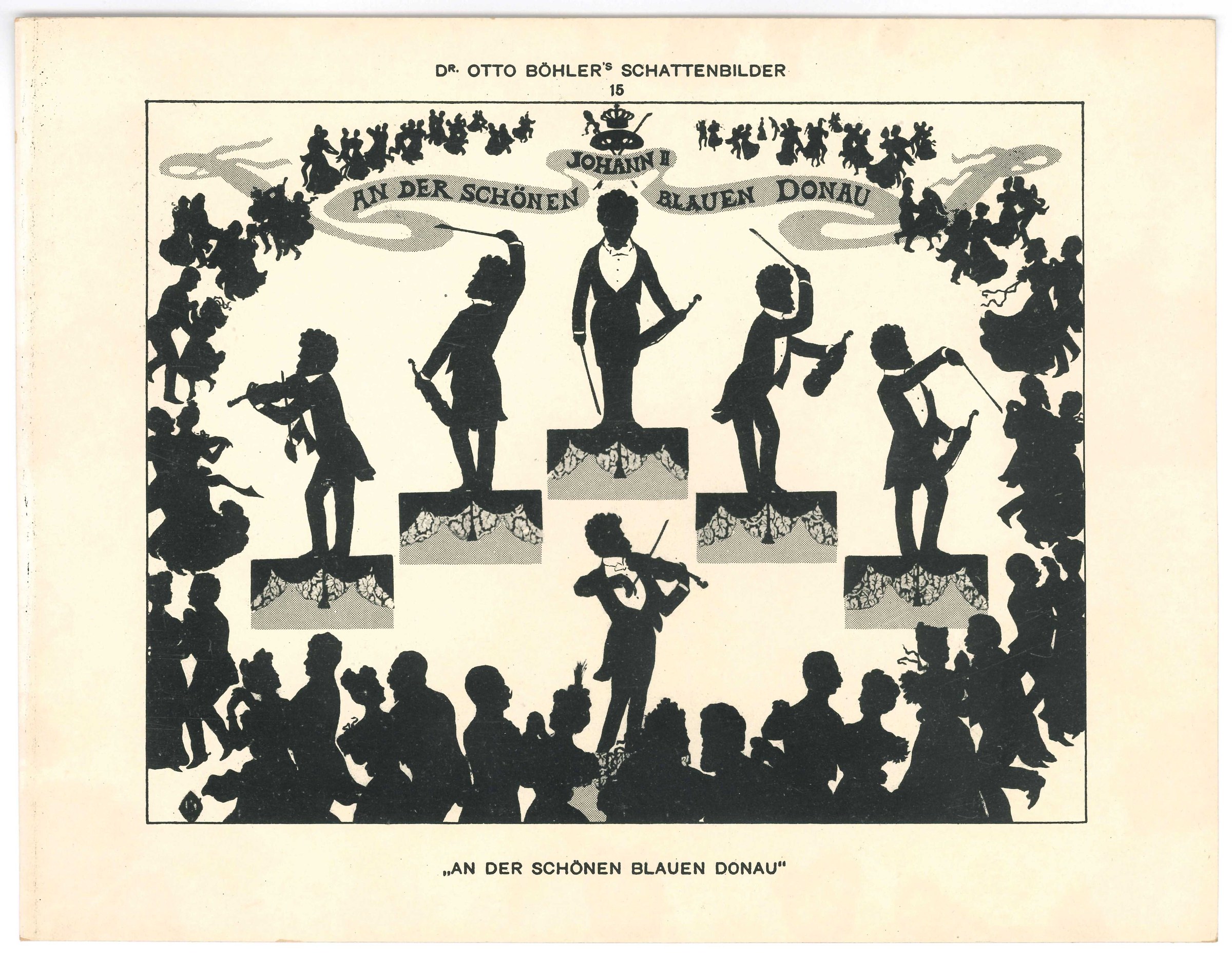
Johann Strauss Donauwalzer The Blue Danube silhouette Otto Böhler
Otto Böhler (1847–1913)
- Medium:
- Oil Painting
- Dance:
- Waltz
- Era:
- 1900-1920 (Ragtime/Early Jazz)
- Source:
- Wikimedia Commons
- Rights:
- Public domain — free to use, share and adapt.
- Recorded as:
- Public Domain
This work documents the apotheosis of the Viennese waltz in popular culture at the turn of the 20th century, when Strauss's music had become inseparable from the dance itself. The silhouette technique, which creates such graphic clarity, was the dominant medium for program imagery and popular illustration of dance in this era—understanding how dances were visually represented for audiences tells us as much about dance history as the choreography itself. The image is also a record of the gendered and class-specific nature of ballroom waltz: formal dress, conductor-led, spectator-framed, a dance for the concert hall or grand ballroom rather than the street or village square.
What you are looking at
A silhouette composition celebrating Johann Strauss's "An der schönen blauen Donau" (The Blue Danube). The central figure is a conductor or bandmaster in formal dress standing elevated on a platform, baton raised, his posture commanding and upright. Surrounding him in a sweeping circular arrangement are dozens of dancing couples and individual musicians, all rendered in pure black silhouette against a cream ground. The dancers occupy the full perimeter: at left and right, couples turn and sway; at top, a procession of figures with instruments processes across a decorative banner bearing the title and a crowned insignia; at bottom, a dense crowd of seated and standing spectators frames the dance floor. The composition uses decorative scalloped bases beneath the elevated dancers to suggest a stage or ballroom setting. The overall effect is of a waltz in full swing, with the conductor as the animating force at the center, orchestrating both musicians and dancers into unified movement.
The dancing
The dancers are shown in closed ballroom hold throughout—pairs facing each other with arms connected, bodies angled into the characteristic waltz frame. The silhouette technique shows turning and swaying motion through the tilt and angle of shoulders and the sweep of skirts, which billow outward suggesting active rotation. The conductor's raised baton and forward-leaning torso convey authority and tempo-setting; his formal cutaway coat and white shirt front are just visible as details within the silhouette. Musicians scattered through the composition hold instruments—violins especially are silhouetted to show their distinctive shape. The crowds at the bottom are rendered as a dense cluster of hat brims and heads, indicating spectators rather than participants.
The dance depicted
This is unequivocally a Viennese waltz, and almost certainly depicts the waltz as danced in the ballroom or concert hall context of late 19th-century Vienna. The title refers to Strauss's most famous composition, premiered in 1867, which became synonymous with Viennese dance culture. The image shows the waltz in its formal, social context: couples in strict closed hold, turning around a conductor-centered space, performed before an audience. The silhouette format was popular for concert and theatrical programs of this era, allowing rapid reproduction and clear visibility of the compositional structure. This is not theatrical ballet waltz but rather social ballroom dancing of the highest formality.
How it was made
The work is described as oil painting but the image is plainly a silhouette print—likely a lithograph or photomechanical reproduction given the clean blacks and fine detail, and the presence of registration marks and text formatting suggesting commercial printing. The silhouette technique, which creates bold graphic contrasts by rendering figures entirely in solid black, was economical and highly effective for program imagery and popular illustration. The decorative ornamental elements (the scalloped bases, the banner with crown) and the dense compositional arrangement suggest this was created as a concert program cover, theatrical poster, or commemorative print rather than as a standalone fine art work. The technique allowed for wide circulation and reproduction, making Strauss's image and music available to a broad public.
About this work
This is a silhouette composition illustrating the Viennese waltz as performed in the context of Johann Strauss's music. The image celebrates both composer and dance form by positioning the conductor at the spiritual and temporal center of a whirling crowd of dancers and musicians. Created around 1900 by Otto Böhler, a German illustrator known for silhouette work, it is a record of how the waltz was understood in its cultural moment: as a highly formalized, socially sanctioned dance requiring musical accompaniment, conducted authority, and an appreciative audience. The work is emblematic of the fin-de-siècle veneration of Viennese dance culture and Strauss's role in codifying and elevating it.
For dancers and historians, this image serves as a document of how the waltz was staged, costumed, and socially positioned in the generation after Strauss's own. The silhouette format—economical, reproducible, and graphically powerful—made it a tool for spreading images of the dance across Europe. It reveals the waltz not as an intimate social practice but as a spectacle, a concert work, a professional performance worthy of a published program.
How to look at it
Attend first to the compositional structure: the conductor at absolute center, the dancers arranged radially around him, the audience framing the entire scene. This is not a naturalistic snapshot but a symbolic arrangement emphasizing hierarchy and control. The silhouette technique means you read gesture and posture through outline and angle alone—note how the conductor's raised baton and forward lean convey authority, how the dancers' tilted torsos and outswung skirts suggest active turning. The couples' bodies are all angled and canted, conveying the rotational momentum of the waltz. The density of the crowd and the repetition of the turning couples suggest both the social mass-participation aspect of the waltz and its highly choreographed, synchronized nature.
The artist
Otto Böhler (1847–1913) was a German illustrator and painter specializing in silhouette compositions. He was active during the peak of silhouette popularity in commercial and decorative arts—a period when the technique was used extensively for theater programs, concert posters, and popular prints. Böhler's silhouettes are characterized by fine detail within the bold black forms, skillful use of negative space, and elaborate compositional framing. His work was distributed widely across Germany and Austria, making him a significant figure in the visual culture of late-19th-century Central Europe. This print appears to be one of a series on musical and dance subjects.
The period
The image dates to around 1900, a moment when Viennese waltz culture was at its cultural apex and Strauss himself had become an international celebrity. The waltz had evolved from its 18th-century origins as a transgressive folk dance into the ballroom's most prestigious form, taught to the aristocracy and aspiring middle classes. Strauss's compositions, especially "The Blue Danube" (1867), had made the waltz synonymous with Vienna itself—a cultural export that defined the city internationally. Visually, the silhouette was experiencing a major revival in late-19th-century Europe, used extensively in the Art Nouveau movement and in commercial illustration. The program-cover context (suggested by the title banner and decorative framing) reflects the concert-hall waltz tradition that had developed: orchestral waltzes performed by large ensembles, sometimes with accompanying choreography, as prestige entertainment.
Where it lives
The work is documented as sourced from Wikimedia Commons. No current holding collection is recorded in the catalogue. The format and subject matter suggest this was originally a concert or theater program cover, likely reproduced in quantity for distribution, making it a work of commercial and popular culture rather than a unique art object.
Dance in this work
Questions about this work
Is this a painting or a print?
The catalogue lists it as oil painting, but the image itself is a silhouette composition—most likely a lithograph or photomechanical print given the technical execution and commercial context. If Böhler created an oil original, this would be a reproduction of it. The silhouette technique and the ornamental program-cover framing suggest this was designed for mass reproduction rather than as a unique fine art object.
What is the dance being shown?
This is the Viennese waltz as performed in the ballroom and concert-hall context of the late 19th century. The title refers to Strauss's 'An der schönen blauen Donau' (The Blue Danube), arguably his most famous composition. The couples are shown in closed ballroom hold, turning continuously around a central conductor, exactly as the waltz was danced in formal social and concert contexts of the period.
Why is there a conductor in the middle?
By the time this image was made, the waltz had become as much a concert music tradition as a social dance. Large orchestras performed waltzes for listening and dancing audiences. The conductor at the center symbolizes both the musical authority driving the dance and the Viennese cultural tradition in which Strauss was a central figure. The composition makes the conductor the organizing force around which all motion and pleasure revolves.
Who was Otto Böhler?
Böhler (1847–1913) was a German painter and illustrator known for silhouette compositions. He was active during the peak of silhouette popularity in commercial and fine art—the late 19th and early 20th centuries—when the technique was used extensively for theater and concert programs, posters, and popular illustration. His detailed, skillfully composed silhouettes made him a significant figure in Central European visual culture.
More Waltz artwork