42 works in this view — arrow keys or swipe to move between them.
Dance in Art
Phenakistoscope 3g07690u
Eadweard Muybridge
- Medium:
- Oil Painting
- Dance:
- Waltz
- Source:
- Wikimedia Commons
- Rights:
- Public domain — free to use, share and adapt.
- Recorded as:
- Public Domain
The phenakistoscope is the only surviving medium that shows how 19th-century ballroom dancers actually moved—not posed for a portrait, but rotating through space with realistic weight, timing, and proportions. For historians of both dance and visual media, it bridges the gap between written description and film, offering concrete evidence of technique, costume, and spatial relationships that survive no other way. The work also demonstrates that animation, motion study, and the mechanical capture of movement were artistic and scientific concerns long before cinema, making it foundational to the history of both dance documentation and visual media.
What you are looking at
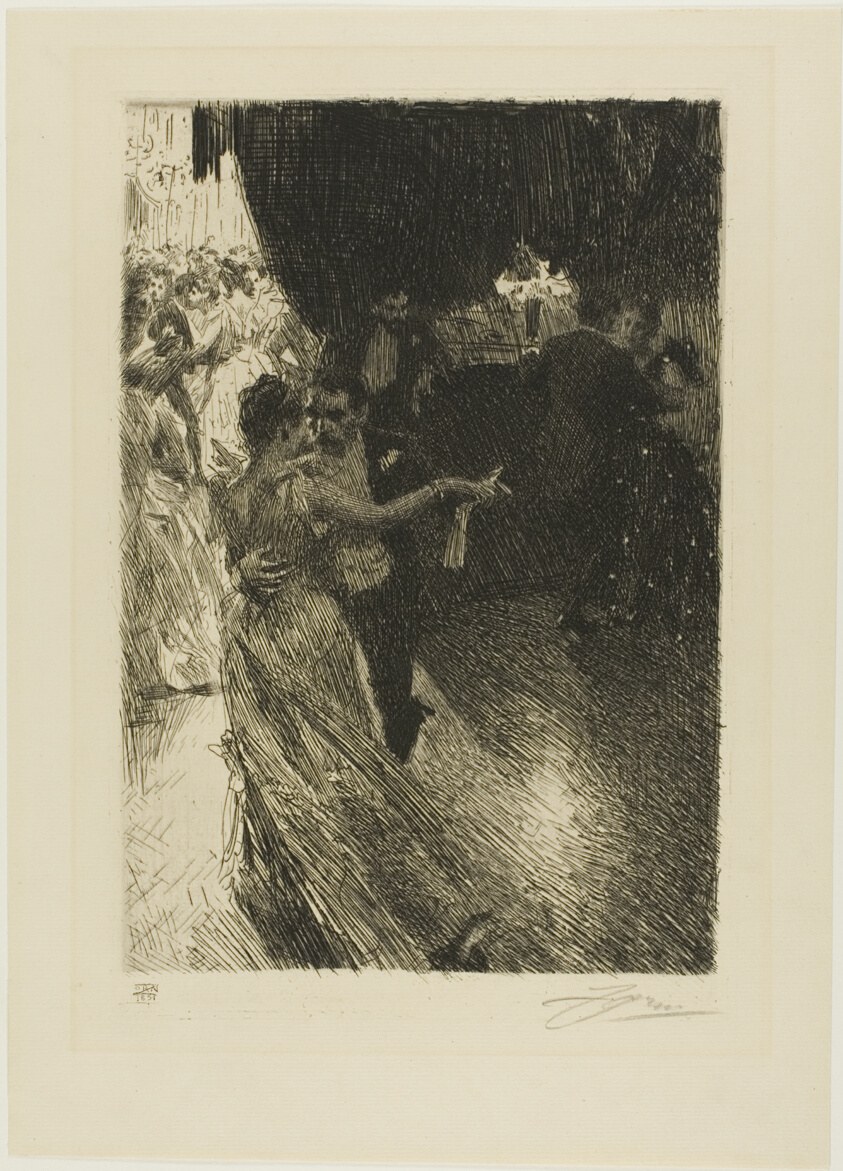
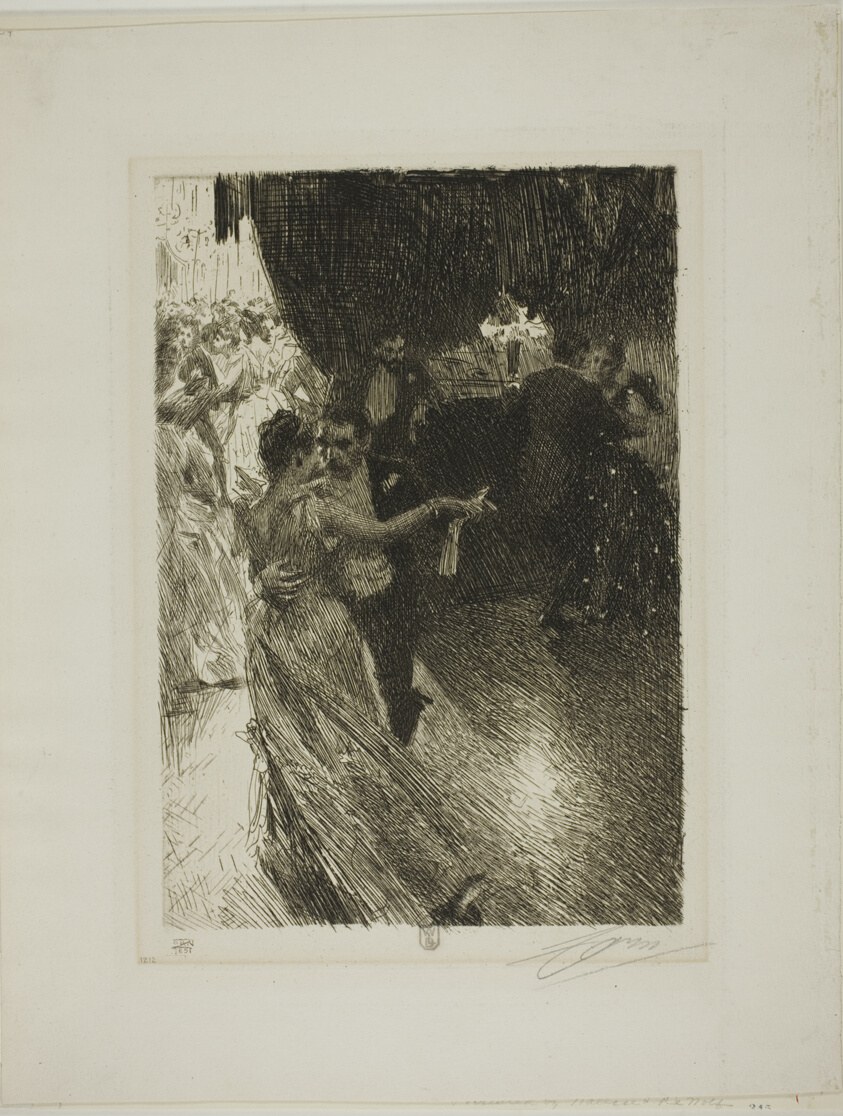
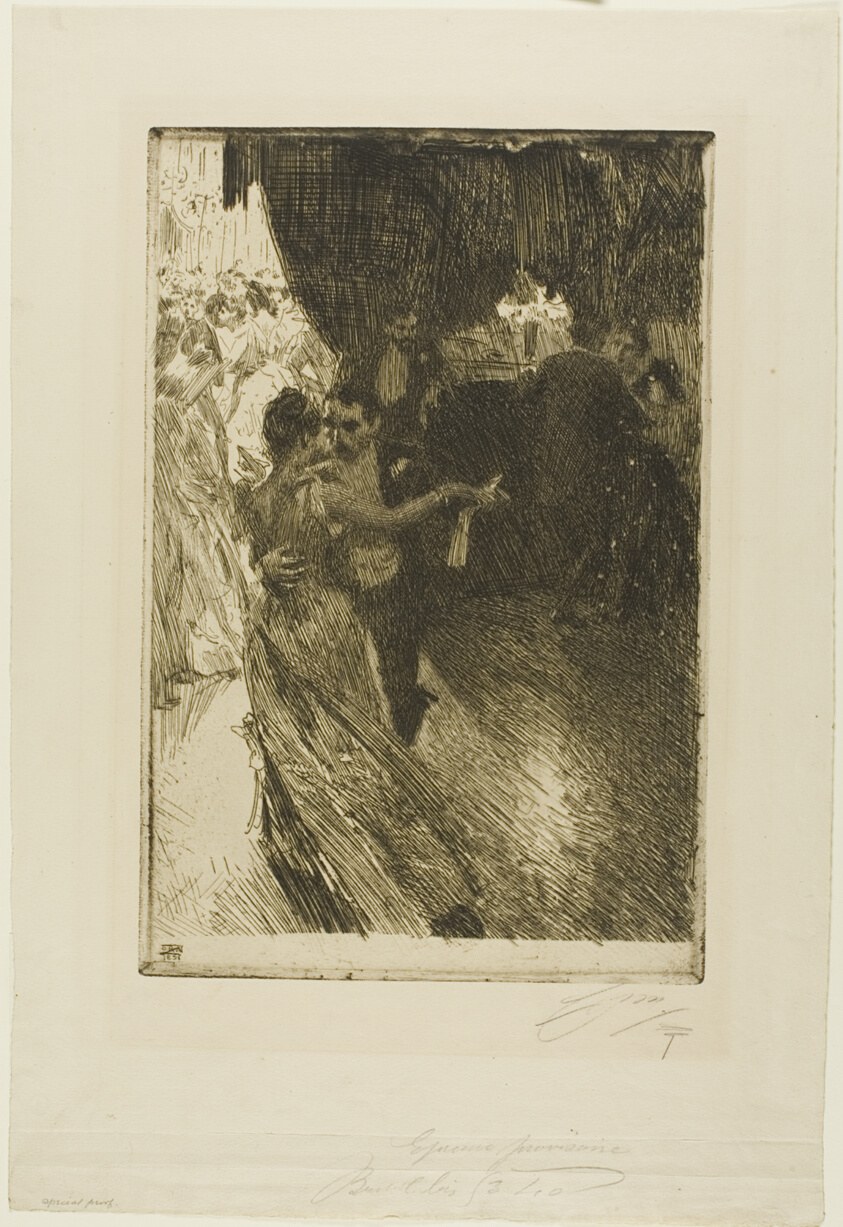
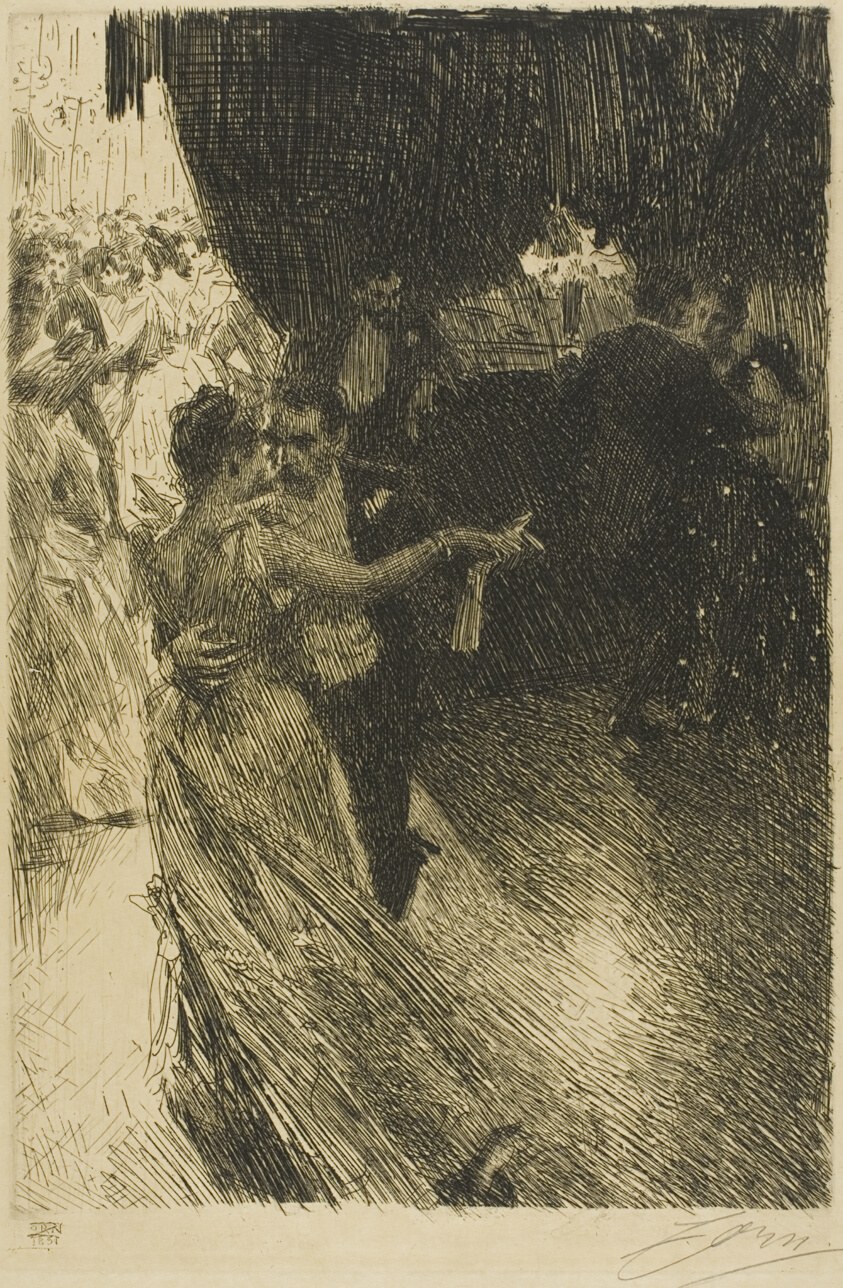
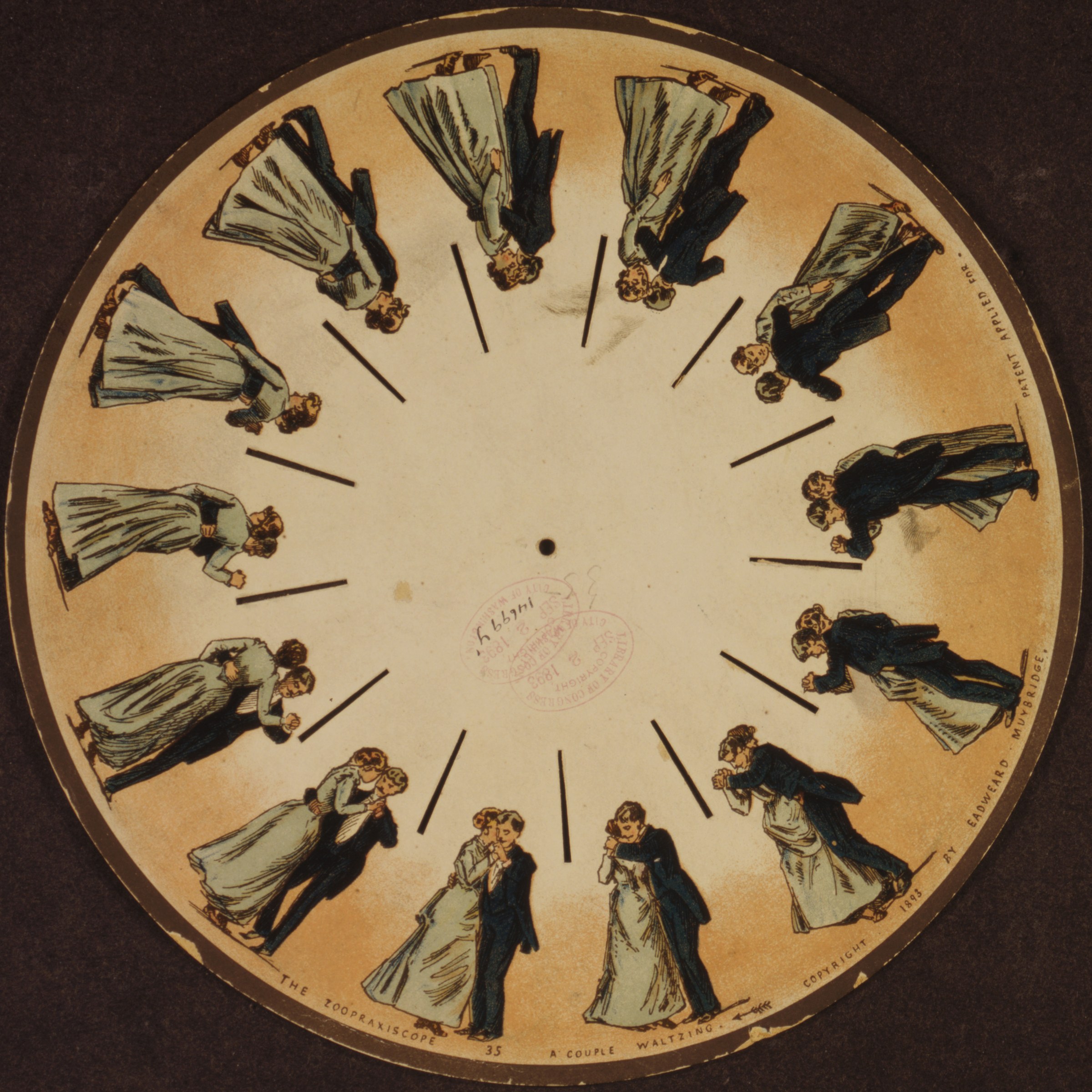
This is a phenakistoscope disk, a pre-cinematic animation device from the 19th century. Twelve sequential illustrations are arranged in a circle around a central point, each showing a couple in progressive stages of a waltz. The figures are rendered in sepia ink on a cream ground, with black silhouettes and delicate line-work for the women's gowns and the men's formal dress. The women wear high-waisted Empire-line dresses with flowing skirts caught in mid-swirl; the men are in tailcoats and trousers. The couples move through the same rotational space, their positions shifting incrementally from frame to frame. When the disk is spun and viewed through a slit, the static images create the illusion of continuous motion—a couple waltzing in place. The wear and foxing of the cream paper, and the archival stamp visible in the center, confirm this is a historic artifact, not a modern reproduction.
The dancing
Each frame shows a man and woman in the closed ballroom hold characteristic of 19th-century waltz: the man's right hand on the woman's waist, her left hand resting on his shoulder, their outer hands joined at shoulder height. The couple's bodies are angled in a slight promenade position, their weight distributed to allow the turning motion central to waltz technique. The woman's skirt flares outward with the rotational momentum. Across the twelve frames, the couple rotates through one full turn in synchronized increments, demonstrating the three-beat musical phrase that structures the waltz.
The dance depicted
This is a waltz, the dominant ballroom dance of the 19th century. The phenakistoscope was invented in the 1830s, and this disk documents what waltz looked like in motion during that era—valuable evidence, since no film footage exists from the period. The dance shown here is the Viennese waltz or a similar European ballroom waltz: a turning couple in closed embrace, pivoting repeatedly through space. The sequential frames reveal what a live observer would see across a single musical measure repeated: the smooth, continuous rotation, the controlled frame, the rise and fall of the body with the music. This is not theatrical ballet or a folk form, but the social ballroom dance of the urban aristocracy and middle classes.
How it was made
The phenakistoscope disk is a hand-drawn engraving or lithograph on paper, approximately 6–8 inches in diameter (standard for the medium). The viewing mechanism worked through a rotating disk with radial slits: as the disk spun, the viewer looked through a slit to see one frame at a time in sequence, and the brain's persistence of vision created the illusion of motion. This was the first practical animation device and preceded cinema by 60 years. The technical requirement of fitting 12 identical compositional frames within a circle, each slightly offset from the last, demanded considerable skill; the artist had to maintain the same scale, perspective, and register across all frames while advancing the gesture incrementally.
About this work
This phenakistoscope disk is a historically significant artifact of both dance and visual culture. It documents the waltz as it was performed in the 1830s–1840s, capturing the characteristic hold, rotation, and proportions of the dance through a mechanical animation process. For dance historians, it is evidence of how the waltz appeared in motion to contemporary observers—a freeze-frame that, paradoxically, comes closest to showing live performance through the illusion of continuous movement. For art historians, it marks the emergence of animation as a technology and artistic practice, predating cinema and demonstrating the 19th-century fascination with capturing motion and creating the appearance of life through sequential images. The disk belonged to a thriving market in optical toys and scientific instruments aimed at educated households, making it both a toy and a teaching device.
How to look at it
Observe the progression of the couple's position as you move clockwise around the disk, frame by frame: the woman's skirt swells and recedes with each turn, the man's posture remains upright and controlled, and their relationship in space stays constant even as they rotate. The consistent framing and scale across all twelve frames is itself a technical achievement—the artist had to solve the problem of fitting identical figures at different points of rotation within a circular boundary. Look at the precision of the hold: the closed embrace is maintained throughout, suggesting that the artist understood waltz technique or was copying from a reliable source. The delicacy of the line-work in the women's gowns contrasts with the bold black silhouettes of the men's tailcoats, creating visual balance and emphasizing the swirl of fabric in motion.
The artist
Eadweard Muybridge (1830–1904) was an English-American photographer and inventor famous for his pioneering work in motion photography and the analysis of animal and human locomotion. Between 1877 and 1886, he conducted systematic studies of humans and animals in motion, publishing his results in *Animal Locomotion* (1887), which became a fundamental reference for artists, dancers, and scientists. However, the phenakistoscope predates Muybridge's motion studies by decades and is not typical of his known work; this attribution may be speculative or based on stylistic similarity to optical-toy designs of the period. The disk reflects the mid-19th-century culture of optical entertainment and scientific demonstration in which artists, engineers, and manufacturers collaborated to create devices that revealed hidden motion.
The period
The waltz emerged as the dominant ballroom dance of Europe and North America in the early 19th century, shocking moralists with its close embrace and rapid turning. By the 1830s, when this disk was likely made, the waltz was fully established as the centerpiece of ballroom culture among the middle and upper classes. Simultaneously, the phenakistoscope (invented by Joseph Plateau in 1832) sparked a popular craze for optical toys that could animate drawings. Artists and manufacturers saw an opportunity to document fashionable dances in motion; phenakistoscope disks showing waltzes, quadrilles, and other ballroom dances were produced throughout the 1830s–1850s, marketed as both entertainment and edifying demonstrations of proper technique and posture. This disk sits at the intersection of these two phenomena: the cultural dominance of the waltz and the new technology for visualizing motion.
Where it lives
The catalog record provides minimal information: the object is listed as sourced from Wikimedia Commons with no accession number or holding institution specified. The archival stamp visible in the center of the disk is partially legible but not clearly identified in the record. Without additional documentation, the object's provenance, date of manufacture, and current location cannot be confirmed.
Dance in this work
Questions about this work
How was a phenakistoscope supposed to be used?
The disk was mounted on a handle or stand and spun rapidly. A viewer stood in front of it and looked through radial slits cut in the disk's edge. As the disk rotated, the slits passed before the viewer's eye in rapid succession, each slit revealing one frame of the animation. The brain's persistence of vision—the tendency to retain visual information for a fraction of a second—created the illusion of continuous motion. It was both a toy and a scientific demonstration, and phenakistoscope disks were often sold in sets for home entertainment.
What does this tell us about how people waltzed in the 1830s–1840s?
The disk shows the waltz as a continuous rotational dance in a closed embrace, with the couple moving through space as a unified unit. The man's frame is upright and controlled; the woman's body follows his lead. The rotation is smooth and regular, suggesting a three-beat musical phrase. The close proximity of the partners and the emphasis on turning match written accounts of the waltz from the period and distinguish it clearly from earlier court dances. The careful rendering of the woman's skirt and posture suggests the artist was documenting actual performance or was copying from a reliable source, making this a valuable record of technique and decorum.
Is this definitely by Muybridge?
The attribution is uncertain. Muybridge did not become famous for motion studies until the 1870s, and phenakistoscope disks were a mass-produced product of the 1830s–1850s, typically made anonymously or by commercial manufacturers. The style and quality of this disk are consistent with mid-19th-century optical-toy production, but without maker's marks, signatures, or archival documentation, the attribution should be treated as provisional. The disk may have been attributed to Muybridge based on stylistic similarity or on incomplete information in its provenance history.
More Waltz artwork