41 works in this view — arrow keys or swipe to move between them.
Dance in Art · 1882
Pierre-Auguste Renoir - Suzanne Valadon - Dance at Bougival
Pierre-Auguste Renoir
- Medium:
- Oil Painting
- Dance:
- Waltz
- Era:
- Late 1800s (Victorian Ballroom)
- Source:
- Wikimedia Commons
- Rights:
- Public domain — free to use, share and adapt.
- Recorded as:
- Public Domain
The painting documents the waltz in its fullest social flowering—no longer shocking or risqué, but the expected entertainment at a suburban garden party. For dance historians, it is a reliable record of the hold, the clothing worn while dancing, the outdoor venues where waltzing took place, and the social mixing (men and women in close contact, observed but unashamed) that the dance enabled. For Impressionist scholars, it is evidence of Renoir's engagement with modern social subjects and his mastery of paint technique in service of a fleeting moment.
What you are looking at
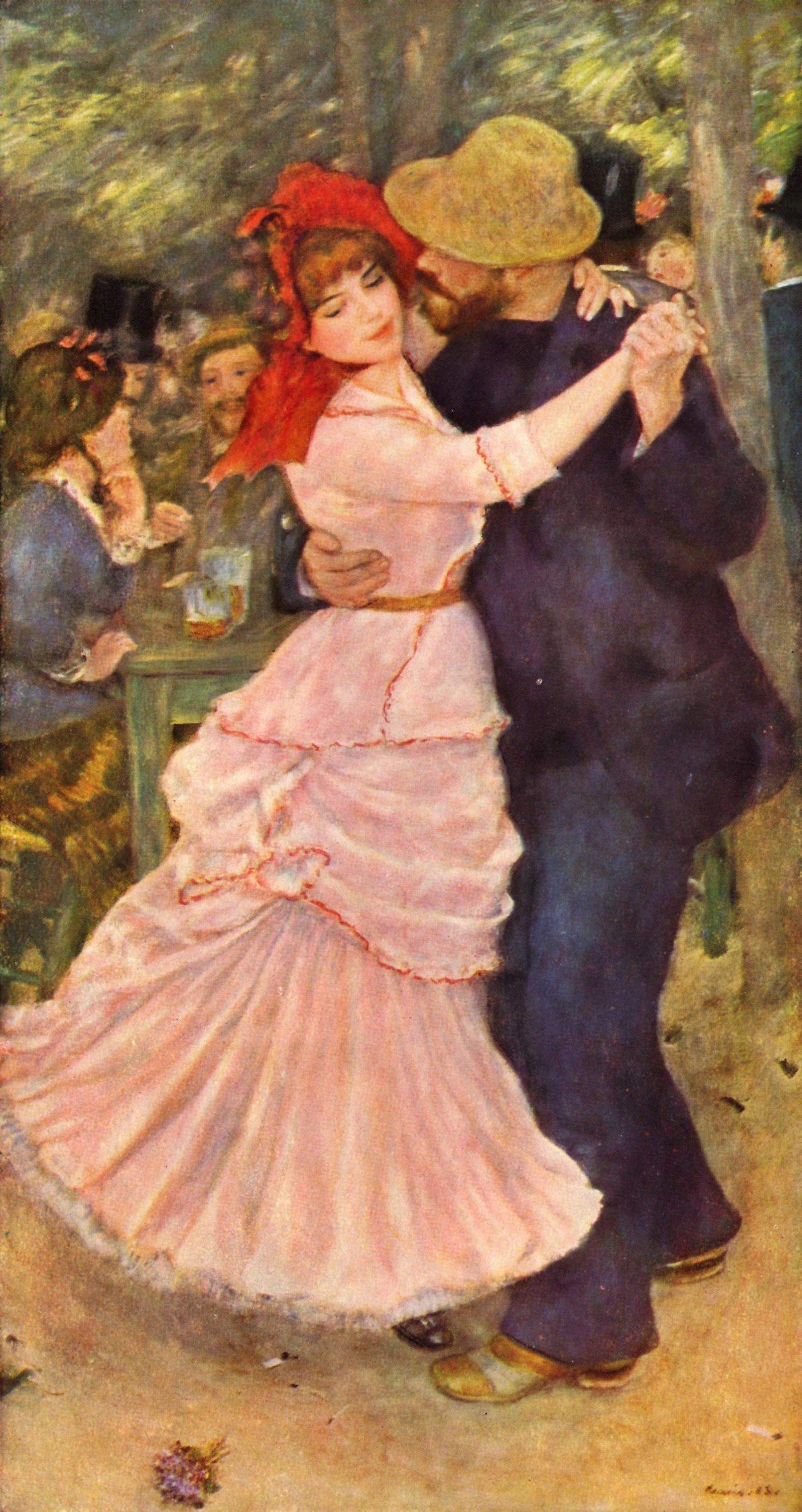
A couple dances in a woodland clearing during daylight, surrounded by spectators in late 19th-century dress. The man, wearing a straw hat and dark suit jacket, holds the woman firmly at the waist as she leans back in an open position, her weight supported by his frame. She wears a pale pink ball gown with a fitted bodice and voluminous skirt adorned with ruching and ribbon detail, a red bonnet or hat perched on her auburn hair. The setting appears to be a country or suburban garden rather than a ballroom—trees frame the scene and natural light filters through the foliage. Several other figures are visible in the background, some watching, others participating in the dance. The mood is one of outdoor leisure and flirtation, a snapshot of recreational dancing among the bourgeoisie.
The dancing
The primary couple occupies the foreground in a closed ballroom hold, with the man's right arm supporting the woman's back and his left hand clasping hers. Her torso is arched backward, creating a diagonal line from her head through her body to her partner's supporting arm—a dramatic pose suggesting either a turn or a moment of playful momentum. Her skirt swirls around her legs, indicating rapid rotational movement. The man's posture is upright and controlled, anchoring the movement. Secondary figures in the background stand at a remove, some in conversation, reinforcing the sense of an observed performance within a social gathering.
The dance depicted
This depicts a Waltz, the most popular couple dance of the late 19th century among the middle and upper classes. The closed hold, the woman's arched back, and the rotational momentum captured in the paint all confirm the waltz's characteristic turning motion and intimate frame. The outdoor garden setting ('Dance at Bougival') suggests a suburban or country venue rather than a formal ball—waltzing was not confined to grand ballrooms but had become a standard feature of social gatherings and outdoor entertainment. The painting captures the dance at a moment of visible rotation and architectural drama, emphasizing the physical abandon and pleasure the waltz afforded its dancers.
How it was made
Oil paint on canvas, rendered in the Impressionist manner with soft brushwork and attention to natural light and atmospheric color. The loose handling of foliage and the luminous treatment of the woman's skin and pink silk show Renoir's characteristic technique—his interest in captured light and the sensuous surfaces of fabric and flesh. This medium and style place the work squarely within the Parisian Impressionist circle of the 1880s, when such scenes of modern leisure were a preferred subject. Oil paint allowed the subtlety of color and the fluid, spontaneous quality essential to conveying the movement and intimacy of the dance.
About this work
This is a portrait of the waltz as a modern social dance, executed in Impressionist style. Painted in 1882, it documents not the formal rituals of the ballroom but the lighter, flirtation-charged atmosphere of garden dancing—a leisure activity that had become central to courtship and social pleasure among the French bourgeoisie. The painting is both a record of dance practice and an exercise in capturing light, movement, and the textures of contemporary dress. It belongs in a dance archive because it is neither allegorical nor theatrical: it shows us how the waltz was actually danced, in what settings, and with what emotional tone, preserving a moment of genuine social dancing at a precise historical moment.
How to look at it
Look at the moment the artist has frozen: the woman is at the apex of a turn, her body arched back and her weight entirely in the man's control. This is not a static pose but the heart of the rotational movement of the waltz. Notice how the swirl of her skirt and the forward lean of his body convey velocity and momentum even in stillness. The background figures—some dancing, some watching—establish that this is a public but informal event, not a staged or theatrical performance. The play of light on fabric and skin, and the dappled woodland setting, are as much the subject as the dance itself; Renoir is interested in the sensory pleasure of the moment, not its technical execution.
The artist
Pierre-Auguste Renoir (1841–1919) was a founder of the Impressionist movement and a painter of modern life. In the 1870s and 1880s, he frequently depicted scenes of leisure, pleasure, and social interaction—dances, boating parties, café scenes—that celebrated the new freedom and mobility of Parisian society. He was drawn to the sensuous and the momentary, and his handling of light and fabric made him an ideal chronicler of such subjects. By 1882, when this work was painted, Renoir was at the height of his powers as an Impressionist, though he was also beginning to reconsider his approach toward a more structured, classical idiom.
The period
The 1880s saw the waltz at the apex of its respectability and popularity. Once condemned by moralists for its close hold and rotational motion, the waltz had become the default social dance of the European bourgeoisie. The setting of the painting—a garden rather than a ballroom—reflects the expansion of dancing into suburban leisure culture; such garden parties and open-air celebrations were a feature of the new rail-connected suburban villas around Paris. In art, Renoir and his peers were documenting contemporary social life with unprecedented immediacy, treating leisure and pleasure as worthy subjects for serious painting. The work also documents the costume of the period: the woman's silhouette, with its tight bodice and elaborate skirt, is characteristic of early 1880s fashion.
Where it lives
The work is recorded in the catalogue as sourced from Wikimedia Commons, with no specified holding collection. The painting is known to exist and is recognized as a work by Renoir from 1882, but the current location is not documented in the present record.
Dance in this work
Questions about this work
Is this a real dance or a posed arrangement?
This is a real social dance, the waltz, captured in a garden setting. The couple's hold and the woman's position during a turn are authentic to waltz technique of the period. However, the moment is composed for aesthetic effect—Renoir chose the moment of maximum drama and beauty, not a random instant. The surrounding figures and the woodland setting are also arranged for pictorial balance, so while the dance is genuine, the overall scene is a constructed artwork, not a candid record.
Who are the dancers?
The catalogue record identifies the woman as Suzanne Valadon, a French artist and model who was also a dancer. She was a prominent figure in the Parisian art world of the 1870s and 1880s. The identity of the man is not specified in the available records. The painting may be a portrait of a specific occasion or individuals Renoir knew, or it may be more of a type study using recognizable models.
Why is the woman arched so far back?
The backward arch is characteristic of the waltz's rotational movement. As a couple turns, the follower (traditionally the woman) often leans back from the leader's frame, creating a dynamic line and allowing greater rotational speed and ease. This pose also emphasizes the drama and sensuality that made the waltz such a powerful subject for artists—it shows physical abandon and trust, the pleasure of movement in a partner's control.
What does 'Bougival' mean?
Bougival is a commune in the suburbs west of Paris, along the Seine. It was a destination for leisure outings—boating, picnicking, and garden parties—especially among the Parisian middle class. The title locates this as a suburban garden dance, not a ballroom event, which was a new and significant social development in the late 19th century.
More Waltz artwork