38 works in this view — arrow keys or swipe to move between them.
Dance in Art · 1900
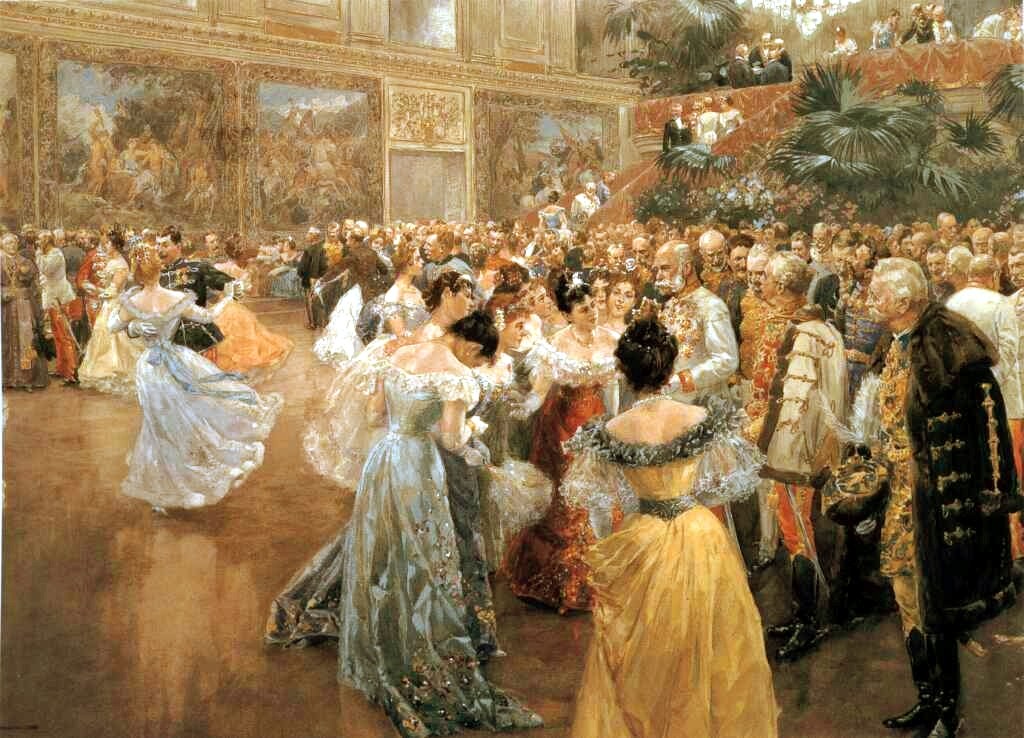
Wilhelm Gause Hofball in Wien
Wilhelm Gause
- Medium:
- Oil Painting
- Dance:
- Waltz
- Era:
- 1900-1920 (Ragtime/Early Jazz)
- Source:
- Wikimedia Commons
- Rights:
- Public domain — free to use, share and adapt.
- Recorded as:
- Public Domain
For dance historians, this painting is invaluable as a record of how the waltz was actually danced and embedded in social life at the turn of the 20th century: the hold, the posture, the mix of active dancing with standing and conversation that defined ballroom culture. For art historians, it is a major example of Gause's mastery of crowd composition and the late society-painting tradition. The work also documents the moment just before the collapse of the Austro-Hungarian imperial order—the last great flowering of Vienna's court culture before 1918.
What you are looking at
A grand ballroom scene depicting an imperial court ball, likely in Vienna's Hofburg Palace or similar ceremonial space. The composition is crowded with hundreds of elegantly dressed figures in formal evening wear—women in low-cut gowns with long trains and elaborate jeweled details, men in military dress uniforms with decorations and dark tailcoats. The setting is ornate: walls are hung with large historical frescoes and gilded Renaissance-style panels; potted palms and flowering plants frame the space at either end, suggesting the height of late 19th-century formal fashion. The foreground shows couples actively dancing or in conversation, while background figures create a dense press of spectators and participants. The lighting is warm and golden, cast by chandeliers and wall sconces, bathing the scene in the amber tones characteristic of gaslit interiors. The artist has captured a moment of animated social activity—not the climax of a dance but the constant circulation of partners, conversation, and movement that defined such occasions.
The dancing
The nearest dancers show the characteristic closed ballroom hold of the period: the man's right hand placed mid-back, the woman's left hand resting on his shoulder, partners facing each other at close quarters. Several women visible in the foreground wear skirts caught mid-turn or stride, their trains following the arc of movement. The postures are upright and formal, with relatively still upper bodies and movement primarily from the lower frame—the deportment expected in Viennese ballroom culture. Dozens of figures mill through the space, some dancing, many standing in small groups or walking, creating the social density and variety of motion typical of a formal court event rather than a unified choreographed performance.
The dance depicted
This is a waltz scene, the dominant ballroom dance of Vienna and the Austro-Hungarian court throughout the 19th century. The closed embrace visible in multiple couple pairs, the three-quarter-time lilt that the composition suggests through the gentle curves of skirts and bodies, and the setting in a Viennese imperial ballroom all confirm this identification. The Waltz—particularly the Viennese Waltz with its rapid rotations—had been the signature dance of Viennese high society for nearly a century by 1900 and remained the formal standard of court balls through the early 20th century. The image shows the waltz not as a performance or demonstration but as embedded social practice: one of dozens of activities happening simultaneously in a room where dance was the vehicle for courtship, social hierarchy, and the display of elegance.
How it was made
Oil painting on canvas, a medium confirmed by the soft blending of colors, the depth of the glazes, and the way light seems to emanate from within the composition rather than reflect off its surface. The scale and finish suggest this was a commissioned easel painting, not a sketch. The technique allowed Gause to layer the crowd with remarkable density—figures in the background fade into a warm blur while those in the foreground show precise detail in dress and expression. This finish and subject matter place it squarely within the 19th-century tradition of society painting, works created for aristocratic and upper-bourgeois patrons who wanted visual records of their own milieu and validation of their taste and status.
About this work
This is Wilhelm Gause's monumental record of a Viennese imperial court ball, almost certainly created around 1900 during his years as a leading society and theatre painter in Vienna. The work depicts the waltz as the living center of high society—not isolated couples in a studio, but dozens of waltzing pairs and spectators occupying a space of immense architectural and social prestige. Gause was celebrated for precisely this subject matter: his ability to render crowded ceremonial occasions with both documentary accuracy and painterly refinement. The work sits within the late 19th-century European tradition of société paintings, a genre that recorded—and celebrated—the visual spectacle of aristocratic life even as that life was approaching its final decades before World War I.
How to look at it
Attend first to the couples in the immediate foreground: the closed hold, the relative formality of posture, the way the woman's trained skirt describes the arc of a turn. Gause has frozen the waltz at a moment of steady rotation rather than a climactic flourish—this is the working rhythm of the dance, not its showpiece. Then expand outward to read the composition as a social landscape: notice how the artist has used the dancing couples as anchors or focal points within a sea of stationary and conversational figures. The spatial composition—with the dancers distributed across the depth of the room rather than gathered in a single area—reflects the actual social choreography of such events, where multiple dances proceeded simultaneously and the room's function was social encounter as much as dancing.
The artist
Wilhelm Gause (1853–1916) was an Austrian painter and illustrator based in Vienna, celebrated for his depictions of high society, theatre interiors, and festive occasions. He was a professor at the Vienna Academy of Fine Arts and maintained a prolific studio practice creating large-scale commissioned works for aristocratic and wealthy bourgeois patrons. Gause specialized in rendering crowds and architectural interiors with meticulous attention to costume and decor, making him the pre-eminent visual chronicler of Viennese élite life in the 1880s–1910s. His work bridges academic tradition and the emerging modernist moment; while his subject matter and technique are decidedly 19th-century, the scale and ambition of his crowd compositions influenced later theatrical and modernist painters.
The period
At the turn of the 20th century, the waltz had dominated Viennese ballroom dance for nearly 100 years and remained the prescribed dance of imperial court ceremonials. Vienna's court culture was at its artistic and architectural zenith in the 1890s–1900s, even as the political structures supporting it were beginning to fracture. The large-scale society or 'Gesellschaftsgemälde' painting was a flourishing genre in Vienna, Paris, and London, commissioned by patrons who wished to be portrayed within scenes of luxury and refined social life. The specific tradition of depicting court balls and imperial ceremonies reached back through the 19th century but intensified in the 1880s–1910s as photographers could not yet capture such scenes with comparable detail and color. Within dance history, this painting documents the waltz at the height of its institutional presence—not an innovation or rupture, but the settled, expected center of formal social movement.
Where it lives
The work's current holding collection is not recorded in the catalogue. The source provided is Wikimedia Commons, a digital repository, suggesting this is a well-known and publicly accessible work, likely held in an Austrian museum collection—possibly the Vienna Museum, the Belvedere, or another major Viennese institution—though verification of the specific holding is not available from the record supplied.
Dance in this work
Questions about this work
What dance is being shown here?
The Viennese Waltz, the dominant ballroom dance of Vienna and the Habsburg court. You can identify it from the closed embrace between partners, the upright posture, and the rotational movement visible in the arrangement of skirts and bodies. The setting—a Viennese imperial ballroom—confirms this identification, as the waltz had been the prescribed dance of court ceremonials for generations.
Is Gause showing real people and a real event?
Almost certainly. Gause was commissioned to paint record scenes of actual court balls, imperial occasions, and high-society events. This appears to depict a specific ball (the title indicates it is a Hofball in Vienna), and while Gause likely composed and idealized the scene for artistic effect, the figures, dress, and setting would be recognizable to contemporary viewers as documenting a real occasion they might have attended or known about.
Why is there so much detail in the background figures if the focus is dancing?
Because the painting's subject is the social event, not just the dance. A court ball was a complex performance of hierarchy, fashion, and social interaction where dancing was one element among many. By showing spectators, conversations, and the architectural setting with equal care, Gause documents the full experience—the experience his patrons wanted recorded and remembered.
What does the dress tell us about the date?
The women's silhouettes—low necklines, small waists created with tight corsetry, full skirts with long trains, elaborate jewels and ornaments—are characteristic of the 1890s–1910s. The men's military dress uniforms with decorations place this firmly in that same period. The painting's style and technique also confirm a date around 1900, consistent with the catalogue record.
More Waltz artwork