49 works in this view — arrow keys or swipe to move between them.
Dance in Art · 1900
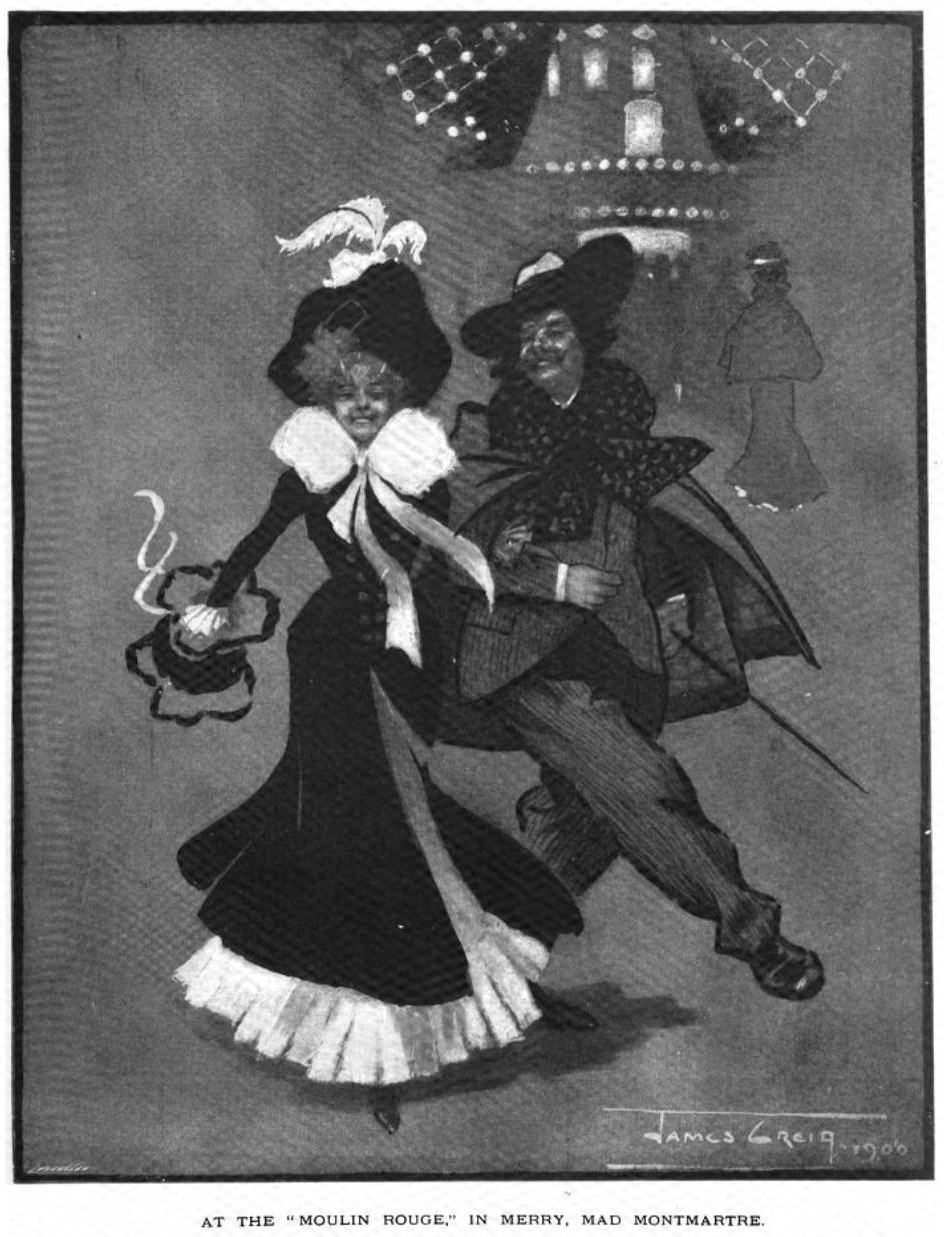
At the Moulin Rouge, in Merry, Mad Montmartre by James McGavin Greig (1861–1941)
James McGavin Greig
- Medium:
- Oil Painting
- Era:
- 1900-1920 (Ragtime/Early Jazz)
- Source:
- Wikimedia Commons
- Rights:
- Public domain — free to use, share and adapt.
- Recorded as:
- Public Domain
This painting is rare evidence of how the waltz was actually danced in a famous Parisian venue at 1900, and of the role of ballroom dance in social courtship and nightlife at the turn of the century. It shows the waltz not as an art form or a technical achievement, but as the fabric of social pleasure in urban modernity.
What you are looking at
A man in formal evening dress—dark coat, patterned waistcoat, and top hat—dances with a woman in a black dress trimmed with white ruffles at the hem and a large white bow at her décolletage. Her hat, crowned with white ostrich plumes, tilts as she turns into the movement. The pair occupy the center of the composition in dynamic mid-turn. Behind them, the interior of the Moulin Rouge recedes in soft focus: hanging lamps glow in the upper portion of the canvas, and a second couple can be made out as silhouettes in the background, establishing the crowded gaiety of the cabaret. The painting is executed in a loose, sketch-like manner with strong contrasts between the brightly lit figures and the darker interior space. The artist's signature, "James Greig," and date "1900" appear in the lower right.
The dancing
The couple is in a close ballroom hold, the man's right arm at the woman's waist, her left hand resting on his shoulder. Both bodies lean into the turn with weight distributed forward on the balls of their feet, suggesting rapid movement. The woman's skirt flares outward from the centrifugal force of the turn, and her body follows the line of her partner's lead. The man's posture is upright and controlled, his head turned to follow the line of dance. The energy is one of smooth, gliding motion rather than staccato or percussive steps.
The dance depicted
This depicts a waltz or similar ballroom dance of the Belle Époque, performed in the social context of the Moulin Rouge cabaret in Montmartre, Paris. The title explicitly names the venue and its character as "merry, mad." The couple's hold, frame, and the rotational movement visible in the woman's skirt are consistent with the Viennese waltz or a similar three-time social dance popular in fashionable Parisian venues at the turn of the twentieth century. This is social dance—ballroom dancing as entertainment and courtship—rather than staged performance, though the painting itself documents it as a subject worthy of fine art attention.
How it was made
The work is painted in oil on canvas. The artist uses loose, impressionistic brushwork and relies heavily on contrast between light and shadow to create atmosphere and depth. The foreground figures are rendered with more detail and brighter pigments, while the background and other dancers fade into warm, muted tones. This technique allows the viewer's eye to rest on the central couple while suggesting the crowded, convivial space surrounding them. The style is consistent with Salon painting of the 1890s–1900s documenting leisure and nightlife.
About this work
James McGavin Greig's 1900 painting captures a moment of social ballroom dancing at the Moulin Rouge, the legendary cabaret in the Montmartre district of Paris. The work is a document of Belle Époque leisure culture: the formal dress, the female fashions (the ostrich-plumed hat, the ruffled hem), and the venue itself all locate the image precisely in the world of fin-de-siècle Parisian nightlife. What matters for dance history is that the painting records not professional entertainment—not a staged can-can or dramatic ballet—but the ballroom waltz as it was danced socially by the well-to-do in the cabaret setting. The artist understood the mechanics of the dance: the close hold, the rotational action, the distribution of weight that produces the characteristic glide of the waltz. The work belongs in a dance collection not because it depicts a named style or school, but because it preserves a specific moment and place where ballroom dance was a central part of elite social life.
How to look at it
Watch the woman's body. The flare of her skirt, the angle of her frame relative to her partner's, and the position of her head all register the rotational momentum of the waltz. The artist has frozen the moment in the middle of a turn, when the partners are most dramatically displaced from the vertical. Notice how the man's body supports and initiates the movement while the woman follows—this is the leader-follower dynamic of ballroom dance. The soft-focus background and the glowing lamps frame this couple as the subject of attention, isolating them from the crowd even though they are surrounded by it. The painting captures not a pose but a phrase of movement.
The artist
James McGavin Greig (1861–1941) was a Scottish painter and illustrator. He was a frequent contributor to The Sketch, a British illustrated weekly magazine of society, fashion, and culture, and this work was published in that journal in November 1900. His practice was chiefly journalistic and illustrative: capturing scenes of fashionable life, leisure, and entertainment. He worked in oil and also in pen and watercolor, producing work intended for reproduction in the periodical press. His subjects were consistently the life of the leisure classes—theatre-goers, dancers, diners, and revelers.
The period
In 1900, Paris was the capital of entertainment and pleasure in Europe. The Moulin Rouge, opened in 1889, had become legendary as a venue where high society mixed with theatrical performers and demi-monde figures. The can-can, the chahut, and other high-energy dances were the house specialties, but the cabaret also hosted social dancing—waltzes, quadrilles, and other ballroom dances—as part of its appeal. Simultaneously, the waltz itself was undergoing evolution: it remained respectable in ballroom contexts but was also subject to critique from moralists who saw it as physically intimate and morally suspect. The painting sits at the intersection of Salon art (serious painting exhibited at official exhibitions) and illustrated journalism: it documents modern life, leisure, and the role of dance in urban sophistication. The loose, Impressionist-influenced handling reflects the priority of capturing a fleeting moment of gaiety rather than producing a formal or morally laden image.
Where it lives
The work is documented in The Sketch, Vol. XXXII, No. 409, November 28, 1900, page 233, where it was published as a full-page illustration. The current holding collection is not recorded. The work survives in the public domain through its reproduction in the periodical.
Dance in this work
Questions about this work
Is this a real dance, or did Greig invent it?
This is the waltz, the most widespread ballroom dance of the nineteenth and early twentieth centuries. The three-time meter, the rotational movement, and the closed hold are all characteristic of the Viennese waltz and the Waltz à l'Anglaise. What Greig captures is the specific context and moment: waltzing in a fashionable cabaret, not in a court or a formal ball. The dance itself is entirely real.
Why is this painting in a dance archive? Isn't it just a society portrait?
It is both. Greig was an illustrator documenting fashionable life, but the central subject of the image is the dance itself—the hold, the movement, the moment of action. For historians of ballroom dance, this painting is evidence of how the waltz was performed, clothed, and valued in a specific social setting. It is a visual record of dance practice.
What was the Moulin Rouge known for?
The Moulin Rouge opened in 1889 in the Montmartre district and became famous for spectacular revues featuring the can-can and the chahut. But it was also a fashionable restaurant and dancing venue where wealthy Parisians and tourists came to dine and dance. This painting documents the latter function: the ballroom dancing that happened alongside the theatrical entertainment.
Who danced at the Moulin Rouge?
Both professional performers (dancers, acrobats, singers) and wealthy clientele. The venue mixed performances—the can-can and other high-energy dances on stage—with opportunities for social dancing. The couple in Greig's painting are likely wealthy patrons, identifiable by their formal evening dress.
More dance artwork