49 works in this view — arrow keys or swipe to move between them.
Dance in Art · 2022
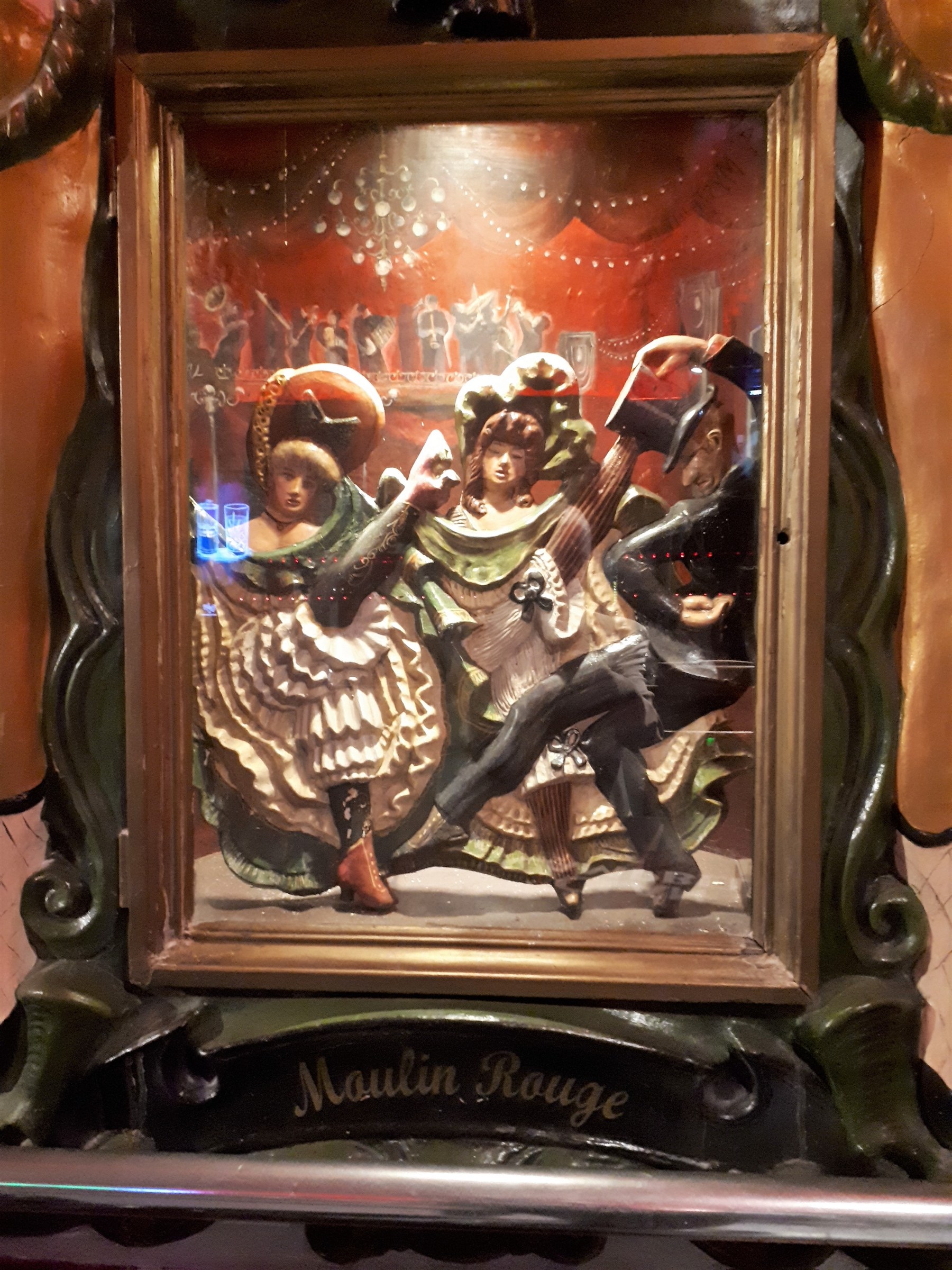
Balajo - Diorama du Bal du Moulin Rouge
Tangopaso
- Medium:
- Oil Painting
- Source:
- Wikimedia Commons
- Rights:
- Public domain — free to use, share and adapt.
- Recorded as:
- Public Domain
The Moulin Rouge was the birthplace of modern cabaret culture and the Can-Can was the first dance form to be mass-produced and mass-marketed as entertainment spectacle. This diorama preserves a visual memory of that revolutionary shift—the moment when dance became urban spectacle, when women's bodies became the principal site of theatrical display, and when 'modern' entertainment was born. For historians of popular dance, gender, and theatre, the work is a primary document of how performance culture transformed in the commercial city.
What you are looking at
This diorama depicts a moment of revelry at the Moulin Rouge, the legendary cabaret in Paris's 11th arrondissement. The composition is crowded and energetic: in the foreground, three women in elaborate costumes dominate the view. The woman at center wears a striking white feathered or ruffled skirt that extends in a wide circle, her body caught mid-movement in a dynamic pose. To her left, a second woman in a green or olive-toned costume leans inward; to her right, a third figure in darker dress completes a triangle of bodies. All three wear period hairstyles consistent with early 20th-century cabaret culture. Behind them, the stage recedes into warm reds and oranges, dotted with additional performers in a haze of theatrical lighting. Pearl-beaded garlands and stage drapery festoon the upper portions of the composition, emphasizing the ornamental, fantasy atmosphere of the venue. The scene freezes a moment of exuberant social dance, the kind of commercial spectacle the Moulin Rouge was famous for.
The dancing
The three foreground dancers occupy a loose, open configuration rather than a closed hold. Their postures are expansive and individual: the central figure appears to be turning or swaying, her weight shifted and her large skirt in motion, while her companions lean and gesticulate with arms raised or extended. None of the figures adopts a ballroom frame or classical dance posture. Instead, their bodies show the flexible, naturalistic movement associated with theatrical and cabaret dance—the weight distributed through the torso, the limbs free to extend and gesture independently. The artist has captured bodies mid-action rather than in a posed, symmetrical moment.
The dance depicted
This is cabaret or theatrical entertainment dance of the Belle Époque era, most likely the Can-Can or a related Moulin Rouge specialty number. The evidence lies in the costume—the prominent, voluminous skirt on the central figure is precisely the silhouette associated with the Can-Can, a high-energy, improvisational dance that emphasized flamboyant leg work and exaggerated skirt movement. The loose grouping, the theatrical setting, the emphasis on individual display rather than partnered technique, and the unstructured, exuberant energy all align with the cabaret repertory. The diorama commemorates this specific venue and its signature form of entertainment rather than depicting ballroom or concert dance.
How it was made
The work is described as an oil painting, but the visual evidence suggests it may instead be a three-dimensional diorama or tableau vivant photographed or rendered—the figures have sculptural volume and spatial depth within a framed enclosure, and the lighting (which casts strong shadows and creates luminous effects on fabrics) suggests either theatrical lighting or studio photography of a constructed miniature scene. The wooden frame and the glass front further suggest a display case. If this is indeed a painted oil work, the artist has used impasto and glazing to create the illusion of fabric texture and theatrical lighting effects, allowing the warm backlighting and the play of light on sequins and feathers to dominate the composition.
About this work
This work documents the Moulin Rouge at the height of its fame as Europe's preeminent cabaret venue, capturing the exuberant, transgressive dance culture that defined Belle Époque Paris. The diorama freezes a moment of the Can-Can or a related cabaret spectacle—the dance form most closely associated with the venue and with modern dance entertainment as it emerged in the late 19th century. The work functions as both a historical record and a celebration of theatrical dance as commerce and spectacle, marking the distance between the regulated world of classical ballet and the anarchic, pleasure-driven culture of commercial entertainment dance. It belongs in the gallery because it depicts a pivotal moment when dance became mass entertainment and when the female body in motion became a central commodity of urban leisure culture.
How to look at it
Attend to the costume and the body language: the voluminous skirt, caught mid-motion, tells you this is the Can-Can. Look at how the artist has positioned the three figures—not in a classical line or formation, but clustered and overlapping, their bodies responding to each other and to the music in ways that suggest improvisation and collective energy rather than choreographed precision. Notice the backlighting and the warm color palette, which recreate the sensory experience of theatrical lighting and the glamour of the venue. The diorama format itself is important—by placing the dancers in a frame and behind glass, the artist mimics the historical relationship between the Moulin Rouge and its audience: the spectators were always separated from the performers by the stage-audience boundary, observing a feminized spectacle designed for consumption.
The artist
Tangopaso is a contemporary artist (the record date is 2022) who works in dioramas and sculptural installations. The choice to create a Moulin Rouge diorama suggests an interest in theatrical history, spectacle, and the preservation of Belle Époque Paris through miniaturized, labor-intensive sculpture. The work sits within contemporary museum-making and curatorial practice—the creation of 'period room' effects or historical re-enactments through three-dimensional craft. The artist's name and practice are not widely documented in standard references, but the technical execution—the attention to costume detail, the lighting effects, the spatial composition—indicates trained craftsmanship in tableau-making and a deep interest in dance history as visual heritage.
The period
The Moulin Rouge opened in 1889 in the Montmartre district and became the epicenter of Belle Époque nightlife and entertainment. The 1890s and early 1900s saw the explosion of cabaret culture as a new form of public entertainment distinct from both classical ballet and music hall. The Can-Can, which had emerged decades earlier, reached its peak popularity as a Moulin Rouge signature attraction in this period. Simultaneously, the visual arts were documenting and celebrating cabaret culture—Toulouse-Lautrec's posters and paintings of the Moulin Rouge (1890–1901) had already made the venue and its dancers iconic subjects for modern art. The theatrical context of this work, created more than a century later, reflects contemporary interest in recovering and celebrating the history of commercial dance and popular entertainment as serious cultural history.
Where it lives
The work is catalogued as a contemporary diorama by Tangopaso, dated 2022. It is listed as sourced from Wikimedia Commons, indicating it may be publicly documented online. No holding collection is recorded in the catalogue data. The work appears to be a recreation or artistic homage to the historical Moulin Rouge rather than a historical artifact from the venue itself.
Dance in this work
Questions about this work
What is the Can-Can and why was it so famous?
The Can-Can is a high-energy, improvisational dance characterized by high kicks, twirls, and flamboyant skirt work, often performed in groups by women in elaborate costumes. It became the signature attraction of the Moulin Rouge and other Parisian cabarets in the late 19th century. The dance was transgressive for its time—it was associated with working-class women, sexual display, and a rejection of Victorian propriety, making it both wildly popular and morally controversial.
Why did the artist create this diorama in 2022, more than a century after the Moulin Rouge's heyday?
The work reflects contemporary interest in Belle Époque Paris as a historical moment of cultural innovation and liberation. By creating a miniaturized, theatrically lit tableau, the artist preserves and celebrates the visual spectacle of the Moulin Rouge as a heritage site of modern entertainment and feminist ambivalence—a place where women's bodies were both empowered as performers and objectified as commodities.
How does this differ from Toulouse-Lautrec's paintings of the Moulin Rouge?
Toulouse-Lautrec documented the Moulin Rouge as a working entertainment venue in the 1890s–1900s, capturing specific performers and the raw energy of live performance. This diorama is a contemporary reconstruction and memorial—a museum object that preserves the venue's memory through meticulous recreation rather than lived documentation. Where Toulouse-Lautrec was a participant-observer, Tangopaso is a historian working through the language of sculpture and display.
More dance artwork