49 works in this view — arrow keys or swipe to move between them.
Dance in Art · 1893
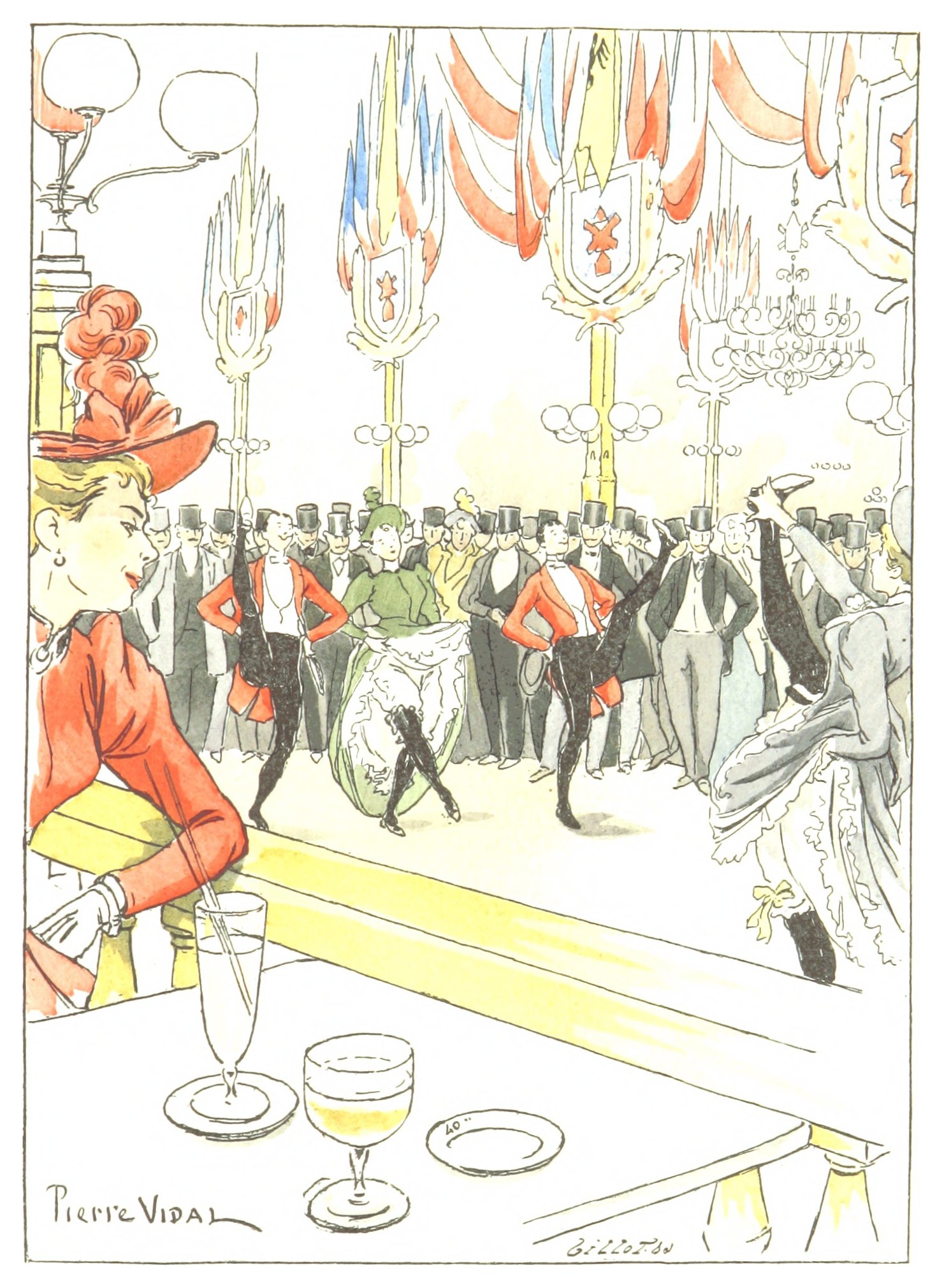
GOUDEAU&VIDAL - Au Moulin Rouge
Unknown artist
- Medium:
- Oil Painting
- Era:
- Late 1800s (Victorian Ballroom)
- Source:
- Wikimedia Commons
- Rights:
- Public domain — free to use, share and adapt.
- Recorded as:
- Public Domain
This work is important evidence of how ballroom dance was represented in the popular visual culture of the 1890s—not as a folk practice or family entertainment, but as a spectacle of urban modernity and theatrical luxury. It captures a specific historical moment when the boundary between ballroom and cabaret was fluid, and when formal dance was inseparable from the machinery of commercial entertainment. The work is also significant as a document of Art Nouveau illustration at its height, showing how the decorative language of the period was deployed to render contemporary social life.
What you are looking at
A grand ballroom scene of fin-de-siècle Paris, viewed from an elevated vantage point that places us among the spectators. The composition is divided between foreground and background: in the immediate foreground, a woman in a striking orange-red jacket and yellow skirt sits at a table with a cocktail glass and plate, her profile sharp and watchful. She dominates the left edge of the frame. Beyond her, the ballroom floor opens into a densely populated space filled with men in dark formal dress—top hats, tailcoats, white shirts—and women in evening gowns. The focal point is a woman in an orange jacket dancing with a man in dark dress, their figures positioned centrally and slightly elevated, suggesting a moment of particular prominence. Above the dancing figures, the artist has rendered an extraordinary architectural vision: massive crossed staffs or poles decorated with ornate finials and draped in ribbons of orange, yellow, and cream, suggesting either an elaborate stage set, a decorated hall, or a fantastical architectural conceit. The lighting is warm and diffuse, with yellow-cream tones dominating; clouds or smoke appear at the top of the composition. The overall effect is of theatrical opulence—this is not a naturalistic interior but a stylized, almost dreamlike rendering of high society at play.
The dancing
The central dancers are depicted in a closed, formal hold typical of ballroom dance: the man's frame is upright and commanding, the woman's torso connected to his, her arm extended. Neither figure is rendered with anatomical precision—the artist prioritizes silhouette and the suggestion of movement over anatomical detail. The supporting figures are summarily drawn, rendered as a crowd rather than as individuals, their postures upright and static. The woman in the foreground sits with her body turned toward the dance floor, her attention directed inward; her posture is alert and proprietary. Throughout, the bodies have the elongated, stylized proportions of Art Nouveau, with emphasis on elegant line rather than naturalistic form.
The dance depicted
This is almost certainly depicting the Waltz or a similar ballroom dance of the 1890s—the closed hold, the formal dress, the mixed-sex couples, and the setting in an elegant Parisian ballroom all point unambiguously to this. The woman in orange and the man in dark dress are frozen in the embrace of what appears to be a Viennese Waltz or similar rotational ballroom form, the kind of dance that dominated European high society in the late 19th century. The theatrical setting and the presence of what may be a stage or elaborate hall decoration suggest this could be depicting the Moulin Rouge or a similar cabaret-ballroom venue where ballroom dancing mingled with theatrical spectacle. The style of dress—particularly the woman's tailored jacket—suggests the 1890s precisely. This is not folk or social dancing but the formalized, mannered dance of the urban elite.
How it was made
The work is executed in ink and watercolor (or gouache) on paper, a technique visible in the fine linear work of the pen lines defining forms, figures, and architectural details, combined with fluid washes of orange, yellow, cream, and blue-grey. The line work is confident and economical—the artist establishes form through outline rather than modeling. The medium allowed for rapid execution and bold color effects; this is almost certainly a work of commercial or journalistic illustration rather than fine art, created for reproduction in a periodical. The technique is characteristic of fin-de-siècle Parisian graphic art, the kind of illustration that would appear in magazines or as part of a satirical or documentary series on contemporary life.
About this work
This is a scene of Parisian ballroom life at the Moulin Rouge or a similar venue in the 1890s, depicting the formal Waltz or ballroom dance of the era rendered in the decorative, stylized idiom of Art Nouveau. The work captures a moment of social spectacle—the mingling of dance, theater, and high society that characterized the cabaret culture of Belle Époque Paris. The woman in orange, who dominates the foreground, appears to be an observer or hostess rather than a dancer; her prominence and her vantage point suggest she is someone of authority or interest within this scene. The artist has chosen to emphasize the theatrical and architectural elements of the venue as much as the dancing itself, rendering the ballroom as a fantasy space of luxury and artifice.
The work belongs to a rich tradition of late 19th-century illustration of Parisian night life, a subject that fascinated both fine artists and commercial illustrators of the period. It documents not only a style of dance but a social ritual: the formal ballroom as a space of spectacle, display, and controlled eroticism. The artist's handling of the crowd and the individual figures suggests a practiced illustrator accustomed to depicting social scenes and public events.
How to look at it
Attend to the composition's division between foreground and background, and between the watching figure and the watched. The woman in orange occupies the picture plane more fully than any of the dancers, despite not being the primary subject; this compositional choice reflects a concern with spectatorship and authority that was central to representations of the Moulin Rouge. Notice the elaborate architectural fantasy above the dancers—the crossed poles and ribbons—which transforms the ballroom into a stage set and suggests that this is not a naturalistic scene but a rendering of spectacle itself. The artist's treatment of the crowd—as a mass of suggested rather than individuated figures—creates a sense of social density and anonymity that contrasts with the prominence of the central couple. The color palette, dominated by warm oranges and yellows with accents of cool blue-grey, creates an atmosphere of theatrical artifice and gaslit luxury.
The artist
The signature at the lower left reads "Pierre Vidal," and the inscription "GOUDEAU & VIDAL" appears in the catalogue record. This suggests either a collaborative work or attribution confusion. Pierre Vidal was an illustrator active in Paris in the 1890s; the style is consistent with Parisian commercial illustration of the period. Without further research, it is difficult to establish his biographical details or his broader practice, but the quality of the line work and the sophistication of the composition suggest a trained and experienced illustrator, likely someone who worked regularly for periodicals or for publishers of illustrated books.
The period
The 1890s in Paris were marked by the rise of the cabaret and music-hall as sites of entertainment and spectacle. The Moulin Rouge, founded in 1889, epitomized this new culture, blending dance, theatrical performance, and social display. The Waltz had been the dominant ballroom dance for much of the 19th century, and it retained its prestige in high society throughout the 1890s, even as newer dances (like the Tango, which arrived later) began to challenge its hegemony. In the visual arts, the 1890s were dominated by Art Nouveau, a decorative style that emphasized elegant line, stylized form, and the integration of ornament and figure. The illustration of contemporary social life—particularly the life of Paris—was a major genre of commercial and fine art in this period, sustained by the growth of illustrated periodicals and the appetite for images of modern urban experience.
The Moulin Rouge and similar venues were sites of intense artistic interest and moral anxiety. They attracted artists, writers, and performers, but also moral critics concerned about the mixing of classes, genders, and the commercialization of dance and the female body. This image, with its focus on a woman of apparent authority or celebrity watching the dancing from a privileged vantage point, captures some of that ambivalence: the spectacle is presented as both attractive and slightly theatrical, the dancers as both participants and performers.
Where it lives
The work is held in Wikimedia Commons and is sourced from an unspecified collection. The catalogue record provides minimal information about the current holding institution or the object's provenance. The title "Au Moulin Rouge" appears to be a later editorial addition rather than an original title, and the attribution "GOUDEAU & VIDAL" suggests either collaboration or curatorial uncertainty.
Dance in this work
Questions about this work
Is this depicting a real event at the Moulin Rouge?
There is no way to determine from the image alone whether this depicts a specific historical event or a generalized scene of Moulin Rouge life. The style and the title suggest the latter—this is more likely a stylized representation of the venue and its social rituals than a documentation of a particular evening. The theatrical architecture visible in the composition (the massive crossed poles with draped ribbons) appears to be the artist's invention or interpretation rather than a literal rendering of the hall's décor.
What dance is being performed?
The closed hold, the formal dress of both dancers, and the ballroom setting all point to the Waltz, almost certainly the Viennese Waltz, which was the dominant ballroom dance of the 1890s. The couple's upright posture and the sense of rotational movement are consistent with this form of dance.
Who is the woman in orange in the foreground?
The catalogue record does not identify her, and the image alone does not provide enough information to determine her identity. Her prominent placement and her vantage point suggest she is either a performer, a hostess, or a woman of social prominence within the scene. She may be a portrait, or she may be a generalized figure representing spectatorship and authority.
Why is the architecture so fantastical?
The decorative language of Art Nouveau favored stylization and ornament over naturalism. The artist may also be suggesting the theatrical and artificial quality of the cabaret itself—a space designed for spectacle and fantasy. Alternatively, the architectural elements may represent actual theatrical décor used for special performances at the venue.
More dance artwork