49 works in this view — arrow keys or swipe to move between them.
Dance in Art · 1910
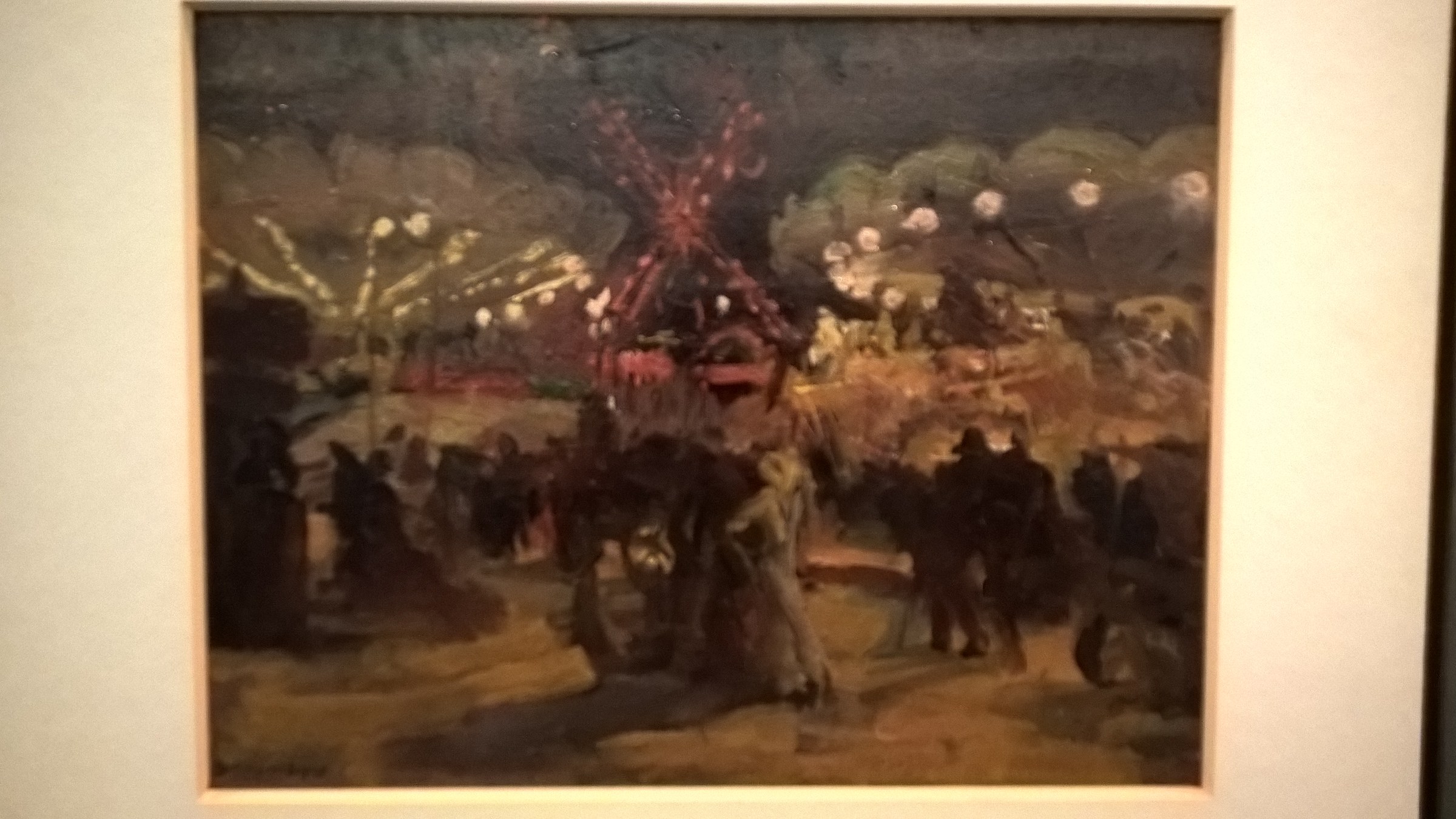
Le Moulin Rouge (noite) Sousa Lopes
Adriano de Sousa Lopes
- Medium:
- Oil Painting
- Era:
- 1900-1920 (Ragtime/Early Jazz)
- Source:
- Wikimedia Commons
- Rights:
- Public domain — free to use, share and adapt.
- Recorded as:
- Public Domain
This painting documents the Moulin Rouge at a crucial moment in dance history, when the can-can had been transformed from a marginal street dance into a commercialized spectacle that defined modern entertainment. It is one of few paintings of the venue made by a significant international artist after Toulouse-Lautrec and the Impressionists, preserving a record of how the space and its dancing continued to fascinate artists into the 20th century. For historians of dance and modernity, it shows how the Moulin Rouge remained a visual obsession even as the original performers and innovations had passed.
What you are looking at
A nighttime scene at the Moulin Rouge, the famous cabaret in the Montmartre district of Paris. The painting depicts the entertainment venue's interior or courtyard alive with activity: patrons in dark evening dress mingle and observe while dancers perform. A striking red structure—possibly a decorative architectural feature or stage element—dominates the center of the composition. The background is rendered in deep browns and blacks suggesting artificial interior lighting of the Belle Époque era. Multiple figures occupy the space: some seated or standing as spectators, others in motion. The palette emphasizes warm oranges, ochres, and creams against the dominant shadows, creating the effect of gaslit or early electric illumination on skin and fabric.
The dancing
The figures are rendered somewhat loosely, their forms suggested rather than sharply defined—typical of painting technique from this period capturing movement and atmosphere. Several dancers appear in the central and right portions of the scene; their postures suggest the high-energy movement characteristic of can-can dancing, with raised limbs and animated positioning. The spectators are mostly static, arranged around the periphery in silhouette or semi-shadow. The dancers' silhouettes and the way their limbs are extended suggest the vigorous leg movements associated with Moulin Rouge entertainment, though the impressionistic rendering makes precise analysis of hold or frame difficult.
The dance depicted
This depicts the Moulin Rouge in its heyday as the capital of Parisian popular entertainment. The venue was famous above all for the can-can, a high-energy, acrobatic social dance performed by women dancers for paying audiences. The red structure in the composition may reference the famous red mill (moulin rouge) that was an iconic feature of the venue's exterior. The painting captures the spectacle and social excitement of the place rather than documenting a specific choreography. The loose, energetic rendering of the central figures and the sense of vigorous movement suggest the high-kicking, uninhibited style associated with can-can, though the impressionistic technique prevents identification of specific steps or formations.
How it was made
Oil painting on wood panel, a intimate and portable format that emphasizes the artist's direct observation and spontaneous handling of paint. The technique is impressionistic: loose brushwork, emphasis on light and atmosphere rather than detail, colors applied with visible gestural confidence. This approach captures the fleeting, ephemeral quality of a moment in a crowded, dimly lit venue. The medium and style suggest this was created as a studio work from the artist's study and memory of the Moulin Rouge rather than a large academic composition, implying it was intended for collectors with modern tastes.
About this work
This is an oil painting from circa 1910 by the Portuguese artist Adriano de Sousa Lopes, depicting the interior of the Moulin Rouge cabaret in Paris during the Belle Époque. The work captures the famous venue at the height of its reputation as a center of entertainment and spectacle. Using an impressionistic technique with loose brushwork and atmospheric light effects, the artist conveys the energy and excitement of the scene—the mingling of patrons, the movement of dancers, and the sense of theatrical occasion—rather than documenting precise choreography or detail.
The Moulin Rouge was inseparable from the can-can, the high-energy social dance that became synonymous with Parisian nightlife in the late 19th and early 20th centuries. Sousa Lopes's painting belongs to a tradition of artists fascinated by modern urban entertainment and the spectacle of popular culture. The work appears in international collections and art historical records as an example of how the Moulin Rouge captivated European artists and audiences as a symbol of modernity, freedom, and the new nightlife culture of the Belle Époque.
How to look at it
Observe how the artist uses shadow and artificial light to suggest the interior space and the energy of the moment rather than depicting it literally. Notice the contrast between the silhouetted patrons (rendered as dark shapes) and the lighter, more animated forms of the dancers in the center, where the red architectural feature draws the eye. The loose handling of paint—visible brushstrokes that suggest rather than describe—creates a sense of movement and transience appropriate to a crowded, dimly lit venue. The composition emphasizes atmosphere and impression over documentary detail, inviting the viewer to feel the buzz and excitement rather than count the dancers or analyze steps.
The artist
Adriano de Sousa Lopes (1879–1942) was a Portuguese modernist painter known for his cosmopolitan engagement with European art movements. He worked in Paris during the Belle Époque and early 20th century, where he absorbed Impressionist and post-Impressionist techniques while developing his own distinctive style combining loose brushwork with vivid color. He was particularly drawn to scenes of modern urban life, entertainment, and leisure. His work circulated in international exhibitions and collections, making him a bridge between Portuguese and wider European modernism.
The period
By 1910, the Moulin Rouge (opened 1889) had already become an icon of the Belle Époque—a symbol of Paris as the capital of pleasure, modernity, and cosmopolitan culture. The can-can, initially shocking for its high kicks and apparent lack of propriety, had been fully assimilated into commercial entertainment and even respectability; it was performed nightly as a tourist attraction. In visual art, the Moulin Rouge continued to fascinate painters and printmakers as a subject of modernity and urban spectacle, even as earlier artists like Toulouse-Lautrec had exhausted much of its artistic interest. By the early 20th century, paintings of the venue belonged to a well-established genre of nightlife and entertainment imagery.
Where it lives
The work is recorded as part of the Museu Nacional de Arte Contemporânea – Museu do Chiado (MNAC-MC) in Lisbon, though the catalogue record does not specify acquisition date or provenance details. The artist's name is associated with the Portuguese national collections and international exhibitions of modern art.
Dance in this work
Questions about this work
Is this the same Moulin Rouge I can visit in Paris?
Yes. The Moulin Rouge opened in 1889 in the Montmartre district and continues to operate as a cabaret and tourist venue. This painting from 1910 depicts it during its original Belle Époque heyday, roughly two decades after it became famous for introducing the can-can as a commercialized spectacle. The red mill structure on the building's roof (visible in historical photographs) likely inspired the red element at the center of this composition.
What is the can-can and why was it performed at the Moulin Rouge?
The can-can originated as an energetic social dance among working-class Parisians in the 1830s–40s, shocking middle-class opinion with its high kicks and perceived lack of restraint. By the time the Moulin Rouge opened, it had been adopted as the house specialty—a theatrical, commercialized performance that made the venue famous. Dancers (usually women) performed choreographed versions of the can-can for paying audiences, and it became the defining symbol of Parisian nightlife and the Belle Époque.
Why did artists keep painting the Moulin Rouge after Toulouse-Lautrec?
Toulouse-Lautrec's lithographs and paintings of the Moulin Rouge in the 1890s became iconic documents of the venue and its performers. But the Moulin Rouge continued to fascinate artists well into the 20th century as a symbol of modernity, urban entertainment, and the transformation of dance into popular spectacle. For painters like Sousa Lopes, it represented not just a place but an idea: the energy and excitement of modern city life and the culture of leisure that defined the Belle Époque.
More dance artwork