49 works in this view — arrow keys or swipe to move between them.
Dance in Art · 1896
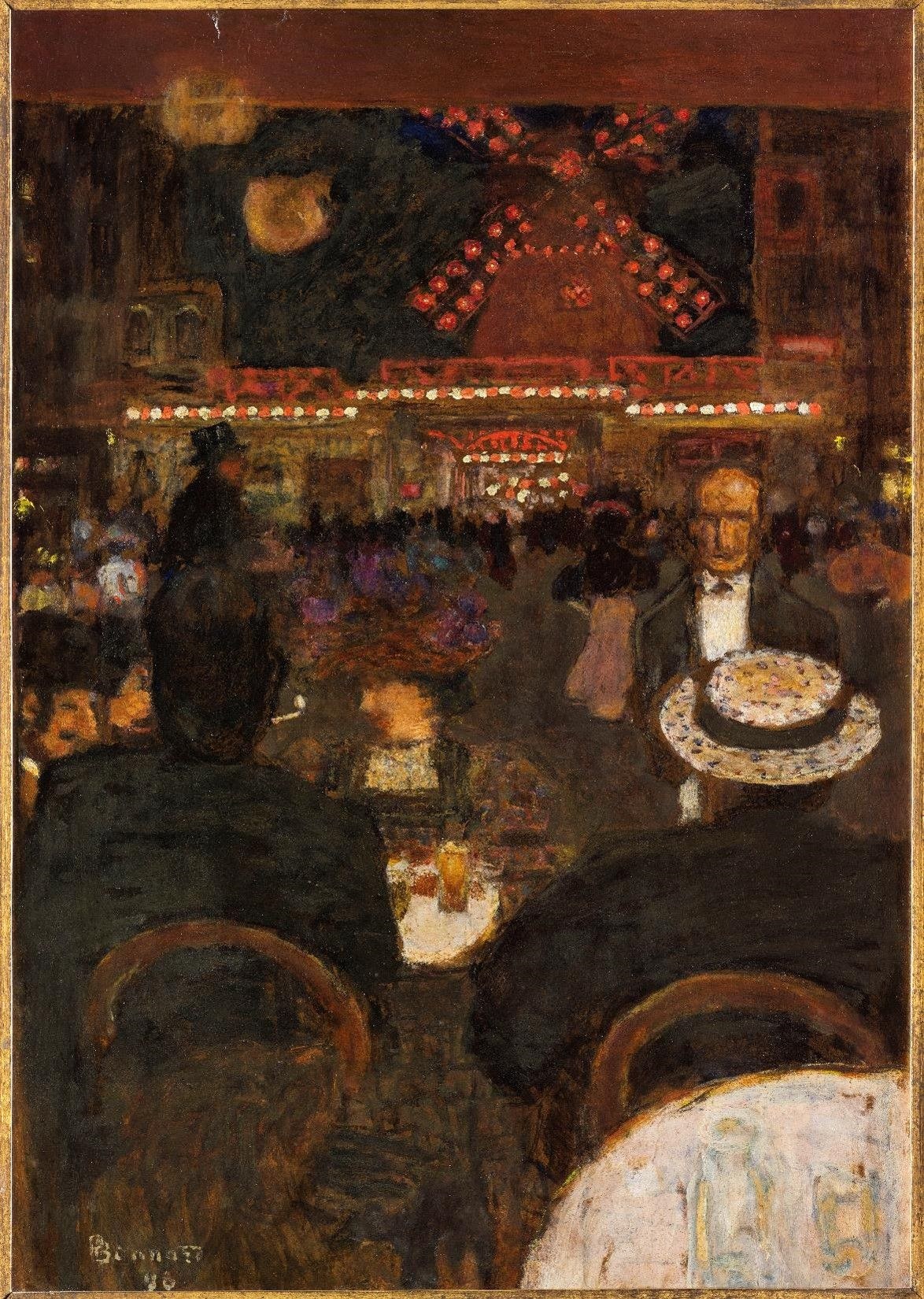
Le Moulin Rouge ou Place Blanche (Terrasse de café), par Pierre Bonnard
Pierre Bonnard
- Medium:
- Oil Painting
- Era:
- Late 1800s (Victorian Ballroom)
- Source:
- Wikimedia Commons
- Rights:
- Public domain — free to use, share and adapt.
- Recorded as:
- Public Domain
This work shows that dance history is not only written by images of bodies in motion—it is also written by where and how those bodies were watched. The Moulin Rouge and its audience were as much a part of dance culture as the can-can itself, and Bonnard's painting captures the modernity and democratic mixing that made music-hall dance a dominant form of entertainment at the century's turn. For historians and dancers, the work documents an entire ecosystem of performance, consumption, and urban leisure.
What you are looking at
A crowded café terrace at night, alive with gaslit lamps and glowing signs. The Moulin Rouge's illuminated stage dominates the middle distance, its red bulbs strung across the proscenium arch creating a halo of warm light against dark walls. In the foreground, patrons in dark formal dress occupy small tables—men in suits and boaters, women in fashionable coats—while waiters in white shirtfronts move between them carrying drinks and food. The composition is viewed from inside the café looking toward the theater; the immediate foreground includes the back of a chair and what appears to be a table edge with a plate. The palette is characteristically Post-Impressionist: heavy browns and blacks modulated by orange, gold, and rose light, with touches of white and pale color on faces and linens.
The dancing
The figures are rendered as simplified silhouettes and loosely defined shapes, typical of the Nabis style; faces are pale ovals with minimal detail. Bodies are upright, seated, or standing in static social poses rather than dance positions. Hands hold glasses and gesticulate in conversation. There is no visible dancing in the immediate foreground—these are spectators and drinkers, not dancers. The distant stage is too small and obscured to determine the posture or technique of any performers.
The dance depicted
The painting documents the entertainment venue itself rather than depicting dance directly. The Moulin Rouge, which opened in 1889, was celebrated for its stage shows featuring the can-can and other music-hall dances, but no dancers are clearly visible here. The work captures the social context of dance entertainment—the café culture, the electric-lit modernity, the mixed-gender audience—rather than the dance itself. The stage is present but the dancers are absent or too distant to analyze.
How it was made
Oil painting on canvas, rendered in the Post-Impressionist manner associated with the Nabis and Symbolist circles of 1890s Paris. The technique favors broad areas of flat color and atmospheric effect over precise illusionism; forms dissolve into tone and light rather than being sharply defined. The loose brushwork and emphasis on the emotional and decorative properties of color and composition allowed works like this to function both as salon paintings and as designs for prints and decorative schemes. The work's nocturnal subject and modernist handling made it a statement about contemporary urban life.
About this work
This is a nightlife scene from the 1890s Parisian entertainment district, centered on the Moulin Rouge cabaret—the venue most associated with the can-can and music-hall spectacle. Rather than depict the dance itself, Bonnard captures the audience and the electric social atmosphere of the place, showing how dance entertainment functioned as a draw for a fashionable mixed crowd. The painting is a document of how dance and spectacle were consumed in the modern city, and of the artistic interest in artificial light, crowds, and popular entertainment that defined the period. It belongs in a dance gallery not as a depiction of technique but as evidence of the cultural role of performance venues and the social choreography of spectatorship.
How to look at it
Attend to the contrast between the bright, glowing stage in the distance and the darker, more tonally complex foreground where the viewer stands among the patrons. Bonnard's composition asks you to experience the venue as the audience did—seated, social, watching a distant illuminated stage. Notice how the painting dissolves forms rather than clarifying them; the figures emerge from and dissolve back into the warm, murky light, making the whole scene feel immersive and atmospheric rather than theatrical or composed. The artificial electric light—then a new and exciting technology—is the true subject, as much as the entertainment itself.
The artist
Pierre Bonnard (1867–1947) was a founding member of the Nabis and a central figure in Post-Impressionism and Symbolism. He worked across painting, printmaking, and decorative design, and was fascinated by intimate domestic and social scenes animated by artificial light and contemporary detail. His interest in the Moulin Rouge and Parisian nightlife was shared by many artists of his circle (including Toulouse-Lautrec); Bonnard's approach was characteristically more atmospheric and less satirical than Toulouse-Lautrec's, focusing on color, mood, and the dissolving effect of lamplight on form rather than on character or caricature.
The period
The 1890s saw an explosion of music-hall and cabaret entertainment in Paris, driven by new technologies (electric light, late-night culture, railways connecting suburbs) and new audiences (working and middle-class, gender-mixed, pleasure-seeking). The can-can and other high-energy social dances became symbols of modernity, liberation, and urban excitement. Simultaneously, avant-garde artists—Symbolists, Post-Impressionists, and early modernists—treated contemporary entertainment venues as subjects worthy of serious attention, seeing in them a new kind of beauty rooted in artificial light, mass culture, and the psychology of crowds. Bonnard's painting sits at the intersection: it is both a genuine record of a specific place and a modernist meditation on perception, color, and the poetry of contemporary life.
Where it lives
The work is recorded as oil on canvas from 1896, held in an unspecified collection. It is known from Wikimedia Commons, suggesting it is in a publicly accessible collection, likely a major European museum, though the exact holding is not confirmed in the catalogue record provided.
Dance in this work
Questions about this work
Can you see the can-can dancers in this painting?
No—the stage is visible in the background with its glowing lights, but the performers are too distant or obscured to identify the dance or the dancers' bodies. Bonnard chose to paint the social experience of the venue rather than the spectacle itself.
Why is this painting so dark?
The darkness is intentional: the painting depicts a nighttime scene inside a gas- and electric-lit café, with the only bright light source being the stage itself. The muted palette and emphasis on light effects were fashionable in avant-garde art of the 1890s and suited the subject perfectly.
Is this a painting or a print?
This is an oil painting, as stated in the catalogue record. The loose, sketchy handling might suggest a study or print, but the medium is paint on canvas.
What is the Moulin Rouge and why does it matter for dance history?
The Moulin Rouge, opened in 1889, was a music-hall and cabaret venue in the Montmartre district of Paris, famous for popularizing the can-can and for hosting spectacular revues. It was the most celebrated dance entertainment venue of its era and a symbol of modern, democratic, pleasure-seeking urban culture. It became iconic in art and remains a landmark in dance history.
More dance artwork