49 works in this view — arrow keys or swipe to move between them.
Dance in Art · 1954
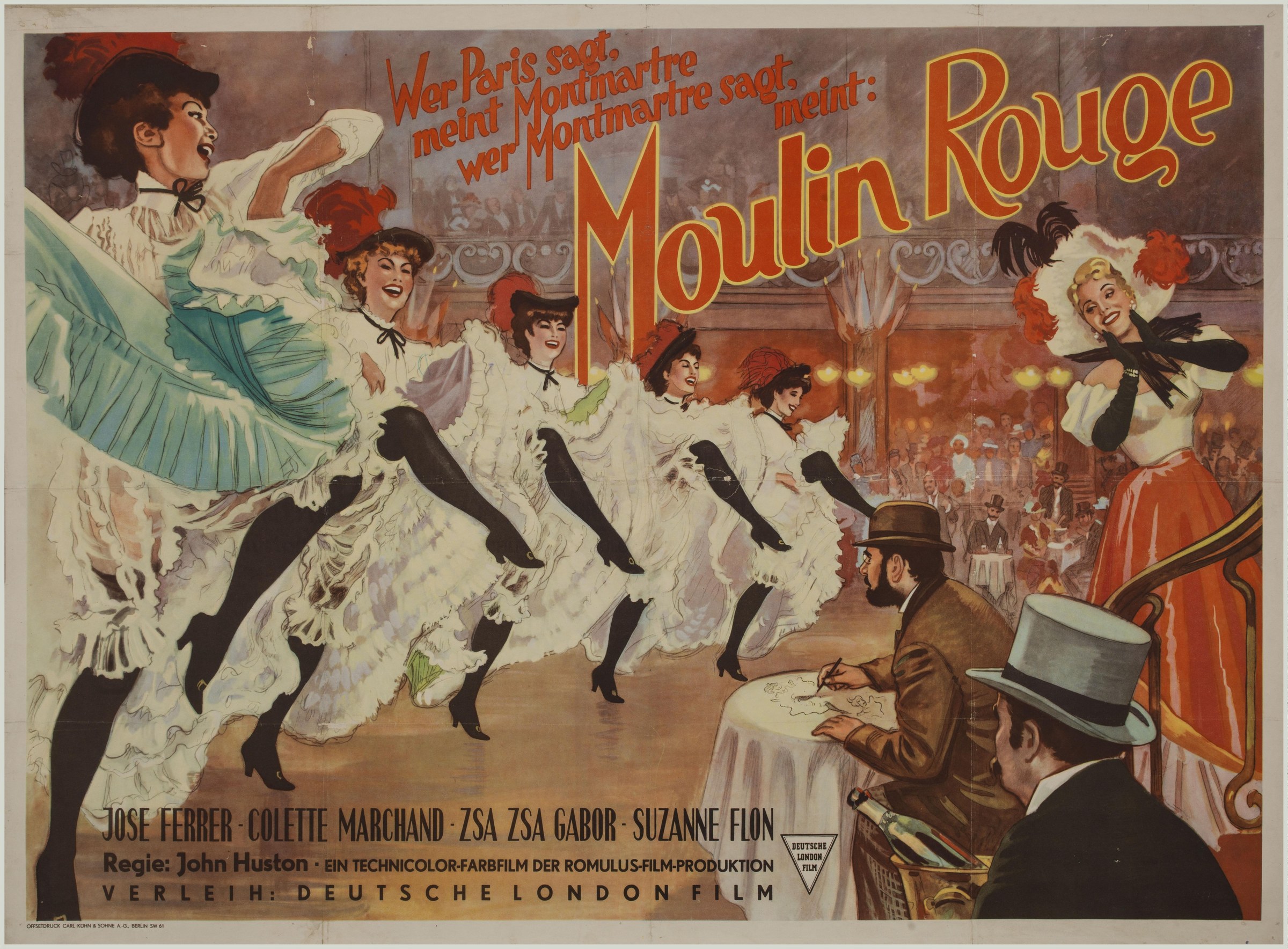
Moulin Rouge 1954 Moulin Rouge (film de John Huston) (affiche)
Unknown
- Medium:
- Oil Painting
- Source:
- Wikimedia Commons
- Rights:
- Public domain — free to use, share and adapt.
- Recorded as:
- Public Domain
For dance historians, this poster documents the visual and gestural vocabulary of mid-century cabaret performance—how the can-can was understood, packaged, and marketed by the mid-twentieth century, distinct from its anarchic 1890s origins. For those interested in the can-can specifically, it confirms the standardization of the form by the 1950s into an orderly line dance with codified high-kick technique, and shows how that codification was used to communicate spectacle and modernity to mass audiences. The poster is also evidence of how cinema remediated live performance, promising to bring cabaret entertainment to those who could not attend Paris.
What you are looking at
This is a poster for John Huston's 1954 film adaptation of the Moulin Rouge story, rendered in the theatrical chromolithography style characteristic of cinema publicity in the mid-twentieth century. The composition is split between foreground spectacle and background venue. In the foreground, a line of six can-can dancers stretches across the lower two-thirds of the image, their bodies angled into the vigorous high-kick positions iconic to the Moulin Rouge. Each wears a white or cream-colored costume with voluminous ruffled skirts, black stockings, and heeled boots; their bodies are caught mid-gesture, legs extended at varying heights, torsos leaning into the kick. To the left, a seventh dancer in a turquoise and cream costume dominates: her leg flies highest, her face animated in exertion or exhilaration. At right, a woman in a crimson skirt and white corseted top gestures theatrically, possibly representing a star or featured performer. The background shows the interior of the Moulin Rouge itself—warm-lit, crowded with seated patrons at round tables, a band or orchestra visible—rendered in softer focus to push the dancers forward. The artist has used strong diagonal lines through the dancers' extended legs and arms to create motion and energy across the plane. Text in German and French appears across the top, identifying this as a German-language release ("Deutscher London Film" is credited at bottom).
The dancing
The dancers are arranged in a loose line that reads left to right, each body rotated toward the audience in a frontal or three-quarter stance despite their legs pointing sideways or backward—a compositional choice that maximizes the visibility of both the face and the leg extension. The leg height varies from nearly horizontal (left foreground) to moderate knee-height (center), suggesting either deliberate choreographic variation or a moment captured mid-sequence where different dancers are at different points in the kick. The arms are held variously: some extended laterally or raised, others held closer to the body. The weight appears to be on the supporting leg, with the extended leg trailing behind or rising in front, characteristic of can-can technique. The dancers' faces are generally visible and expressive, aligned with the entertainment value required of this style.
The dance depicted
This is a can-can dance scene, the Parisian cabaret style that became synonymous with the Moulin Rouge from its founding in 1889. The can-can was characterized by high kicks, rapid leg movements, full skirts designed to display the legs, and a theatrical, audience-facing energy meant to shock and delight. The poster depicts the style in its mid-twentieth-century codified form: structured, visibly rehearsed, performed by a line of identically costumed dancers in a professional venue. The original Moulin Rouge featured the chahut (a more anarchic precursor) and the quadrille performed by performers like La Goulue and Jane Avril in the 1890s; by 1954, the can-can was an established, almost classical form within the cabaret repertory. The image confirms the commercial, line-based, spectacle-oriented nature of the form as it existed in the mid-twentieth century.
How it was made
This is a chromolithographic poster, a process that separated color into multiple stone plates to allow mass reproduction. The technique is evident in the vibrant but flat color planes, the slight registration variations visible at color edges, and the overall quality of the printing. Chromolithography was the dominant method for cinema publicity from the 1890s through the 1950s, allowing studios to produce thousands of identical copies for distribution to theaters across a region or continent. The technique demanded that the original design be bold and legible at small scale and at distance; hence the strong diagonal lines, the clear contrast between the dancers' pale costumes and dark stockings, and the warm, golden interior lighting of the background. The painterly quality—the soft modeling of faces, the rendering of fabric—is created through subtle dot and line patterns in the stone, not by brush. Chromolithography positioned this poster as a mass-market object, circulated widely in the German-speaking territories (as the credit line indicates), making it an artifact of cinema's promotion as much as of dance history.
About this work
This is promotional material for a major film, created in a moment when cinema was competing with live theater and cabaret for entertainment dollars. The Moulin Rouge cabaret and its associated dance styles were already iconic—visual shorthand for Parisian modernity, female sexuality, and theatrical risk-taking—by the time Huston's film was made. The poster's design uses all available visual codes to communicate what the audience will see: the venue, the glamour, the energy, the line of professional dancers. The presence of male patrons and the orchestral setting anchor this as a commercial performance venue, not a street festival or folk tradition. The image thus captures not the historical can-can of the 1890s but its mid-twentieth-century iteration as an established theatrical genre, performed for an audience of leisure-class onlookers in a fixed venue with electric light and commercial infrastructure. The work sits at the intersection of dance history, design history, cinema history, and the history of how modernist entertainment forms became commodified and standardized.
How to look at it
Attend first to the frozen moment in the leg action: the artist has chosen a moment of maximum extension and maximum visibility, with legs at varied heights creating visual interest and motion across the picture plane. Notice how the dancers' torsos remain relatively upright and frontal even as their legs point to the side—this is the can-can's distinctive geometry, unlike, say, a high-kick chorus line in which the whole body rotates. Observe the faces: they are animated, visible, engaging the audience directly. The white costumes are lit to read as voluminous and dynamic even when still. The background, though crowded and active, is deliberately kept soft and warm to focus attention forward on the dancers. The poster uses every element—composition, color, legibility, theatrical lighting—to communicate motion, transgression, professional skill, and mass spectacle.
The artist
The artist of this poster is not recorded in the catalogue. The work bears no visible signature and no research method available has attributed it. The production credit names John Huston as director and lists Romulus Film Produktion and Deutscher London Film as production entities, but the poster designer remains anonymous. This is not unusual for mid-century cinema posters, which were often produced by studios' in-house design departments or by contract design studios working without individual artist credit. The poster's style—the soft rendering of faces, the bold compositional lines, the warm color palette—is consistent with the chromolithographic poster tradition of the 1950s, likely produced by a Vienna or Berlin printing house familiar with cinema promotion.
The period
By 1954, the can-can had been a fixture of Parisian entertainment for sixty-five years. What had scandalized audiences in 1889—the visible legs, the whirling skirts, the transgressive energy—had become a tourist attraction and a symbol of Belle Époque glamour. Huston's film was part of a mid-twentieth-century wave of nostalgia for that period, and for the Paris of Toulouse-Lautrec and the Moulin Rouge. Simultaneously, color film and improved theatrical projection made cinema a credible rival to live performance; studios promoted films by emphasizing spectacle that matched or exceeded the stage. The chromolithographic poster was itself becoming obsolete by 1954 (offset lithography and photographic printing were emerging), so this object marks a moment of transition in media technology. In dance, the can-can had been substantially formalized and professionalized—incorporated into ballet curricula, standardized into a line dance with clear vocabulary—in ways that the improvisatory, gender-transgressive 1890s version had not been. The poster thus captures the can-can at a point of maximum codification and commercial deployment.
Where it lives
The work is held on Wikimedia Commons and is presented as a digital image. No holding institution or accession information is recorded in the catalogue. It is described as an affiche (French: poster), indicating it was produced for public distribution to promote the film release.
Dance in this work
Questions about this work
Is this poster from the original 1889 Moulin Rouge, or from later?
Neither. This is a poster for John Huston's 1954 film about the Moulin Rouge and its history. The Moulin Rouge cabaret itself was founded in 1889, but this image advertises a mid-twentieth-century cinema interpretation of that history. The can-can depicted here represents the codified, professional form of the mid-1950s, not the original anarchic 1890s version.
What is the can-can, and how is it different from other high-kick dances?
The can-can is a French cabaret dance style that emerged in the 1870s and became famous at the Moulin Rouge from 1889 onward. It is characterized by high kicks (often performed in a line), rapid leg movements, full skirts designed to display the legs, and a theatrical, audience-facing energy. Unlike some high-kick chorus lines, the can-can maintains the dancer's torso relatively upright and frontal while the legs swing to the side or rise in front, creating a distinctive geometric opposition between upper and lower body. By the 1950s, it had been standardized into the orderly line form shown here.
Why is this a chromolithographic poster and not just a photograph?
Chromolithography was the standard method for mass-producing cinema posters from the 1890s through the 1950s. Photographs could not be reproduced economically at scale during this period; instead, a painted or drawn design would be prepared and then separated into color plates for printing. Chromolithography allowed studios to produce thousands of identical copies quickly and cheaply, and to distribute them to theaters across a region. The bold design and flat color planes you see here are characteristics of the medium—they ensured legibility at distance and at small scale, which was essential for street-level promotion.
What does this poster tell us about how cabaret was understood in the 1950s?
This poster shows cabaret as a commercialized, professionalized, orderly spectacle: a line of identical dancers, lit by electricity, performing in a fixed venue for paying customers. The presence of the seated patrons and orchestra in the background emphasizes that this is a commercial entertainment business, not a spontaneous celebration. By 1954, the anarchic, transgressive energy of the 1890s Moulin Rouge had been transformed into a reproducible commodity—something cinema could promise to sell to mass audiences.
More dance artwork