49 works in this view — arrow keys or swipe to move between them.
Dance in Art · 1910
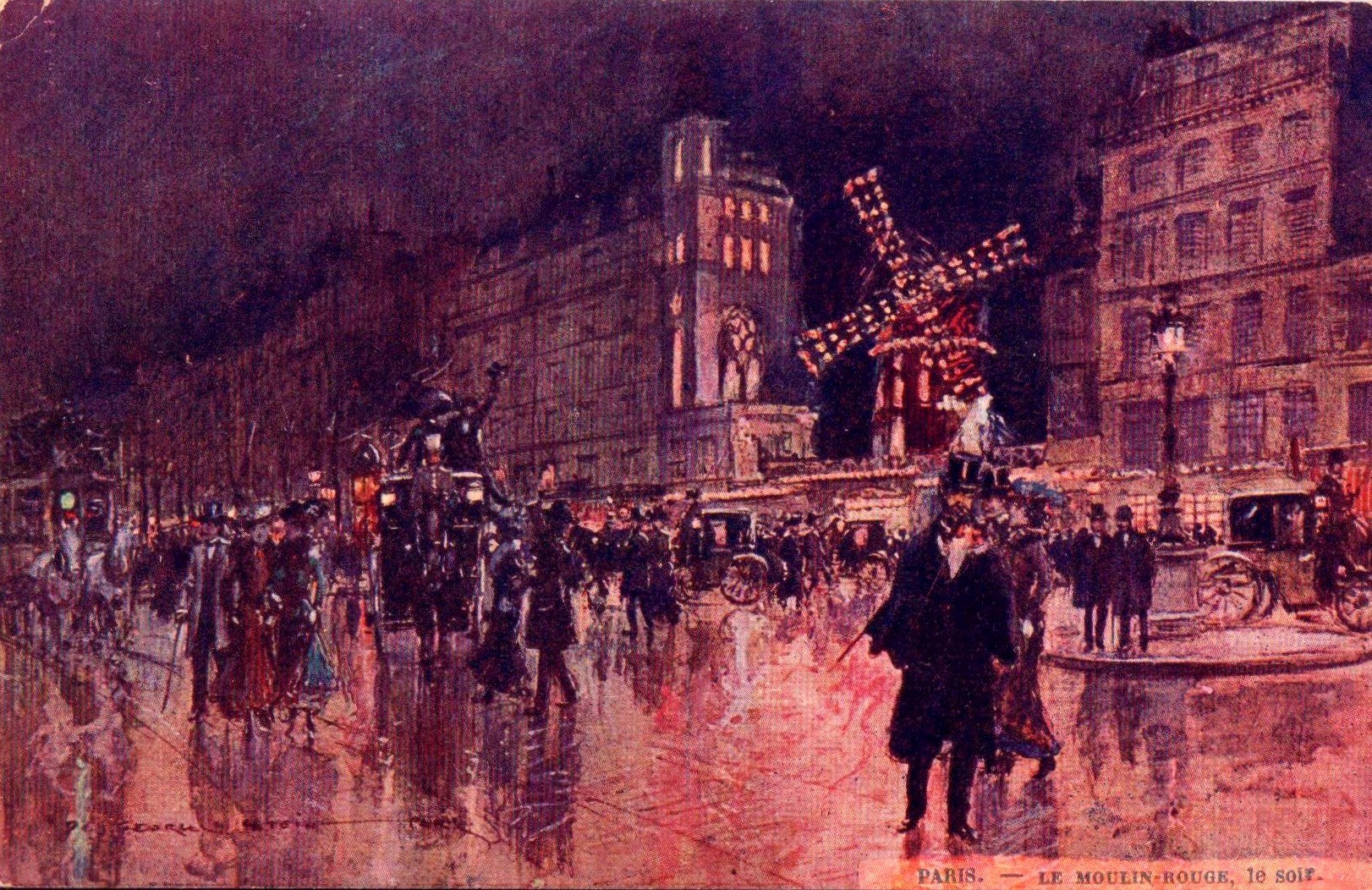
Paris. Georges Stein. Le Moulin Rouge, le soir. Postcard, c.1910
Publisher: Unknown.
- Medium:
- Oil Painting
- Era:
- 1900-1920 (Ragtime/Early Jazz)
- Source:
- Wikimedia Commons
- Rights:
- Public domain — free to use, share and adapt.
- Recorded as:
- Public Domain
The Moulin Rouge is inseparable from the history of the can-can and early theatrical modernism in dance; understanding how the venue was perceived, marketed, and imagined by its public is central to understanding how dance moved from ballroom and stage into the urban nightclub. This postcard was a mass-media artifact that shaped international perception of Paris as the capital of modern pleasure and transgressive performance, and postcards like it were instruments that spread knowledge of new dance forms globally.
What you are looking at
A teeming nocturnal crowd fills the Place Blanche in Paris before the illuminated Moulin Rouge cabaret. The composition is thick with figures—dancers, patrons, strollers—rendered in warm amber and rose tones against a deep purplish night sky. In the foreground, a woman in dark dress stands prominently, her posture and isolation from the crowd suggesting a moment of observation or pause. The cabaret's iconic red mill glows in the distance, a beacon of entertainment, while the surrounding Haussmann buildings frame the scene. The painting captures the energy of Belle Époque nightlife: the electric gaslights casting pools of warmth, the crush of elegantly dressed bodies in motion, the promise of spectacle and transgression that drew crowds to this notorious venue after dark.
The dancing
The bodies visible are upright and mobile, arranged in loose social groupings rather than formal dance formation. A few figures appear to move in couples or pairs, but none are captured in a closed ballroom hold or any discernible partnered dance frame. Most figures stand, converse, or walk with the posture of cabaret patrons—relaxed, social, observational. The woman in dark dress in the foreground stands alone, weight evenly distributed, her gaze directed toward or away from the crowd. Costumes are street dress and evening wear rather than performance costume, indicating this is a scene of social dance and nightlife rather than staged performance.
The dance depicted
This is not a depiction of a formal dance style performed on stage, but rather an image of social dancing and the nightlife surrounding a famous cabaret. The Moulin Rouge, which opened in 1889, was the birthplace of the can-can and hosted both tourist crowds and performers. The painting documents the atmosphere of spontaneous social movement, flirtation, and entertainment that characterized the venue. If dancing occurs within this crowd, it is the vernacular, improvisational social dancing of Belle Époque nightlife—the movement of bodies in public space animated by music and alcohol rather than choreography.
How it was made
The work is described as an oil painting, but the artifact presented here is a colored postcard from approximately 1910, printed on paper stock. The soft, atmospheric quality and the smooth, tonal rendering visible in the image suggest this may be a photographic reproduction or chromolithographic print of an oil painting, not the painting itself. The warm palette—golds, roses, and deep purples—was achieved through printing technique rather than oil pigment. As a postcard, this work circulated widely among tourists and inhabitants of Paris, making it a mass-produced window into the famous venue and its reputation for modern nightlife.
About this work
This is a postcard reproduction of a nocturnal scene at the Moulin Rouge, Paris's most famous cabaret, captured during the Belle Époque period around 1910. The image documents the social world of turn-of-the-century Parisian entertainment rather than a specific dance performance: the crowd of patrons, the atmosphere of possibility and spectacle, the mixing of classes and genders that made the venue notorious. The work belongs in a dance gallery not because it depicts choreographed movement, but because it records the physical culture and social space in which modern dance was born—the cabaret as incubator of new forms, new bodies, and new freedoms of movement that would reshape European performance and nightlife.
How to look at it
Attend to the composition of the crowd and the interplay of light and shadow: the artist has rendered the scene as a unified field of warm light and movement, rather than depicting individual performers or clearly legible dance steps. The isolation of the foreground figure against the crush of the crowd behind creates visual and social depth—we are viewing a moment at the threshold of the spectacle, neither fully outside nor inside the performance. Notice how the red mill's glow and the warm lamplights structure the scene emotionally, drawing the eye inward toward the promise of transgression and entertainment. The painting captures not a frozen dance movement but the perpetual motion of a modern crowd.
The artist
The painting is attributed to Georges Stein in the record, but the artist identity cannot be confirmed from the image alone. The work is signed in the lower left corner. Stein appears to have specialized in scenes of Parisian nightlife and spectacle in the early twentieth century; the style suggests academic training in the rendering of light and crowd scenes, applied to documentary or journalistic subject matter.
The period
The Moulin Rouge opened in 1889 and became immediately famous for its can-can dancers and its carnival atmosphere. By 1910, when this postcard was made, the cabaret was a major tourist destination and a symbol of the Belle Époque—a period when Paris was understood as the capital of modernity, pleasure, and sexual liberation. The cafe-concert and cabaret were sites where new social dances emerged from African diaspora forms (ragtime, early jazz) and where women's bodies and movement became subjects of public fascination and moral anxiety. The chromolithographic postcard was a crucial medium for circulating images of modern urban life; this type of night-scene postcard was collected and sent internationally, shaping global perceptions of Paris.
Where it lives
This work is known as a postcard, reproduced from an oil painting (or possibly a chromolithographic print). The source is Wikimedia Commons. Postcards of Parisian nightlife were mass-produced and distributed globally as both tourist souvenirs and mailable artworks; this example is one of many scenes of the Moulin Rouge circulated in this format.
Dance in this work
Questions about this work
Did the Moulin Rouge have a house dance company, and what did they perform?
Yes. The Moulin Rouge opened in 1889 as a music hall and cabaret featuring the can-can (French quadrille), performed by a troupe of female dancers. By the early twentieth century, the venue also hosted jazz musicians, singers, and acrobatic performers, and it was a key site for the circulation of African diaspora dance forms in Paris. The can-can itself was a European quadrille variant with high kicks and provocative energy that scandalized conservative critics.
What is a Belle Époque postcard, and why are they important to dance history?
Postcards were a cheap, mass-produced medium for circulating images in the late nineteenth and early twentieth centuries. They served both as tourist souvenirs and as mail, making them powerful tools for shaping global knowledge of places and practices. Postcards of cabarets, music halls, and dance venues documented new forms of public entertainment and female performance, and they were often the first image of modern dance that viewers outside Paris encountered. They constitute a visual archive of how modernist nightlife was packaged and sold.
Why is this scene considered dance history if nobody is clearly dancing?
Modern dance emerged not only in theaters and concert halls, but in cabarets, music halls, and social spaces where new forms of movement, music, and intermixing of bodies became possible. The Moulin Rouge was a laboratory of modernism in which can-can dancers, jazz musicians, and new social dances collided with tourism and spectacle. Understanding the visual culture and atmosphere of these venues—the crowds, the light, the promise of liberation—is central to understanding how dance changed and how it moved into the twentieth century.
More dance artwork