49 works in this view — arrow keys or swipe to move between them.
Dance in Art · 1902
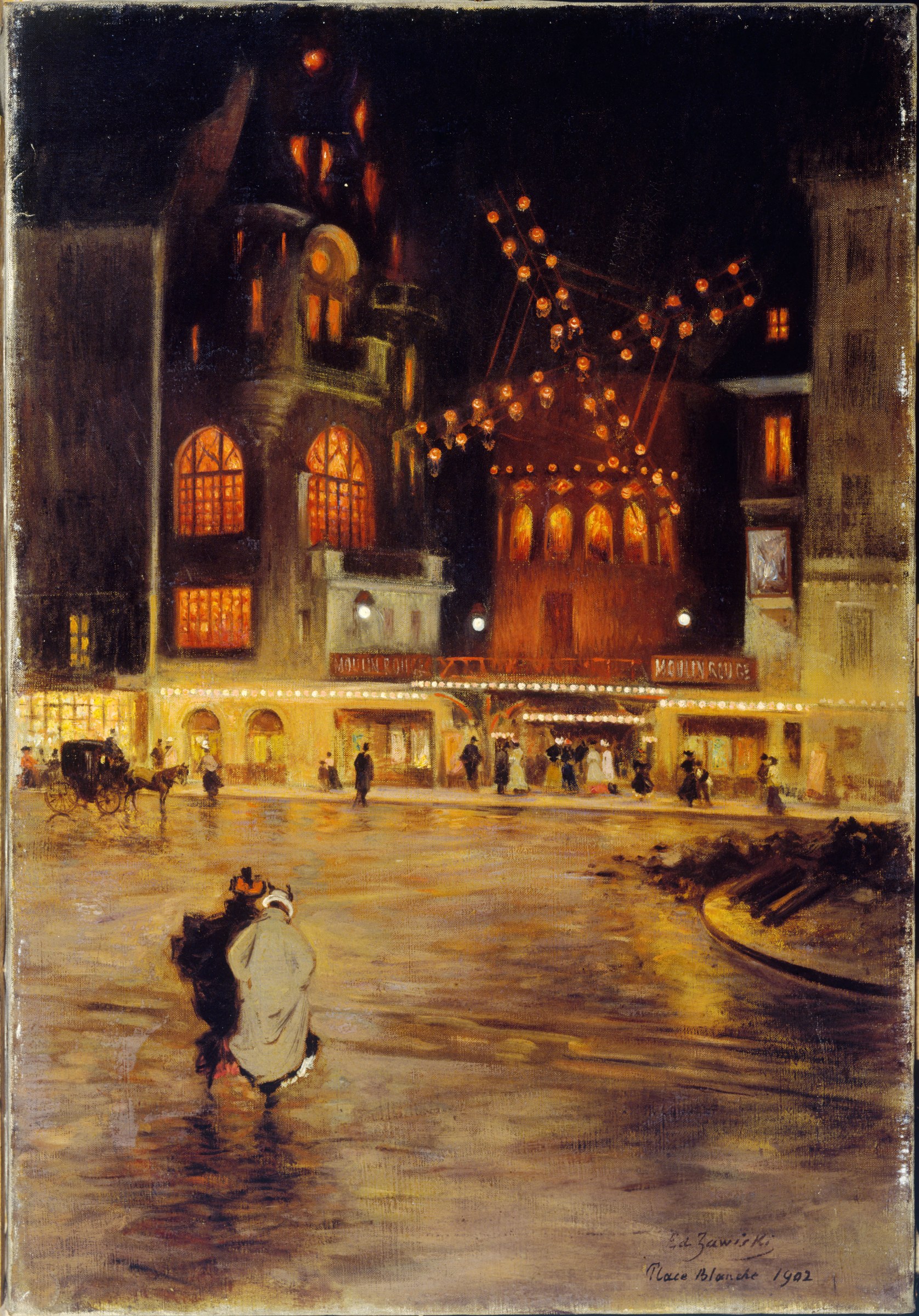
Zawiski - La Place Blanche et le Moulin Rouge - P519 - Musée Carnavalet
Edouard Zawiski
- Medium:
- Oil Painting
- Era:
- 1900-1920 (Ragtime/Early Jazz)
- Source:
- Wikimedia Commons
- Rights:
- Public domain — free to use, share and adapt.
- Recorded as:
- CC0
This work records a pivotal moment in dance history: the transformation of dance from an elite theatrical form to a mass popular entertainment embedded in urban nightlife. The Moulin Rouge and venues like it democratized dance, making it accessible and commercially significant, and this painting captures that shift not in the ballroom but in the street, where the performer becomes a public figure navigating the modern city.
What you are looking at
A nocturnal urban square transforms into a theater of light and movement. The Moulin Rouge dominates the composition—its illuminated windows glow amber against the dark facade, while decorative lights cascade from the roof in a sweeping arc, creating a constellation of warm points against the night sky. The street itself is wet, reflecting the building's glow, suggesting recent rain or the aftermath of evening crowds. In the foreground, a solitary figure in white—likely a dancer or performer emerging from or returning to the venue—moves through the empty plaza with purposeful grace, their body angled and wrapped in drapery. The surrounding architecture frames the scene: tall Parisian buildings create a canyon of shadow, while the theater's marquee glows at street level. Horse-drawn carriages and scattered pedestrians occupy the middle ground, suggesting this is a moment of transition—perhaps late evening as the night's entertainment draws crowds, or early morning as the city settles.
The dancing
The central figure is rendered in white drapery with a dark, possibly feathered or crowned head, moving with an extended, almost arabesque-like quality to the posture. The body leans forward from the vertical, creating diagonal momentum across the wet pavement. Other figures in the square are small and architectural in treatment, functioning more as indicators of human scale and activity than as detailed studies of movement. The solitary dancer's isolation against the crowd and architecture emphasizes the performance itself as the compositional anchor.
The dance depicted
The figure's posture and the theatrical setting strongly suggest this depicts a performer from the Moulin Rouge itself—most likely a can-can dancer or similar stage performer captured in a moment of arrival, departure, or promenade. The white drapery and arabesque-like extension of the body suggest the balletic grace that characterized the venue's dancing, though the outdoor urban setting and the figure's integration into street life rather than stage space indicates this may be documenting the performer as a public figure moving through the city, not a staged performance. The Moulin Rouge was famous for its high-energy, sexually suggestive can-can, but this image captures something quieter: the transformation of performer into pedestrian.
How it was made
This is an oil painting executed with careful attention to nocturnal light effects. The artist has layered translucent glazes to render the glow of electric light—a relatively new technology in 1902—creating luminous halos around the streetlamps and windows. The wet pavement is rendered with horizontal strokes that catch and reflect the warm light, grounding the scene in atmospheric specificity. This is a studio work, not a sketch, suggesting the artist has synthesized multiple observations into a composed meditation on urban modernity and performance culture.
About this work
This 1902 oil painting captures the Moulin Rouge at night, Montmartre's famous dance hall transformed into a glowing architectural jewel against the dark Parisian sky. The work documents both the building as a space of spectacle and a solitary figure—likely a dancer—as a performer moving through the urban landscape. It sits at the intersection of three major developments: the rise of electric light in the city, the emergence of popular entertainment venues as defining urban spaces, and the theater of everyday life in Belle Époque Paris. The painting is not primarily a document of dance technique or choreography, but rather a cultural portrait of how dance and dancers had become woven into the public fabric of the modern city.
How to look at it
Attend first to the architecture and light: the painting is as much about how electric illumination transforms a building into a glowing jewel as it is about dance. Then observe the solitary figure in white, which the composition emphasizes through isolation and the directional focus of the light. Notice how the figure's posture and movement are conveyed through the angle of the drapery and the lean of the body—the artist is interested in motion and grace, not anatomical detail. The wet pavement and scattered crowds suggest a specific time of evening, a threshold moment between performance and departure.
The artist
Edouard Zawiski was a French painter active in the late 19th and early 20th centuries, known for urban scenes and nocturnal landscapes that emphasize the visual effects of electric light on Parisian architecture and street life. His work belongs to the Impressionist-influenced tradition of urban modernism, capturing the sensory experience of the city at night rather than its topographical accuracy.
The period
In 1902, the Moulin Rouge (opened 1889) was at the height of its fame as the epicenter of Belle Époque entertainment culture. The can-can, once considered scandalous, had become a major tourist attraction and a symbol of Parisian modernity. Electric lighting was still relatively new and visually spectacular, making lit buildings at night subjects of fascination for artists. In dance specifically, this was the era when popular social dancing—the can-can, the quadrille, social waltzes—were being codified and commercialized as tourist spectacles, even as ballet maintained its classical traditions elsewhere.
Where it lives
The work is held in the Musée Carnavalet, Paris's museum of urban history, where it functions as a document of Belle Époque Paris and the rise of popular entertainment venues in the city's cultural landscape.
Dance in this work
Questions about this work
Is this painting about the can-can?
The painting is set at the Moulin Rouge, famous for the can-can, and the solitary figure's posture and the theatrical context suggest a performer from that tradition. However, the artist has chosen to paint not a stage performance but a moment of arrival or departure, a quiet promenade rather than the high-energy spectacle the venue was known for. It is as much about the performer as a figure in urban life as it is about the dance itself.
Why paint a nighttime scene of a building rather than the dance itself?
By 1902, electric light was still novel and visually compelling. Painting the Moulin Rouge at night allowed the artist to explore the visual drama of illumination transforming architecture into spectacle. Additionally, the painting documents the social fact of the Moulin Rouge: not just as a venue for performance, but as a destination and gathering place that shaped Parisian nightlife and public space.
What does the white-clad figure represent?
Most likely a dancer or performer associated with the venue, rendered as a solitary figure moving through the urban landscape. The white drapery and graceful posture suggest the balletic or theatrical dimensions of the performance tradition, while the street setting and isolation emphasize the performer as a public figure, not confined to the stage.
More dance artwork