49 works in this view — arrow keys or swipe to move between them.
Dance in Art
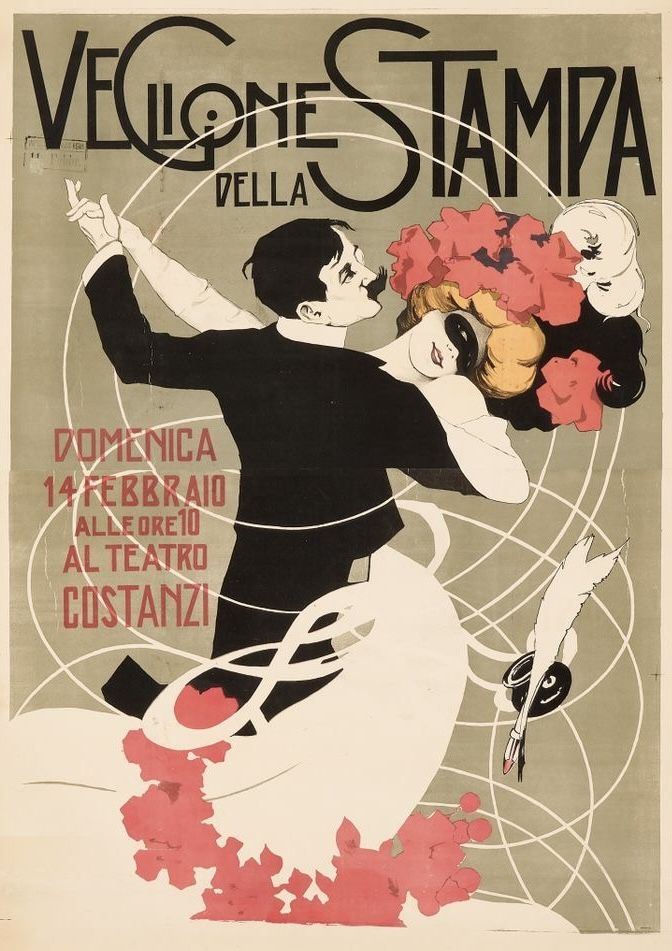
Veglione della Stampa
Anonymous
- Medium:
- Color lithograph
- Era:
- 1900-1920 (Ragtime/Early Jazz)
- Rights:
- Artist unrecorded; the work dates from before 1931 and is in the public domain in the United States.
- Recorded as:
- public_domain
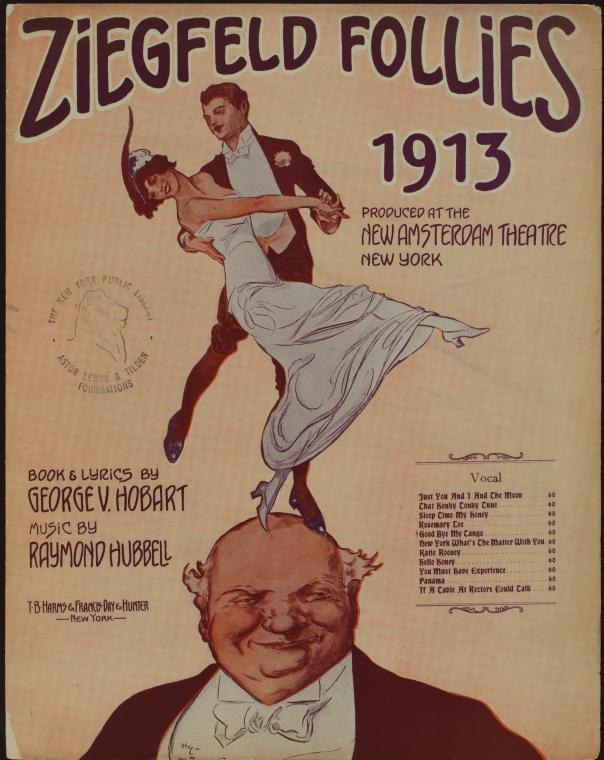
This poster documents the cultural status of ballroom dance at a specific historical moment—when the waltz remained the dance of formal high society and when the design of public space (the poster) could be devoted entirely to the aesthetic celebration of dance itself. For historians of dance, it offers visual evidence of how the ballroom couple was imagined and presented to the public in the early 1900s: as a model of elegance, mutual control, and joyful motion. For art historians, it exemplifies the use of dance as a central motif in Art Nouveau design, where the flowing line and the human body in motion became the organizing principle of visual composition.
What you are looking at
A dynamically composed Art Nouveau poster depicts an elegant couple in the moment of an exuberant waltz or ballroom dance. The man, dressed in formal black tailcoat and white shirt, leans back with his left arm raised high, his body weight thrown backward in a dramatic arch. The woman, in a flowing white gown with voluminous skirts, is caught mid-spin, her body angled upward and away from her partner. Her elaborate headdress—pale blonde or white hair piled high—and the cascading folds of her dress create a sense of weightless motion. The composition is framed by sweeping Art Nouveau curves and geometric line-work that echo and amplify the dancers' movement. Red flowers (likely peonies or roses) bloom abundantly around the couple's feet and burst through the composition, adding warmth and celebration to the scene. The background is a soft, neutral beige or cream tone that makes the figures and floral elements stand out with striking clarity.
The dancing
The pair are in a closed ballroom hold, though the dramatic lean suggests a moment of exuberant turn rather than a standard frame. The man's torso is deeply inclined backward, his left arm extended upward at shoulder height or higher—a gesture of confident leading and exhibition. The woman's upper body follows his line, creating a long diagonal from her extended leg through her torso to her raised arm. Her skirts fan outward with centrifugal force, indicating rapid rotational momentum. Both dancers have elongated, elegant proportions characteristic of Art Nouveau figuration, with the woman's posture showing the upward lift and extension expected in formal ballroom dance of the period.
The dance depicted
The image depicts social ballroom dancing, most likely the Waltz, given the closed hold, the whirling motion suggested by the woman's skirts, the formal evening dress, and the era. The Viennese Waltz or the standard Waltz (one-step triple-time rotation) were the dominant couple dances at press balls and formal events in early 20th-century Europe. The dramatic backward lean and the exuberance of the pose suggest the public exhibition version of ballroom dance—the kind performed at society events for an audience rather than purely recreational social dancing. The setting (a press ball in Turin) confirms this was an upper-class social dance in a metropolitan European context.
How it was made
This is a color lithograph, a technique that allowed for bold, flat areas of color and strong linear design—perfectly suited to Art Nouveau aesthetics. Lithography was a commercial printing method that permitted wide circulation of poster art to the urban public; a poster of this scale and quality (approximately 139 × 100 cm according to the record) would have been displayed publicly to advertise the event. The artist has used the properties of the medium—the ability to layer transparent color and to combine fine line-work with solid fills—to create dramatic contrast between the figures, the ornamental framing, and the floral elements. The technique enabled rapid reproduction and distribution, making this both an advertisement and a work of visual art.
About this work
This is an Art Nouveau poster advertising the Veglione della Stampa (Press Ball) in Turin, a high-society dance event of the early 20th century. It captures not merely the fact of ballroom dancing but the aesthetic and emotional experience of the waltz in its moment of fullest expression—the backward arch, the centrifugal swirl of the skirt, the mutual trust required of the couple. The work sits at the intersection of commercial poster design and fine art, using the formal language of the dance itself (symmetry, balance, rotational momentum) to organize the visual composition. The celebration of the dance as a subject reflects the cultural prestige of ballroom dancing in early 20th-century European society, when such events were major social rituals of the urban elite.
How to look at it
Attend first to the moment of the pose: the artist has chosen the instant of maximum extension and rotation, when both dancers' bodies are fully engaged in the turn. The backward arch of the man's torso is not accidental but a deliberate display of leading strength; the woman's upward line and the fan of her skirt show her responding to that lead with full participation. Notice how the Art Nouveau framing curves—the geometric spirals and waves in the background—mirror and amplify the dancers' own lines and momentum, making the design itself seem to spiral. The red flowers are not mere decoration but a visual echo of the energy and vitality of the dance itself. This is a poster designed to make the viewer want to attend the ball and to experience the feeling of that upward, outward, rotating motion.
The period
The early 20th century saw the waltz at the height of its cultural prestige in European society. The dance had been established as the dominant couple dance of the ballroom since the early 19th century, and by the 1900s it was the standard feature of formal balls, press events, and high-society gatherings. The rise of Art Nouveau (roughly 1890–1910) coincided with this period, and the movement's celebration of flowing, organic line and the human figure in motion made dance a natural subject. Posters became a major art form in this era, used to advertise everything from theater to social events, and the highest-quality poster artists treated the medium as a vehicle for serious visual innovation. Turin, an industrial and cultural center in northern Italy, hosted such society balls as markers of urban modernity and cosmopolitan taste.
Where it lives
The source record indicates this is a color lithograph, approximately 139 × 100 cm, held in an unrecorded collection and encountered through Pinterest. The work is an advertisement for a specific historical event—the Veglione della Stampa in Turin—making it both ephemeral commercial material and a designed object worthy of preservation.
Dance in this work
Questions about this work
What is a veglione?
Veglione is an Italian term for a masked ball or formal evening dance event, often held by social or professional organizations. The 'della Stampa' (of the Press) indicates this ball was organized by or for the press or newspaper industry of Turin. Such events were major social occasions for the urban elite and a venue for displaying fashionable dress and ballroom skill.
How do we know this is a waltz?
The closed ballroom hold (frame and hand position), the formal evening dress, the rotational motion suggested by the woman's skirts, and the historical context (a formal Italian press ball in the early 1900s) all point to the waltz as the most likely dance. The waltz was the standard ballroom dance of the era and the expected dance at such events. The dramatic three-quarter turn captured in the pose is characteristic of waltz movement.
Why are there flowers in a dance poster?
In Art Nouveau design, flowers and floral motifs were used symbolically to represent vitality, growth, and natural beauty. Here, the flowers may represent the celebration and festivity of the ball, but they also serve a formal design purpose: their curved, organic forms echo the curves of the dancers' bodies and the spiral framing, creating visual unity and reinforcing the sense of dynamic motion.
What can we learn about early 1900s ballroom dancing from this image?
The poster shows that ballroom dancing was a highly formal, partner-based activity performed by the educated urban elite in carefully dressed evening wear. The dramatic, extended posture of the dancers—especially the backward arch—suggests that the waltz was danced with full-bodied commitment and theatrical flair, not as a stiff or constrained movement. The fact that a major poster artist devoted this much design skill to advertising a ball demonstrates that ballroom dancing was considered an important cultural event worthy of serious artistic attention.
More dance artwork