47 works in this view — arrow keys or swipe to move between them.
Dance in Art
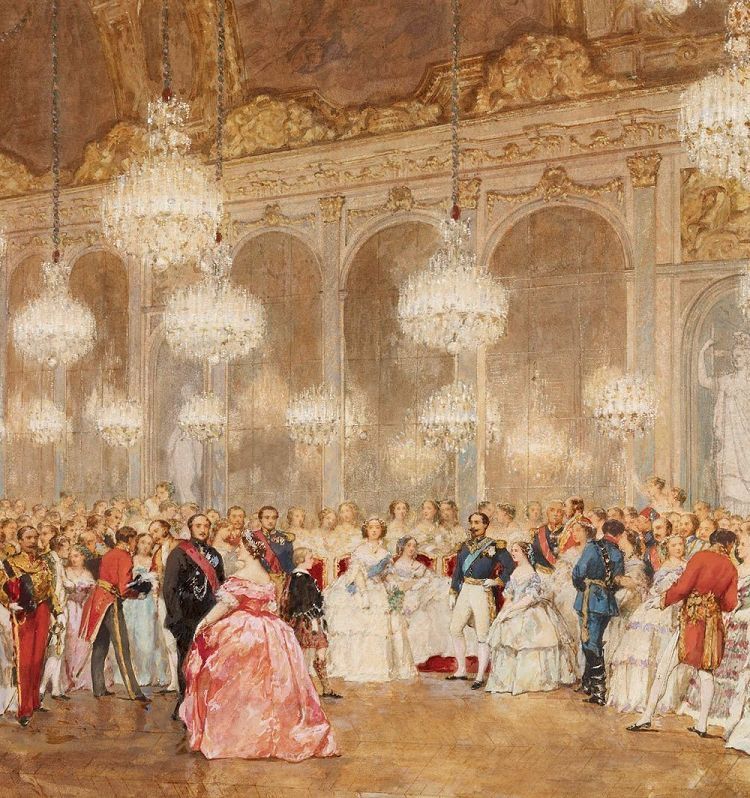
Court Ball
Eugène Lami (attributed)
- Medium:
- Watercolor
- Era:
- Mid 1800s (Polka Era)
- Rights:
- Attributed to Eugène Lami; the work dates from before 1931 and is in the public domain in the United States.
- Recorded as:
- public_domain
The work provides visual evidence of ballroom dress, spacing, and social protocol at the height of the French court's visual splendour—essential context for understanding how nineteenth-century waltz and quadrille were actually performed and staged. It also documents the painter's practice: court artists like Lami synthesised detail from many observations to create these panoramic records.
What you are looking at
A grand ballroom scene beneath soaring ornamental ceilings studded with crystal chandeliers that cast warm light across the gathered crowd. The room is lined with tall arched mirrors and elaborate gilt decoration, creating an impression of endless depth and luxury. Military officers in dress uniforms with decorations and sashes stand alongside civilians in evening wear. The women wear voluminous ball gowns in pale silks and satins, many with off-shoulder necklines and corseted waists; several sport flowers or feathers in their hair. The men are predominantly in dark tailcoats and white ties, though several officers wear full-dress military uniforms in red, blue, and gold. The floor is highly polished parquet. Couples and small groups are distributed throughout, some in active conversation or movement, creating the sense of a lively but orderly social event rather than choreographed performance.
The dancing
The bodies throughout the scene show the upright posture and formal bearing of ballroom etiquette. Several pairs appear to be in closed or semi-closed position suggesting partner dances—the nearest figures show the characteristic frame of nineteenth-century waltz or quadrille, with partners upright and at a composed distance. Most figures stand or walk rather than executing obvious footwork; the artist has captured conversation and social positioning rather than mid-movement moments. The weight distribution and carriage are uniform across the crowd: straight spines, composed arms, the formal restraint of court dress codes.
The dance depicted
This depicts a formal court ball of the Second Empire (1852–70), a social event centred on partner dances—principally the waltz and quadrille—performed by the nobility and haute bourgeoisie as both entertainment and courtship ritual. The image captures the social ballroom rather than a performance; dance here is participation by guests, not display. The composition shows the characteristic French court format: large ensemble, military and civil dress, mixed-gender conversation punctuated by dancing partners. The specific dances are not frozen in dramatic action but suggested through posture and spatial arrangement.
How it was made
Watercolour on paper, a medium well suited to capturing the luminosity of gaslit interiors and the translucency of silk and tulle. The artist has layered washes of warm ochre, pale gold, and cream to build the ornamental surfaces and reflected light, then added figures in more opaque pigment. This technique allows atmospheric depth and the impression of crowd without dense detail—faces and costumes are suggested rather than finished.
About this work
A watercolour record of formal ballroom society during the French Second Empire, depicting the ordered luxury of a court ball where dance was woven into courtship, politics, and social hierarchy. The painting captures the setting and participants rather than the dance itself—these are the moments between and around the formal figures. The work belongs to a large tradition of ballroom documentation by court painters, particularly popular under Napoleon III, where the visual spectacle of dress, architecture, and assembled power was itself the subject. For dance historians, it is less a record of technique than of context: the architecture that framed social dance, the costumes worn, the gender and class composition of ballroom society, and the integration of dance into state ceremony.
How to look at it
Attend to the ceiling and its chandeliers: these are the visual hero of the composition, and they anchor the impression of imperial luxury that frames the human figures. Note the distribution of uniform and dress throughout the crowd—military presence was not incidental to court balls but essential to their political meaning. Look at how few couples are shown in obvious dancing position; most are conversational or standing—this is accurate to ballroom life, where much of the evening was spent in social exchange between dances. The pale tonality and warm light are achieved through watercolour technique and create the feeling of gaslit interior rather than daylight.
The artist
Eugène Lami (1800–1890) was one of the most prolific documentarians of Parisian high society, court ceremonies, and fashionable life during the July Monarchy and Second Empire. He worked primarily in watercolour and lithography, combining fine detail with rapid execution to capture fashion, architecture, and social spectacle. His works were widely reproduced and collected. His style merged narrative detail with atmospheric breadth, making him a primary visual source for understanding nineteenth-century elite life.
The period
The Second Empire (1852–70) saw the waltz and quadrille at their zenith as both social and state ritual. Empress Eugénie presided over elaborate court balls that were as much diplomatic events as social occasions. This was the moment when the waltz—once controversial for its close partnering—had become the absolute norm of respectable ballroom culture, and quadrille remained the opening figure of the evening. Gaslit ballrooms with mirrors and chandeliers created an unprecedented visual spectacle. In art, ballroom scenes became a favoured genre for documenting contemporary life and the visual excess of the regime—comparable in function to fashion plates but with broader social content.
Where it lives
The catalogue record attributes the work to Eugène Lami; the attributing authority is not recorded. No holding collection or accession number is recorded; the source listed is Pinterest, indicating this is a reproduction of unknown current location. The watercolour format and subject suggest it may have been part of a collection of Lami's court studies or sold as a finished work to a private collector.
Dance in this work
Questions about this work
Is this a specific ball or a composite scene?
Most likely composite. Court painters like Lami attended many such events and synthesised them into representative scenes rather than recording one evening. The precision of architecture and dress suggests observation, but the perfect crowd composition and lighting suggest artistic arrangement. Without inscription or provenance, it cannot be tied to a specific date or event.
Why are there so many military uniforms?
Court balls were state occasions where military rank and hierarchy were visibly performed. Officers in dress uniform attended by right and by display; their presence signalled both the regime's military power and the aristocratic or official status of attendees. This was particularly true under Napoleon III.
More dance artwork