49 works in this view — arrow keys or swipe to move between them.
Dance in Art
An Elegant Evening
Victor Gabriel Gilbert
- Medium:
- Oil on canvas
- Era:
- Late 1800s (Victorian Ballroom)
- Rights:
- By Victor Gabriel Gilbert; the work dates from before 1931 and is in the public domain in the United States.
- Recorded as:
- public_domain
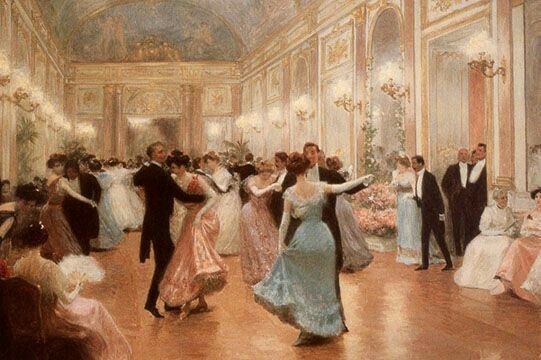
This work is essential evidence for how the waltz was actually performed and experienced in elite Parisian society at the turn of the 20th century. It shows the characteristic hold, the spatial relationships, the dress code, and the social context that transformed the waltz from a 19th-century innovation into an institution of respectability. For dance historians, it is one of the clearest visual records of Viennese Waltz technique in a real social setting rather than a theatrical one.
What you are looking at
A fashionable ballroom scene in full swing: couples waltz across a polished wooden floor beneath an ornate ceiling with gilt panels and frescoed lunettes. The room glows with warm lamplight from wall sconces. In the immediate foreground, a couple dominates—the woman in a flowing white gown with leg-of-mutton sleeves, her partner in black tailcoat—locked in the closed waltz hold, her skirt billowing from the turn. Around them, perhaps twenty other dancers in evening dress create a shimmer of movement: men in dark coats, women in pale or pastel silk gowns of the 1890s cut, their bodies inclined toward one another in the characteristic waltz posture. Scattered through the composition are bystanders in formal dress, some watching from the periphery, lending the scene the quality of a fashionable social gathering rather than a dance lesson or performance. The artist has captured the moment mid-movement, with figures at various phases of the waltz step, creating a sense of continuous elegant rotation.
The dancing
The focal couple exemplifies the waltz hold of the period: the man's right hand at the woman's back, their left hands clasped at shoulder height, bodies angled and leaning slightly into the turn. The woman's substantial skirts register the rotational momentum. Across the floor, other couples maintain the same closed frame, their inclination and arm positions consistent with the Viennese waltz technique of the era. Bodies are upright, weight forward, the frame closed and controlled. The artist demonstrates clear understanding of the ballroom waltz as a partnered, rotating dance requiring balance and coordination between partners.
The dance depicted
This is unmistakably a waltz scene, almost certainly the Viennese Waltz that dominated European ballrooms in the 1890s. The closed hold, the continuous three-beat rotation, the formal dress, and the ballroom setting leave no doubt. The waltz was the presiding dance of respectable society in this period—the only dance in which couples held each other in a closed position, which made it both thrilling and controversial. The artist captures it at its social and cultural peak, the moment when it was the principal marker of fashionable courtship and elite leisure.
How it was made
Oil on canvas, rendered in the academic Salon style of late 19th-century France. The artist has built the composition with careful atmospheric perspective: the foreground couple sharp and luminous, the middle-ground dancers slightly softer, the far wall and ceiling dissolved into warm golden tones. This technique creates depth and movement simultaneously—the eye reads the scene as a flowing, continuous space. The painting is finished with high technical facility, particularly in the rendering of fabrics: the shine on men's coat-tails, the translucency and weight of women's silk and tulle. This was the language of the Paris Salon, designed for a bourgeois audience of collectors and exhibition-goers familiar with both ballroom dance and academic painting.
About this work
This is a Belle Époque ballroom scene depicting the Viennese Waltz at the height of its dominance in European high society. Created by Victor Gabriel Gilbert, a painter celebrated for his scenes of Parisian social life, the work captures a moment of choreographed courtship in one of Paris's grand salons—a space where dance functioned as both entertainment and a carefully regulated form of intimate social contact between men and women. The painting exemplifies how dance operated as a subject for academic art in the 1890s: not as spectacle or performance, but as a marker of elegance, modernity, and social standing. For historians of dance, it is a vivid document of how the waltz was danced, dressed, and understood at the very peak of its cultural authority.
How to look at it
Attend first to the hold and posture of the foreground couple: note how the man's frame supports the woman's body; how their heads are positioned; the way the woman's weight flows into the turn and billows her skirt. Then track the rhythm across the floor—see how every couple maintains the same frame and angle, creating a visual pattern that reads as the three-beat waltz rhythm itself translated into space. Notice the artist's choice to paint the moment mid-rotation, with bodies leaning and skirts flying, rather than an upright stance. Finally, observe the composition: the foreground couple is highest in value and sharpest, while the background couples dissolve into golden shadow, a technique that uses the waltz's circular motion to pull the eye into deep space.
The artist
Victor Gabriel Gilbert (1847–1933) was a French painter and regular exhibitor at the Paris Salon who specialized in scenes of contemporary urban life. He was particularly known for paintings of Parisian markets, shops, and the everyday social world of the middle classes. His work belonged to the academic tradition but with a strong interest in capturing contemporary costume, gesture, and social detail—the visual ethnography of modern Paris. His dance scenes, like this ballroom, were part of his broader project of documenting the leisure and social rituals of his moment.
The period
The 1890s were the absolute zenith of the Viennese Waltz in European society. By this date, the waltz—once shocking for its close partnership—had become the emblem of respectability and modernity, the dominant dance of the Parisian beau monde and other European capitals. Simultaneously, this was the era of the Moulin Rouge and the rise of theatrical dance as a separate category (cancan, ballet, music-hall spectacle); the academic ballroom represented a parallel but distinct dance culture—private, intimate, and rigorously coded. In painting, scenes of contemporary social life, including dance, were a major Salon category, reflecting bourgeois interest in images of their own world.
Where it lives
The work is recorded as oil on canvas, date and current location unknown, accessed via Pinterest. This suggests a painting of Salon quality intended for private collection or exhibition sale, likely owned by a Parisian or European collector of contemporary art.
Dance in this work
Questions about this work
What is the difference between this waltz and other dances shown at the time?
The closed hold visible here was unique to the waltz and some waltzes' cousins like the Viennese Waltz. Most other ballroom dances of the era (quadrille, lancers, cotillion) used open or side-by-side positions. The waltz's close partnership made it both fashionable and controversial—it was the dance of intimate courtship, which is why it appears in scenes of romance and flirtation.
How do I know this is the 1890s and not earlier or later?
The women's dresses are the primary evidence: the leg-of-mutton sleeves (full at the shoulder, fitted at the forearm), the high collars, and the silhouette of the skirts are characteristic of the 1890s, particularly the latter part of the decade. The men's tailcoats are standard evening wear across a longer period, but the overall palette, lighting, and painting technique point to the 1890s Salon aesthetic.
Were real ballrooms decorated like this?
Yes. The grand salons of the Paris Opéra, wealthy private homes, and fashionable hotels featured exactly this kind of ornamental ceiling, gilded paneling, and wall sconces. The artist has painted a plausible setting for a ball in the Parisian haute monde.
What was the waltz's social meaning at this moment?
By the 1890s, the waltz had become the principal dance of courtship and respectability among the European upper and upper-middle classes. Its close partnership was no longer shocking but rather the emblem of proper modern society—in sharp contrast to the theatrical dances (like the cancan) that were simultaneously thrilling Paris's entertainment venues. This painting shows the waltz as the dance of 'society,' not entertainment.
More dance artwork