28 works in this view — arrow keys or swipe to move between them.
Dance in Art
Caroso — Dance Plate (plate 2)
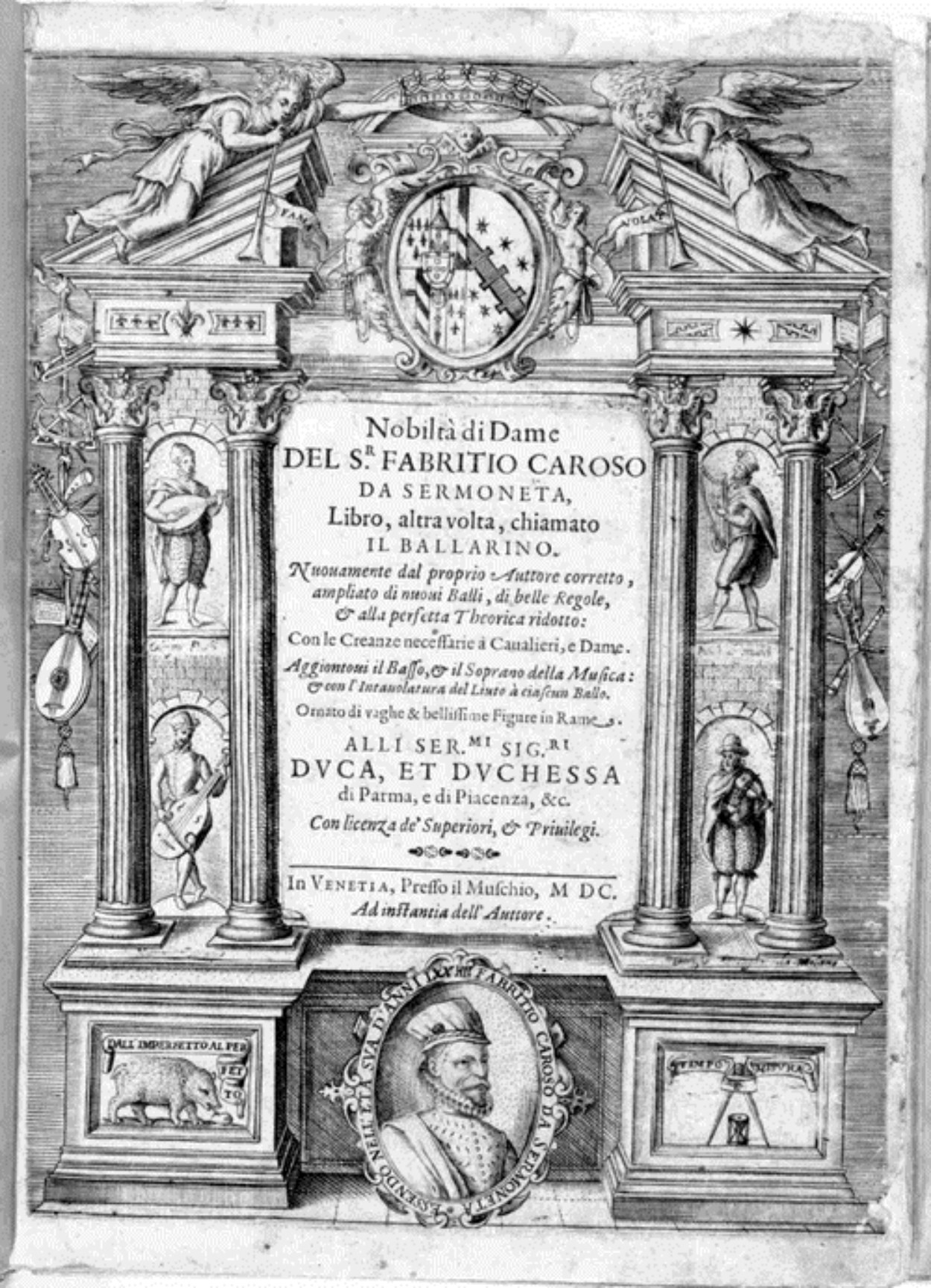
Fabritio Caroso da Sermoneta
- Medium:
- Woodcut
- Dance:
- Notation/Choreography
- Era:
- Pre-1700 (Renaissance/Baroque)
- Collection:
- Il Ballarino (1581)
- Source:
- Library of Congress
- Rights:
- Public domain — free to use, share and adapt.
- Recorded as:
- Public Domain
*Il Ballarino* was the first comprehensive printed codification of European court dance, and Caroso's illustrated plates are among the earliest systematic visual records of dance technique and costume in print. For dancers and dance historians, these images are primary sources for understanding Renaissance choreography, body mechanics, dress, and the social context of courtly movement. This particular plate demonstrates how dance was being professionalized and standardized in the late 16th century, moving from oral transmission to printed notation and illustration.
What you are looking at
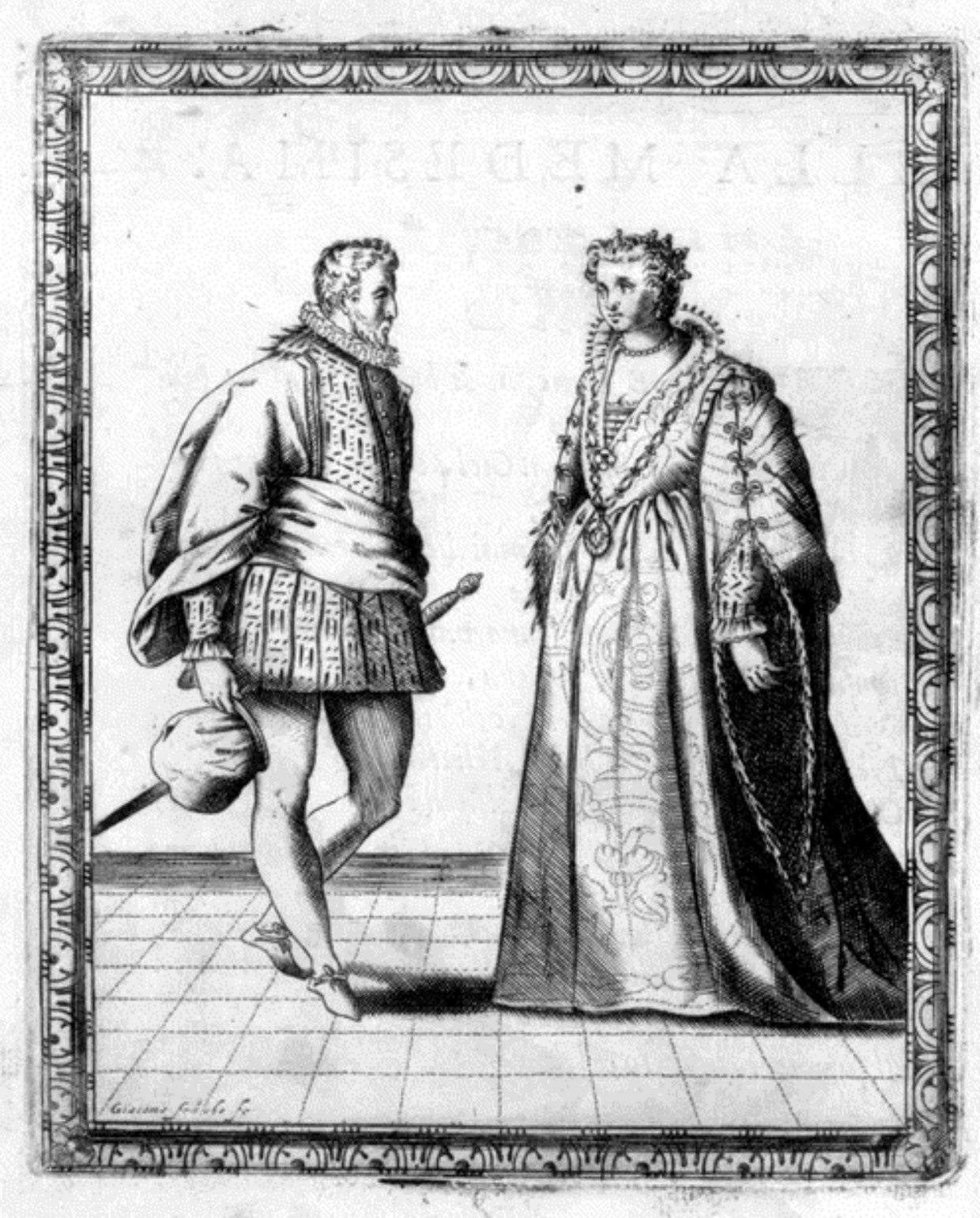
A woodcut from Caroso's *Il Ballarino* depicts a Renaissance Italian court couple in formal dance position. The man stands at left in three-quarter view, wearing a richly embroidered doublet with vertical pleating at the waist, a short cape draped over one shoulder, and hose; he holds a plumed hat in one hand and gestures with the other in an open, courtly manner. The woman at right faces him in a long gown with elaborate patterning, a high collar, and a dark-patterned overgown or robe with fur trim draped across her shoulders; she wears a pearl necklace and her hair is bound up in the fashion of the period. Both figures stand on a simple tiled floor against a plain background, framed by an ornate classical border. The composition presents them as a teaching example: formal, still, and positioned to show the costume and bearing expected of noble dancers.
The dancing
The couple are separated by a modest distance rather than in closed contact. The man's posture is open and declarative, with one arm extended in a gesture of address or invitation; his weight appears centered and his stance is confident. The woman stands more formally upright, her body frontal and composed, her arms at her sides or loosely positioned. There is no physical connection between them—this is a presentation of how the bodies should be held and presented rather than a snapshot of movement in progress. The engraver has prioritized clarity of costume and courtly bearing over the capture of a specific step or moment of contact.
The dance depicted
This is almost certainly a *pavane* or *galliard*, the foundational couple dances of the Italian Renaissance court that Caroso catalogued in detail. *Il Ballarino* (1581) was a systematic notation of the steps and patterns of these dances, and such plates served as visual reference for the posture and dress expected of dancers. The image emphasizes stillness and decorum rather than action—it functions as a model of how dancers should present themselves between steps or at the opening of a dance. The couple's separation and formal facing positions are typical of Renaissance dance photography of court choreography, where stateliness and symmetry of presentation were paramount values.
How it was made
This is a woodcut, a relief-printing technique that allowed for mass circulation of instructional images. Woodcut lines are direct and bold, making the ornament and pleating of the costumes legible even at small scale; the medium favors clear silhouettes and strong contrasts over fine gradation. The ornate border suggests this was an expensive, prestigious publication intended for a noble or educated audience. Woodcut's accessibility—cheaper than engraving, faster to produce, durable in the press—made *Il Ballarino* far more widely circulated than a manuscript could have been, enabling its influence on dance practice across Italy and beyond.
About this work
This plate from the first printed Italian dance manual of the Renaissance presents two noble dancers in formal court dress, positioned as a visual teaching example rather than caught mid-movement. Caroso's *Il Ballarino* (Venice, 1581) was revolutionary in its attempt to notate and standardize the steps and patterns of court dances—pavanes, galliards, and others—that defined the social practice of the Renaissance aristocracy. The woodcut serves a pedagogical function: it shows how the body should be held and presented, how the costume should look, and what nobility of bearing the dancer was expected to embody. For historians and dancers, this image is invaluable evidence of what Renaissance court dancers actually wore, how they positioned themselves, and how a foundational European dance tradition was documented and disseminated at the moment of print.
How to look at it
Look first at the costume: the man's doublet is constructed to show verticality and lift, with deep pleating and careful tailoring that suggests how the body should be held—chest forward, posture erect. The woman's gown is designed to move in flowing planes, and the overgown draped across her shoulders adds weight and visual richness without compromising the vertical line. Notice how the artist has positioned the couple not facing one another in intimacy but rather both turned slightly outward, as if performing for an audience—this was the actual convention of Renaissance court dance, which was as much display as it was romantic encounter. The formal spacing and stillness of the figures reflect the pedagogical purpose: this is instruction, not narrative.
The artist
Fabritio Caroso da Sermoneta (c. 1526–c. 1605) was an Italian dancing master, choreographer, and author active in Rome. He was among the most celebrated and respected dance masters of the Renaissance, renowned for his knowledge of the dances of the Italian court and his ability to compose new choreographies. *Il Ballarino* (1581) was his masterwork—a lavishly illustrated manual that presented dances with remarkable precision, using both written description and woodcut plates to convey steps, patterns, and the proper deportment of dancers. The work was so successful that Caroso published an expanded version, *Nobiltà di Dame*, in 1600. His systematic approach to dance instruction influenced European dance practice for generations.
The period
In the late 16th century, dance was undergoing rapid professionalization and codification across Europe. The Renaissance court had elevated dance from entertainment to an essential accomplishment of nobility, and the growth of printing made it possible to standardize and disseminate choreography beyond the reach of a single master's students. *Il Ballarino* appeared at a pivotal moment: it was among the earliest attempts to capture in print what had previously been transmitted only through live teaching and imitation. The 1580s saw an explosion of interest in Italian dance forms—the pavane and galliard in particular—and a corresponding flood of manuals and treatises. Caroso's work stood out for its visual sophistication and systematic completeness, establishing a model for dance instruction that would persist well into the 17th century.
Where it lives
This woodcut plate is from *Il Ballarino* (Venice: Antonio Gardano, 1581), the first printed Italian dance manual. It is part of the Library of Congress collection and represents one of the most important surviving documents of Renaissance dance practice.
Dance in this work
Questions about this work
What is a pavane, and is that what these two are doing?
A pavane is a stately, processional couple dance in duple meter, popular in Renaissance courts; a galliard is its faster, more athletic complement, featuring jumps and turns. Both were central to *Il Ballarino*'s curriculum. This particular plate does not show them mid-step but rather presents the formal bearing and dress expected of dancers—a visual model of deportment rather than a moment of action.
Why are the dancers not touching?
Renaissance dances often featured separated sections where partners moved independently or at a distance before coming together. But more importantly, this plate is designed as a teaching image to show costume, posture, and the noble presentation of the body. Caroso used such plates to establish a visual standard for how dancers should carry themselves.
Why was this book printed rather than handwritten?
Printing made Caroso's knowledge reproducible and widely available, transforming dance from a skill transmitted only through direct apprenticeship to one that could be studied from a book. Woodcut illustration allowed for quick, legible depiction of costume and bearing across multiple copies. This democratization of dance instruction was revolutionary in the 1580s.
What do the clothes tell us about Renaissance dance?
The elaborate embroidery, pleating, and layering show that Renaissance dancers wore formal court dress—heavy, structured garments that required a particular carriage and deportment. The male figure's vertical pleating and the female figure's long, columnar gown both encouraged and required an upright, dignified posture. Dance and fashion were inseparable in the aristocratic world Caroso served.
More Notation/Choreography artwork