31 works in this view — arrow keys or swipe to move between them.
Dance in Art
Caroso — Dance Plate (plate 5)
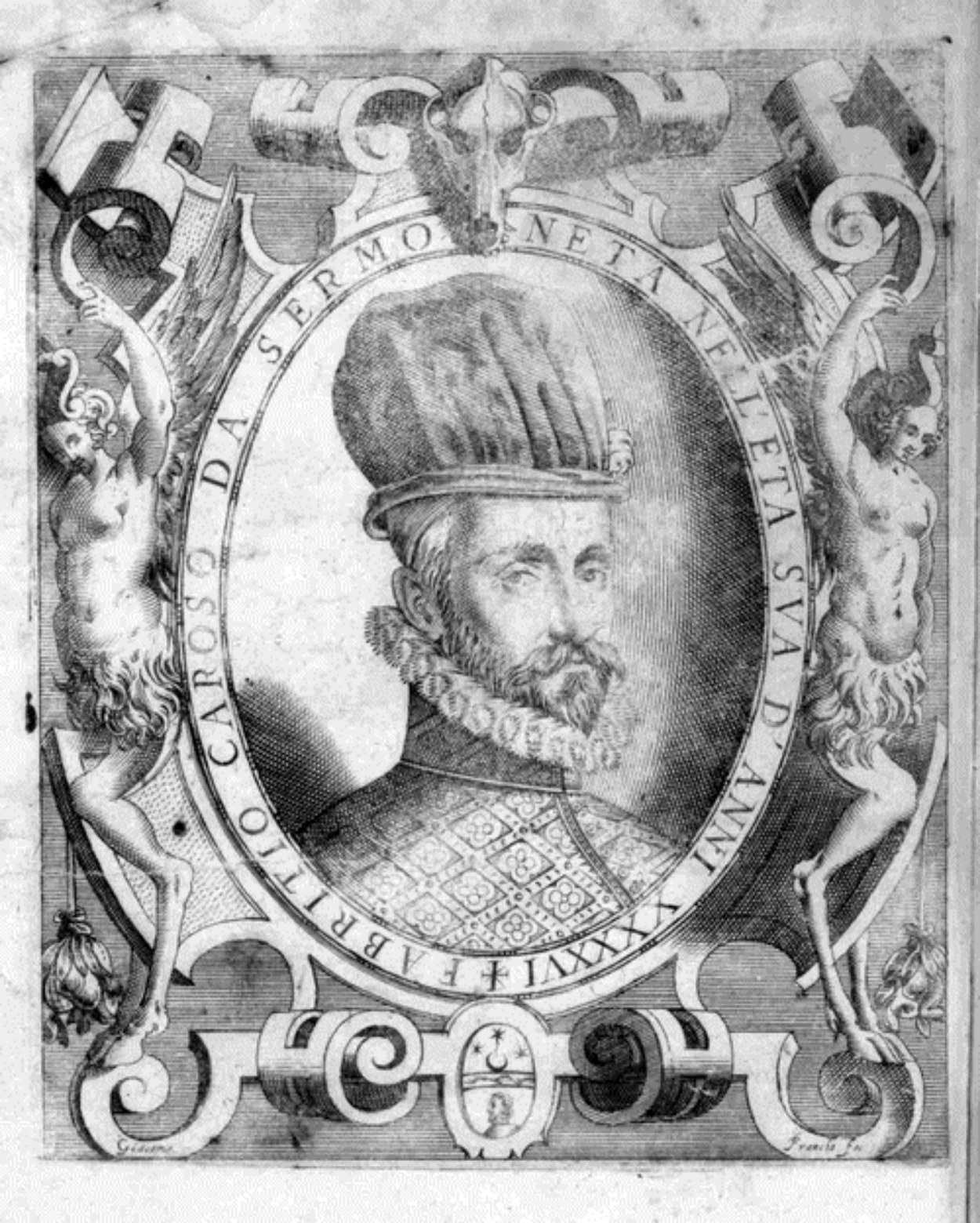
Fabritio Caroso da Sermoneta
- Medium:
- Woodcut
- Dance:
- Notation/Choreography
- Era:
- Pre-1700 (Renaissance/Baroque)
- Collection:
- Il Ballarino (1581)
- Source:
- Library of Congress
- Rights:
- Public domain — free to use, share and adapt.
- Recorded as:
- Public Domain
This is one of the earliest systematically published images of dance technique and remains among the most detailed surviving records of Renaissance Italian court dance as actually performed. Caroso's plates are the visual equivalent of musical notation—they codified movements that would otherwise have vanished, and they established the principle that dance could be documented in print and transmitted across space and time.
What you are looking at
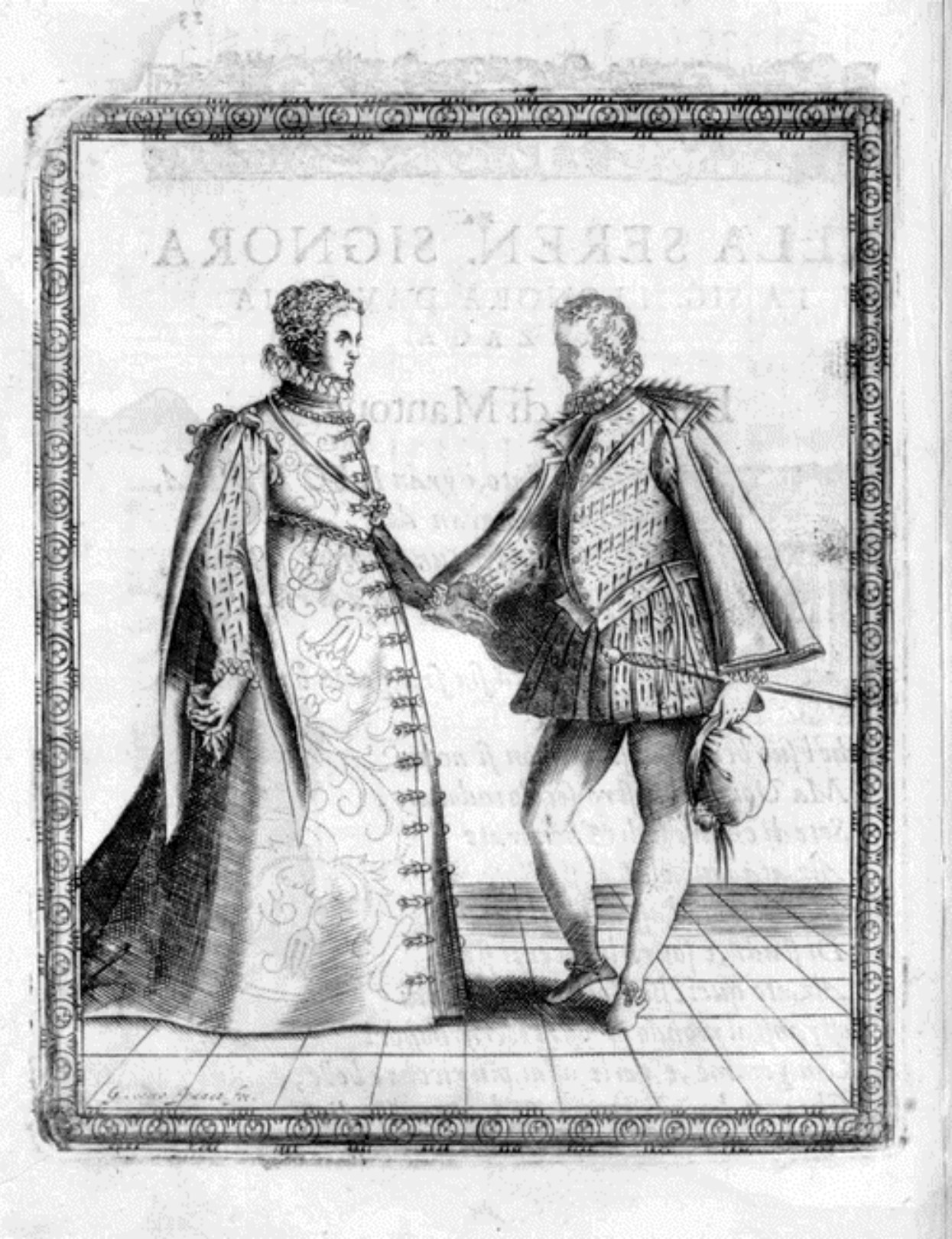
A man and woman in elaborate Renaissance court dress stand facing each other in formal encounter, their hands joined in a gesture of courtship or salutation. The woman wears a floor-length gown with ornate embroidered decoration down the front and a high collar; a voluminous cape lined with geometric patterning drapes from her shoulders. The man wears a short doublet with decorative armor-like plating across the chest, puffed breeches to mid-thigh, and a similarly patterned cape. Both figures have curled hair in the fashion of late-sixteenth-century Italy. The setting is a bare interior with a tiled floor rendered in perspective; the background is plain, drawing all attention to the figures and their formal posture. The woodcut medium renders the figures in sharp black lines against white, with fine cross-hatching establishing volume and fabric texture. The ornamental border frames the composition as a print page.
The dancing
The two dancers stand at a slight angle to one another, bodies upright and composed. Their hands meet at approximately waist height in what appears to be a right-hand grasp or joining—a fundamental position in Renaissance courtly dance. Both figures maintain an erect carriage with weight evenly distributed; neither shows the flexed knee or forward lean that would indicate active motion. The gesture suggests the opening or closing moment of an encounter rather than mid-movement; the formal, deliberate quality of their stance indicates this is a position to be held and demonstrated rather than a snapshot of dynamic action.
The dance depicted
This plate illustrates one of the dances catalogued in Caroso's *Il Ballarino*, the most comprehensive manual of Italian Renaissance dance technique. The joined-hands position and formal facing arrangement are characteristic of the *basse danse* or *pavane*—stately processional dances that formed the foundation of courtly repertoire. The couple's upright frame and measured spacing suggest the kind of patterned, geometric movement that Caroso documented in choreographic notation. This is not performance captured in motion but rather a teaching image: the figures demonstrate a specific position that dancers would hold, recognize, and replicate from the printed page.
How it was made
This is a woodcut, a relief-printing technique in which an image is carved into the surface of a wooden block; ink is rolled across the raised surface and transfers to paper. Woodcut allowed for the bold, clear lines and high contrast visible here—essential for legibility in a printed manual meant to be read by students at a distance. The technique also permitted fine parallel lines (hatching) to suggest fabric folds and the shine of embroidered surfaces. As a page from *Il Ballarino*, this woodcut was reproduced in multiple copies, making it the first widely circulated, standardized image of Italian court dance technique—a crucial development in the transmission of dance knowledge before film or photography.
About this work
This is one of thirteen woodcut plates from Fabrizio Caroso's *Il Ballarino* (Venice, 1581), the most influential dance manual of the Italian Renaissance. Rather than depicting spontaneous movement, it functions as a teaching image: the couple demonstrates a formal position that would be held, named, and practiced by courtiers learning fashionable dances. The plate is both art and instructional document—a visual score in an era when printed choreography was revolutionary.
Caroso's manual transformed dance from an oral tradition into a recorded, reproducible practice. The woodcuts are not merely illustrations but integral to the text: they show precisely how the body should be positioned, how capes and skirts should drape, how partners should relate in space. For a dancer or historian, these plates are primary evidence of sixteenth-century Italian technique, decorum, and the relationship between the body and courtly dress.
How to look at it
This is a teaching image rather than a narrative scene, so look for the position being demonstrated rather than the progression of movement. Notice the precise alignment of the bodies—the way neither figure leans, how their feet are planted, how the hands meet. The elaborate dress is not merely decorative; it is integral to the dance—capes drape in particular ways, skirts had specific weights and fabrics that shaped movement. The flat background and formal framing create the effect of a dance position held for inspection, much as a fencer's lunge or a rider's seat might be illustrated in a contemporary manual. The woodcut technique ensures maximum clarity: every line is purposeful, nothing is accidental. This is dance reduced to essential geometry.
The artist
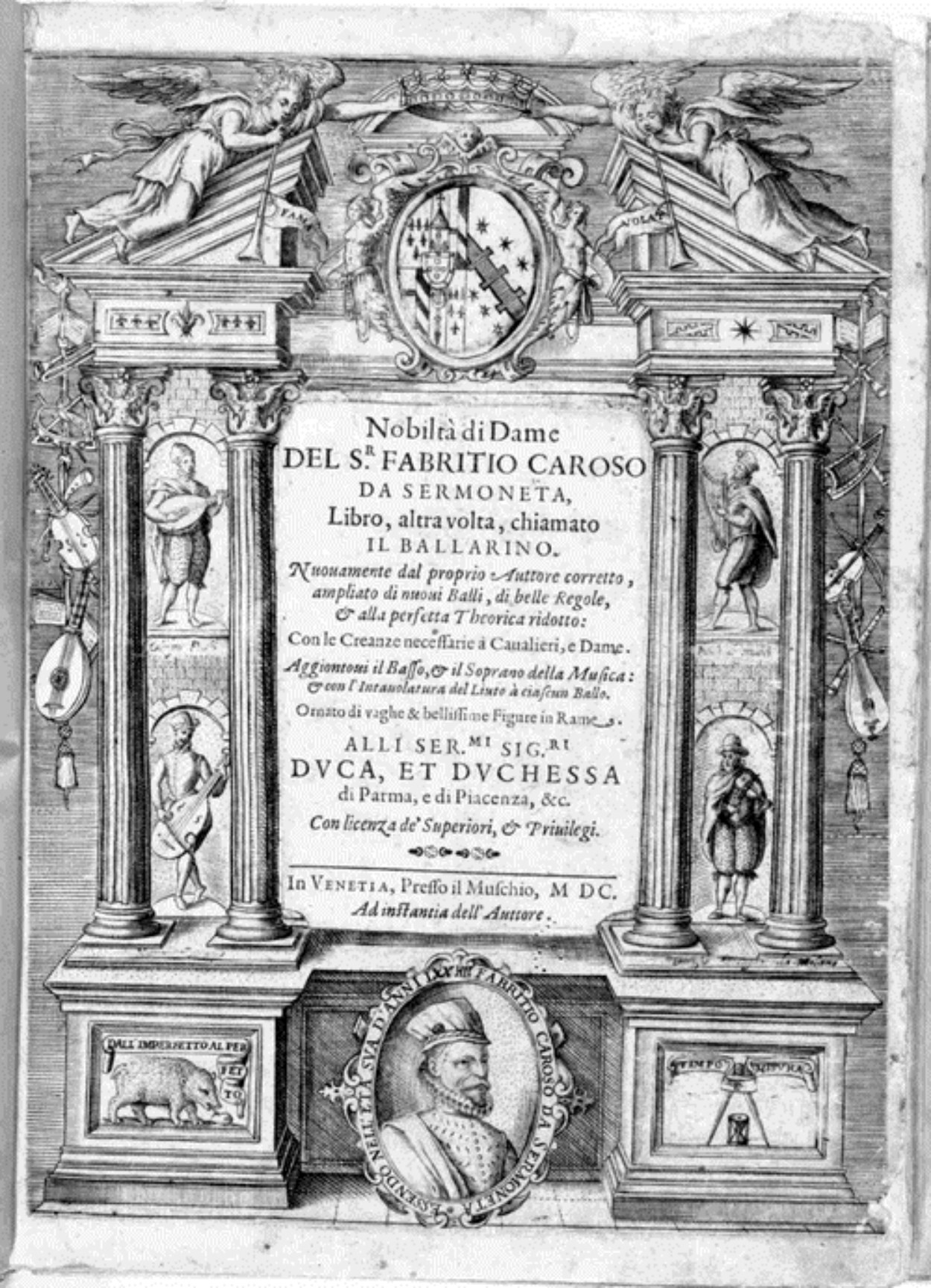
Fabrizio Caroso da Sermoneta (c. 1535–after 1605) was a virtuoso dancer and choreographer active in late-Renaissance Rome and Venice. *Il Ballarino* was published in Venice in 1581 and reissued in an expanded edition as *Nobiltà di dame* in 1600. Caroso's manuals were the most comprehensive and methodical dance treatises of their era, combining notation, written description, and woodcut illustration. He synthesized the ornamental vocabulary of *basse danse*, *pavane*, *galliard*, and *volta* into a coherent system teachable to the nobility. His work was known across Europe and influenced courtly practice for decades after publication.
The period
In the 1580s, Italian courtly dance was at the height of its formal elaboration. The Renaissance court valued dance as a marker of gentility, grace, and control—qualities demonstrated through precise, measured movement and perfect partner coordination. The ability to dance fashionably was essential to social standing, and professional dancing masters like Caroso commanded high fees to teach the nobility. Printing had recently made possible the wide distribution of technical instruction; before this, dance knowledge had been transmitted orally and through long apprenticeship. Caroso's *Il Ballarino* arrived at a moment when both dance technique and print technology were mature enough to meet: it was the first dance manual to combine detailed verbal description, choreographic notation, and realistic figurative illustration. In art, the late Renaissance was moving toward more naturalistic representation of the human body, yet this plate maintains the formal, diagrammatic quality essential to its function as a teaching tool.
Where it lives
This is a woodcut plate from *Il Ballarino*, published by the Venetian printer Girolamo Scotto in 1581. The source listed (Library of Congress) indicates this impression is held in a public collection. The plate is one of thirteen illustrations of couple dances distributed throughout the manual's text.
Dance in this work
Questions about this work
What dance are they doing?
The manual does not label this single plate with a dance name. The position—two figures standing upright, hands joined, in formal facing arrangement—is consistent with the opening or closing posture of stately Renaissance dances such as the pavane or basse danse. Caroso's text would identify which choreography this belongs to, but the image alone shows a position to be learned and held rather than a continuous sequence.
Why is the background empty?
An empty background focuses attention entirely on the body position and the relationship between the two dancers. This is a deliberate pedagogical choice: a teaching image should eliminate distraction. It also reflects the convention of Renaissance instructional prints, which often used blank space to make the subject legible and reproducible.
Is this what Renaissance dancing actually looked like?
This shows the opening or closing frame of a dance, or a position held during the dance. Real performance would involve flowing transitions between such positions, changes of direction, and intricate footwork. Caroso's other plates show more dynamic attitudes—turned bodies, raised arms—that suggest movement progression. This plate, static and formal, represents a stopping point in the dance sequence.
Could a modern dancer learn from this?
Yes, but with limits. The plate shows posture, spacing, and hand position clearly. Caroso's written text and notation system in the manual provide footwork patterns and timing. Together, the text and images have been used by modern researchers and historically informed dancers to reconstruct Renaissance dances with reasonable fidelity. The image alone is a valuable document; the manual as a whole is a workable reconstruction source.
More Notation/Choreography artwork