34 works in this view — arrow keys or swipe to move between them.
Dance in Art
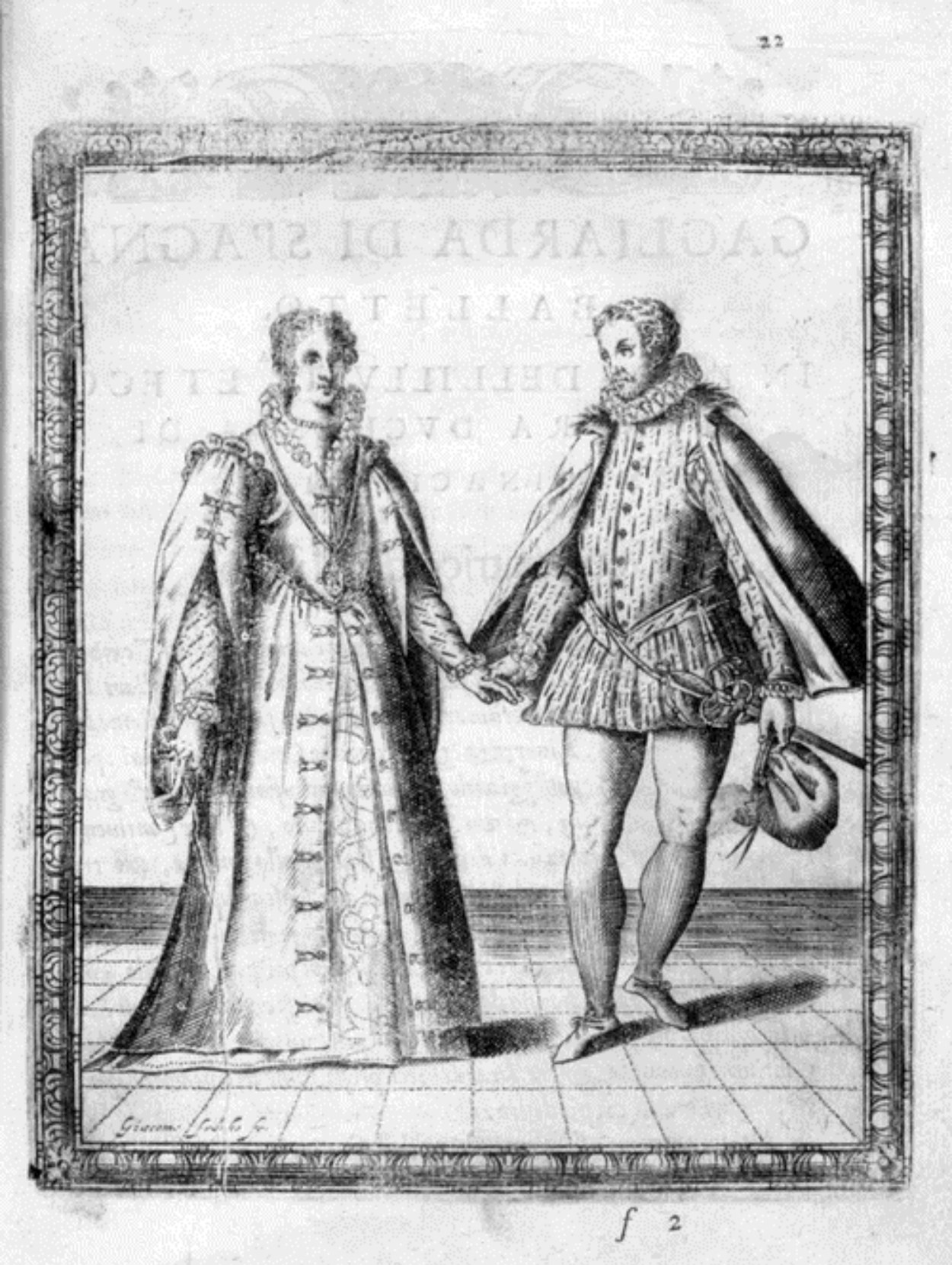
Caroso — Dance Plate (plate 8)
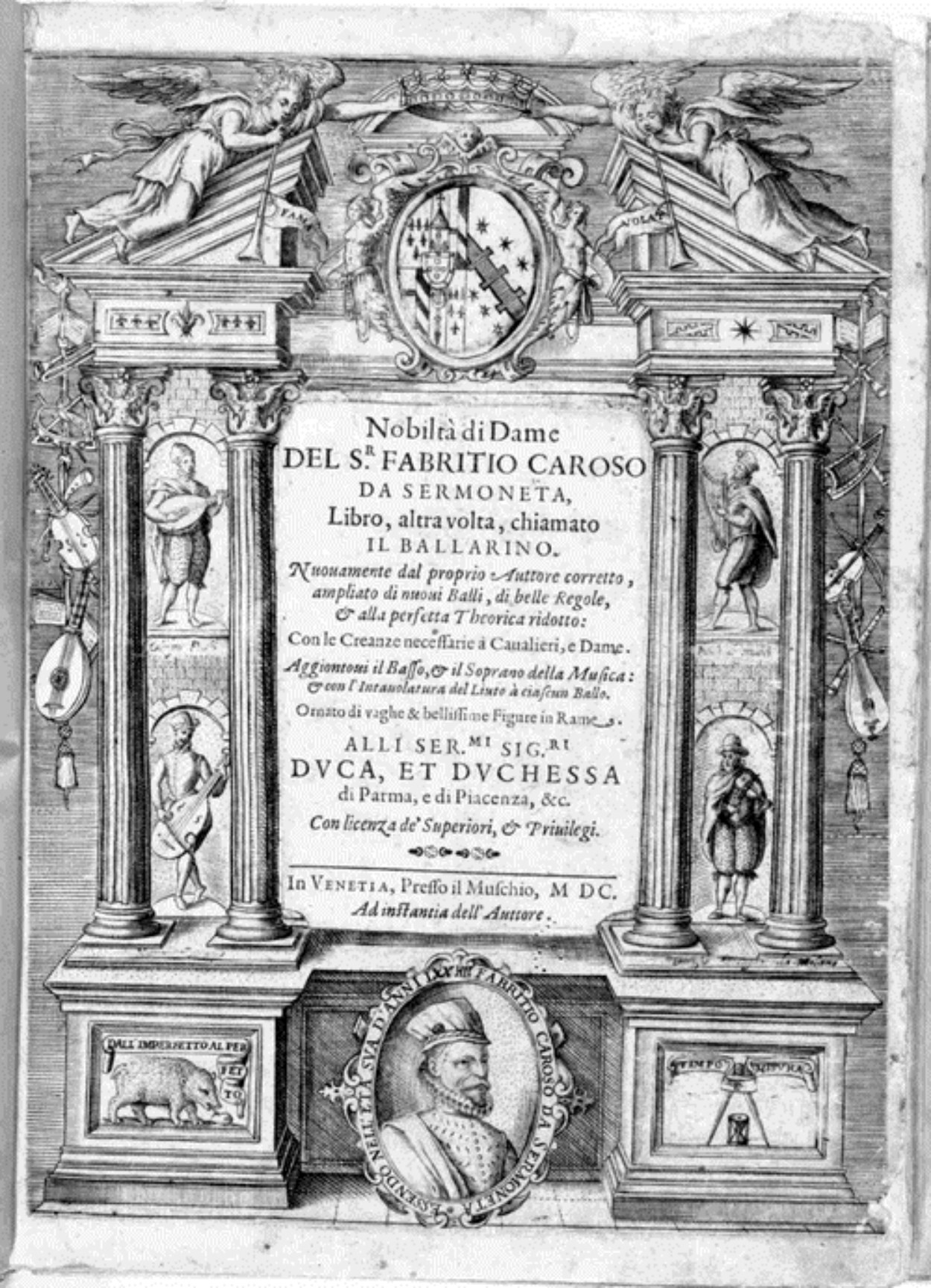
Fabritio Caroso da Sermoneta
- Medium:
- Woodcut
- Dance:
- Notation/Choreography
- Era:
- Pre-1700 (Renaissance/Baroque)
- Collection:
- Il Ballarino (1581)
- Source:
- Library of Congress
- Rights:
- Public domain — free to use, share and adapt.
- Recorded as:
- Public Domain
Caroso's *Il Ballarino* is one of only two surviving dance manuals detailed enough to permit reconstruction of Renaissance court dance; without this plate and others like it, we would have no concrete knowledge of how these dances were actually performed or what they looked like. The costume detail and formal composition show what Renaissance dancers understood as correct posture, hold, and courtly presentation—information that shapes how contemporary dancers and historians interpret the period. This single plate has been reproduced and studied thousands of times; it is perhaps the most widely circulated image of Renaissance dance.
What you are looking at
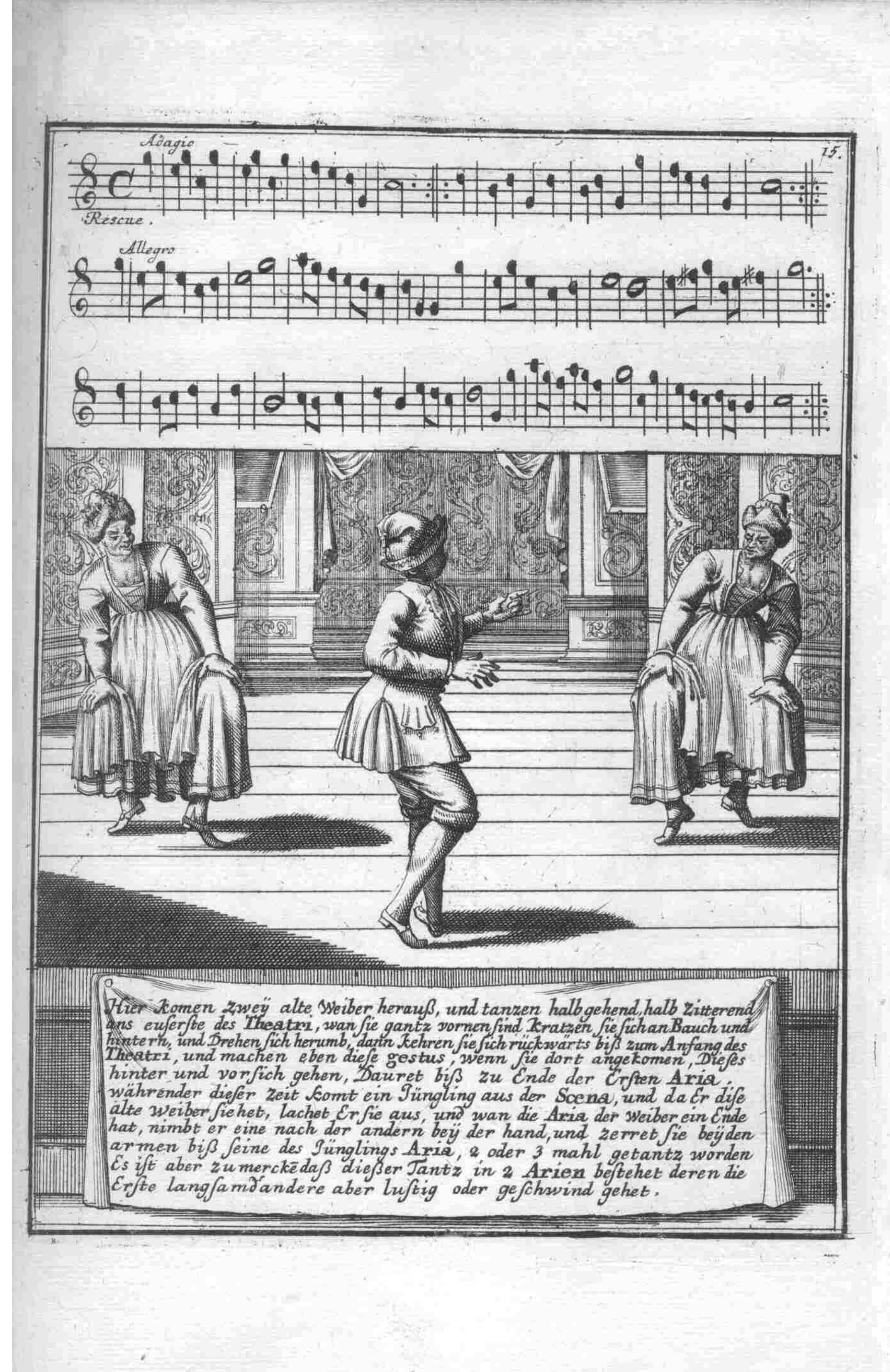
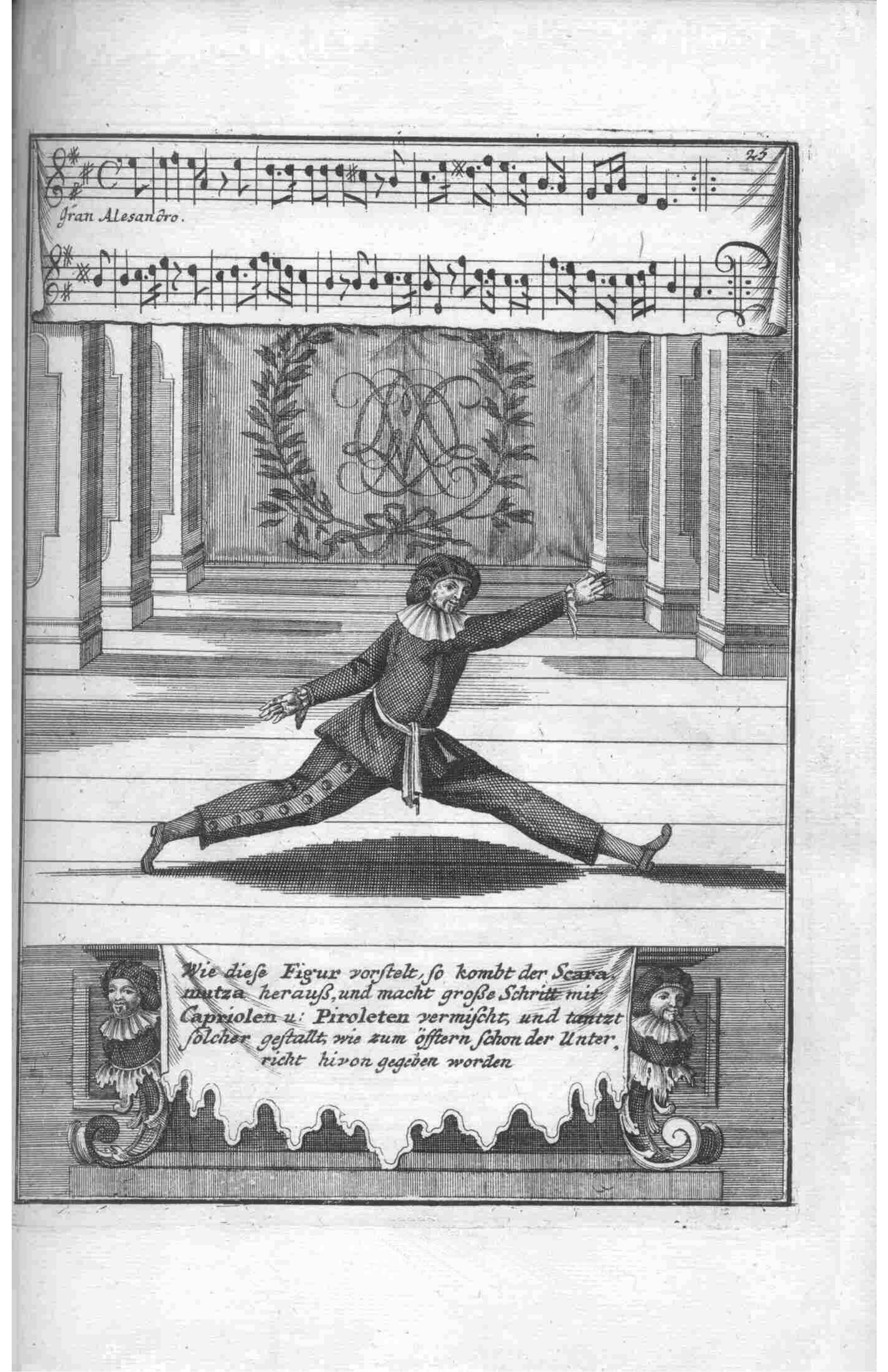
A woodcut plate showing two figures in elaborate Renaissance Italian court dress, standing face-to-face and holding hands in a formal gesture. The figure on the left wears a long gown with puffed sleeves and an ornate jeweled necklace, the skirt falling in stiff folds to the ground and detailed with vertical button or ornament closures down the front. The figure on the right wears a doublet and hose, with a short draped cloak or cape, the legs bare and the stance upright and formal. Both figures are rendered in sharp black ink against a plain background, with a decorative Renaissance-style border frame. The style and composition are characteristic of an instructional woodcut, presenting the figures as exemplars of courtly deportment rather than captured mid-movement. The gridded floor beneath them suggests a ballroom or formal dance space.
The dancing
The two figures stand upright in symmetrical poses, meeting at roughly the center of the frame, hands joined at waist height in what appears to be an opening or presentation gesture rather than a dynamic dance position. Neither figure shows weight shift, flexed knees, or the dynamic tension of active movement—both are posed as still displays of courtly bearing. The man's posture is rigid and frontal, while the woman's elongated silhouette emphasizes the formal line of Renaissance fashion. Their relative height and the stylization suggest these are idealized models of courtly propriety rather than naturalistic dancers captured mid-step.
The dance depicted
This plate documents one of the dances catalogued in Caroso's *Il Ballarino*, the definitive manual of late-16th-century Italian court dance. The hand-hold and upright posture are consistent with the opening position of a pavane or galliard—the foundational court dances of the Renaissance. The woodcut format and pedagogical purpose indicate this is a reference image for instruction rather than a narrative record of performance; the stillness is intentional, freezing the dancers in a moment of formal presentation that a reader could study and recreate. Caroso's manual established the dances of the Venetian and Italian courts as the standard of courtly accomplishment across Europe.
How it was made
This is a woodcut, a relief-printing process in which an image is carved into the surface of a wooden block, with the raised lines and planes then inked and printed. The technique produces the crisp, high-contrast black lines and areas characteristic of the image—note the precise rendering of the costume details, the decorative border, and the gridded floor. Woodcut was the dominant method of reproducing images in Renaissance printed books and allowed for mass circulation; this plate would have been printed as part of the bound *Il Ballarino* and seen by the educated courtiers and dancers across Italy and beyond who could afford the book. The medium's directness and clarity made it ideal for instructional material.
About this work
This is a pedagogical woodcut from Fabritio Caroso's 1581 *Il Ballarino*, the most authoritative surviving manual of Renaissance Italian court dance. It presents an idealized couple in the opening position of one of the dances documented in the text, rendered with meticulous attention to the costume and formal bearing that defined courtly accomplishment. The work belongs in a dance gallery because it is not a narrative or decorative image but an instruction set—a deliberate freeze-frame of a specific moment in a specific dance, meant to be studied and replicated by readers who aspired to the social and artistic mastery that Renaissance dance embodied. Caroso's manual was the bridge between the dances of the 15th-century Italian courts and the more elaborate court dances of the 17th century, making this plate a crucial record of a historical repertoire that would otherwise be lost.
How to look at it
Attend first to the stillness and formality of the pose: this is not a snapshot of motion but a deliberate holding of an opening or presentation moment. Notice the precision of the costume—the vertical embellishments on the woman's gown, the exact angle of the man's cloak, the formal jewelry—which tells you that courtly dance was inseparable from the display of richness and control. Look at the hand-hold, which is neither the modern closed ballroom frame nor a loose social connection, but a specific formal gesture of Renaissance courtesy. The gridded floor beneath them is a reference tool for the reader, helping to establish scale and spacing; it is not a decorative element but a teaching aid.
The artist
Fabritio Caroso da Sermoneta (c. 1526–1605) was a celebrated dancing master of the late Renaissance, based primarily in Rome. He is known almost exclusively through *Il Ballarino* and its expanded 1600 revision *Nobiltà di Dame*, both of which compile detailed descriptions and illustrations of the dances he taught and performed in aristocratic households and at court celebrations. No biographical details survive beyond his professional reputation; his legacy rests entirely on these two books, which represent the fullest documentation of a Renaissance court dance repertoire and the pedagogy behind it. The precision and professionalism of the *Il Ballarino* text and illustrations suggest a man of considerable social standing and technical authority.
The period
The 1580s were the height of the Renaissance Italian court, when Venice and Rome were centers of artistic and intellectual innovation. Court dance was a central art form—a marker of education, grace, and social rank, performed at balls, weddings, and state ceremonies. The pavane and galliard, the foundational dances of the period, were already established as the vocabulary of courtly behavior; Caroso's work documents them at their peak of refinement and complexity. The publication of *Il Ballarino* in Venice in 1581 coincided with a broader explosion of printed dance manuals across Europe—a professionalization and codification of dance that had previously been transmitted orally or through manuscript. By the early 17th century, the Italian court dances documented in Caroso's work had become the foundation for French and English court dance, and they would remain central to ballroom dancing into the 18th century.
Where it lives
This woodcut is one of the numbered plates in Caroso's *Il Ballarino*, published in Venice in 1581 by the Ziletti press. The Library of Congress holds a copy of the printed book, and this plate reproduces Plate 8 from that edition. The work is a primary historical source—a page from a working manual, not a commissioned artwork or framed print.
Dance in this work
Questions about this work
Who are these dancers?
They are idealized models, not specific historical people. Caroso used them as exemplars to show readers the correct posture, costume, and opening position for the dances he documented. Each plate pairs a man and woman in formal court dress, the standard costume for Italian Renaissance court dancing.
What dance is this showing?
The hand-hold and upright posture are consistent with the opening of a pavane or galliard, the two foundational court dances of the Renaissance. Without access to Caroso's text (which would accompany this plate), the specific identity cannot be certain, but both dances appear repeatedly in *Il Ballarino* and were the most widely taught dances of the period.
Why is there a grid under their feet?
The gridded floor is a pedagogical tool, not a literal setting. It helps readers judge scale, spacing, and proportion—information essential for learning steps and patterns from a printed book. Renaissance dance manuals often used this device to make the written choreography easier to visualize and reconstruct.
How do we know what Renaissance dances looked like without film?
Caroso's *Il Ballarino* and Thoinot Arbeau's *Orchésographie* (1589) are the two most detailed surviving Renaissance dance manuals. They combine written descriptions, woodcut illustrations like this one, and in Arbeau's case, a form of musical notation that allows modern dancers to reconstruct the choreography with considerable confidence. This plate is part of that historical record.
More Notation/Choreography artwork