35 works in this view — arrow keys or swipe to move between them.
Dance in Art
Caroso — Dance Plate (plate 9)
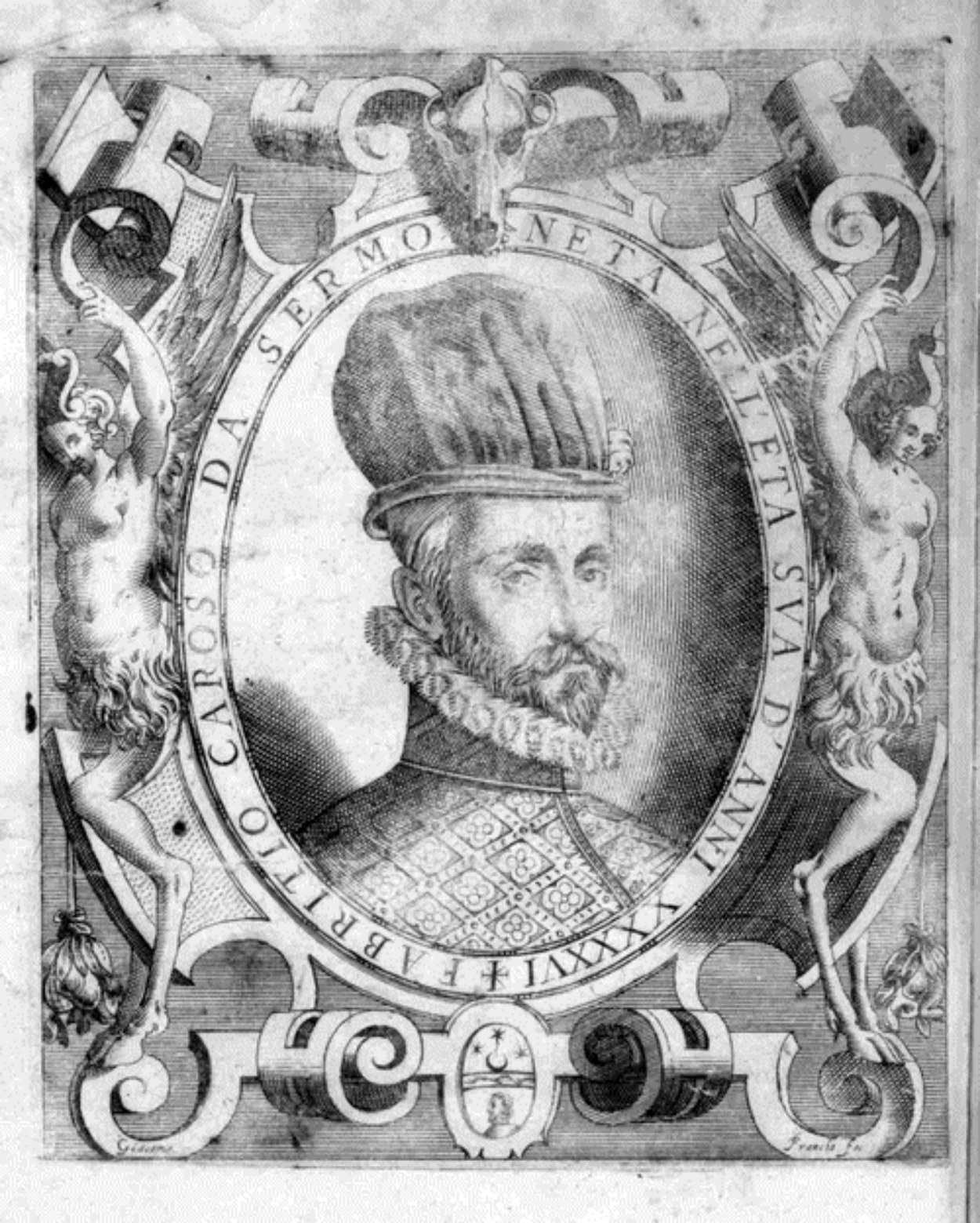
Fabritio Caroso da Sermoneta
- Medium:
- Woodcut
- Dance:
- Notation/Choreography
- Era:
- Pre-1700 (Renaissance/Baroque)
- Collection:
- Il Ballarino (1581)
- Source:
- Library of Congress
- Rights:
- Public domain — free to use, share and adapt.
- Recorded as:
- Public Domain
For historians of dance, this image is invaluable because it shows how court dances were actually taught and understood in their own time—not through abstract notation alone, but through explicit demonstration of the body, the costume, the posture, and the social context of performance. For dancers today, it reveals that Renaissance nobility dance was as much about courtly presentation and dignity as about footwork, a principle that modern reconstructors must grasp to perform these dances authentically.
What you are looking at
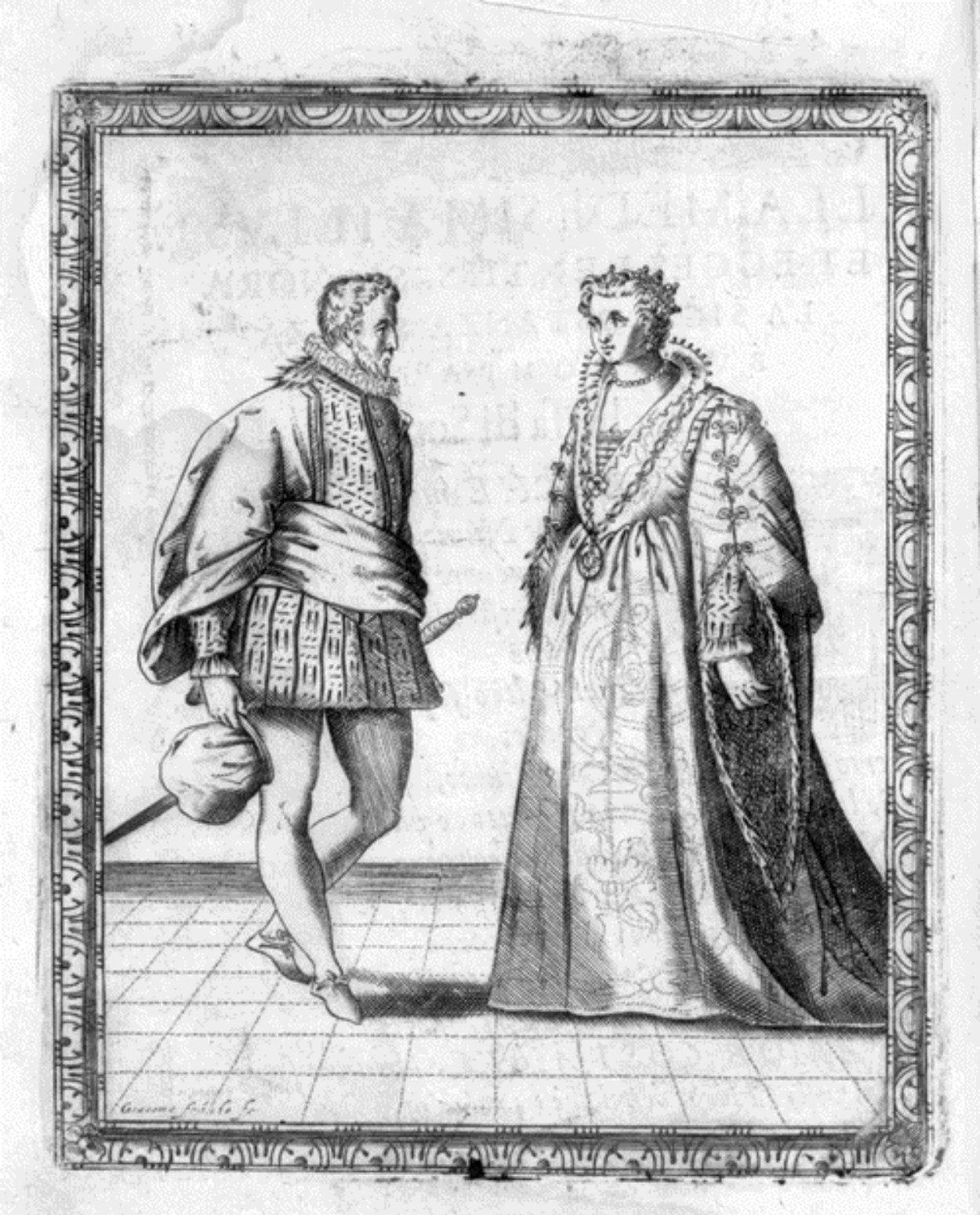
A woodcut plate from Caroso's dance manual depicting a Renaissance Italian couple in formal court dress, posed as if mid-demonstration of a courtly dance. The man, positioned on the left, wears a richly decorated doublet with ornate embroidery and a short pleated skirt (paned hose), a draped cape fastened at the shoulder, and holds a plumed hat in one hand while gesturing expressively with the other. The woman stands to the right in an elaborate gown with a high waistline, puffed sleeves embellished with decorative patterns, and a deep collar of gathered linen; her hair is dressed with a jeweled ornament and she wears a long rope of pearls. Both figures stand on a tiled floor against a plain background, framed by an ornamental border typical of printed books. The composition captures them in an instructional moment—bodies alert and balanced, demonstrating posture and bearing rather than capturing mid-movement action.
The dancing
The man's body is angled three-quarter view, his weight appears centered and his arms are positioned in an open, expressive frame—one arm gestures toward his partner, the other holds his hat. The woman faces forward, her posture upright and formal, her arms hanging naturally but gracefully. Neither figure is in a closed ballroom hold; instead they are positioned as if presenting the courtly deportment and individual carriage that defined Renaissance dance. The spatial relationship between them suggests partnered movement but emphasizes display of noble bearing and elaborate costume over physical contact.
The dance depicted
This plate demonstrates a dance from the Italian Renaissance court, most likely a pavane or galliard given the formal dress and the instructional context of Caroso's *Il Ballarino*, which catalogued the court dances performed among Italian nobility in the mid-to-late 1500s. The image is not meant to freeze a moment of active footwork but rather to show the posture, frame, and courtly demeanor expected of noble dancers. The couple's formal address and the emphasis on their elaborate costume indicate that these were dances in which appearance, dignity, and graceful bearing were as important as technical footwork.
How it was made
This is a woodcut, a relief-printing technique that could be reproduced many times from a single carved block, making it ideal for wide circulation in printed books. The technique produces the bold black lines and high contrast visible here, with clear definition of the figures against plain ground. Woodcut was cheaper and more durable than engraving for large print runs, which allowed Caroso's manual to reach a broad courtly audience across Italian territories. The clean outlines and lack of fine tonal gradation are characteristic of the technique and suited to instructional purposes—the viewer reads the form and dress clearly at a glance.
About this work
This is a pedagogical image from one of the most influential dance manuals of the Renaissance, Fabritio Caroso's *Il Ballarino* (Venice, 1581). It serves not as a snapshot of dancers in motion but as a model for courtly comportment and dress, demonstrating to readers how nobility should appear when performing the fashionable dances of the Italian court. The work belongs in a gallery of dance imagery because it represents dance not as physical spectacle but as a system of codified behavior and noble self-presentation—a form of social performance central to Renaissance court culture. The figure of Caroso himself was legendary; he was the most celebrated dancing master of his era, and his written notation system and illustrated demonstrations established a template for dance instruction that influenced European practice for generations.
How to look at it
Attend first to the costume: every detail—the embroidered doublet, the puffed sleeves, the jeweled headdress, the ropes of pearls—is part of the dance itself. In Renaissance court dance, the dancer's appearance was inseparable from the movement. Notice next the posture and frame: both figures are upright, dignified, balanced, and formally separated. There is no embrace or close hold; instead, the space between them conveys both courtesy and decorum. Look at the hand positions and the direction of the gesture—the man's open arm and the woman's composed repose show how bodies were meant to address their partner and the watching court. Finally, consider that this is not a moment of action but a pose of presentation: Caroso stops the dance to show you how to look and stand, not how to move.
The artist
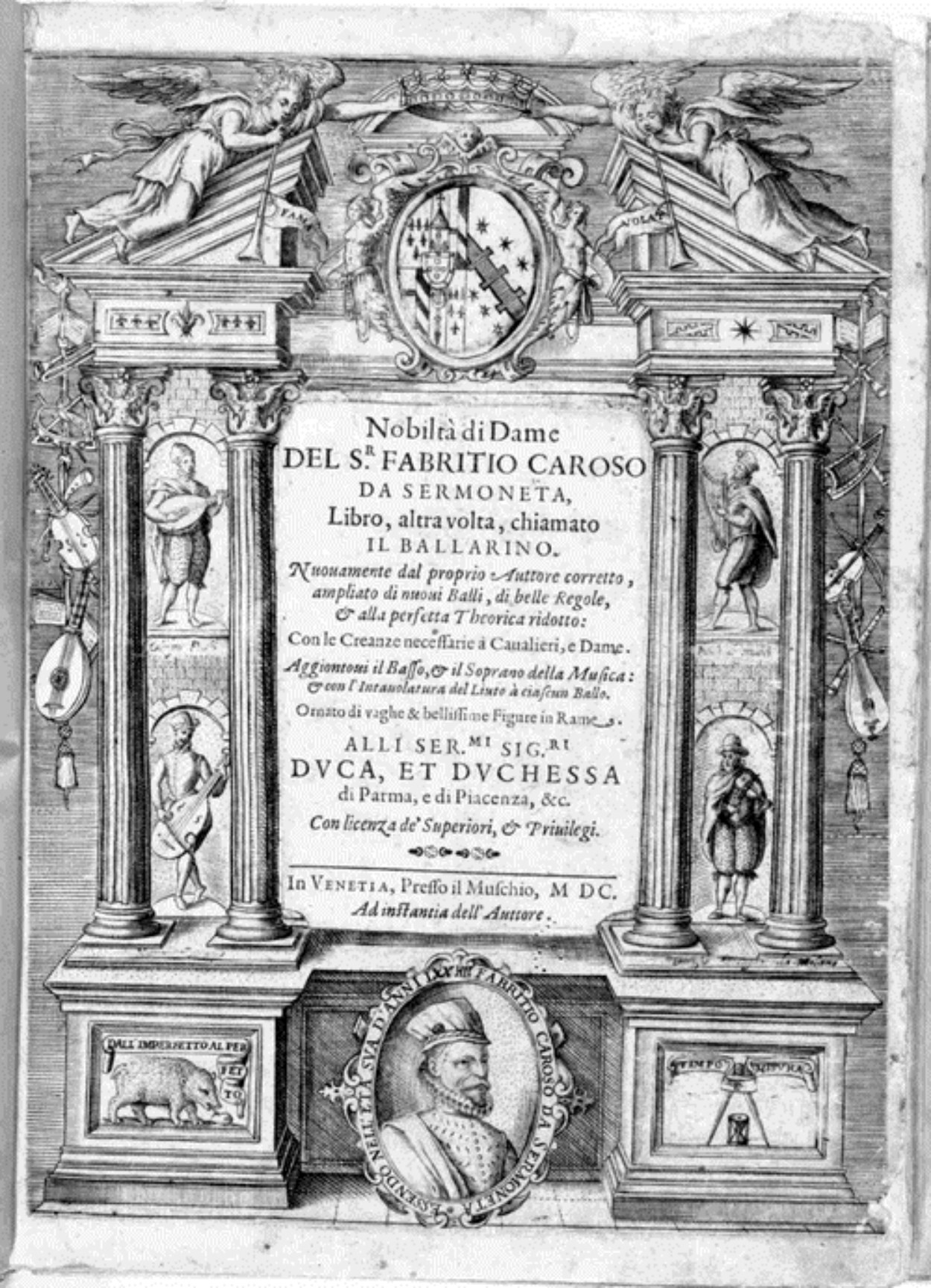
Fabritio Caroso da Sermoneta (c. 1526–after 1605) was the most celebrated dancing master of the Italian Renaissance and one of the most influential dance pedagogues in European history. Based primarily in Rome, he served the nobility and papal court and published two major works on courtly dance: *Il Ballarino* (Venice, 1581) and *Nobiltà di Dame* (Venice, 1600). His manuals combined prose descriptions, choreographic notation, and illustrative woodcuts to document and standardize the court dances of his era. Caroso was not only a choreographer but also a theorist of dance as an essential accomplishment of noble life, and his systematic approach to dance instruction—breaking movements into named steps and combinations, illustrating proper carriage and dress—made him the primary authority on Renaissance Italian dance for both his contemporaries and later historians.
The period
In the mid-to-late 16th century, court dance in Italy was at its height as a marker of noble status and courtly refinement. The Renaissance Italian court—particularly Venice, Milan, Florence, and Rome—was a center of artistic innovation, and dance was considered one of the liberal arts alongside music and poetry. The pavane and galliard were the dominant choreographed dances of the period, characterized by measured, processional movement (pavane) alternating with more vigorous jumping and turning (galliard). Caroso's *Il Ballarino* was published at a moment when printing technology made it possible to disseminate dance knowledge widely, and his illustrated manual became the standard reference for Italian courtly dance. The period also saw increasing emphasis on the master's role as educator and arbiter of taste—Caroso presents himself not just as a choreographer but as a teacher shaping the behavior and bearing of the nobility.
Where it lives
This is a woodcut plate from *Il Ballarino*, published by the Venetian printer Girolamo Franzini in 1581. The book itself was widely distributed and reprinted, making it one of the most accessible and influential dance manuals of the Renaissance. This particular plate is held in the Library of Congress collection.
Dance in this work
Questions about this work
What dance is being demonstrated here?
The specific dance is not labeled in most reproductions, but given the formal dress, the courtly setting, and Caroso's catalog, it is most likely a pavane or possibly a galliard—the two dominant social dances of the Italian Renaissance court. The image shows posture and bearing rather than footwork, so the emphasis is on how nobility should appear while dancing rather than the exact steps.
Why are they not touching?
In Renaissance court dances, couples often moved in proximity without continuous contact. The space between them was intentional and courtly—it allowed both dancers to display their individual carriage and the full beauty of their costume, and it reflected social protocol. Some dances required holding hands or arm-in-arm positions at certain points, but the default was separate bodies in formal relation.
How do we know how to dance these steps today?
Caroso's written descriptions (in prose and in choreographic notation) accompany these illustrations in *Il Ballarino*. By combining the visual image, the named steps (such as *doppio*, *semplice*, and *riverenza*), and the musical context, modern dancers and historians have been able to reconstruct these dances with considerable accuracy. Caroso is the most reliable surviving source for Italian Renaissance courtly dance.
What does the costume tell us about this dance?
The elaborate embroidery, the jewels, the high-quality fabrics, and the careful arrangement of the gown all indicate that this is a noble, formal social dance, not a servant's dance or a street entertainment. The costume is part of the performance: nobility displayed their status, refinement, and allegiance through dress, and the dance was the occasion to do so in front of the court.
More Notation/Choreography artwork