37 works in this view — arrow keys or swipe to move between them.
Dance in Art
Solo Dancer — Plate 18
Gregorio Lambranzi
- Medium:
- Copper-plate engraving
- Dance:
- Notation/Choreography
- Era:
- 1700s (Enlightenment/Minuet Era)
- Collection:
- Nuova e curiosa scuola de' balli theatrali (1716)
- Source:
- Library of Congress
- Rights:
- Public domain — free to use, share and adapt.
- Recorded as:
- Public Domain
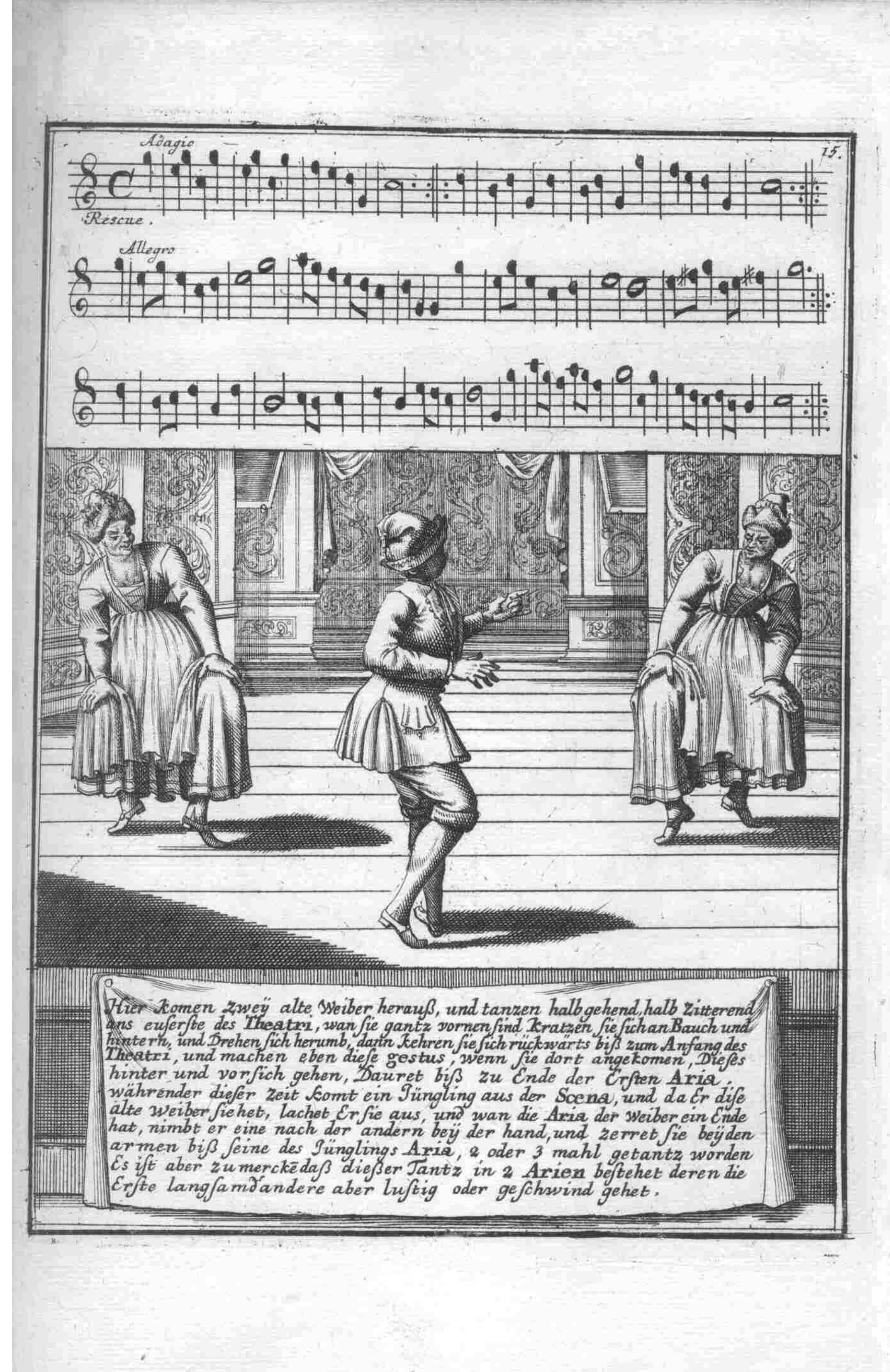
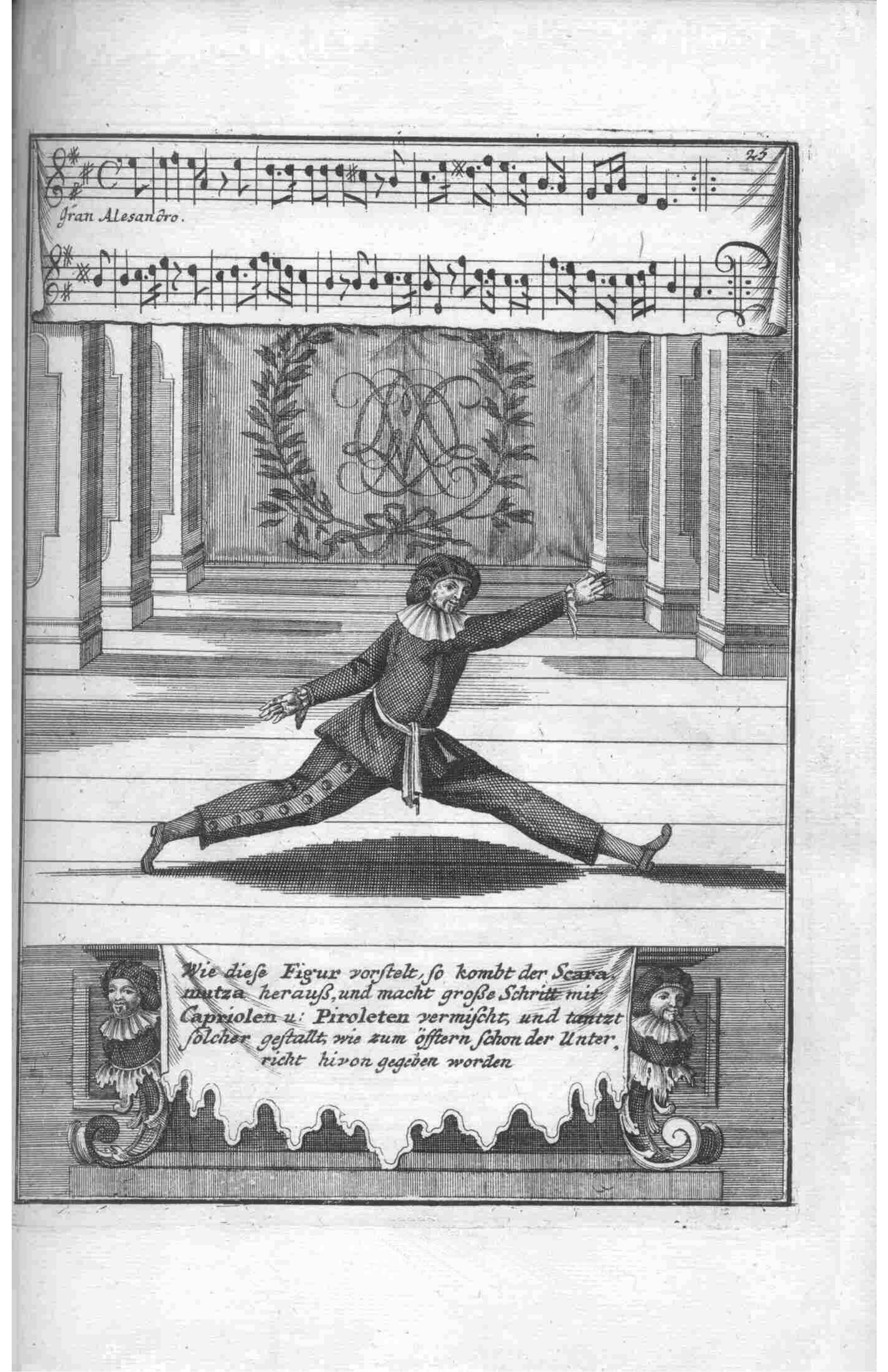
Lambranzi's *Scuola* is one of the few surviving visual documents that shows how professional theatrical dancers of the early 18th century actually moved—not idealized or stylized, but captured in precise engravings paired with music notation. This plate is valuable because it documents the reverence, a foundational element of all courtly movement that is often invisible in dance history: the gesture of deference and respect that was as essential to the trained dancer as turnout or carriage. For historians and dancers, this image confirms what written sources tell us but does not show—that the grammar of baroque dance was built on the body's capacity to express social hierarchy and courtly propriety through controlled, measured gesture.
What you are looking at
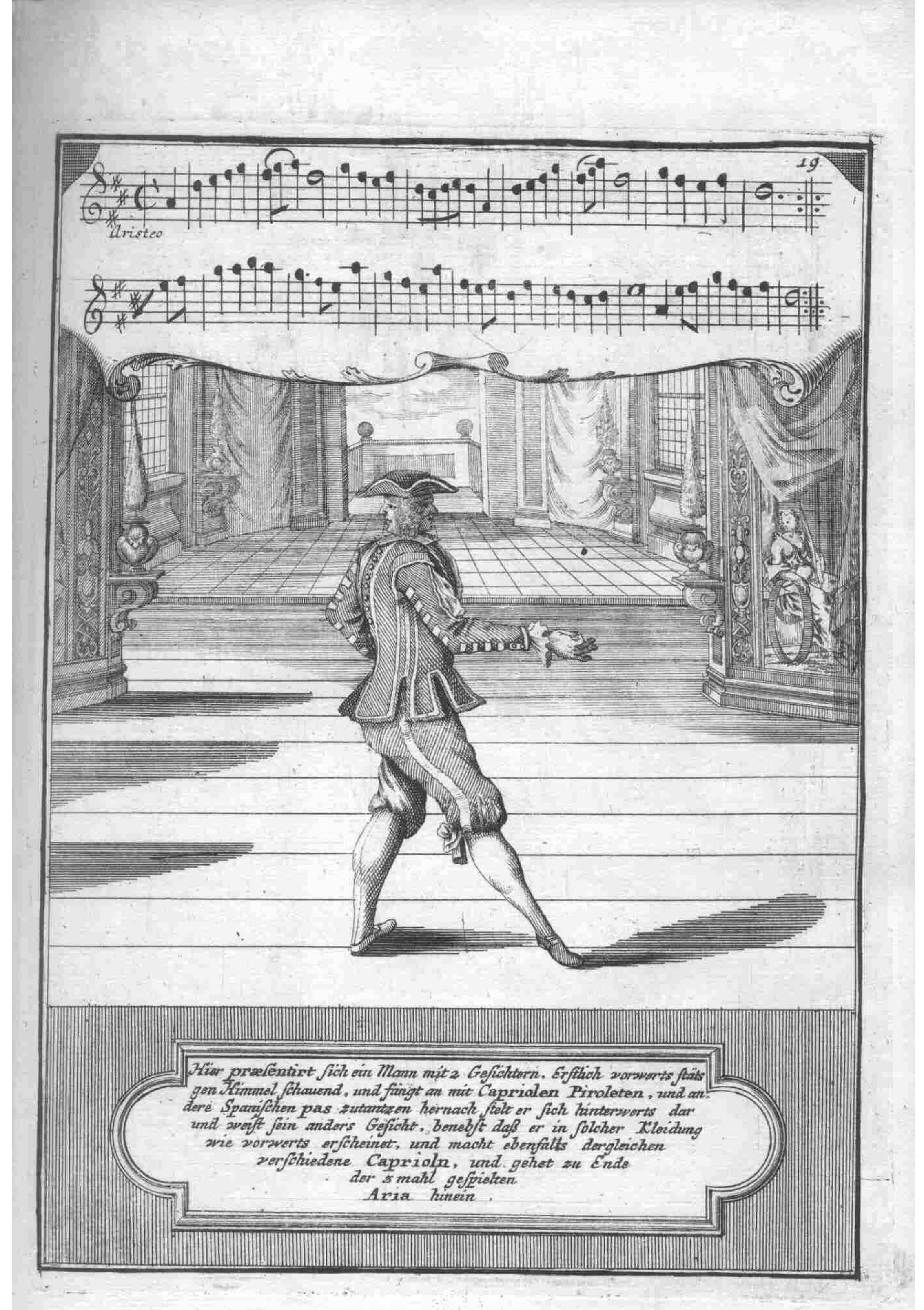
A solo male dancer in elaborate 18th-century theatrical dress stands center stage in a deep, courtly bow or reverence. He wears a plumed tricorn hat, an ornately embroidered coat with full skirts, and fitted breeches; his posture is formal and controlled, with one leg extended and his torso folded forward in the characteristic deep obeisance of court dance. The stage behind him is a perspective interior draped with heavy curtains and decorated with classical pilasters and sculptural figures in niches—the whole apparatus of aristocratic theater. The floor is rendered with strong linear perspective lines, emphasizing depth and the formality of the space. Above the theatrical scene, two staves of musical notation indicate the piece being danced. Below, a German caption in an ornamental cartouche provides textual commentary. The engraving is clean and precise, with fine hatching for shadow and texture.
The dancing
The single male dancer occupies the center of the composition in a profound forward bow with legs in a wide stance—likely a révérence or similar obeisance figure. His upper body is folded from the hips, his head bowed, and his arms are positioned in a manner consistent with courtly deportment of the period (the right arm appears extended or held in frame). His weight is distributed across both legs, and the pose is static and held rather than caught mid-motion, suggesting this is an opening or concluding salutation rather than a traveling step. The formality and depth of the bow indicate this is an obligatory gesture of respect rather than a dynamic movement phrase.
The dance depicted
This depicts a révérence or similar opening salutation from French baroque court dance (danse de cour), likely the minuet or a related formal theatrical dance of the early 18th century. The reverence was a standard opening figure that opened social and theatrical dance and was performed by male dancers as a mark of deference and courtly propriety. The image documents not the spectacular virtuosity of the dance but its ceremonial foundation—the gestural grammar of respect that preceded all formal dancing in the period. The printed musical notation above confirms this is a notated choreography, and the theatrical setting indicates this is theatrical interpretation of court dance conventions rather than ballroom practice.
How it was made
This is a copper-plate engraving, a process that allowed fine linear detail and consistent reproduction of intricate costume and architectural ornament. The technique was ideal for dance notation books and theatrical documentation, as it could render both small-scale musical staff notation at the top and the full figured scene below with equal precision. Engravings could be printed multiple times without degradation, making them the standard medium for disseminating choreographic knowledge and theatrical reference across Europe. The clarity and finish of this plate indicates it was produced for a wealthy or institutional audience—not a disposable popular print but a bound or collected volume for professional dancers and patrons.
About this work
This is Plate 18 from Gregorio Lambranzi's *Nuova e curiosa scuola de' balli theatrali*, one of the most influential dance manuals of the early 18th century. Each plate paired a musical composition (notated above) with a costumed male or female dancer performing a specific figure or movement phrase on a theatrical stage. This plate captures a révérence—the formal bow that opened all courtly and theatrical dance—performed by a solo male dancer in full court dress. The work sits at the intersection of dance pedagogy, theater documentation, and music notation: it is simultaneously instructional, visual, and notational, giving shape to movement that would otherwise exist only in the body and memory of trained dancers. The engraving's precision and finish ensured that this image of courtly movement could circulate widely among dancers, choreographers, and patrons across Europe for generations.
How to look at it
Look at the posture: the dancer's profound forward fold and the wide stance of his legs are deliberate and held, not transitional. The bow is an act of respect and acknowledgment, not a movement phrase. Notice the costume: every detail of embroidery, plumage, and fit is rendered with precision, because the dancer's appearance was inseparable from his role and status. The theatrical setting—the columns, draperies, and sculptural details—anchors this as a professional theatrical performance, not a ballroom dance. The musical notation at the top is not decorative but functional: it shows the rhythmic structure and melody that the dancer's body interprets. This is a teaching image: it shows students what a reverence looks like, how the body should be disposed, and what music accompanies it.
The artist
Gregorio Lambranzi (c. 1681–1728) was an Italian ballet master and choreographer active in Nuremberg in the early 18th century. He is known almost exclusively for the *Nuova e curiosa scuola de' balli theatrali*, published in two volumes in Nuremberg in 1716. The work was innovative for its combination of engraved figures, musical notation, and German textual description—a hybrid instructional medium designed to make choreography legible and teachable across language and distance. Lambranzi's dancers are rendered with individual character and specificity, suggesting he was documenting actual performers and their repertory rather than inventing idealized types. The work was reprinted multiple times and was influential well into the 18th century.
The period
In 1716, when this was published, the court dance tradition (danse de cour) was entering its final phase as a living social and theatrical practice, though its forms and values remained dominant in professional dance and aristocratic society. The minuet, the most refined and formal of court dances, was at the height of its social and aesthetic prestige and would remain so for decades. Theatrical dance in German-speaking lands was heavily influenced by French and Italian styles, and dance manuals had become a crucial technology for codifying and spreading movement vocabularies across Europe. Lambranzi's *Scuola* was published in the same period as Feuillet's notation system was achieving wide circulation—both represent the early 18th-century impulse to make dance teachable and reproducible through notation and image. The reverence shown here was considered the foundation of all civilized movement, taught to aristocrats and professional dancers alike as the visible sign of courtesy and self-mastery.
Where it lives
This plate is from Gregorio Lambranzi's *Nuova e curiosa scuola de' balli theatrali*, published in Nuremberg in 1716 by the engraver(s) of the work (the individual engraver is not identified in the record). The volume is held in numerous institutional collections across Europe and North America, including the Library of Congress. It is a bound printed book of engravings, each pairing a choreographed dance figure with musical notation and German text.
Dance in this work
Questions about this work
What is the dancer doing here?
He is performing a révérence, a formal bow or salutation that opened all courtly and theatrical dance in the 17th and 18th centuries. It was an obligatory gesture of respect and deference, performed by dancers at the beginning of a dance or when acknowledging a patron. The reverence was so standardized that it became a foundational movement, taught to all dancers as the visible sign of courtly propriety and self-control.
Who was Gregorio Lambranzi?
Lambranzi was an Italian ballet master and choreographer active in Nuremberg in the early 18th century. He is remembered almost entirely for his *Nuova e curiosa scuola de' balli theatrali* (1716), a two-volume dance manual that paired engraved figures with musical notation and German text. The work was innovative and influential, showing how choreography could be documented and taught through image and notation.
How was dance documented and taught in the 18th century?
Dance was taught primarily through live demonstration and verbal instruction from a master, but notation systems and printed images became increasingly important. Lambranzi's *Scuola* used a combination of engraved figures, musical notation, and text to make choreography legible and portable. This hybrid approach allowed dancers and choreographers to study movement across distance and to preserve specific figures and sequences for future generations.
Why does the costume matter?
The dancer's costume identifies his social role and status. The tricorn hat, embroidered coat, plume, fitted breeches, and stockings are the dress of a male courtier or theatrical dancer of rank. The precision with which these details are engraved indicates that costume was part of the dance's meaning—the way a dancer looked was inseparable from what his movement expressed.
More Notation/Choreography artwork