40 works in this view — arrow keys or swipe to move between them.
Dance in Art
Courtly Couple — Plate 21
Gregorio Lambranzi
- Medium:
- Copper-plate engraving
- Dance:
- Notation/Choreography
- Era:
- 1700s (Enlightenment/Minuet Era)
- Collection:
- Nuova e curiosa scuola de' balli theatrali (1716)
- Source:
- Library of Congress
- Rights:
- Public domain — free to use, share and adapt.
- Recorded as:
- Public Domain
Lambranzi's engravings are among the very few primary sources in which 18th-century Baroque theatrical dance is shown, notated, and named at the same time. They offer direct evidence of how dancers held their bodies, shaped their arms, and moved through theatrical space when court dance was at its height. For a historian, choreographer, or dancer seeking to reconstruct Baroque movement, this manual is indispensable.
What you are looking at
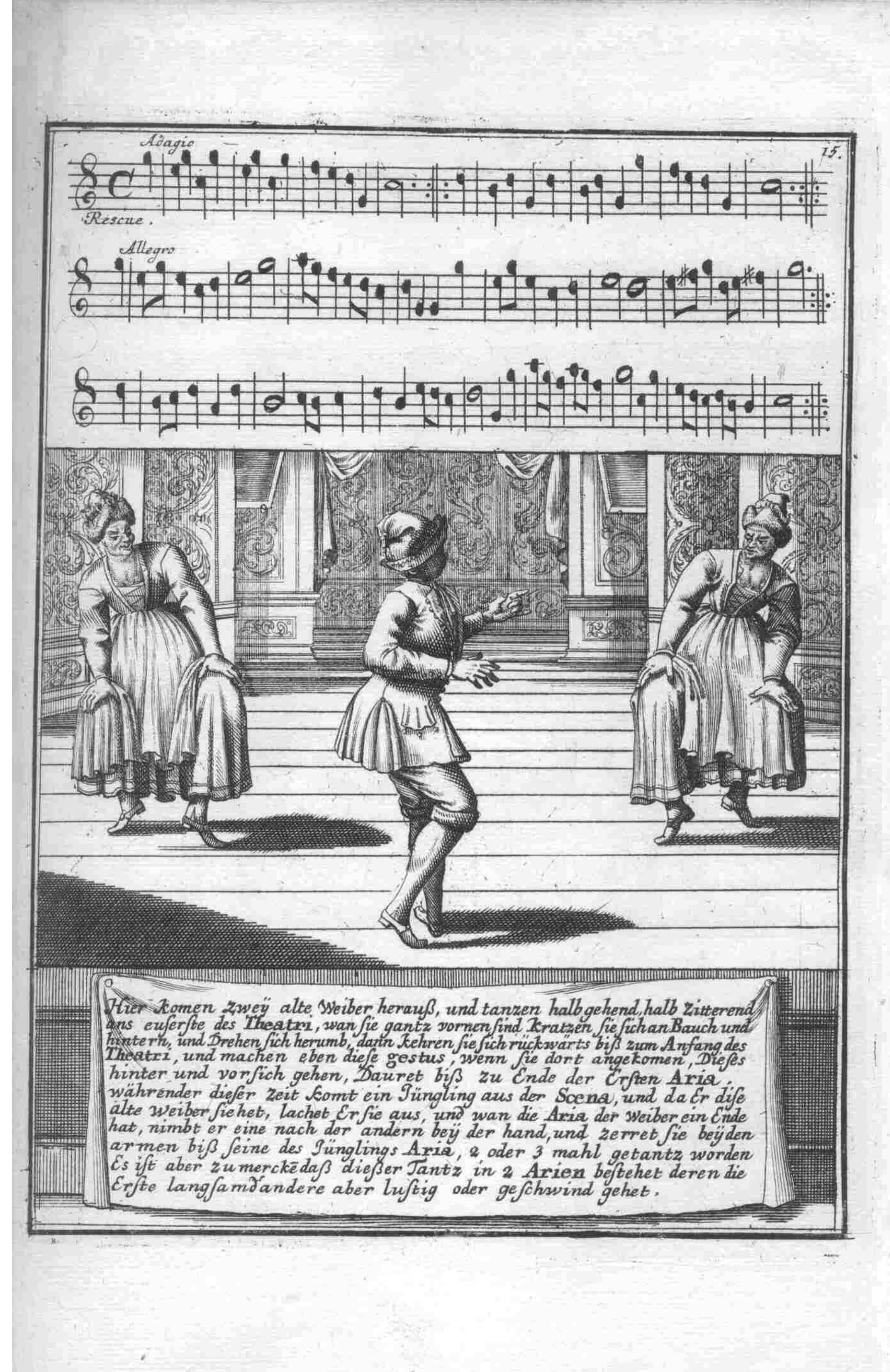
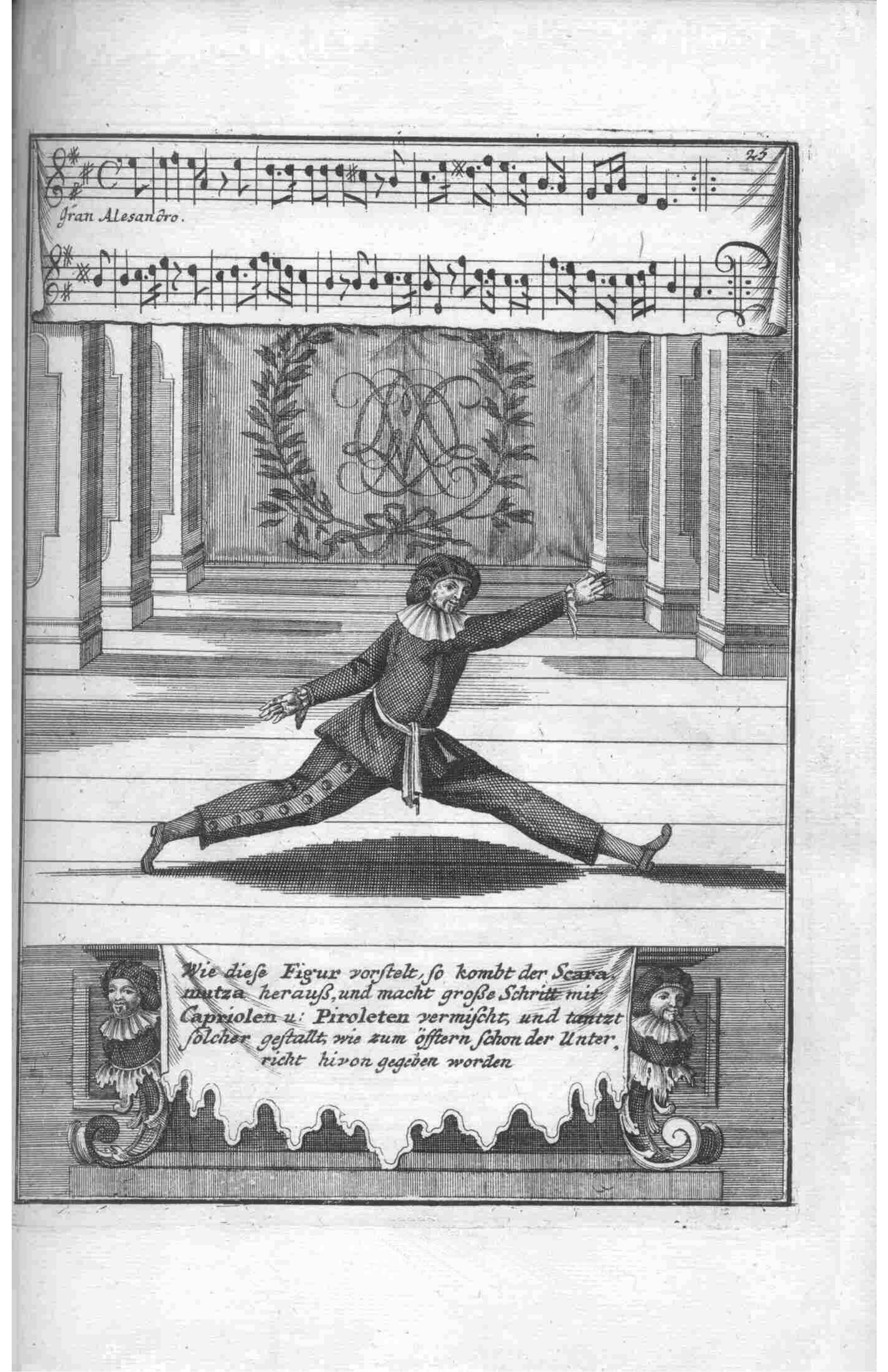
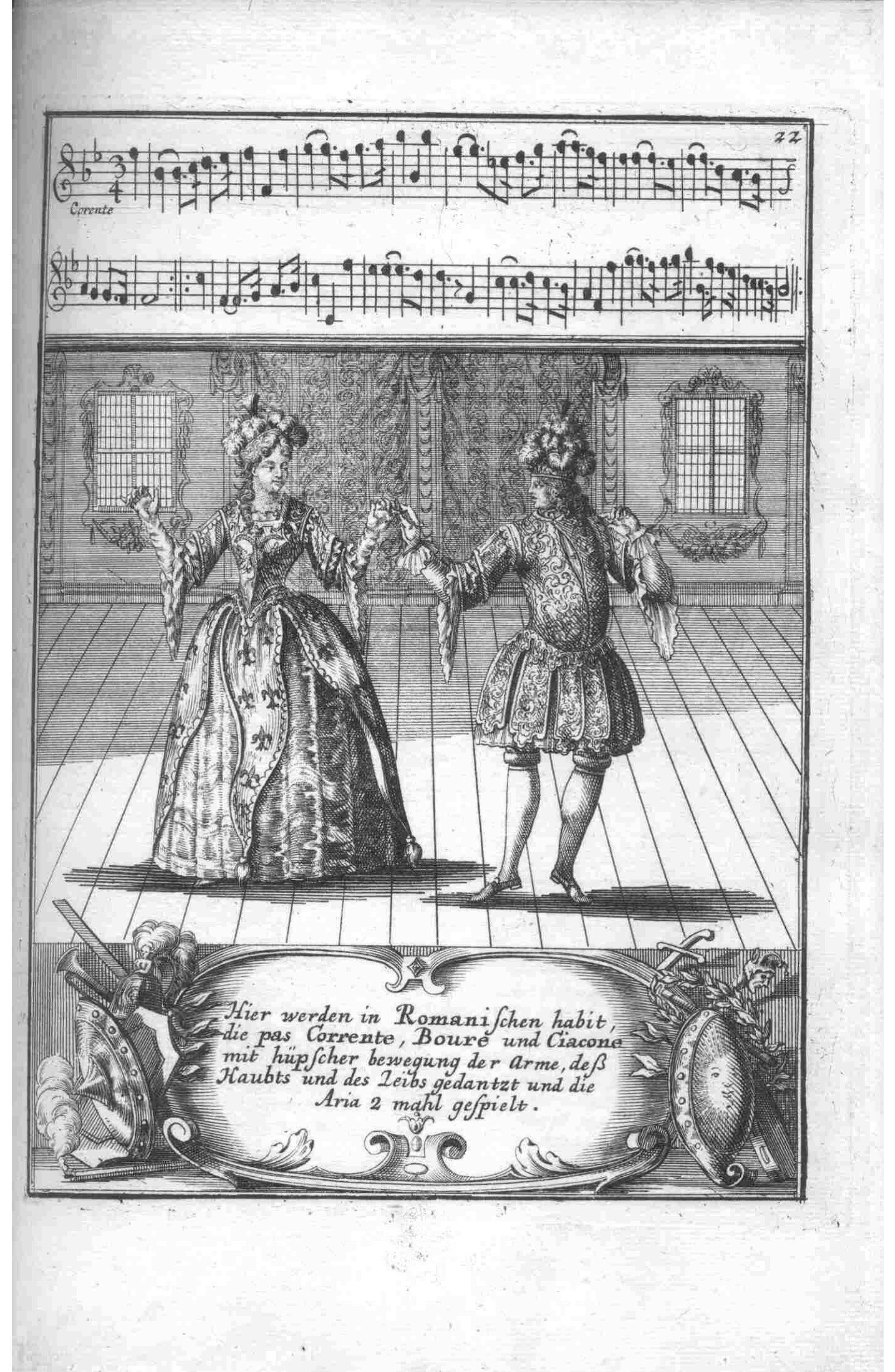
A man and woman in lavish Baroque court dress stand on a wooden stage against a backdrop of ornate drapery, caught mid-dance. The woman wears a full-skirted gown with elaborate embroidered patterns and a high bodice; her hair is dressed up and decorated. The man is in a patterned coat and breeches, one leg extended in a dancing attitude. Both figures are animated—arms raised and positioned with deliberate grace—suggesting a moment of forward motion or a turning phrase. The stage is framed by windows at either side and bordered by ornamental wall panels, creating the illusion of a grand interior. The engraving is dense with detail, the music staff above showing the air or movement that accompanies this choreography.
The dancing
The couple stand in open position but near each other, not in closed ballroom hold. The man's frame is upright and turned; his raised leg and arm position suggest a pas or cadence. The woman's posture is equally alert, her arms extended gracefully outward, her weight distributed for motion. Both dancers face slightly toward each other and the viewer simultaneously, a frontal positioning typical of theatrical dance meant to be seen from house seating. The bodies show control and articulation rather than mere stepping—the limbs are deployed with deliberation.
The dance depicted
This is a theatrical Baroque couple dance, almost certainly from the French tradition that dominated European court and stage dancing in the early 18th century. The setting (a stage with drapery), the notation above (a measured air or gavotte-like melody), and the formal dress all mark this as a dance composition for performance rather than social dancing. The open position and the emphasis on elevation and arm gesture place it within the vocabulary of dances like the minuet, courante, or gigue that Lambranzi's manual was designed to teach. Without the notation being fully legible, we cannot identify the exact danse de caractère or dramatic situation, but the theatrical costume suggests this couple may be performing characters—perhaps from a ballet d'action or a ballet-pantomime—rather than themselves.
How it was made
This is a copper-plate engraving, a technique that allowed fine detail and wide circulation in the early 18th century. Each image pairs a notated music staff with a costumed figure (or in this case, a couple) in a posed, instructional moment. Engraving demanded precision in both musical notation and figure drawing, and the technique's slow execution meant that such dance manuals were expensive and sought-after by dance teachers and noble students. The medium's popularity for instructional works on dance—Feuillet notation, Taubert, Lambranzi himself—reflects the period's investment in capturing and transmitting the grammar of aristocratic movement.
About this work
This is Plate 21 from Gregorio Lambranzi's *Nuova e curiosa scuola de' balli theatrali*, a foundational manual for Baroque theatrical dance published in Nuremberg in 1716. Lambranzi's work documented the practices of the Italian school of theatrical dance, offering notated choreographies paired with engravings of costumed dancers in the moment of performance. This plate shows a courtly couple mid-execution, their dress and setting establishing the world of the aristocratic stage. The manual was influential across Europe and remains one of the richest visual records of how Baroque dance was actually performed—not theorized, but shown in motion, with notation to guide the dancer's feet and arms through the air.
The work matters because it bridges two forms of evidence: the music and the image. Lambranzi's couples move through real architectural and narrative spaces, not abstract fields. They are characters, in costumes, performing on stages. This transforms dance history from a genealogy of steps into a record of theatrical practice—what was seen, what was admired, and how the body was trained to signify rank, emotion, and story within an elite visual culture.
How to look at it
Look first at the posture and arm frame: both dancers are elevated and composed, with a lightness of carriage and a deliberate spacing of the limbs that speaks to training. Notice how the woman's skirt is drawn to show the articulation of her moving legs beneath it, not simply as decorative fabric. The man's extended leg and open arm position suggest a moment of stepping and turn, the kind of phrase a viewer would recognize as demanding technical control. The stage setting and costume are as important as the bodies—this is not dancing as private courtly pleasure but as theatrical performance, a distinction Lambranzi's manual insists upon. Finally, attend to the notation above: it is a cue that this is not an imagined or idealized dance but a real, repeatable composition.
The artist
Gregorio Lambranzi (c. 1680–c. 1752) was an Italian dance master and choreographer who documented the theatrical dance practices of the late Baroque with unusual precision. His *Nuova e curiosa scuola de' balli theatrali* (Nuremberg, 1716, with a second edition in 1728) was one of the first choreographic manuals to pair detailed engravings with musical notation in the manner of Feuillet. Lambranzi worked within the Italian tradition of theatrical dance, which emphasized mime, character, and spectacular costume, and his manual served both as a teaching tool and as a record of the dances performed in courts and commercial theatres across Europe.
The period
By 1716, the Baroque was reaching its height in courtly and theatrical Europe. French court dance—the minuet especially—dominated fashion, but Italian dance masters like Lambranzi maintained a parallel tradition emphasizing character dances, mime, and narrative spectacle. Feuillet notation, developed in France in the 1680s, had begun to standardize the written record of choreography, and Lambranzi's adoption of it signals the period's growing investment in the conservation and transmission of movement knowledge. This was also the age of the commercial ballet d'action in Italy and the early development of pantomime as a theatrical form. The engraving medium allowed Lambranzi's manual to circulate widely, making it a tool of professional standardization and status.
Where it lives
This is one of 49 engravings from the first edition of Lambranzi's *Nuova e curiosa scuola de' balli theatrali*, published in Nuremberg in 1716. It is housed in the Library of Congress collection. Each plate in the manual is numbered and presents a different dance, dancer, or couple, with a German verse or caption beneath the theatrical scene.
Dance in this work
Questions about this work
Can I dance this from the notation?
Possibly, if you can read Feuillet notation. The music staff above the engraving shows the air or melody; the figure should be moving through steps that align with it. Scholars have reconstructed some of Lambranzi's choreographies with reasonable success, though the engravings alone do not always capture every step or transition. The best approach is to use the image and notation together, cross-referencing with other Baroque dance manuals and surviving notation of similar dances.
What is the relationship between the man and woman here?
The open position and the way they are angled toward each other suggest a courtship or flirtation, common themes in theatrical Baroque dance. The couple may be performing characters—nobility, shepherds, or allegorical figures—rather than themselves. The theatrical setting and costume support this: these are actors in roles, not private dancers.
Why does Lambranzi pair images with notation?
Lambranzi believed that dance was a teachable discipline, like music or rhetoric, and that its grammar could be transmitted through a combination of visual example and written direction. The notation preserves the timing and the spatial path; the engraving shows the carriage, costume, and theatrical context. Together, they offer a more complete record than either alone.
How does this differ from French court dance?
Lambranzi's Italian tradition emphasizes character, mime, and spectacle—dancers in costume performing roles on a stage. French court dances, especially the minuet, were more formal and less narrative, designed for participation in court ceremony rather than theatrical performance. Lambranzi's couples are performers; French courtiers were participants.
More Notation/Choreography artwork