42 works in this view — arrow keys or swipe to move between them.
Dance in Art
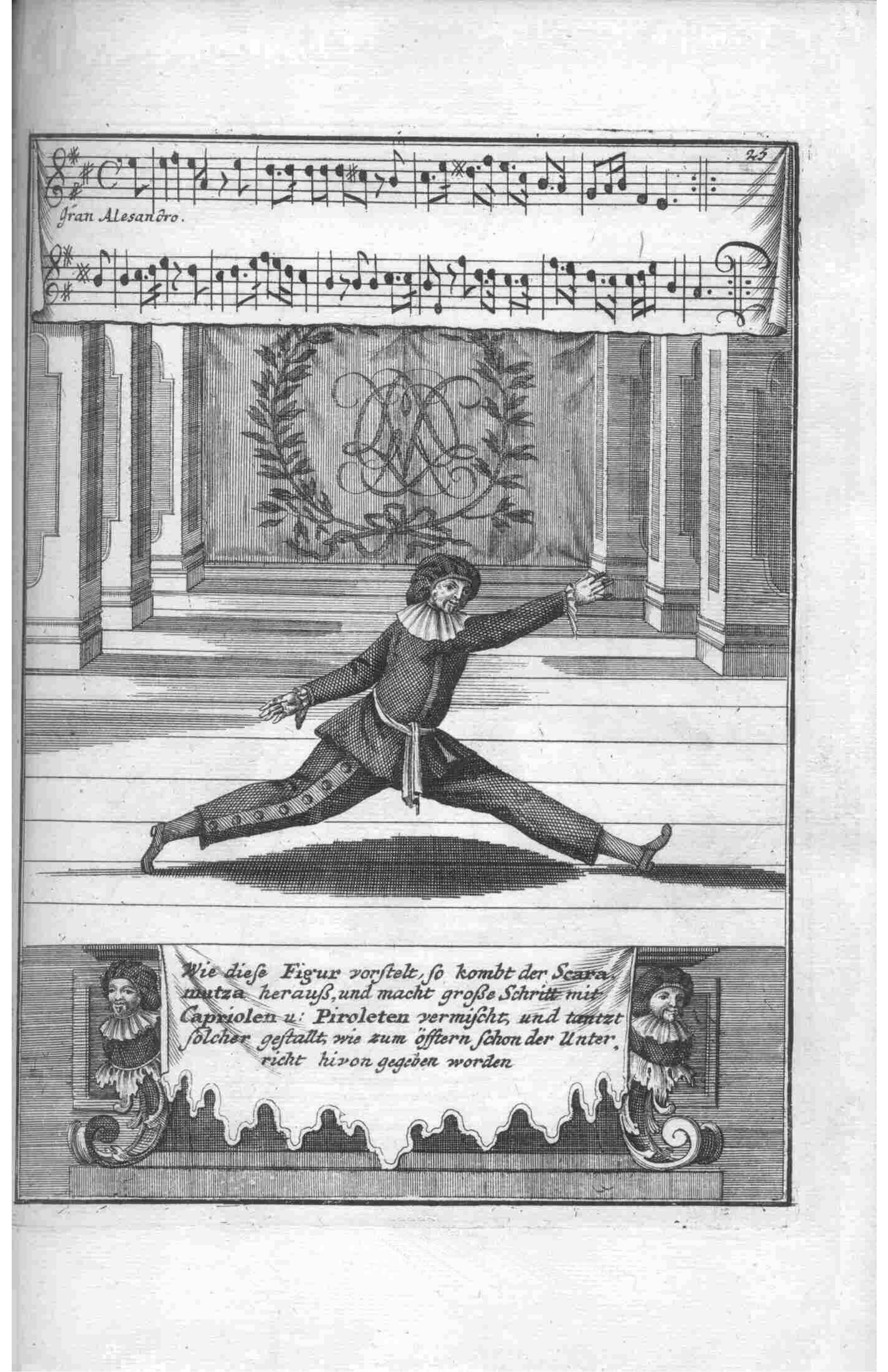
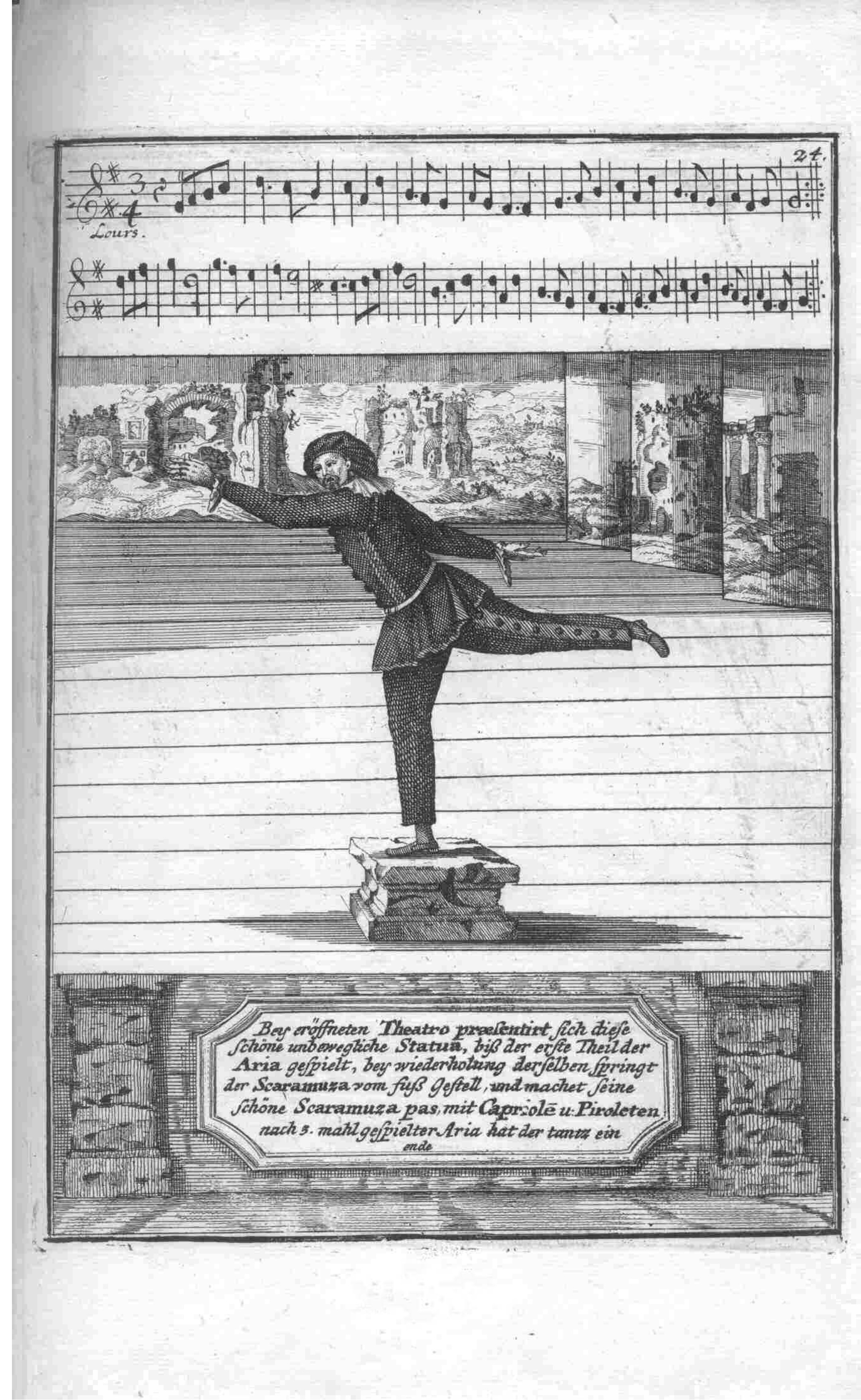
Solo Dancer — Plate 23
Gregorio Lambranzi
- Medium:
- Copper-plate engraving
- Dance:
- Notation/Choreography
- Era:
- 1700s (Enlightenment/Minuet Era)
- Collection:
- Nuova e curiosa scuola de' balli theatrali (1716)
- Source:
- Library of Congress
- Rights:
- Public domain — free to use, share and adapt.
- Recorded as:
- Public Domain
Lambranzi's plates are primary visual evidence for how trained dancers moved, what they wore, and how the stage was lit and designed in the early 1700s—information that cannot be fully recovered from notation alone. For historians and practicing dancers, these engravings make visible the aesthetic of the theatrical body in the age of the minuet, showing how formality, balance, and display governed even the moment of greatest extension.
What you are looking at
A single male dancer in formal eighteenth-century dress stands in a striking contrapposto pose on a small rectangular stone plinth, his body twisted dramatically with one leg extended behind him and one arm reaching forward. He wears a fitted, buttoned coat with a patterned or checkered weave, knee breeches, stockings, and heeled shoes; a tricorn hat sits on his head. The background depicts a Baroque theatrical stage with a painted architectural backdrop showing ruins, fortifications, and distant landscape, while heavy drapery frames either side. The wooden floor of the stage extends clearly forward, establishing spatial depth. The print sits beneath two staves of notated music—likely the tune accompanying this choreographed solo—suggesting this is a documented theatrical dance step or variation meant to be reproducible by readers.
The dancing
The dancer's weight rests on his upstage leg while the downstage leg extends long behind, creating a deep lunge or balancé effect. His torso twists, with one arm extended forward and the other presumably at his side, forming a diagonal line from back leg through the upper body. His posture suggests controlled elevation or recovery from a traveling step, with the extended back leg indicating either a recent hop or jump or a moment of balance in a turning phrase. This is classical theatrical dance of the period—not folk or social—with deliberate, codified positioning.
The dance depicted
This appears to be a theatrical solo from the early 18th-century French court or commercial stage tradition, almost certainly a minuet variation or other courtly danced air, given the formal dress, stage setting, and notated music. The pose itself—with extended leg and rotated torso—resembles positions documented in Raoul-Auger Feuillet's choreographic notation system, which was the primary method for recording stage dances in this era. The plinth isolates and displays the dancer's body against the architectural backdrop, a common staging device for solo variations. The included music staff indicates this was meant as instruction: a reader could learn the step by reference to both the notation and this engraved figure.
How it was made
This is a copper-plate engraving, a medium suited to fine detail and reproducible in multiple impressions. The cross-hatching creates volume and fabric texture; the careful rendering of the stage architecture and the figure's musculature suggest a skilled hand. Engraving's precision and portability made it ideal for dance instruction books, which had to circulate among wealthy amateurs, professional dancers, and nobility across Europe. The pairing of musical staff and dancer figure—both engraved on the same plate—was the standard format for Lambranzi's treatise and others of its kind, allowing readers in distant cities to copy steps from the same reference.
About this work
This is Plate 23 from Gregorio Lambranzi's *Nuova e curiosa scuola de' balli theatrali* (*New and Curious School of Theatrical Dances*), published in Nuremberg in 1716. Lambranzi's treatise was one of the most comprehensive manuals of Baroque stage dance, presenting more than 150 choreographed solos and couples' pieces with notated steps, musical accompaniment, and engraved figures. This plate exemplifies the book's method: a single dancer captured mid-variation, costumed and posed against a theatrical backdrop, with the corresponding musical phrase above. Each of the book's plates was designed both as a learning tool and as a document of performance practice, recording steps that otherwise would have existed only in the body and in notation.
The work sits at a crucial moment in dance history, when the codification and circulation of choreography was becoming a matter of publication and instruction rather than oral tradition or court archive. Lambranzi's plates are among the most vivid and detailed images of early 18th-century theatrical dance we possess.
How to look at it
Attend to the dancer's alignment and extension. Notice how the back leg creates a long diagonal; how the torso rotates despite the formal dress; how the heeled shoe and the stage floor establish a precise spatial relationship. The engraver has chosen a moment that displays the body's geometry—not a traveling step, but a moment of balance or recovery that shows the dancer's frame and control. Compare this pose to the notated music above: the relationship between the visual image and the staff is meant to reinforce each other, so a reader learning the step would look at both. The stage backdrop is not merely scenery but part of the composition, situating this solo within theatrical spectacle rather than a social dancing scene.
The artist
Gregorio Lambranzi (fl. 1716–1728) was a Venetian dancing master and choreographer working in the early 18th century. Very little biographical detail survives, but his treatise indicates he was skilled in Feuillet notation and command of both the technical and pedagogical dimensions of theatrical dance. The *Nuova e curiosa scuola* was his primary published legacy; it circulated widely and was reprinted and translated, reaching dancers and amateurs across Europe. The book's success suggests Lambranzi was known and respected in his time, though he left no other major published work or significant archival trace.
The period
The early 18th century was the age of codified theatrical dance and the minuet's ascendancy in European courts and stages. Raoul-Auger Feuillet had published his *Chorégraphie* in 1700, introducing a system of notation that allowed dances to be written down and transmitted in print. This made dance teachable at a distance and gave it a status comparable to music—a learnable art with a canon. Lambranzi's treatise came sixteen years later and drew directly on Feuillet's innovations; it was among the first dance manuals to treat theatrical step and stage performance with such systematic detail. In the same period, the minuet evolved from social dance into a vehicle for virtuosity and display on the stage, often danced by soloists or couples as a set piece within dramatic spectacle. The engraved figure—isolated on a plinth, mid-step—became the standard image through which dance was circulated in printed form.
Where it lives
This plate is from the first and only edition of Lambranzi's *Nuova e curiosa scuola de' balli theatrali*, published in Nuremberg (likely by a German or Nuremberg-based press serving the Italian market). The book survives in relatively few copies; the Library of Congress holds an exemplar. Each plate was engraved individually and printed by hand, making each impression slightly variable in inking and tone. This is one of 152 numbered plates in the treatise, all following the same format of musical notation, dancing figure, and often a brief caption in German, Italian, or French.
Dance in this work
Questions about this work
Can I learn the actual dance step from this image?
Only partially. The engraving shows you the pose and the general body frame, but not the sequence or direction of travel. For a complete step, a reader would consult the Feuillet notation shown above the plate and use that in combination with this figure. The notation system was the primary teaching method; the engraving was a supplement and a visual aid. If you can read Feuillet notation, you can reconstruct the full phrase; if you cannot, this image alone would not be enough to dance the step.
Why is the dancer on a plinth?
The plinth isolates the figure and displays the body against a background, a common device in theatrical prints and dance manuals of the period. It also suggests the dancing master's studio or a formal stage setting, and it gives the engraver a clear visual reference point. The plinth may also be a practical choice: it ensures the dancer's feet are clearly visible and the proportions of the body remain readable at the size of a printed page.
Is this what stage dancing actually looked like in 1716?
Yes, or at least, yes according to Lambranzi and his contemporaries. The dress, posture, and technique shown here—the turned-out leg, the upright torso, the extended frame—are consistent with surviving notated dances and descriptions from the period. However, Lambranzi's treatise was aspirational and instructional, so these images show refined, learned technique rather than popular or everyday stage dancing. This is the minuet world, not the commedia dell'arte or street performance.
Who would have used this book?
Dancing masters, wealthy amateurs in noble courts, professional stage dancers, and music teachers. The book was expensive and in print; it circulated among the elite. A dancing master might buy or own a copy to reference when teaching or choreographing; an amateur musician or courtier might use it to learn new dances. The inclusion of music made it valuable to musicians as well as dancers.
More Notation/Choreography artwork