45 works in this view — arrow keys or swipe to move between them.
Dance in Art
Solo Dancer — Plate 26
Gregorio Lambranzi
- Medium:
- Copper-plate engraving
- Dance:
- Notation/Choreography
- Era:
- 1700s (Enlightenment/Minuet Era)
- Collection:
- Nuova e curiosa scuola de' balli theatrali (1716)
- Source:
- Library of Congress
- Rights:
- Public domain — free to use, share and adapt.
- Recorded as:
- Public Domain
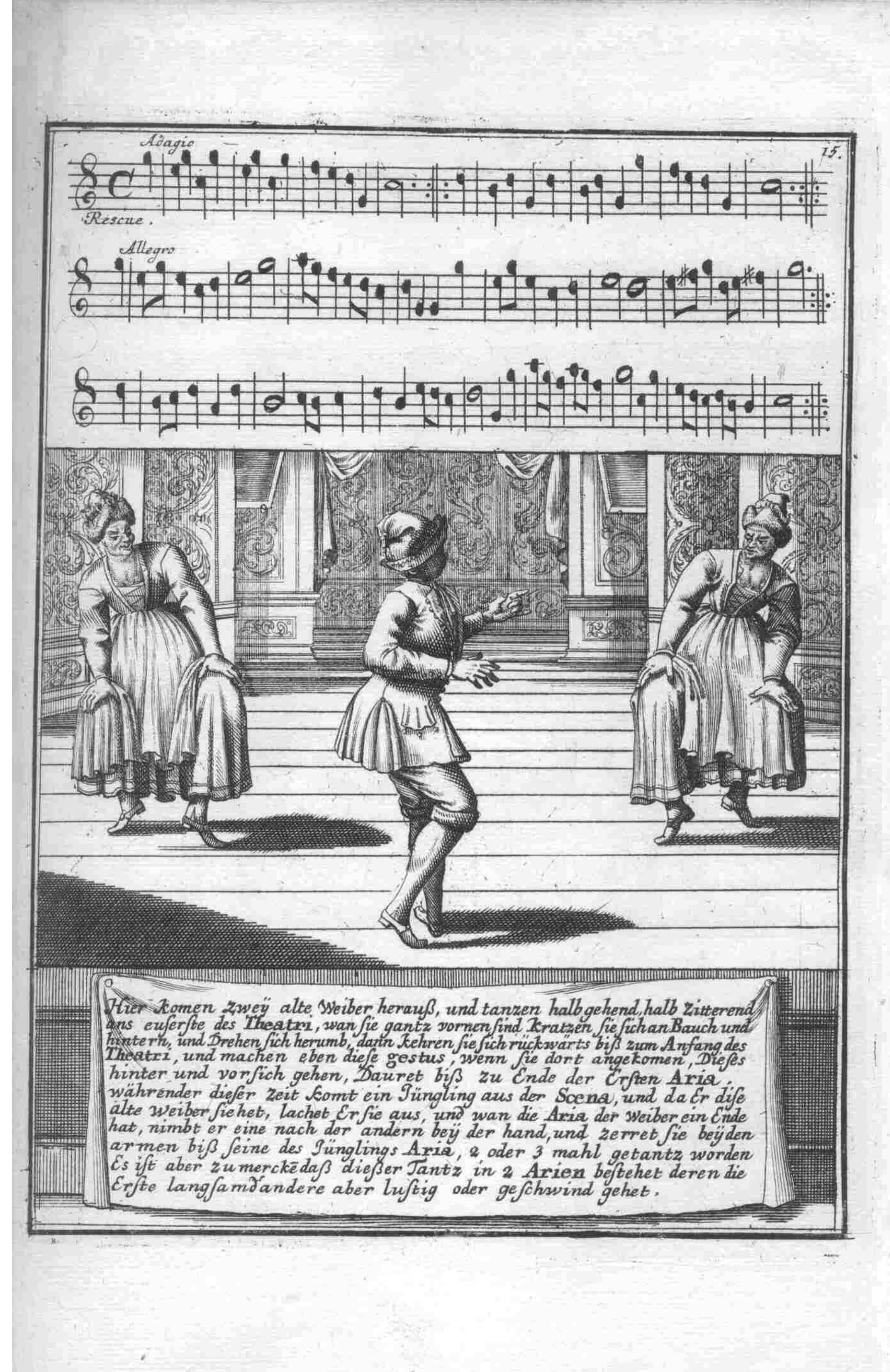
Lambranzi's manual is one of the earliest and most detailed visual sources for theatrical dance steps and their relationship to music, and one of the few surviving sources that shows how women dancers actually moved in formal theatrical costume during this period. Without engravings like this, knowledge of baroque stage dancing would rest almost entirely on written notation, which cannot convey the spatial qualities, speed, or the visual effect of a moving body in fabric.
What you are looking at
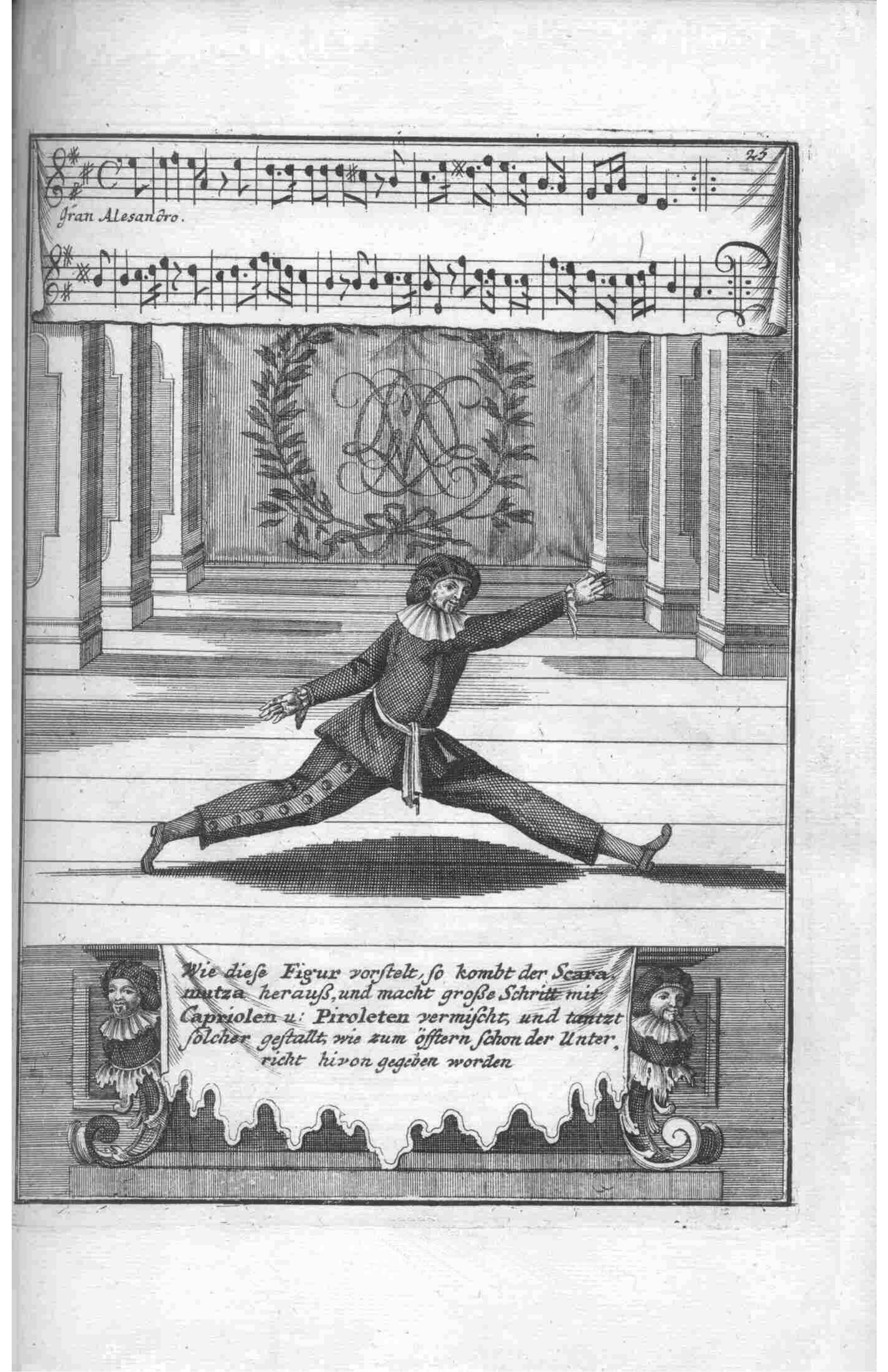
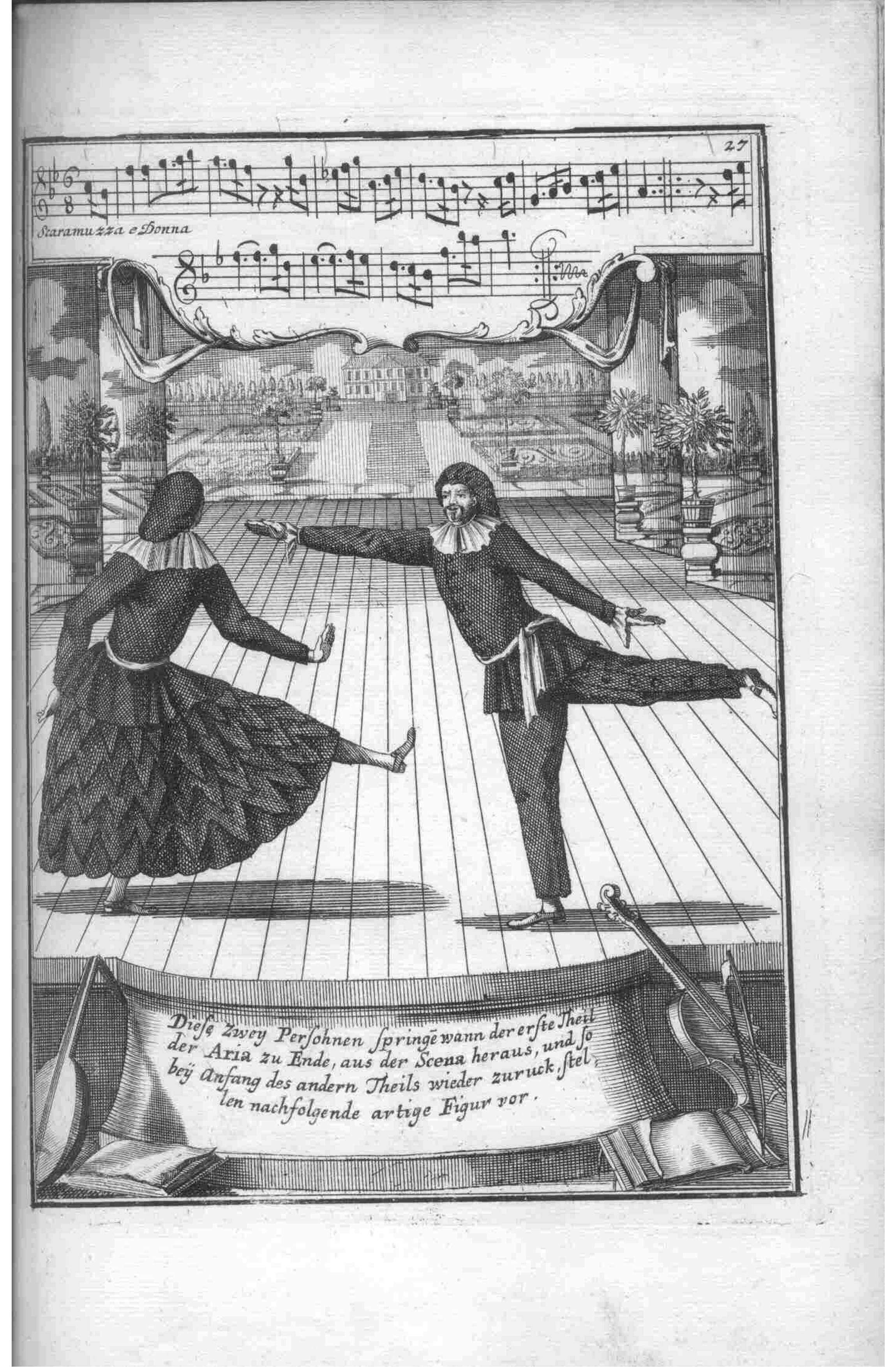
A solo female dancer occupies the center of a wooden stage, framed by ornamental curtains that sweep upward at both edges. She wears a dark, long-sleeved bodice with a prominent white collar and a full skirt that billows outward, suggesting rapid movement. The dancer is captured mid-gesture with her right leg extended and her torso angled, one arm reaching forward and the other extended to the side—a pose of dynamic elegance. Behind her, a painted backdrop depicts a formal garden or courtyard with a palace or grand house in the distance, classical urns, and figures strolling among orderly pathways, establishing this as a theatrical rather than social setting. The stage floor recedes in perspective lines. At the top of the page, musical notation in two staves shows the accompaniment for this dance.
The dancing
The dancer stands in a strongly asymmetrical pose: weight appears to shift onto her left leg while her right leg extends in a controlled line, and her arms frame a spiraling, elegant carriage of the upper body. Her head is turned, and her posture suggests both balance and a kind of restraint—the movement reads as refined rather than exuberant, with emphasis on verticality and the play of the full skirt. There is a single dancer, isolated against the stage, with no partner or group interaction.
The dance depicted
This is almost certainly a theatrical dance from the early 18th-century Italian or European court tradition, most likely a minuet or other galant dance form adapted for the stage. The notated score at the top suggests this is an illustration from a dance notation manual, where each plate pairs music with a choreographed solo. The flowing skirt, the elongated lines of the body, the refined arm positions, and the emphasis on clarity of line and deliberate pacing all point to court dance vocabulary transposed into theatrical costume. The painting indicates this was danced by trained performers in formal settings, not social dancers.
How it was made
This is a copper-plate engraving, a technique that allowed precise linear detail and fine gradations of tone through hatching. The medium created multiple identical prints suitable for circulation as a bound volume or portfolio, making this a teaching tool rather than a unique artwork. The engraver has used line alone to suggest light, fabric, depth, and movement; the fine parallel strokes of the background and the deliberate cross-hatching of shadow define the three-dimensional space. This technique was ideal for anatomical precision and the clear rendering of gesture and costume necessary for a dance manual.
About this work
This is a single plate from Gregorio Lambranzi's influential *Nuova e curiosa scuola de' balli theatrali* (Nuremberg, 1716), a copperplate-engraved manual of theatrical dance choreographies. Each plate in the book pairs a notated musical score with a costumed dancer executing a single choreographed solo, creating a visual archive of early 18th-century stage dancing. The work is one of the most detailed surviving sources for how these dances were actually performed, capturing not only the steps notated in the score but the costume, carriage, and theatrical context in which they were executed. This particular plate shows a solo female dancer in refined, courtly dress executing a passage that emphasizes elongated lines, controlled weight shifts, and the decorative play of fabric—hallmarks of the minuet and related galant forms.
How to look at it
Attend to the precise moment the engraver chose to freeze: not the apex of a leap or a moment of maximum extension, but a controlled transitional pose in which the dancer's weight and direction are unambiguous. Notice how the musical score at the top would have aligned with this gesture—the engraving is designed to be read in tandem with the notation, so the rhythm and tempo of the music would control how long the dancer held this position. The pose reads as neither resting nor climactic, but as a waypoint in a continuous flow, which is exactly how minuet-style dances moved: as a series of elegant, measured transitions rather than dramatic gestures.
The artist
Gregorio Lambranzi was a Nuremberg-based dancer and choreographer who compiled and notated a repertory of theatrical dances for the German-speaking stage. His *Nuova e curiosa scuola* (New and Curious School of Theatrical Dances), published in two volumes in 1716 with engravings and dance notation, represents one of the first attempts to systematically document theatrical choreography with both verbal notation and visual representation. The work was influential across Europe and circulated in multiple editions and translations, making it a foundational source for dance historians.
The period
The early 18th century saw the formalization of court dance on the theatrical stage and the emergence of the minuet and related galant dances as the dominant courtly idiom across Europe. Women were increasingly visible as professional stage dancers during this period, though still often in male-dominated theatrical hierarchies. The tradition of publishing dance manuals with notation and illustration had grown out of 15th- and 16th-century practice (Paix, Arbeau, Caroso) but reached a new level of visual sophistication in the early 1700s, driven by the need to codify and spread new fashionable forms. Lambranzi's work emerges at a moment when theatrical dance was becoming a distinct profession separate from social dancing.
Where it lives
This is Plate 26 from the first edition of Lambranzi's two-volume *Nuova e curiosa scuola de' balli theatrali*, published in Nuremberg in 1716. The work survives in multiple institutional copies across Europe and North America, and this particular plate derives from the Library of Congress holding.
Dance in this work
Questions about this work
How do we know this is a minuet?
We do not know with certainty from the image alone. However, the refined carriage, the extended lines of the body, the emphasis on control and clarity rather than elevation or speed, the full skirt worn for display, and the theatrical palace setting all suggest galant court dance forms of the early 18th century. The minuet was by far the most common and prestigious of these forms, and this aesthetic matches contemporary descriptions of minuet technique.
Could this be a real person, or is it idealized?
It is probably a composite based on real dancers but refined for the page. Engravers working from observation or dance masters' descriptions would stylize the figure to emphasize clarity and grace, particularly the line of the legs and the carriage of the arms. The exaggerated elegance is partly artistic convention and partly reflects genuine training—baroque court dancers were taught to move with this kind of elongated, composed quality.
What is the music at the top?
The musical staff at the top notates the accompaniment for this particular choreographed dance. Lambranzi's system linked notation to music, so a dancer or musician reading this plate would know both the steps (encoded in the gestural illustration) and the musical tempo and meter. The pairing of music and movement was central to understanding how these dances were performed.
Who would have used this book?
Dance masters, professional stage dancers, and serious amateurs who could read musical notation and understand dance notation would have used this as a teaching and reference tool. It was expensive to produce and circulated primarily among educated, urban, relatively wealthy readers—performers, composers, and patrons of dance in German-speaking lands and beyond.
More Notation/Choreography artwork