48 works in this view — arrow keys or swipe to move between them.
Dance in Art
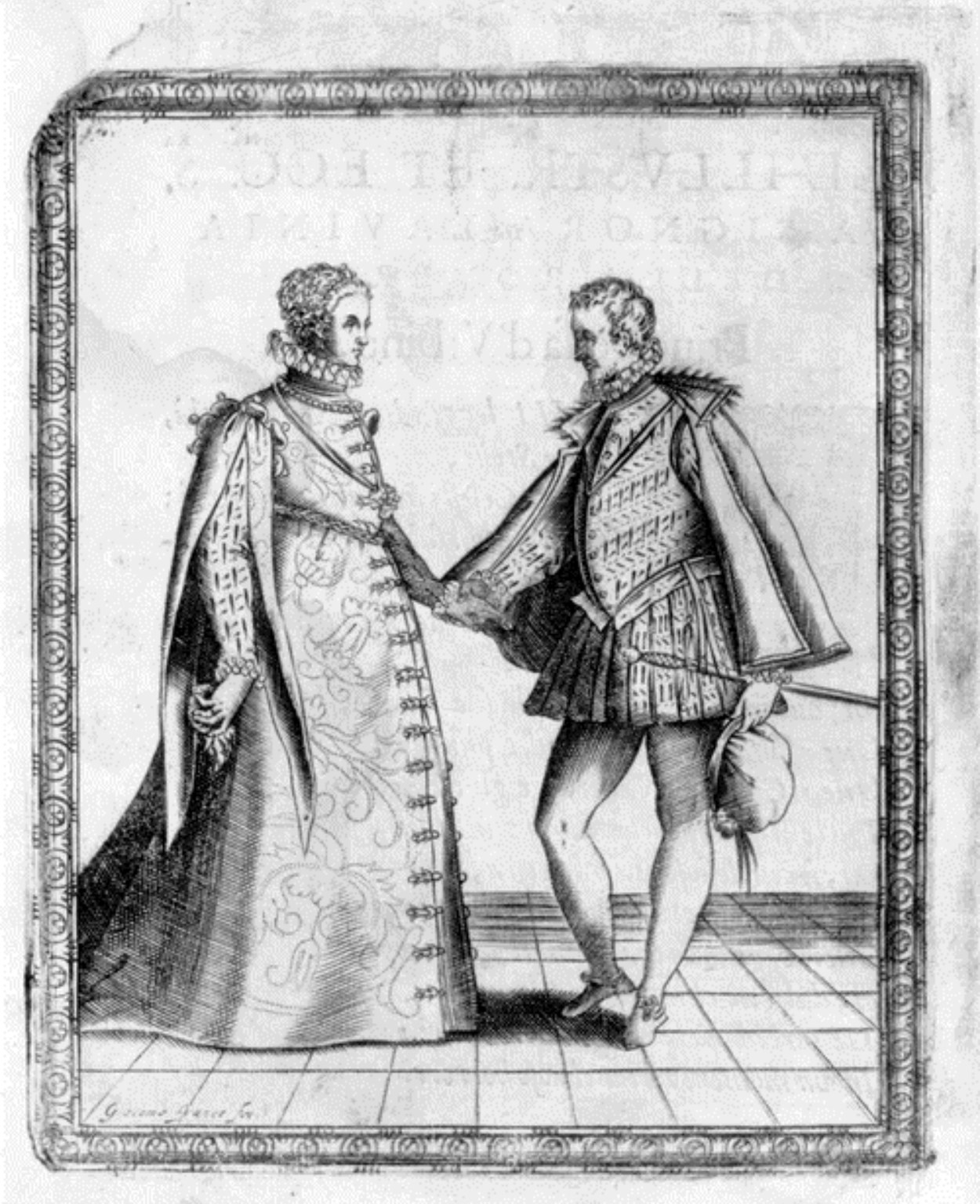
Caroso — Dance Plate (plate 12)
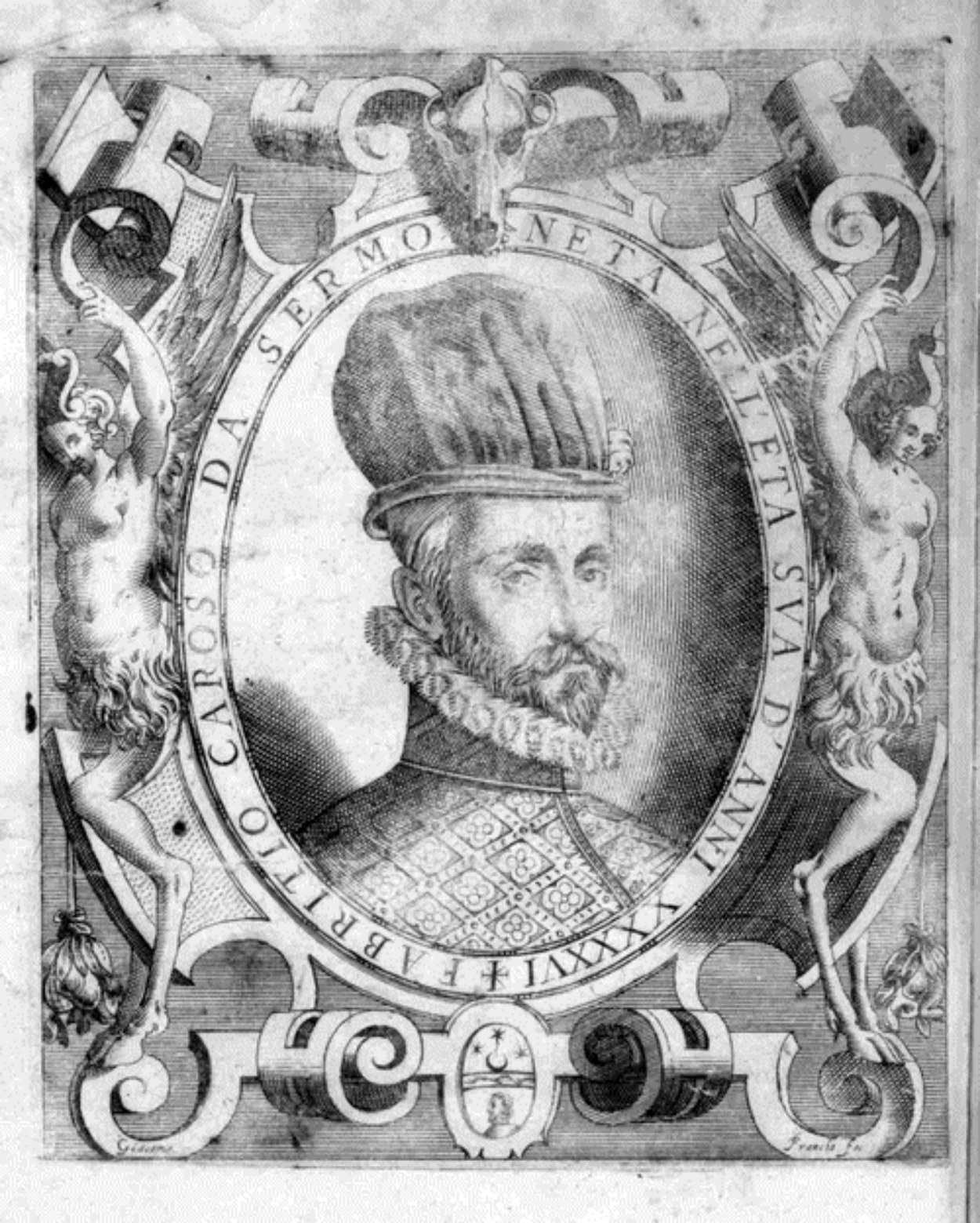
Fabritio Caroso da Sermoneta
- Medium:
- Woodcut
- Dance:
- Notation/Choreography
- Era:
- Pre-1700 (Renaissance/Baroque)
- Collection:
- Il Ballarino (1581)
- Source:
- Library of Congress
- Rights:
- Public domain — free to use, share and adapt.
- Recorded as:
- Public Domain
This plate is primary evidence for the appearance, deportment, and formal procedure of Renaissance court dance. For historians and dancers, it provides concrete visual information—the spacing between partners, the arm height and hand contact, the dress worn—that words alone cannot convey. It also demonstrates how dance knowledge was preserved and transmitted in print before the development of systematic choreographic notation: Caroso's combination of illustration and written text created a hybrid record that made the dances reproducible across time and geography.
What you are looking at
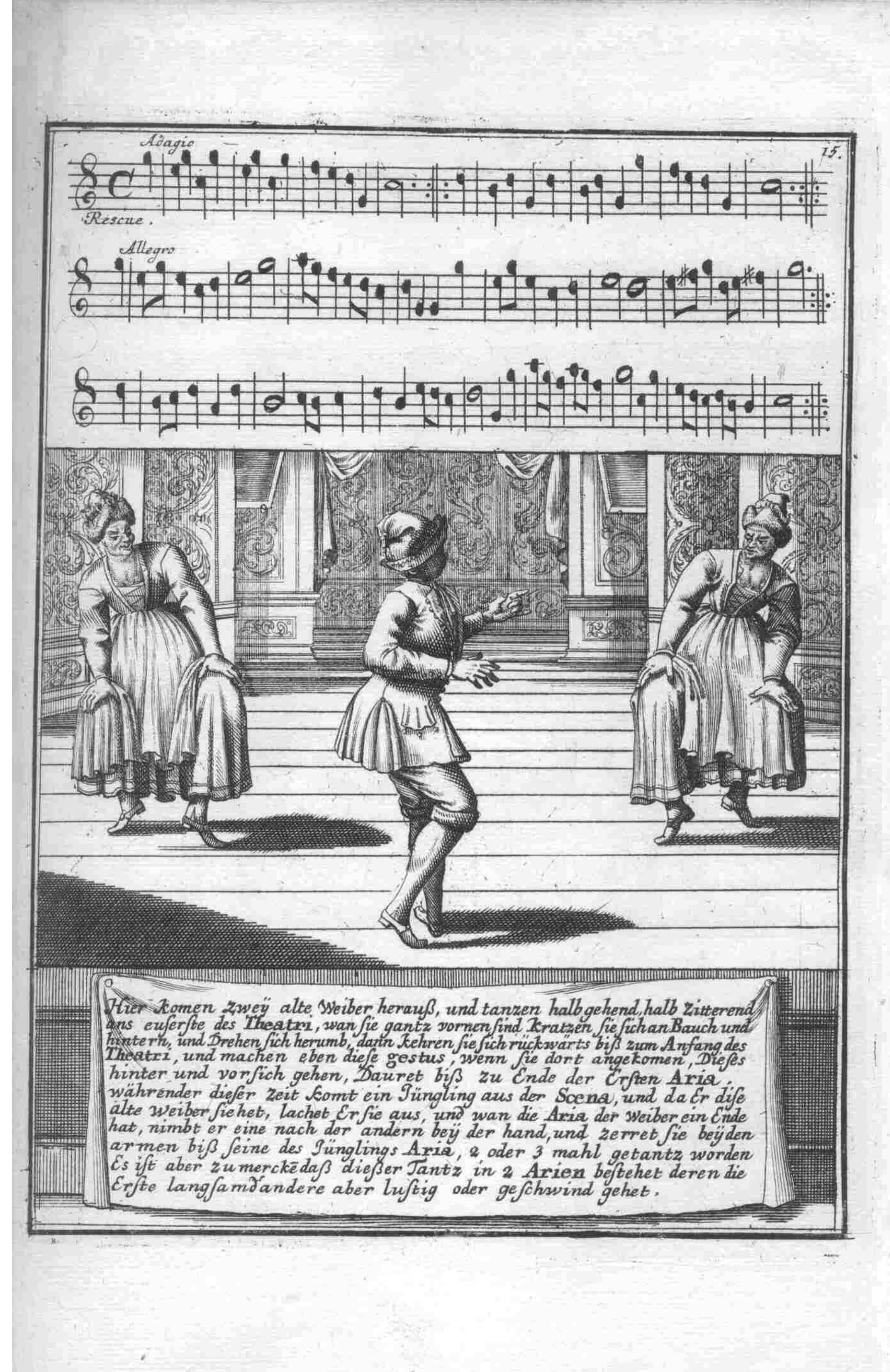
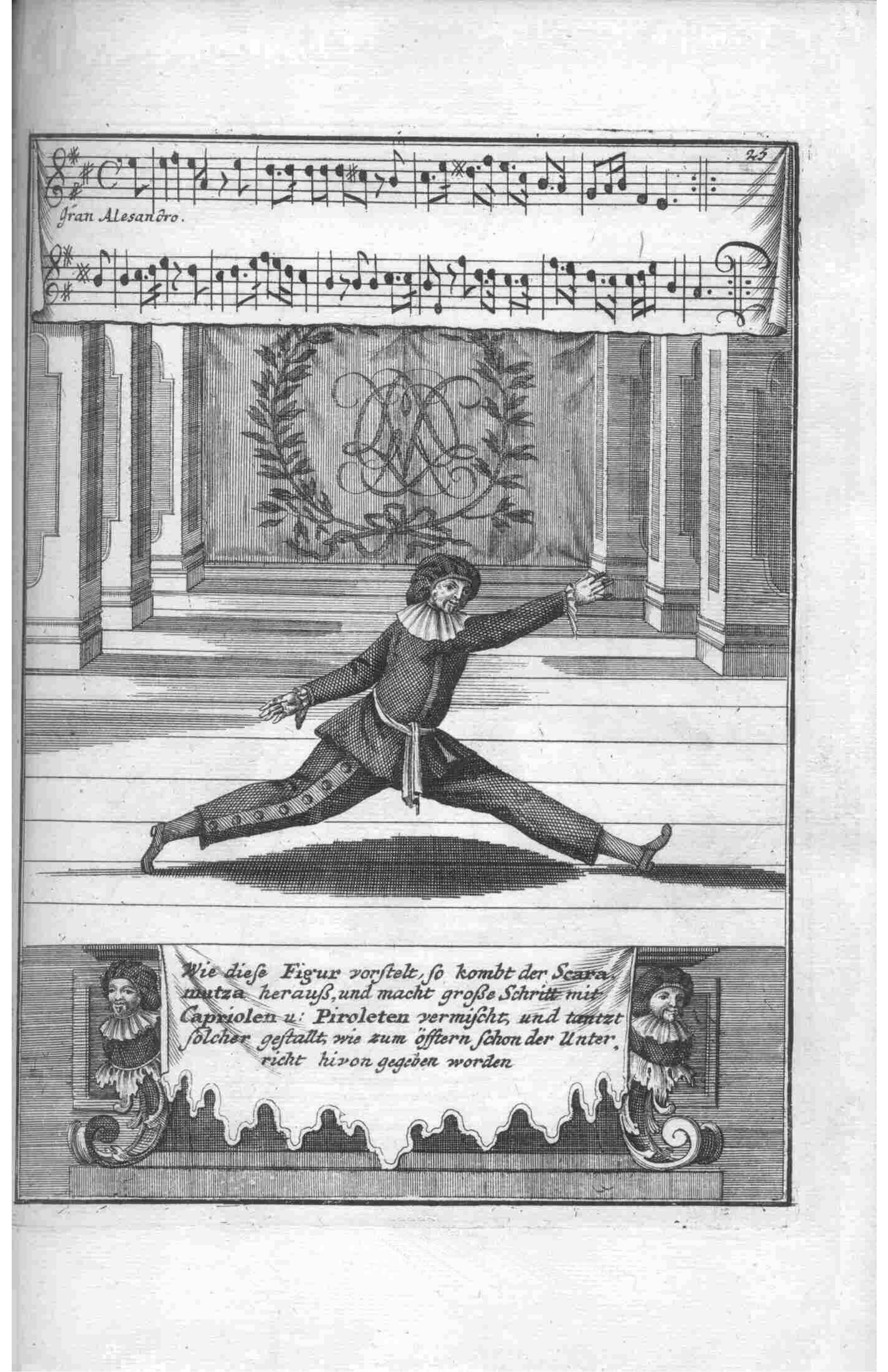
A woodcut depicting two figures in Renaissance court dress, facing each other in what appears to be a formal dance instruction or demonstration. The figure on the left wears an elaborately patterned long gown with a high collar, the fabric densely decorated with scrolling motifs, and a flowing cape lined with geometric patterns draped from the shoulders. The figure on the right wears a shorter doublet with similar linear patterning across the chest, breeches, and a cape of comparable construction. Both figures have their hair styled in the tight curls fashionable in late-sixteenth-century Italy. They stand on a tiled floor rendered in simple perspective. Their hands are joined or nearly touching at roughly waist height, suggesting a moment of connection or instruction within a formal dance. The composition is symmetrical and still, emphasizing clarity of costume and stance over dynamic movement. A decorative border in the style of a printed book frames the entire scene.
The dancing
Both figures stand upright with weight distributed evenly, their bodies nearly parallel to the picture plane. Their hands meet or nearly meet between them at approximately waist level, a position consistent with partnered Renaissance dances that required hand contact during certain passages. The frame is open rather than closed—the dancers are not locked in embrace but maintain formal distance. Their posture is erect and dignified, with no suggestion of turning, bending, or weight shift; the artist has chosen a moment of pause or preparation rather than active traveling or turning.
The dance depicted
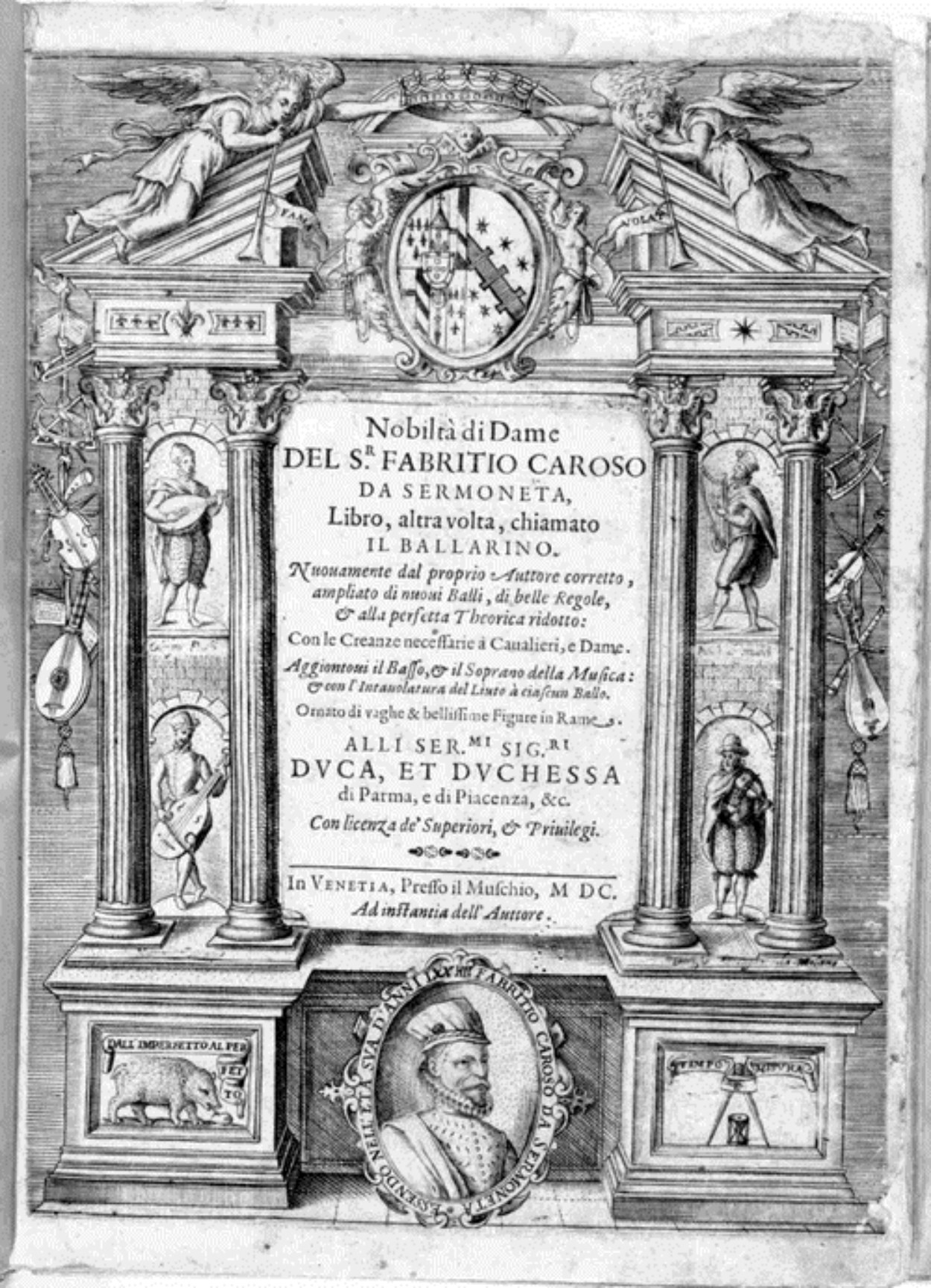
This plate illustrates one of the dances catalogued in Fabritio Caroso's *Il Ballarino* (1581), the most comprehensive and lavishly illustrated dance manual of the Italian Renaissance. Caroso documented the balletti and balli of the Venetian and Roman courts, and his plates served both as a record and as an instructional aid for dancers across Europe. The hand position and formal stance suggest a ballo or balletto—the courtly social dances of the period—rather than a theatrical spectacle dance. The symmetrical composition and the clear depiction of costume and deportment indicate that the primary purpose was instructional: to show the dancer the proper stance, dress, and spatial relationship required at a key moment in the choreography. Without the accompanying text, the specific dance cannot be named, but the formality and restraint suggest one of the more stately forms such as a pavane or the opening section of a galliard.
How it was made
This is a woodcut, a relief printing technique in which the image is carved into the surface of a wooden block, with ink applied to the raised areas. Woodcut allowed for bold, clear lines and areas of solid black, making it ideal for book illustration and for legibility when printed on the relatively rough paper of the sixteenth century. The technique's reliance on strong contrasts and simplified modeling of form—visible here in the parallel hatching used to render fabric pattern and the absence of subtle tonal gradation—is characteristic of the medium. As a page from a printed book, this image circulated widely among the literate classes and professionals who could afford Caroso's expensive, beautifully printed manual; it was not a one-off unique work but a reproducible illustration designed for repeated consultation and study.
About this work
This woodcut plate from Fabritio Caroso's *Il Ballarino* documents a moment from one of the balletti performed in the Italian Renaissance court. It is not a narrative scene or a theatrical spectacle, but rather an instructional image: a frozen moment showing two dancers in formal court dress, positioned to demonstrate the proper stance and hand placement required at a key point in a choreographed dance. The image combines costume documentation with choreographic notation in visual form—a way of recording and transmitting movement knowledge before the advent of detailed written notation systems.
Caroso's manual is one of the foundational texts of dance history, preserved in multiple printed editions and surviving copies across Europe. His plates are among the most vivid surviving records of how Renaissance courtiers actually dressed and moved. This particular work belongs to a tradition of dance notation and instruction that was central to courtly culture: the ability to dance well was an essential accomplishment of nobility, and printed manuals like this one made such instruction available beyond the immediate circle of a court master.
How to look at it
The artist has chosen the moment of hand contact or near-contact between the two dancers—the moment of formal greeting or the beginning of a partnered passage. This freeze-frame approach is typical of dance instruction manuals: rather than attempting to depict continuous movement, the illustration shows a static, legible position that a dancer could adopt and hold. Pay attention to the hands: they are not high or theatrical but held at a functional, controlled height. Notice also the feet—barely distinguished in the woodcut but clearly placed with weight distributed evenly, the stance that signals readiness rather than active motion. The symmetry of the composition and the equal scale of both figures emphasize that this is a formal, mutually respectful social exchange, not a performance for an audience. The elaborate costume is not incidental detail but part of the dance itself: in Renaissance court culture, the ability to move gracefully while wearing heavy, elaborately patterned fabrics was a key measure of skill and nobility.
The artist
Fabritio Caroso da Sermoneta (c. 1527–after 1605) was an Italian dancing master, choreographer, and author based primarily in Rome and Venice. He was among the most celebrated and prolific dance masters of the Renaissance, known for creating elaborate balletti for the courts and for his detailed, systematic approach to dance instruction. *Il Ballarino* (first published in Venice in 1581, with a revised edition in 1605 called *Nobiltà di Dame*) represents his life's work: a compendium of choreographies, techniques, music, and illustrated instruction. Caroso's manuals are distinguished by their beautiful woodcut illustrations, which are among the finest visual records of Renaissance dress and movement. His methodical approach to teaching dance—breaking movements into named steps, sequencing them logically, and illustrating key positions—made him influential across Europe and helped establish the foundations of codified dance technique.
The period
The late sixteenth century was a period of intense refinement and codification of courtly dance practices across Europe. In Italy, the courts of Venice, Rome, Mantua, and Urbino were centers of innovation, where professional dancing masters created new dances and refined existing ones. The invention of the printing press had made it possible for the first time to distribute detailed dance manuals in illustrated form; earlier generations of dancers relied almost entirely on oral transmission and live instruction. Caroso's *Il Ballarino* appeared at the height of this print-based transmission of dance knowledge and was one of the most successful and widely owned manuals of the period. Visually, the late sixteenth century was also a moment of extraordinary elaboration in courtly dress—the high-necked gowns, the patterning, the capes, and the tailoring visible in Caroso's illustrations reflect the peak of Venetian and Roman Renaissance luxury in textile and tailoring.
Where it lives
This is a page from *Il Ballarino*, a printed book published in Venice in 1581. The Library of Congress holds a copy of this work. The plate is not a unique artwork but one of many identical impressions made from the same woodblock during the original printing and subsequent printings of the manual.
Dance in this work
Questions about this work
Who were these dancers? Are they real people?
They are generic representations of a nobly dressed couple, not portraits of specific historical individuals. Caroso's plates show the ideal courtly dancers of his time: they are idealized types meant to instruct rather than to document actual performances. The elaborate dress and formal poses represent the standard of courtly accomplishment in Renaissance Italy.
What dance is this showing?
Without access to Caroso's accompanying text for this particular plate, the exact dance cannot be identified with certainty. However, the formal stance, the hand position, and the open frame suggest one of the slower, more stately balletti such as a pavane or the opening section of a galliard. Caroso's manual catalogues dozens of distinct choreographies, each with named steps and figures.
Why is this printed rather than painted?
Printing allowed Caroso's manual to be reproduced and distributed to courts and professional dancers across Europe. A unique painted work would have been seen by only a few people in one location. The woodcut medium, while simpler visually than painting, was ideal for creating an instructional manual that could be owned, consulted, and copied by anyone with access to a printing press.
How do we know this is about dance and not just fashion or courtly etiquette?
The hand contact between the figures and the formal, balanced stance are characteristic of partnered dance positions rather than of static social ceremony. Moreover, this plate is explicitly part of Caroso's dance manual, where every illustration documents a step, figure, or moment from a choreographed dance. The title of the manual and the context of the surrounding text confirm its choreographic intent.
More Notation/Choreography artwork