49 works in this view — arrow keys or swipe to move between them.
Dance in Art
Caroso — Dance Plate (plate 13)
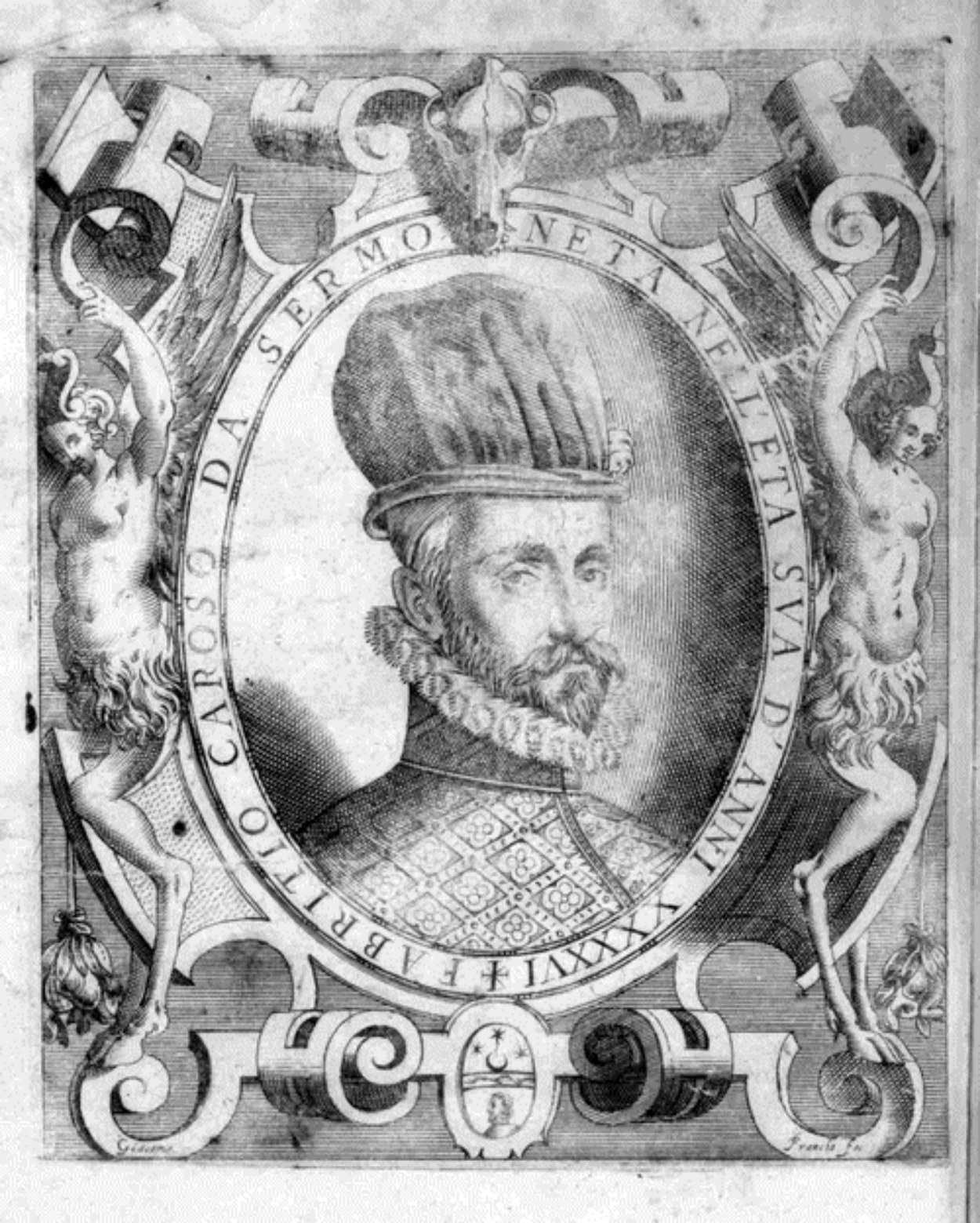
Fabritio Caroso da Sermoneta
- Medium:
- Woodcut
- Dance:
- Notation/Choreography
- Era:
- Pre-1700 (Renaissance/Baroque)
- Collection:
- Il Ballarino (1581)
- Source:
- Library of Congress
- Rights:
- Public domain — free to use, share and adapt.
- Recorded as:
- Public Domain
Caroso's *Il Ballarino* is one of only two surviving major Italian Renaissance dance manuals, and its woodcuts are among the earliest visual documentation of courtly dance technique and partnership. This plate and its companions established visual conventions for dance instruction that would influence European dancing-master manuals for the next two centuries.
What you are looking at
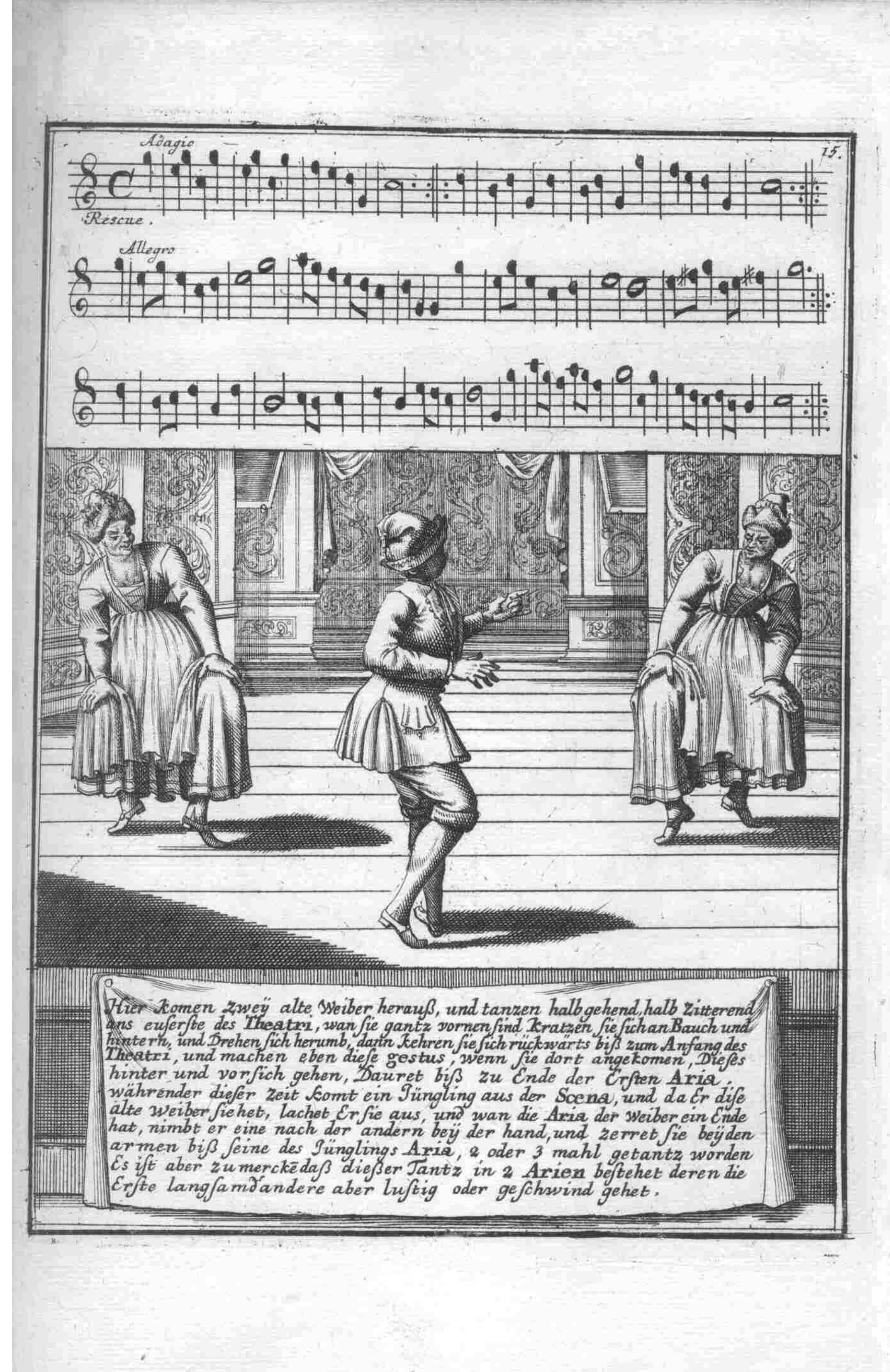
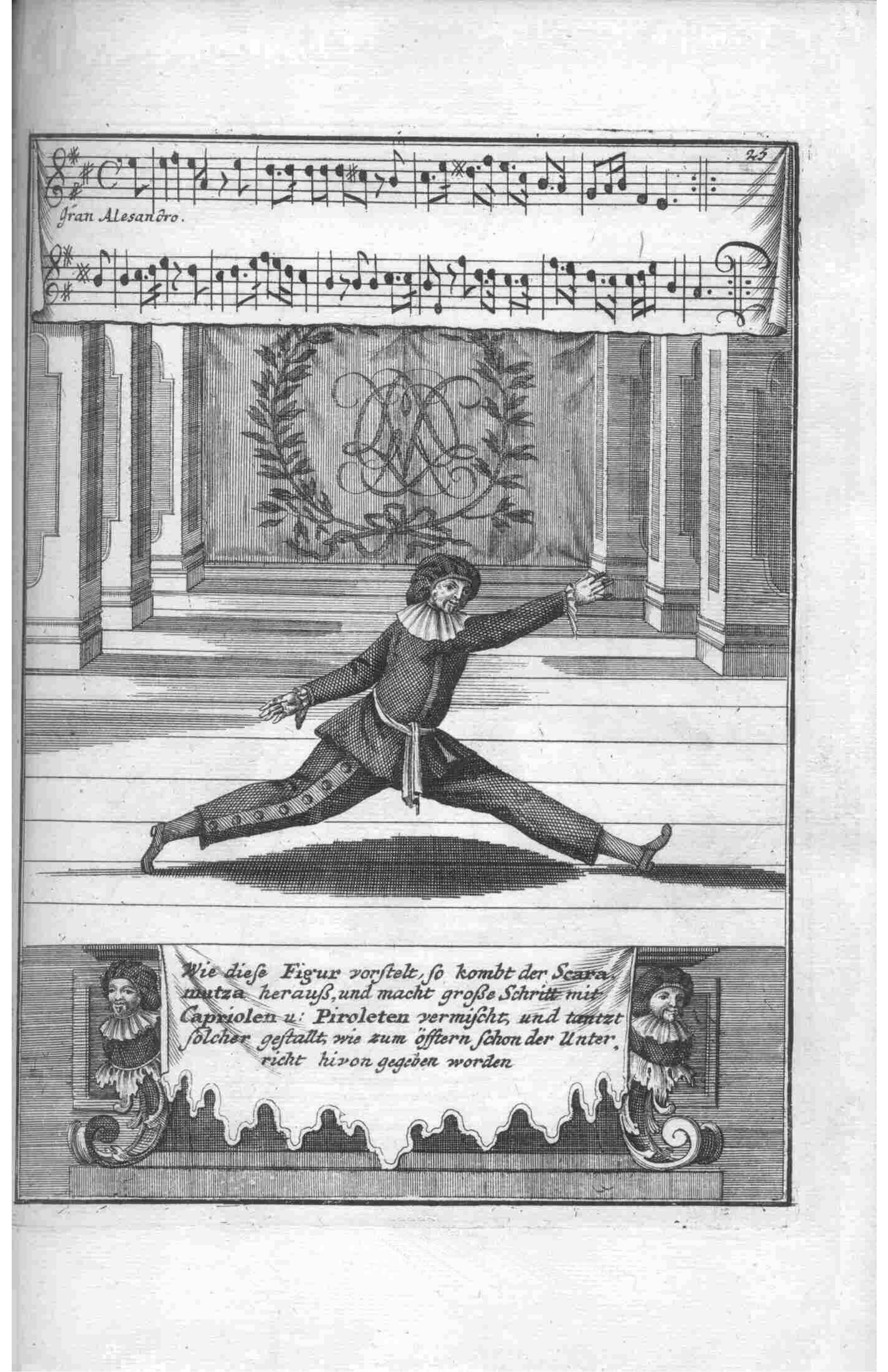
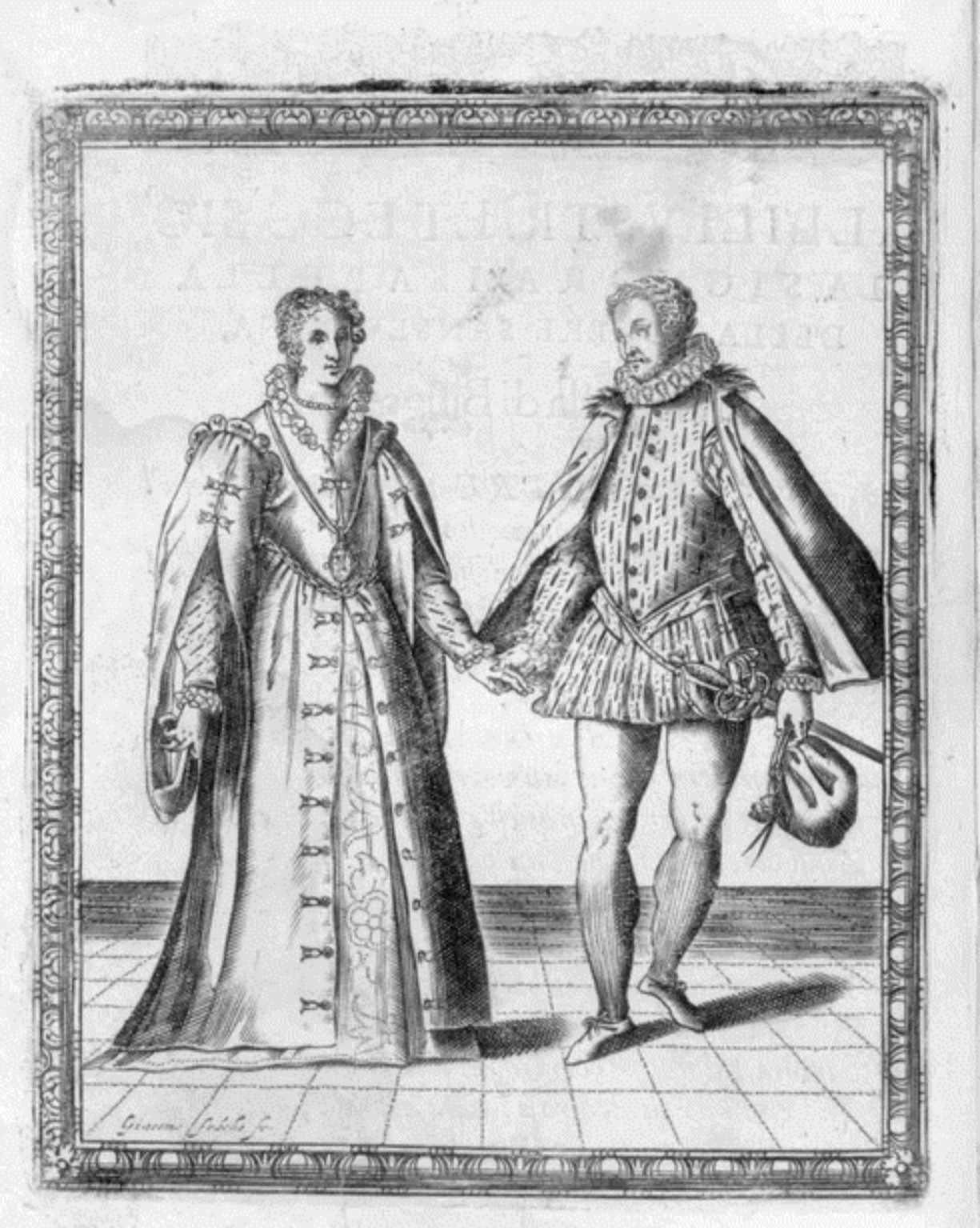
A woodcut from Caroso's treatise shows a Renaissance couple in formal court dress, standing hand-in-hand on a tiled floor against a plain background. The woman wears an elaborate gown with long sleeves, a high neckline, and ornamental fastenings down the front; her hair is dressed up and adorned. The man wears a short doublet with decorative slashing, trunk hose, and a voluminous cloak lined or trimmed with pattern, draped from one shoulder. Both figures are upright and composed, their hands connected at roughly waist height. The couple faces slightly toward each other, their bodies arranged in the formal parallel stance typical of court dance notation and instruction. The scene is framed by a decorative border characteristic of Renaissance printed books.
The dancing
The two figures stand in an upright, dignified posture with minimal flexion at the knees—the formal carriage required of court dancers. Their hands meet in a gentle clasp rather than an active grip, with arms at a natural length. The woman's weight appears centered, her elaborate train trailing behind her; the man stands equally balanced, his cloak settling around him. There is no suggestion of active movement or rotation through the torso; the bodies are presented in the stillness of a defined position rather than caught mid-step.
The dance depicted
This is a didactic illustration from Caroso's *Il Ballarino*, a systematic account of Italian Renaissance court dances. The couple demonstrates one of the numbered dances catalogued in the treatise—likely an *allemande*, *pavane*, or *galliard* based on the formal stance and partnership arrangement. Caroso's woodcuts were designed to accompany written descriptions and choreographic notation, making them tools for learning rather than records of a single performance. The image shows how partners held position and carried themselves—essential information for courtiers learning these dances, which were as much about social grace and proper comportment as about footwork.
How it was made
This is a woodcut, a relief-printing technique that yields bold lines and strong contrasts suited to reproduction in printed books. The technique allowed Caroso's *Il Ballarino* to circulate widely in Venice and beyond, making dance instruction available to a broader courtly audience than could attend a dancing master in person. Woodcut's aesthetic—the sharp outlines, the flat tones—gave the figures a formal, almost heraldic quality appropriate to their role as exemplars of courtly behavior. The decorative border was typical of prestigious Renaissance publications.
About this work
This is one of thirteen instructional woodcuts from Fabritio Caroso's *Il Ballarino* (Venice, 1581), the most influential Italian dance manual of the Renaissance. It documents not a choreographed sequence but a fundamental position and carriage—the baseline from which the steps and figures described in the text would unfold. The couple's formal dress, deportment, and hand-hold are not incidental details but the substance of what Caroso is teaching: how to look, stand, and move in the company of peers at court. As a printed image reproduced in copies owned across Europe, it shaped how Renaissance dancers understood and practiced their art.
Caroso's work is foundational to historical understanding of 16th-century Italian court dance. This plate, repeated in multiple copies and imitated by other teachers, became a visual standard for how couples should present themselves on the dance floor—a standard that persisted in modified form through the Baroque and beyond. For anyone studying how dance was learned, taught, and understood in Renaissance Italy, these woodcuts are primary evidence.
How to look at it
Observe the stillness of the image: these are not dancers caught mid-leap or mid-turn, but dancers presenting themselves in a foundational position. The woodcut technique emphasizes the silhouette and outline of the figures, making the cut and drape of the garments part of what we read as their posture and deportment. Notice how much of the 'dance' in Caroso's system is invisible to still images—it lies in the steps, the flow, the music—and how his woodcuts therefore focus on what must be held still: the formal frame, the proper stance, the correct hand-hold. The couple's composure is not inaction but *control*.
The artist
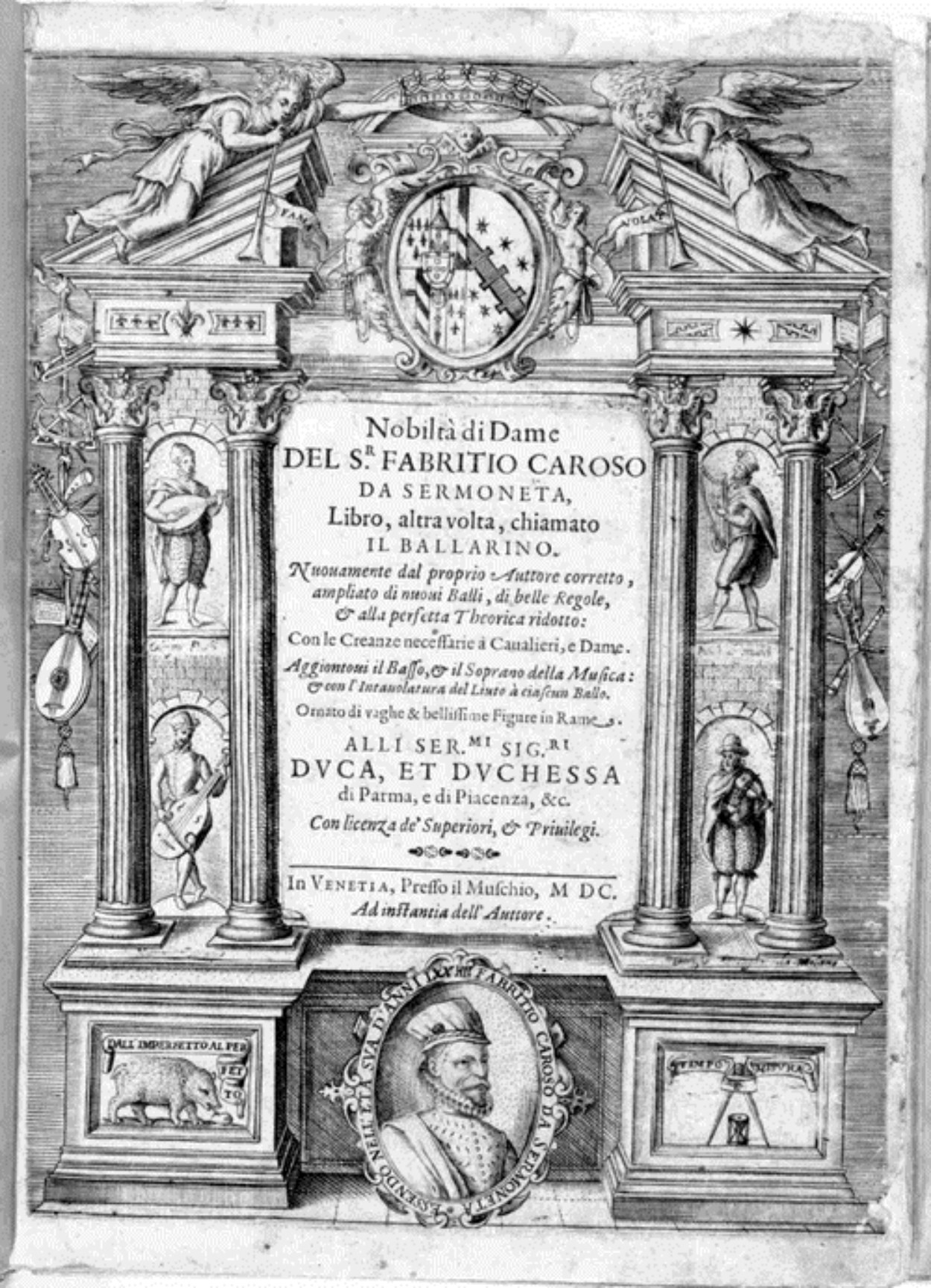
Fabritio Caroso da Sermoneta (c. 1526–after 1605) was a prominent Roman dancing master who served noble families and the papal court. His *Il Ballarino*, published in Venice in 1581, was revised and reissued as *Nobiltà di Dame* in 1600, and both editions remained in circulation throughout the 17th century. Caroso was known for systematizing Italian dance practice into a coherent pedagogy; his treatise provided written descriptions, choreographic notation (using a letter-based system), and these woodcut illustrations together, making it the most comprehensive Renaissance dance manual available to his contemporaries.
The period
The late 16th century saw a flourishing of printed dance manuals across Europe. Caroso's *Il Ballarino* appeared in an era when dance was becoming more formalized and codified—a shift from improvisation toward the choreographed *balli* (named dances) and *balletti* that dominated Italian court life. This coincided with a broader Renaissance interest in systematizing knowledge through print and illustration. The couple shown here—in their formal dress, their composed bearing, their partnership in a courtly ritual—embody the ideal of *sprezzatura* (effortless grace) that defined elite Renaissance social practice. Dance was central to that performance of refinement.
Where it lives
This woodcut comes from *Il Ballarino* (Venice: Giolito de' Ferrari, 1581), the first and most influential printed treatise on Italian Renaissance court dance. The Library of Congress holds a copy, as do major research libraries across Europe. The woodcut was reproduced in the 1600 revised edition and has been widely referenced in subsequent dance-history scholarship.
Dance in this work
Questions about this work
What dance are they doing?
Caroso's woodcuts illustrate individual dances from his treatise, each identified by number and name in the text. Without the corresponding text, we cannot be certain which of the dozens of dances catalogued in *Il Ballarino* this particular plate accompanies—it could be a pavane, an allemande, a galliard, or one of the named balli Caroso describes. The formal stance and closed partnership hold it to the family of European court dances performed at Renaissance courts.
Why are they just standing there?
Renaissance dance manuals used still images to communicate position and posture—the foundational elements from which steps and figures flow. Caroso's woodcuts work with written descriptions and notation (visible in the text) to convey the full dance. A still image alone cannot show steps, timing, or weight transfer, so Caroso used it to show what a dancer needed to *hold*: the frame, the carriage, the proper hand-hold with a partner.
Who is Caroso?
Fabritio Caroso was the leading dancing master of Renaissance Rome, serving the papal court and noble families. His *Il Ballarino* (1581) and its later revision, *Nobiltà di Dame* (1600), are the most comprehensive surviving Italian Renaissance dance manuals. Unlike many of his contemporaries, Caroso combined written description, choreographic notation, and woodcut illustration to make dance teachable from a book.
How were these dances actually performed?
Caroso's text and notation describe the steps and figures in detail; the woodcuts show the carriage and frame. A Renaissance court dance typically featured a processional opening, a series of named steps and figures (galliards, doubles, singles, hops), often in set patterns, and a concluding sequence. They were performed to live music—usually a string ensemble—and were as much about demonstrating grace, status, and control as about athletic ability.
More Notation/Choreography artwork