49 works in this view — arrow keys or swipe to move between them.
Dance in Art
Caroso — Dance Plate (plate 14)
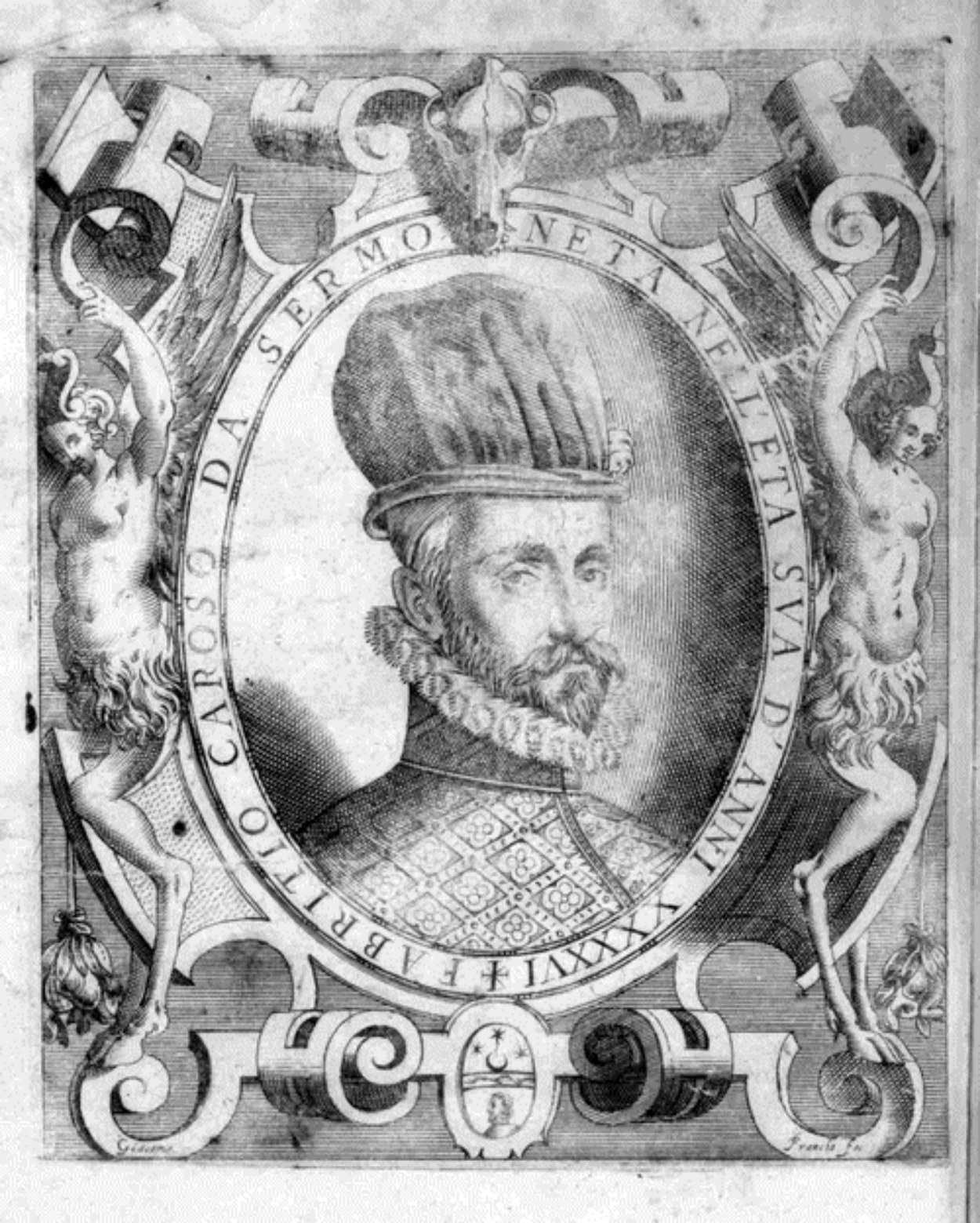
Fabritio Caroso da Sermoneta
- Medium:
- Woodcut
- Dance:
- Notation/Choreography
- Era:
- Pre-1700 (Renaissance/Baroque)
- Collection:
- Il Ballarino (1581)
- Source:
- Library of Congress
- Rights:
- Public domain — free to use, share and adapt.
- Recorded as:
- Public Domain
This work is one of the only surviving documentary sources that shows how Renaissance court dances were actually performed, combining written choreography with realistic contemporary dress and body position. For dancers and historians, Caroso's plates are irreplaceable evidence of Renaissance kinesthetic culture—the posture, spacing, timing, and social ritual embedded in elite courtly movement. The work also exemplifies how dance instruction was transmitted and validated through print culture in the Renaissance, predating later codifications and revealing a moment when dance was considered an essential art of courtship and diplomacy.
What you are looking at
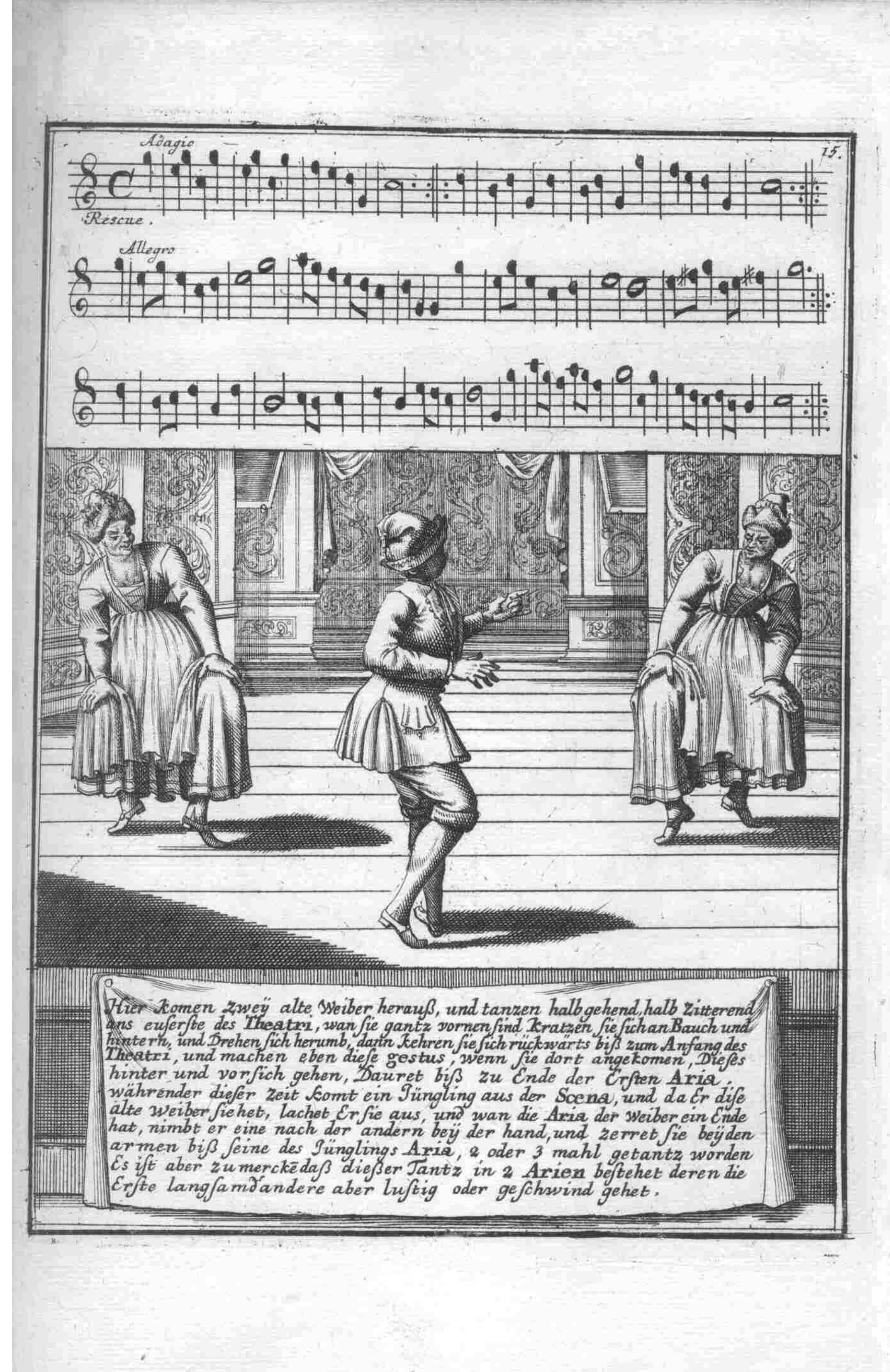
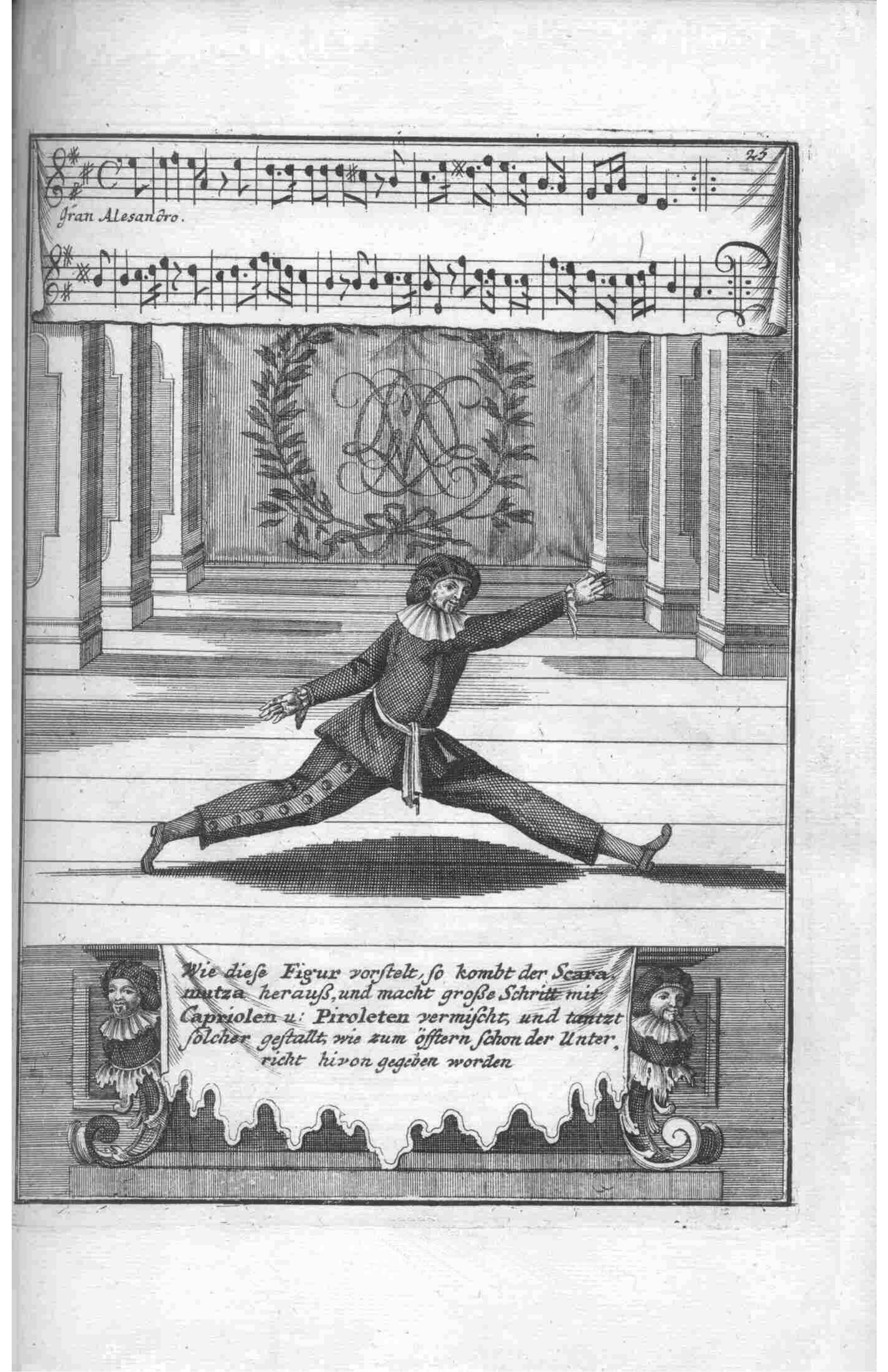
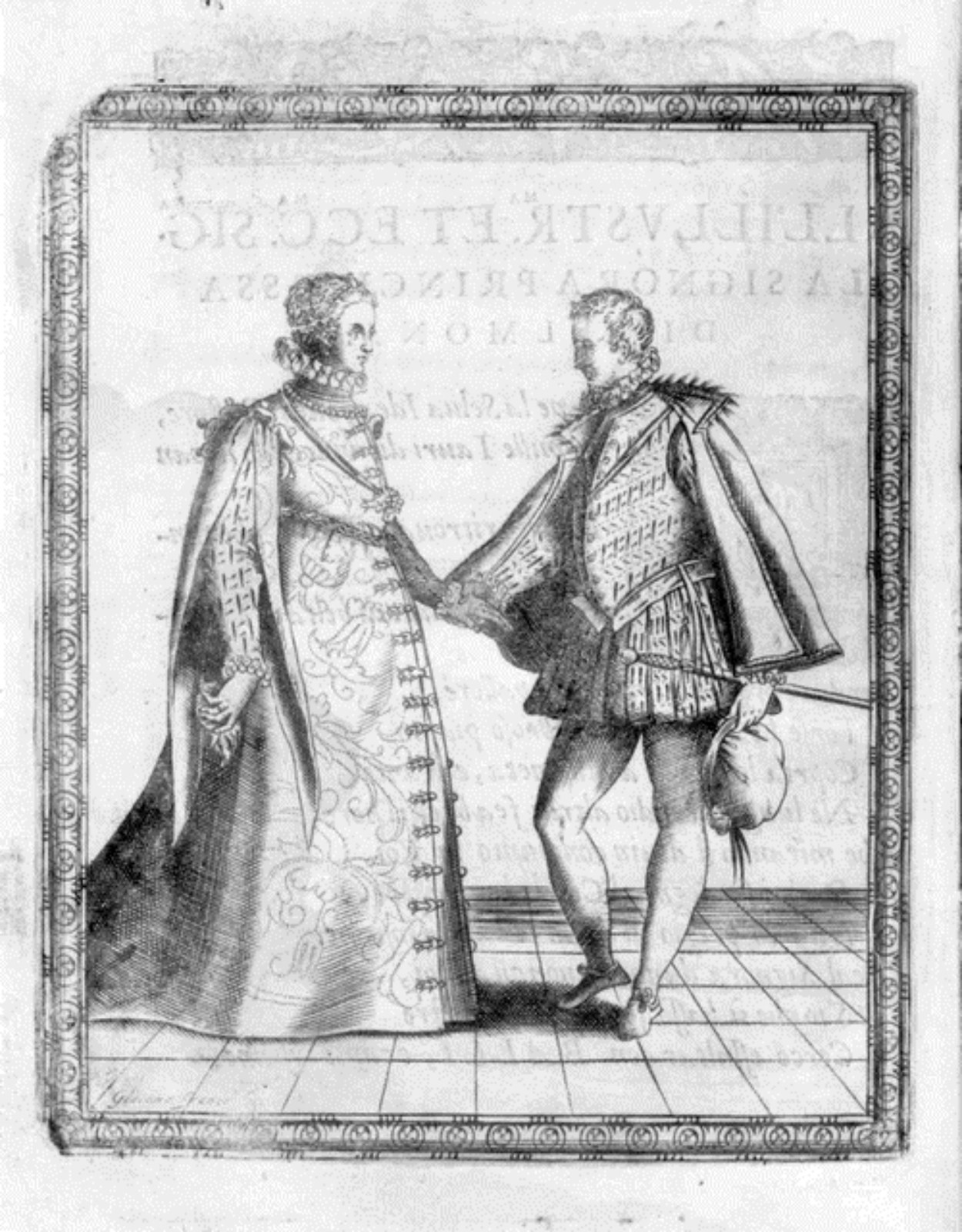
A woodcut from Caroso's dance manual depicts two elegantly dressed Renaissance figures in a formal court setting, posed to demonstrate a dance step or movement. The figure on the left wears an elaborate gown with intricate patterned brocade, a high collar, and a long flowing cape lined with decorative patterning, their body angled toward their partner. The figure on the right wears a richly decorated doublet with parallel lines suggesting quilted or segmented armor, short fitted breeches, and a draped cloak; they hold what appears to be a helmet or decorative headpiece in one hand. Both stand on a tiled floor rendered in perspective, their heads turned slightly toward one another in profile or three-quarter view. The setting is austere and formal—a bare interior with an ornamental border frame characteristic of printed Renaissance dance instruction. The poses suggest a moment of salutation, negotiation of distance, or preparation for a coupled movement rather than active motion.
The dancing
Both figures maintain an upright, dignified posture with weight distributed evenly, suggesting the controlled deportment required of Renaissance court dancers. Their bodies angle toward each other without closed contact; the left figure's hand reaches toward the right figure's arm or hand in what appears to be an invitation or formal greeting gesture. The right figure's free hand gestures or balances with the helmet, while both dancers' legs remain relatively still and extended, with no visible disruption of their elaborate garments suggesting active footwork. The spacing and body angles suggest a moment of approach or recognition before movement begins, typical of Renaissance choreographic conventions that emphasized measured transitions.
The dance depicted
This plate illustrates a moment from one of the processional or courtship dances documented in Caroso's *Il Ballarino*, most likely either a pavane (a stately processional dance) or a galliard figure (though the poses lack the dynamic elevation characteristic of galliards). The printed manual catalogued the actual dances performed in late-16th-century Venetian and Italian courts, and Caroso's instructions paired written choreography with woodcut figures to guide dancers through specific steps, weights, and arm positions. The formality of dress—the woman's elaborate brocaded gown and the man's quasi-military doublet—indicates this represents elite courtly practice rather than common social dancing. The carefully posed moment captures not a leap or turning movement but the geometric and spatial relationships that structured Renaissance couple dances: the precise distance, angle, and mutual acknowledgment that the dance system required.
How it was made
This is a woodcut printed from *Il Ballarino*, a sumptuous 1581 Venice publication. Woodcut allowed for mass production of instructional images far cheaper than engraving, making Caroso's system teachable and reproducible across European courts. The medium's linear clarity and bold blacks suited didactic purposes: every seam of the clothing, every architectural line, and every body contour reads distinctly, leaving no ambiguity about posture or dress. The ornamental border—characteristic of printed books of the period—frames the image as an authoritative plate within a larger system of instruction. Woodcut's limitations (fine detail, subtle tonal gradation) meant the artist worked in silhouette and line, emphasizing the structural bones of the pose rather than atmospheric or painterly qualities.
About this work
This is a woodcut instructional plate from Fabritio Caroso's *Il Ballarino* (Venice, 1581), one of the two most influential Renaissance dance manuals, showing two elaborately dressed court dancers posed to demonstrate a specific moment in a couple dance. Rather than depicting vigorous action, it freezes a moment of formal approach and spatial negotiation—the geometry and decorum that structured Renaissance dancing. The image is primary documentary evidence for how elite dancers of the Venetecento understood their bodies, their partners, and the visual codes of courtliness. Caroso's plates are among the few surviving visual records that pair dance instruction with accurate contemporary dress, making them invaluable for reconstructing how Renaissance court dances actually looked in performance.
How to look at it
Look at the precise angle of the bodies relative to each other and the floor, the hand position, and the symmetry of the composition. The artist has chosen a moment of formal recognition or invitation—not a high point of movement but a structured threshold. Notice how both figures' weight appears centered and stable, neither foot advanced; this is the stasis and control that Renaissance courtesy required. The elaborate dress is not incidental—every seam, button, and textile pattern is legible because the movement needed to accommodate these garments. By showing the dance in formal dress rather than in motion clothes, the plate documents the actual conditions of performance: Renaissance court dances were demonstrations of the dancer's ability to move elegantly despite (and through) rich, restrictive clothing.
The artist
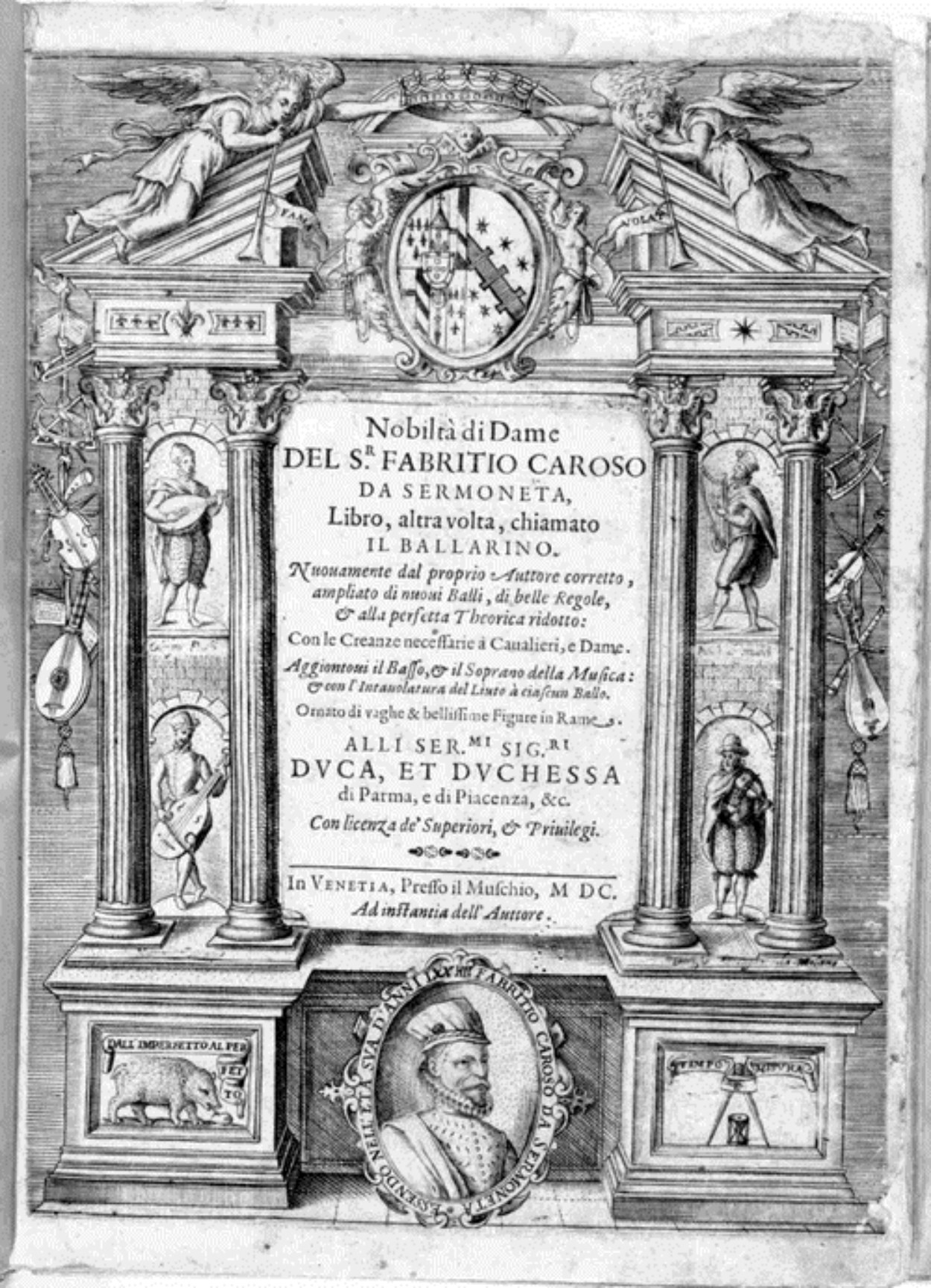
Fabritio Caroso da Sermoneta (c. 1526–1605) was a celebrated Roman dancing master and theorist who served the papal court and taught nobility across Italy. He documented his practice in two major publications: *Il Ballarino* (Venice, 1581) and a substantially revised edition, *Nobiltà di Dame* (Venice, 1600). Caroso's method was systematic and prescriptive—he provided named dances with numbered steps, specified music, and illustrated plates showing the dancers' positions at key moments. His work represents the high-water mark of Renaissance dance codification and was widely circulated and imitated across Europe, making him one of the most influential dance teachers of the Renaissance.
The period
The late 16th century saw dance elevated to the status of essential courtly accomplishment, practiced as a mark of noble status and refined breeding. In Venice and the Italian courts, dancing masters like Caroso professionalized instruction and began publishing systematic treatises, transforming dance from ephemeral performance into documented knowledge. The rise of printed dance manuals—Caroso's *Ballarino* followed Antonio Cornazano's earlier treatise and accompanied Marco Fabritio Caroso's contemporary work—reflected both the growing importance of dance in court culture and the Renaissance appetite for systematic classification and transmission of knowledge. Woodcut and engraving allowed these manuals to circulate widely, making dance instruction available to a far broader audience than oral tradition had permitted, though the elaborate dress depicted—silk brocade, jeweled collars, quilted armor—marked these dances as an elite practice.
Where it lives
This woodcut is from the collection of the Library of Congress and is held as part of their Renaissance printed materials. The plate is one of approximately 80 woodcut instructional figures in *Il Ballarino*, each depicting a different dance position or moment from the dances Caroso catalogued. The work survives as a printed page in bound copies of the original 1581 Venice edition.
Dance in this work
Questions about this work
What dance is being shown here?
The specific dance cannot be identified with certainty from the pose alone, but Caroso's system suggests either a pavane (a processional dance) or a moment from a galliard figure. The formal, upright postures and the moment of approach are consistent with several of Caroso's documented dances. The printed text accompanying the plate in the original book would have specified the dance name and step sequence, which is not visible in this reproduction.
Why does the man hold a helmet?
The object may be a decorative helmet or a stylized representation of courtly masculine dress and status; it may also indicate a specific dance's narrative or allegorical content. Renaissance court dances often drew on themes of chivalry, warfare, and courtship, and props or costume elements sometimes carried symbolic meaning. Without access to Caroso's accompanying text, the object's precise significance cannot be determined.
How were Renaissance court dances actually taught?
Dancers learned through private instruction from a dancing master (like Caroso), who would physically demonstrate steps and positioning. Caroso's printed manual accelerated this process by allowing teachers to reference standardized figures and sequences; wealthy patrons could own the book and use it to refresh their memory or teach others. The combination of numbered steps, musical notation, and illustrated poses created a reproducible system, making Renaissance dance teaching more uniform across courts and more achievable without direct access to the master.
What does the ornamental border mean?
The elaborate border is a convention of Renaissance printed books, especially luxury editions intended for aristocratic audiences. It signals that the content within is authoritative, valuable, and worthy of display. For Caroso's *Ballarino*, the decorated border frames each dance instruction as an official, certified system of knowledge—elevating dance instruction to the status of other scholarly and artistic disciplines.
More Notation/Choreography artwork