49 works in this view — arrow keys or swipe to move between them.
Dance in Art
Caroso — Dance Plate (plate 18)
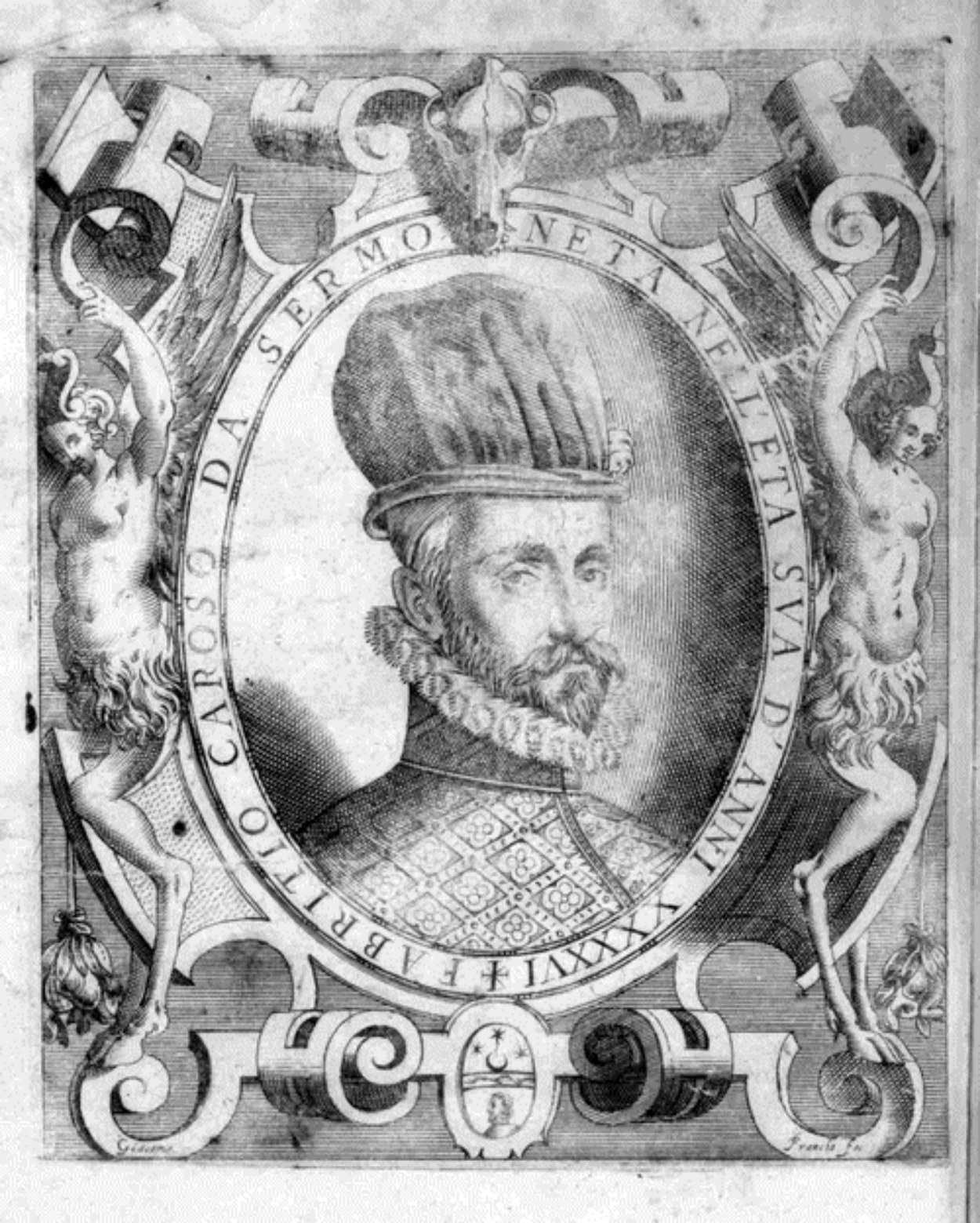
Fabritio Caroso da Sermoneta
- Medium:
- Woodcut
- Dance:
- Notation/Choreography
- Era:
- Pre-1700 (Renaissance/Baroque)
- Collection:
- Il Ballarino (1581)
- Source:
- Library of Congress
- Rights:
- Public domain — free to use, share and adapt.
- Recorded as:
- Public Domain
Caroso's *Il Ballarino* is one of the two most important European dance manuals of the Renaissance, and the woodcut illustrations are the most reliable visual documentation we have of how the dances of the period were actually performed and costumed. For dancers and historians, these plates are primary source material: they show us the dancer's posture, the relationship between partners, the role of costume and jewels in the visual effect, and the formal conventions of courtly movement.
What you are looking at
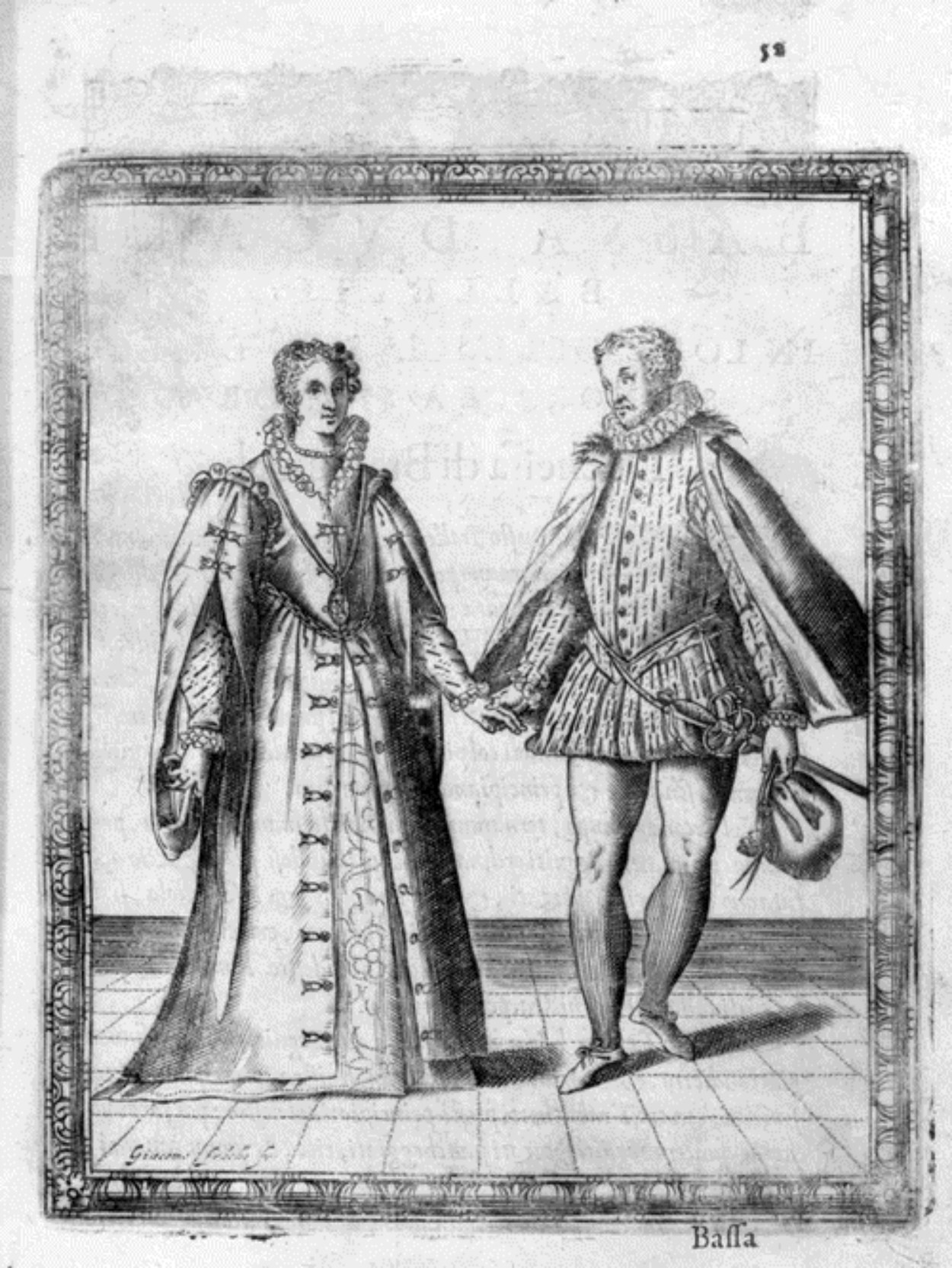
A woodcut depicting a Renaissance Italian couple in elaborate court dress, standing face-to-face in a formal pose against a plain background. The man, on the right, wears a richly decorated tunic with vertical pleating, a high collar, and a sweeping cape lined with a dotted or stippled pattern; his legs are bare and he wears fitted hose. The woman, on the left, is dressed in a long gown with a fitted bodice decorated with ornamental fastenings and a dramatically long, trailing train or skirt that extends across the floor. She wears a close-fitting cap or headdress and jewels at her throat. Both figures are shown in three-quarter view, their bodies aligned in parallel, their hands meeting or nearly touching at their centers in an intimate but formal gesture. The composition is symmetrical and ceremonial, framed by an ornamental border typical of Renaissance printed books. The figures occupy the middle ground of the image, with no setting or architectural detail to suggest location—the focus is entirely on the dress and the studied arrangement of the two bodies.
The dancing
Both dancers stand upright with their weight distributed evenly, their posture formal and dignified. The man's right hand and the woman's left hand are brought together at the center of the composition, suggesting either a joining of hands or the moment before contact—a gesture central to Renaissance court dance. Their bodies remain largely vertical and restrained; there is no visible torsion or dynamic weight shift, and the legs are extended straight rather than bent. The positioning suggests an opening moment of a dance or the formal greeting that preceded it, with both figures poised and attentive to each other.
The dance depicted
This plate illustrates one of the dances catalogued in Caroso's *Il Ballarino*, the most comprehensive and influential dance manual of the late Renaissance. Caroso's dances were performed in aristocratic courts across Italy and involved couples in formal geometric patterns, with emphasis on symmetry, deliberate gesture, and precise footwork. The hand-joining gesture and the upright posture are consistent with dances of the *bassa danza* family or the early *galliard*, which were staples of Italian court dancing in the Cinquecento. The woman's long train and the man's cape reflect the actual costume worn for these performances and constrained the movement vocabulary—steps were relatively small and controlled, and the visual spectacle came as much from the fabric and jewels as from the dance itself.
How it was made
This is a woodcut, a relief printing technique in which an image is carved into the surface of a wooden block, with ink applied to the raised surfaces. Woodcuts were fast to produce and inexpensive to print, making them ideal for book illustration in the 1580s. The technique allows for bold contrasts between line and solid area, and here it renders the ornamental details of costume—the pleating of the tunic, the jeweled bodice, the dotted lining of the cape—with precision. Woodcuts were the standard vehicle for dance manuals in this period because they could reproduce both text and figural demonstration at reasonable cost, allowing the book to circulate to a wide readership of court musicians, dancing masters, and aristocratic performers.
About this work
This is a plate from Fabritio Caroso's *Il Ballarino* (Venice, 1581), the most celebrated and widely distributed dance manual of the Italian Renaissance. The book presents a repertory of fashionable court dances with detailed instructions, and each dance is accompanied by a woodcut showing two dancers in costume in the formal pose or opening moment of the dance. This plate shows a couple in elaborate Cinquecento dress—the man in a pleated tunic and lined cape, the woman in a long gown with decorated bodice and sweeping train—positioned to show the formality and the hand-joining gesture that characterize Renaissance court dance. The work is important as both a technical manual and a visual record of how aristocrats dressed and moved in the late 1500s.
How to look at it
Look at the positioning of the hands and the evenness of the weight: this is the formal opening gesture of a dance, captured at the moment of greeting or hand-joining. Notice how much of the visual composition is devoted to costume—the elaborate embellishment of the tunic, the jeweled bodice, the patterned lining of the cape. For the Renaissance aristocracy, the dance was inseparable from the dress; a great part of the spectacle came from the movement and arrangement of these heavy, ornate fabrics. The woodcut technique renders fabric texture and ornament with remarkable clarity, and the blank background keeps the eye on the figures themselves. This is a formal, studied moment, not a snapshot of frenetic movement—that restraint is itself the point of the dance.
The artist
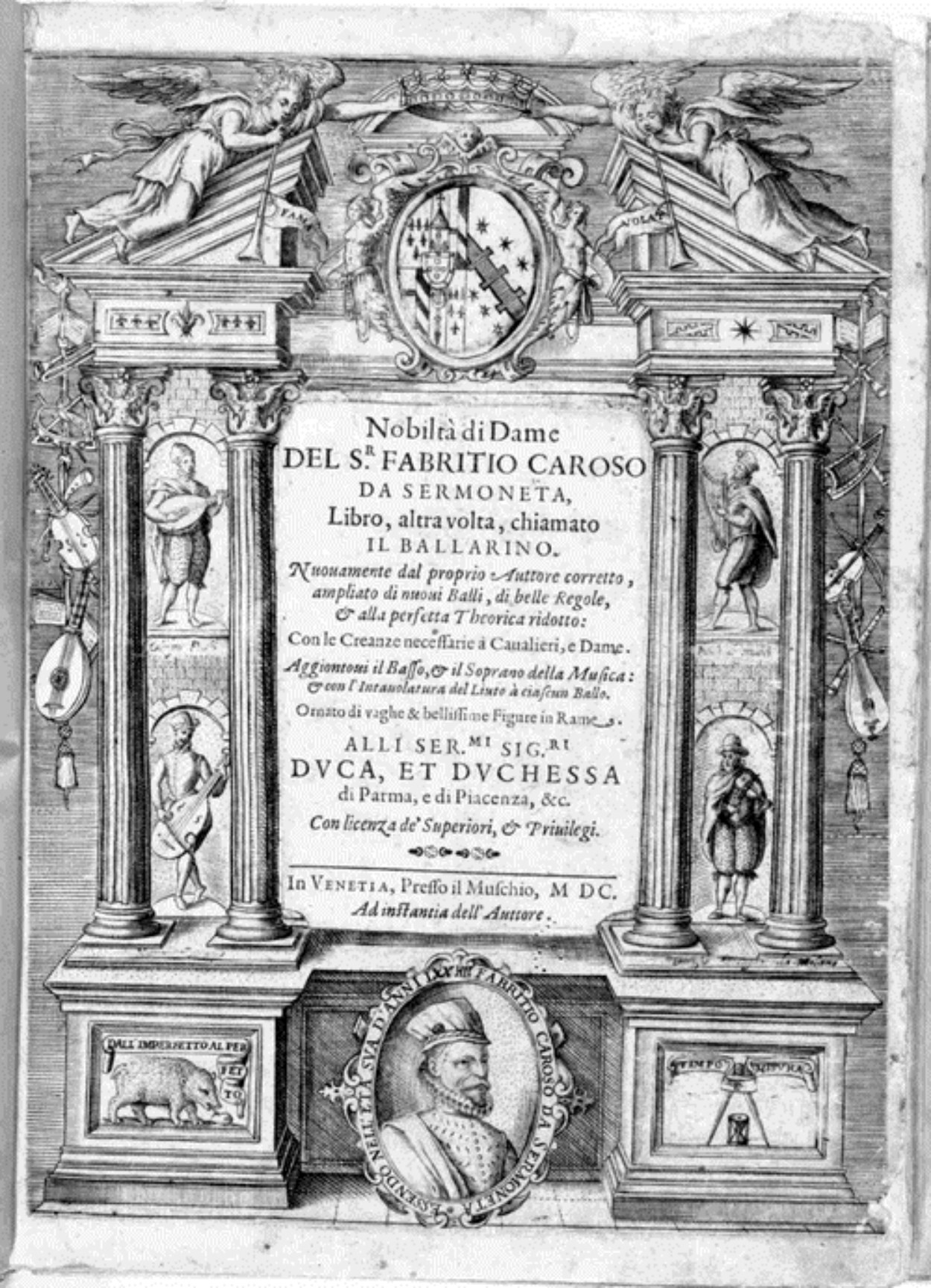
Fabritio Caroso da Sermoneta (c. 1535–1605) was a celebrated dancing master and choreographer active in Rome and across Italy during the latter half of the sixteenth century. He is known to have taught aristocratic patrons and performers, and he brought together his choreographic knowledge and his understanding of courtly decorum into *Il Ballarino*, first published in 1581. The book was revised and reprinted multiple times and was copied and adapted by other dancing masters across Europe. Caroso's second manual, *Nobiltà di dame* (1600), further established his authority. His work represents the peak of the Italian school of Renaissance dance and influenced the development of dance in France and the courts of northern Europe.
The period
In the late Renaissance, dance was a central courtly accomplishment and a marker of nobility and education. The Italian aristocracy prided itself on refined movement, geometric precision, and elaborate costume—all values reflected in Caroso's dances. The publication of *Il Ballarino* in 1581 coincided with a moment of high refinement in the Italian courts, when the *bassa danza*, *pavan*, *galliard*, and *volta* dominated social and ceremonial occasions. The printed manual was a new phenomenon in dance history; earlier dances existed in manuscript or in oral tradition. Caroso's decision to publish, and to include woodcut illustrations, helped standardize the dances and preserve them for posterity. The book also reflects the Renaissance fascination with notating and documenting cultural practices, from architecture to courtship rituals.
Where it lives
This plate comes from a copy of *Il Ballarino* held in the Library of Congress. The book was printed in Venice in 1581 and circulated widely in manuscript form and in printed copies throughout Europe. Individual plates were also copied and adapted by other dancing masters.
Dance in this work
Questions about this work
What dance is this showing?
The plate illustrates one of the dances in Caroso's *Il Ballarino*. Without the accompanying text description, it is not possible to say with certainty which dance is depicted, but the formal upright posture, the hand-joining gesture, and the costume suggest one of the slower, more ceremonial dances of the period, such as a *bassa danza*, *pavan*, or *galliard*. The woodcut is meant to work in conjunction with Caroso's written instructions, not to stand alone.
How do we know this is actually how people danced?
Caroso's *Il Ballarino* is the most detailed and authoritative Renaissance dance manual we have. It includes text descriptions of steps and figures, choreographies for specific dances, and woodcut illustrations of dancers in the opening poses. The book was widely known and copied, and it influenced dance practice across Europe. For historians, it is the closest thing we have to a reliable record of how Renaissance aristocrats actually danced.
Why is the woman's dress so long and elaborate?
Long gowns with elaborate trains and jeweled decoration were the standard court dress for aristocratic women in the late sixteenth century. The train was an essential part of the visual effect—dancers had to manage it skillfully as they moved. In Renaissance court dances, the manipulation of these long skirts was itself part of the choreography, creating sweeping visual lines and requiring physical control.
How was this image made?
This is a woodcut, made by carving an image into the surface of a wooden block. The raised parts of the block are inked and printed onto paper. Woodcuts were fast to produce and cheap to print, making them ideal for book illustration. The technique is very good at rendering bold contrasts and fine linear detail, which is why Caroso's costume is rendered with such clarity.
More Notation/Choreography artwork