49 works in this view — arrow keys or swipe to move between them.
Dance in Art
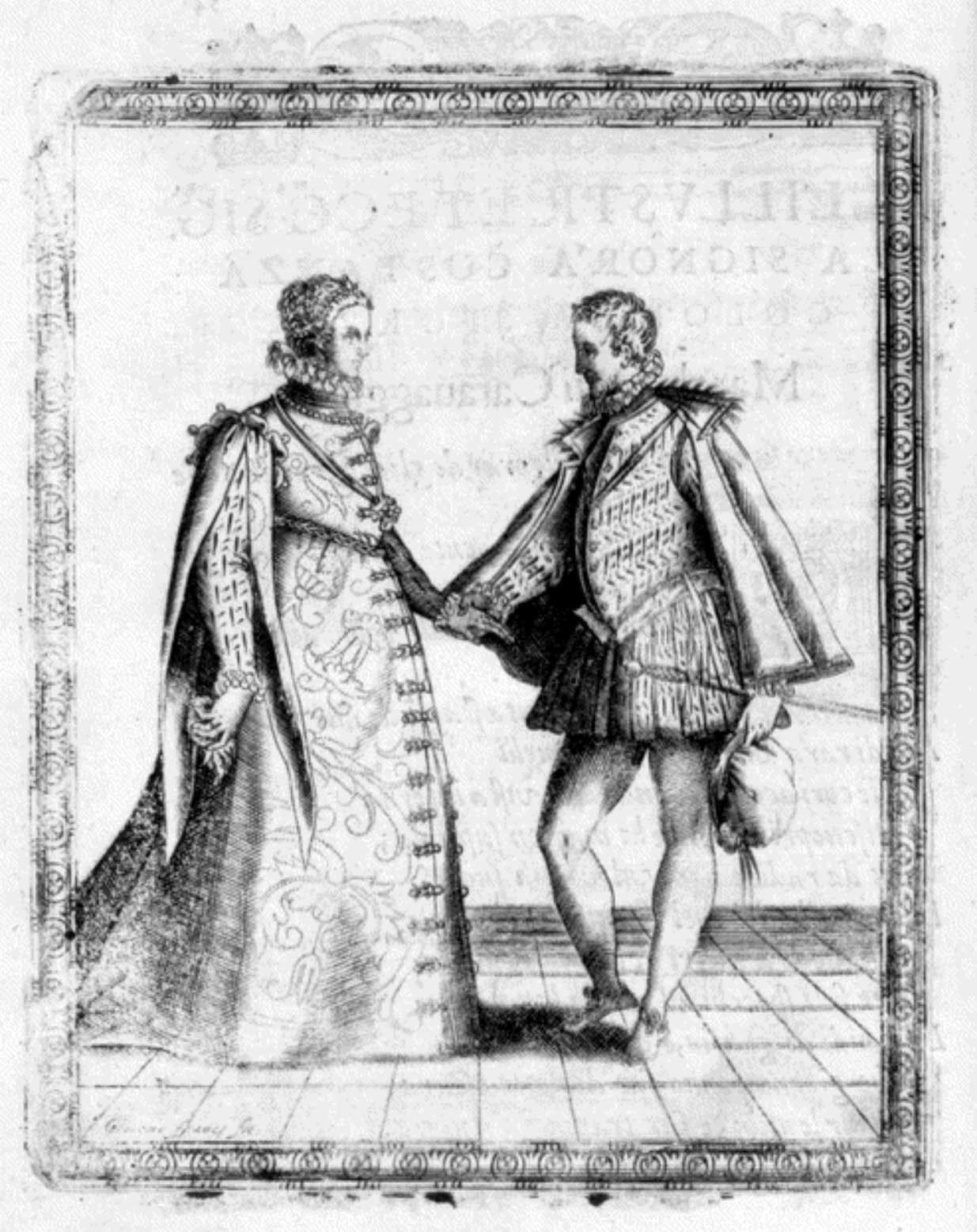
Caroso — Dance Plate (plate 19)
Fabritio Caroso da Sermoneta
- Medium:
- Woodcut
- Dance:
- Notation/Choreography
- Era:
- Pre-1700 (Renaissance/Baroque)
- Collection:
- Il Ballarino (1581)
- Source:
- Library of Congress
- Rights:
- Public domain — free to use, share and adapt.
- Recorded as:
- Public Domain
For a dancer or historian of dance, this plate is direct evidence of how Renaissance court dances were actually structured, taught, and performed—not a literary description but a visual specification of posture, hand-hold, and spatial relationship between partners. Caroso's manual is one of the two or three most important sources for understanding pre-Baroque European dance, and this image is one of the tools through which that knowledge was transmitted and preserved. The precision of the rendering also tells us how seriously the sixteenth-century court took the visual and bodily language of dance as a marker of civility and rank.
What you are looking at
Two figures in sumptuous Renaissance Italian court dress stand facing each other in what appears to be an interior space defined by a tiled floor and simple architectural framing. The figure on the left wears an ornate long gown with elaborate patterned fabric, a high jeweled collar, and a flowing cape lined with decorative material draped over one arm. The figure on the right wears a richly decorated short doublet or armor-like garment with geometric patterns, bare legs, and what appears to be a cape or cloak. They clasp hands between them in a formal gesture—neither a passionate embrace nor a casual touch, but the kind of measured physical contact that would signal a specific dance movement or social protocol. The composition is symmetrical and dignified, with both figures rendered in careful anatomical detail, their bodies positioned to show the line and carriage expected of nobility. The engraving is finely detailed, with careful attention to textile pattern and the jeweled ornaments that signal rank.
The dancing
Both figures maintain an upright, formal posture with the weight distributed evenly on both feet—the stance of courtly dancers trained in controlled, stately movement rather than naturalistic walking. Their joined hands are at waist height, and the clasp appears neither tight nor distant, suggesting a hold appropriate to a processional or measured partnered dance. The man's free arm hangs at his side; the woman's opposite arm trails her cape. Neither figure leans toward or away from the other; the distance and symmetry between them is scrupulously maintained. This is the physical language of ceremony and choreography, not spontaneous interaction.
The dance depicted
This plate illustrates a specific dance from Fabritio Caroso's choreographic manual, most likely a pavane or galliard based on the formal hand-joining, the upright posture, and the dress appropriate to Italian court dancing of the 1580s. Caroso's *Il Ballarino* documented the dances performed by the Medici court and other Italian noble households, and his plates served as visual instruction for dancers learning these highly formalized steps. The hand position and the careful symmetry suggest a moment in a dance that required partners to process or turn together with measured dignity. The engraving format allowed Caroso to present each dance as a discrete, repeatable instruction: this is what the step looks like, executed by properly dressed performers in the proper frame.
How it was made
This is a woodcut, a technique that allowed Caroso to produce multiple copies of his manual for distribution to courts and wealthy households across Italy and beyond. Woodcut is less fine-grained than engraving but more durable for repeated printing; the clarity of the line and the careful rendering of pattern and texture suggest a skilled cutter working from careful drawings. The decorative border framing the scene is typical of woodcut book illustration of the period and emphasizes the image as a formal instructional document rather than a sketch or study. The print was bound into *Il Ballarino* (Venice, 1581), making it a functional component of a teaching text rather than a standalone artwork.
About this work
This woodcut plate from Fabritio Caroso's *Il Ballarino* (1581) documents a single moment in a Renaissance Italian court dance, showing two nobles in the formal dress and measured posture required for the choreography. The work sits at the intersection of dance, fashion, and courtly protocol: it is simultaneously a record of what people wore, how they positioned their bodies, what steps they performed, and how that performance reproduced their social status. Caroso's manual was the most comprehensive and widely circulated guide to Italian court dancing of the sixteenth century, and these plates were used by dancers across Europe to learn and transmit the dances themselves. The image is not a portrait or a genre scene but an instructional diagram rendered with the precision and dignity appropriate to its serious purpose.
How to look at it
Focus on the hand-joining and the posture: this is the moment in the dance where Caroso chose to freeze the movement, and it tells you what he considered essential to understand and remember. The symmetry and dignity of the composition are not accidental—they reflect the values of the court and the carefully balanced relationship between male and female dancers. Notice also the detail lavished on the fabric and ornaments: the wealthy were meant to dance in expensive, heavy, restrictive clothing, and the fact that both figures maintain perfect posture and composure while clothed this way was part of the point. The engraving format itself is significant: this is not a casual sketch but a formal, reproducible document, meant to look authoritative and to instruct.
The artist
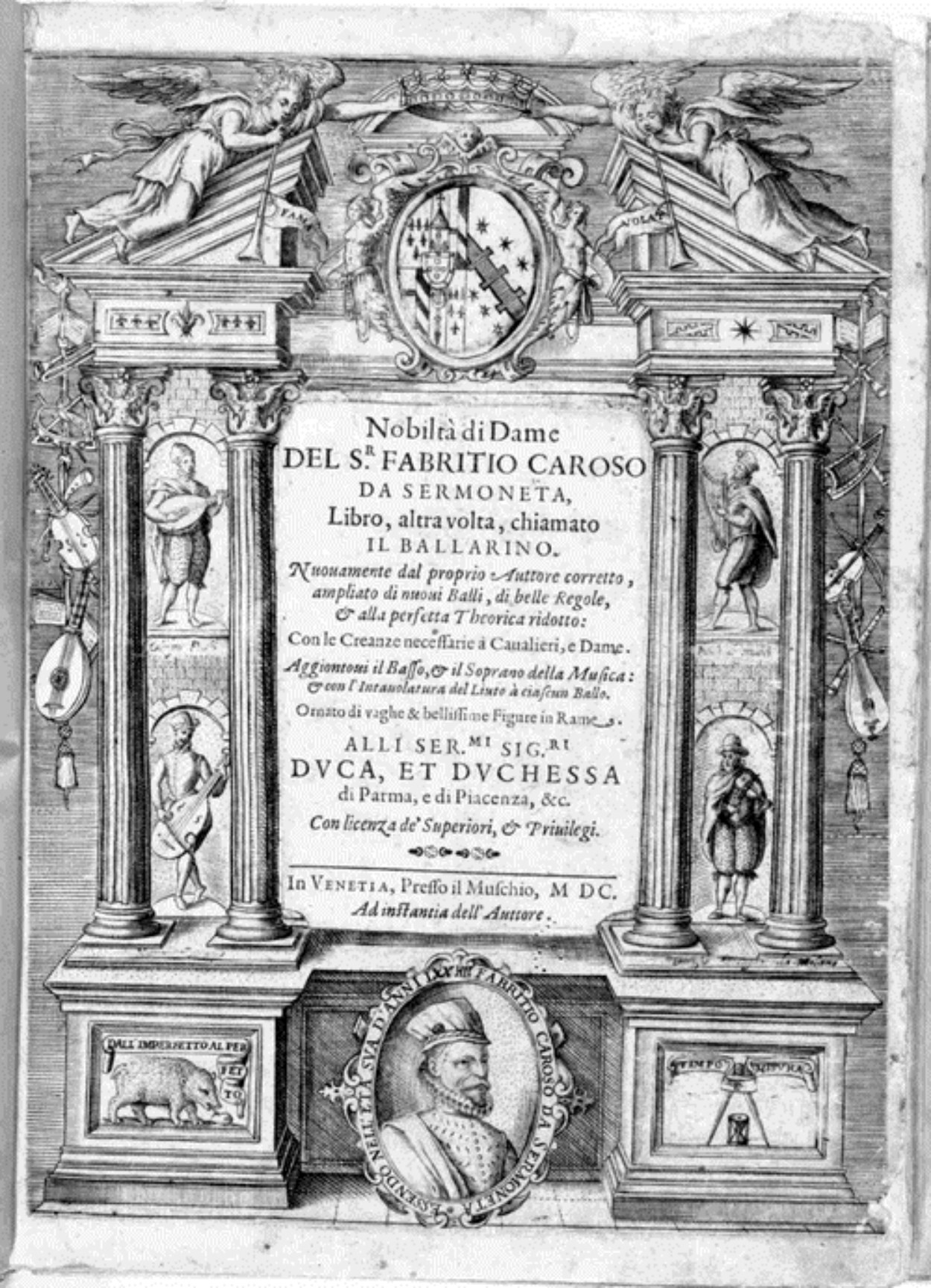
Fabritio Caroso da Sermoneta (c. 1526–1605) was a dancer and dance master in Rome and later at the Medici court in Florence. He is remembered almost entirely through *Il Ballarino* (1581) and a later expanded version, *Nobiltà di Dame* (1600), which together represent the fullest surviving documentation of Italian Renaissance court dancing. Caroso did not compose all the dances in his manual; many were already current in the courts where he worked. His contribution was to systematize them, describe them in words, and have them illustrated so that they could be learned, performed, and transmitted across time and space. He understood that dance was a teachable, repeatable, and reproducible art form—and that printing could make that possible.
The period
In the late sixteenth century, court dancing was one of the primary arts of the nobility, requiring years of training and serving as a central medium for displaying refinement, status, and bodily control. The Italian courts were particularly sophisticated centers of dance, and Venice was the printing capital of Europe. Caroso's decision to print and illustrate his manual was unprecedented and revolutionary: it elevated dance from an ephemeral, orally transmitted practice to a documented, studyable art form. At the same time, the Renaissance was seeing a new emphasis on the body as a subject for careful observation and representation—evident in the anatomical accuracy of the figures and the meticulous attention to the surfaces of dress and ornament.
Where it lives
This plate is part of *Il Ballarino*, a printed dance manual published in Venice in 1581. The work is held by the Library of Congress as a complete copy of the original publication. As a page in a bound manual, it functioned as both instruction and reference, used by dance masters and courtly performers to learn and execute the dances documented in the text.
Dance in this work
Questions about this work
How do we know what dance this is?
We do not know with certainty which of Caroso's dances this plate illustrates. The catalogue record does not specify it, and the plate itself contains no label identifying it as plate 19 in the sequence. A historian with access to the full manual and its text could match the hand-hold and posture to Caroso's description of a specific dance, but from the image alone we can only say it is one of the formalized court dances documented in *Il Ballarino*—most likely a pavane or galliard based on the style of hand-joining and posture.
Why are they holding hands like that?
In Renaissance court dances, hand-holding was a specific, choreographed element that differed from dance to dance. This particular hold—at waist height, with arms relatively straight and distance maintained between the partners—suggests a processional or turning movement, not an embrace. The formality and precision of the hold reflect the fact that these dances were highly structured, with each movement prescribed and repeatable. Hand-holding also signaled the social relationship between the dancers: it was a mark of respect and partnership within a hierarchical courtly framework.
What does the clothing tell us?
Both figures wear the ornate, expensive dress of the Italian nobility in the 1580s—rich fabrics, jeweled ornaments, and carefully tailored garments. The fact that dancers in this court performed in such heavy, restrictive clothing tells us that the dances themselves were designed to accommodate it, emphasizing upright posture, controlled movement, and dignity over speed or agility. The woman's cape and the man's armor-like doublet would have restricted movement considerably, yet both figures maintain perfect posture and composure. This too was part of the point: the ability to dance gracefully despite such constraints was a mark of training and refinement.
Is this a real couple or just a generic illustration?
These are generic demonstrations, not portraits. Caroso's plates show idealized, properly trained dancers in the correct posture and dress, serving as models for others to imitate. The figures represent the type of noble dancer and the standards of form and carriage that all courtly performers were expected to achieve. There is no evidence that either figure is based on a real historical person.
More Notation/Choreography artwork