49 works in this view — arrow keys or swipe to move between them.
Dance in Art
Caroso — Dance Plate (plate 20)
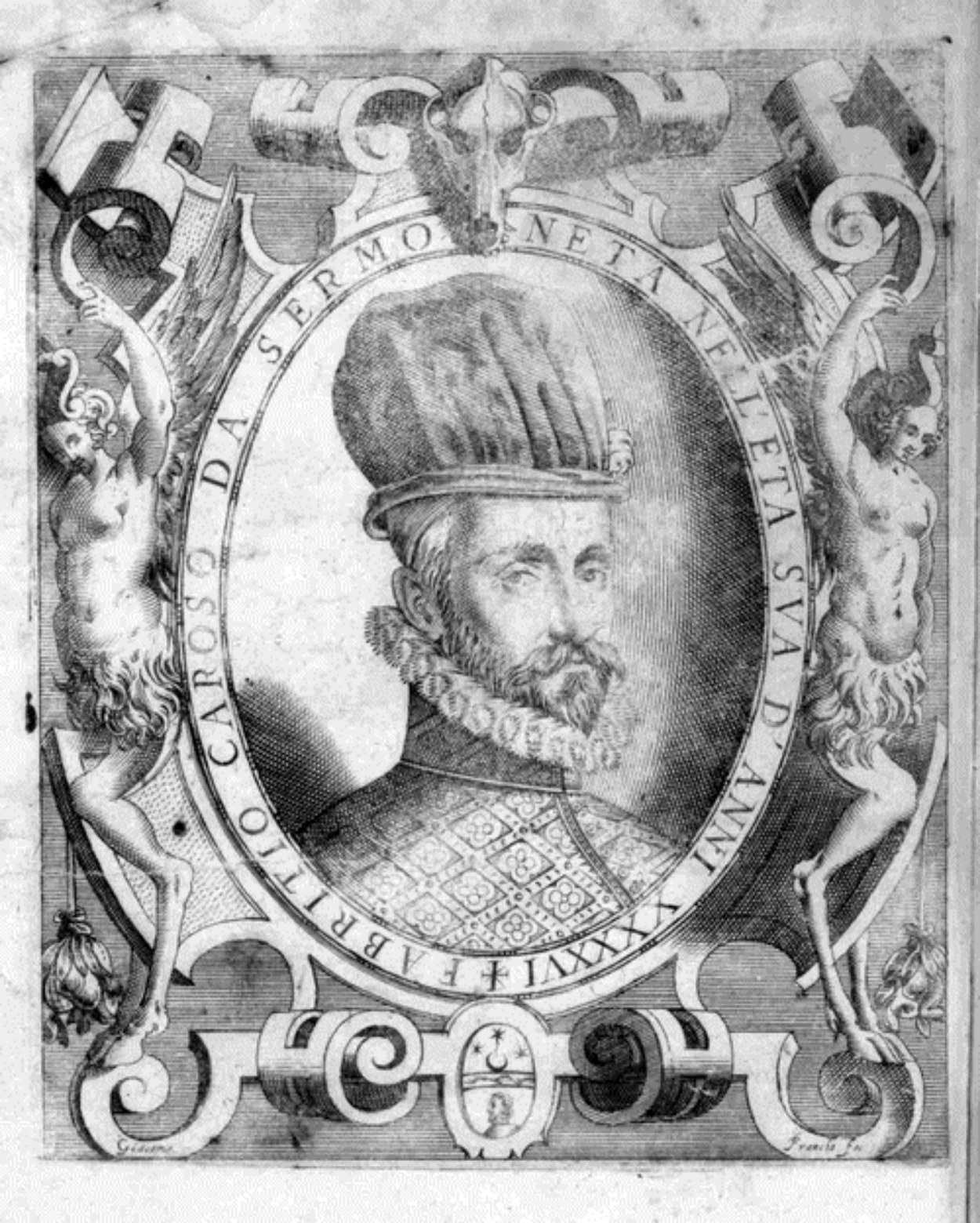
Fabritio Caroso da Sermoneta
- Medium:
- Woodcut
- Dance:
- Notation/Choreography
- Era:
- Pre-1700 (Renaissance/Baroque)
- Collection:
- Il Ballarino (1581)
- Source:
- Library of Congress
- Rights:
- Public domain — free to use, share and adapt.
- Recorded as:
- Public Domain
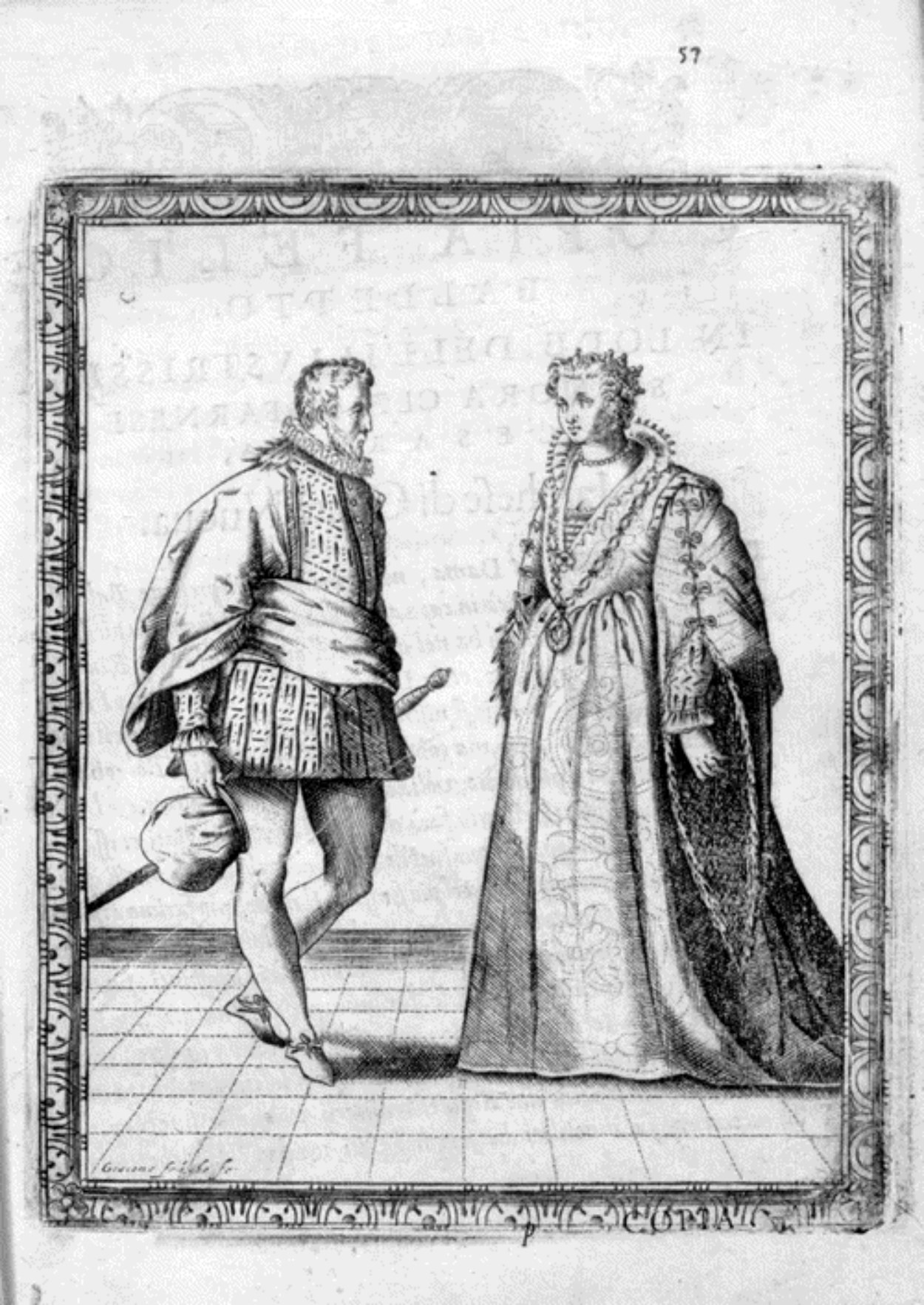
Caroso's manual is the single most important source for reconstructing Renaissance Italian court dance, and his woodcuts are the only contemporary visual documentation of how dancers dressed and held themselves. For historians and reconstructors, this plate provides definitive evidence of costume, posture, and the formal aesthetic that governed courtly movement in the period—information that cannot be derived from the choreographic notation in the text alone.
What you are looking at
Two figures in elaborate Renaissance Italian court dress stand facing one another on a checkered floor, framed by a decorative border typical of printed books. On the left, a man in profile wears a short pleated tunic with horizontal striping, a wide sash at the waist, and a short cloak draped from one shoulder; he holds a feathered hat in one hand and a sword or wand in the other, his weight shifted onto one leg in a posed stance. On the right, a woman faces slightly toward him, wearing a long gown with puffed sleeves, an ornate jeweled collar, and an elaborate headdress; her gown is fitted through the bodice and flows into a full skirt with deep fabric at the hem, and she wears a long cloak or overdress draped loosely from her shoulders. Both figures are rendered with fine engraving detail that captures the texture of fabrics—the pleating of his tunic, the embroidery and jewels of her garments, the fur trim of her cloak. The setting is a palace interior, suggested only by the geometric floor and the architectural frame; the light is even and comes from above, casting no shadows, as is typical of woodcut illustration. The moment is one of formal presentation or encounter rather than active movement—this is a teaching image meant to show the dancers in costume and the positions they would assume.
The dancing
Both figures are shown in upright, formal posture suited to courtly presentation. The man's weight rests primarily on his right leg, the left slightly advanced, his torso turned to face the woman; his arms are relatively relaxed, one holding the hat and the other the wand or baton. The woman stands with weight distributed evenly, her arms at her sides or held naturally before her; her frame is entirely frontal and composed. There is no active hold between them—they are presented as separate figures in parallel rather than as an interacting pair mid-step. The spacing and formal arrangement suggest this is instructional: two dancers shown in the opening position or dress for a specific dance, not captured mid-movement.
The dance depicted
This is a page from Caroso's *Il Ballarino*, the foundational printed manual of Italian Renaissance court dance published in Venice in 1581. The woodcut serves as an illustration of dancers in the elaborate costumes required for the ballroom dances catalogued in the text—likely showing the opening position or formal dress for one of the branles, galliards, or pavanes that made up the courtly repertoire. The image documents dress and decorum rather than the kinetics of movement; it establishes what dancers looked like, how they were adorned, and the posture they maintained in the presence of the court. Caroso's manual was the primary source for understanding how Italian Renaissance nobility danced, and these plates were circulated throughout Europe to teach both the steps and the aesthetic standards of Italian courtly dance.
How it was made
This is a woodcut, a relief printing technique in which an image is carved into the surface of a wooden block, with the raised portions creating the printed image. Woodcut allowed for broad areas of black line and tonal variation through cross-hatching, making it ideal for rendering the textures and patterns of Renaissance fabrics—the pleats, embroidery, and fur are suggested through the density and direction of carved lines. The technique was economical enough to be reproduced in multiple impressions, allowing the manual to be printed in a trade edition for circulation among the European nobility and their dancing masters. The decorative border—a repeated pattern of concentric circles and scrollwork—is a standard feature of Renaissance printed books and signals that this is a carefully produced work intended for an educated readership.
About this work
This is one of the instructional plates from Fabritio Caroso's *Il Ballarino* (Venice, 1581), the first comprehensive printed manual of Italian Renaissance court dance. The woodcut shows two dancers in the elaborate silk, jewels, and fur of late-Cinquecento courtly dress, posed formally to illustrate the aesthetic standards and costume conventions of ballroom dancing in Renaissance Italy. Rather than capturing a moment of choreography, the image functions as a visual reference for dancers learning from Caroso's text—it establishes the look, bearing, and decorum expected of a dancer in the Italian court. The *Ballarino* was hugely influential throughout Europe and remained the standard source for understanding Renaissance courtly dance into the 17th century; these plates are among the earliest printed visual evidence of how European nobility danced.
How to look at it
This is a teaching image, not a scene of dancing. The two figures are presented frontally and in profile so that a reader can see the full costume and posture from multiple angles—a convention of instructional and anatomical illustration. Notice the formality of their bearing: the upright spine, the composed arms, the balanced weight distribution. This is not the body at rest but the body performing courtly decorum. The woman's elaborate costume, especially the jeweled collar and the layers of her gown, shows that dress was performative and expensive—these were garments worn by nobility, and the ability to move gracefully in them was itself a skill. The man's short tunic and hose, by contrast, show greater freedom of leg and movement, suggesting that male courtly dress prioritized mobility for the more complex footwork required in galliards and similar dances. The checkered floor is a standard feature of Renaissance interiors and courtly spaces; it grounds the figures in the architectural space of the palace or great hall where these dances took place.
The artist
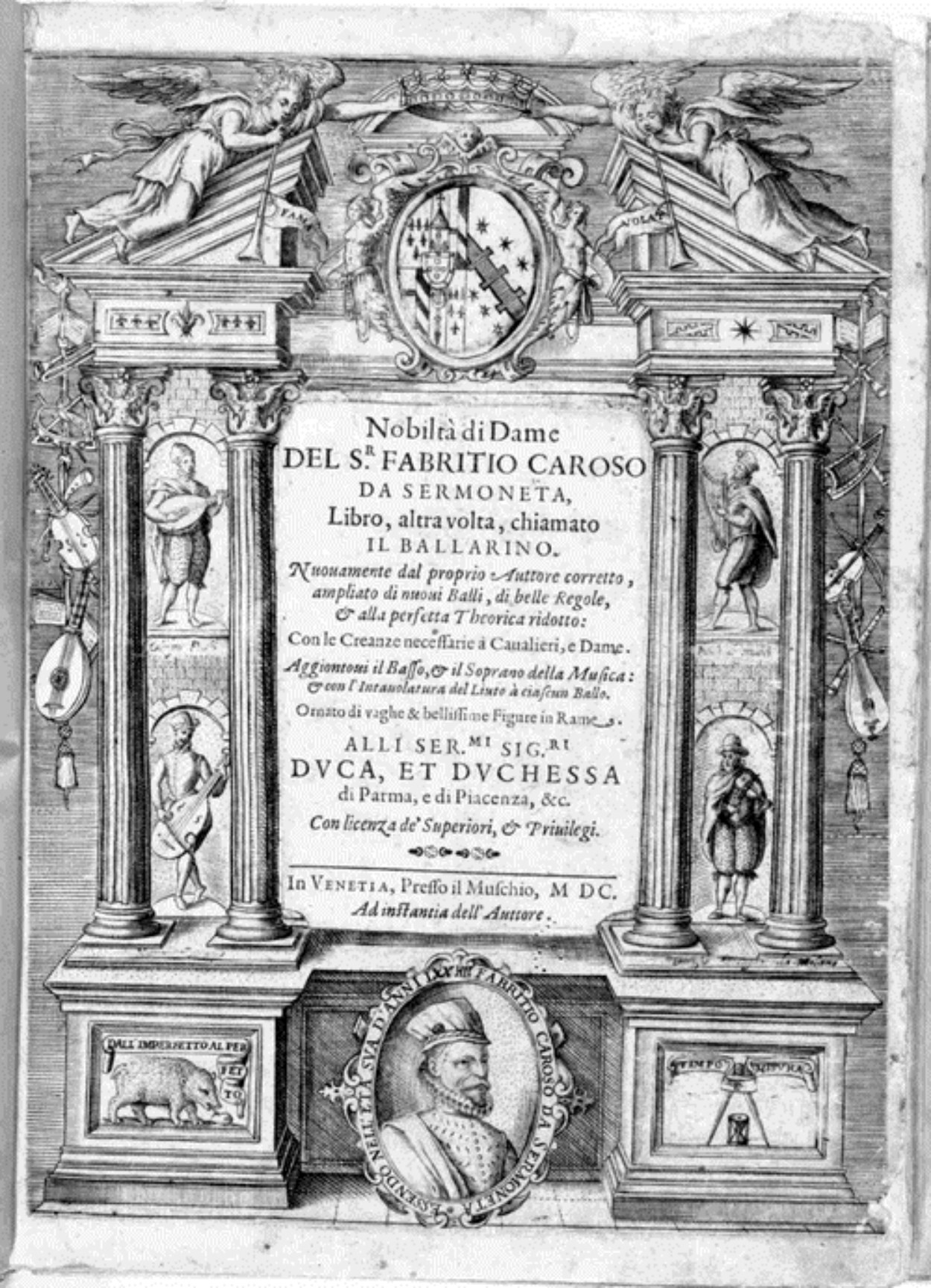
Fabritio Caroso da Sermoneta (c. 1526–after 1605) was the most celebrated dancing master of Renaissance Italy and a courtier in Rome. He served the Medici and other Italian princes, and his reputation as a choreographer and theorist was pan-European; his manual was translated, reprinted, and plagiarized across the continent. Caroso was among the first to document dance in print, giving it the status of a written art form comparable to music or literature. His *Il Ballarino* (1581) and its expanded revision, *Nobiltà di Dame* (1600), together constitute the most complete surviving record of Renaissance ballroom choreography and its cultural context.
The period
The late 16th century saw the emergence of dance as a subject worthy of serious documentation and print publication. The Italian Renaissance court, particularly under the Medici, had established dance as a central courtly accomplishment—a marker of nobility, grace, and education. By the 1580s, the traditions of 15th-century courtly dance (pavane, galliard, allemande, branle) had evolved into a complex, regulated system with prescribed steps and choreographies. Caroso's decision to publish these dances in print, with both notation and illustration, was revolutionary; it transformed dance from an oral/gestural tradition into a fixed, reproducible text. The woodcut medium allowed this knowledge to circulate widely, and the *Ballarino* became the standard reference for dancing masters across Europe. The elaborate costumes shown here—the jewels, fabrics, and tailored silhouettes—reflect the enormous expense and visual importance of dress at the Renaissance court, where a dancer's appearance was as crucial as their steps.
Where it lives
This woodcut is from the first edition of Caroso's *Il Ballarino*, published in Venice in 1581 by the printer Ziletti. The work is held in the Library of Congress and is one of the foundational printed sources on Renaissance dance. The *Ballarino* exists in numerous copies, as it was widely reprinted and distributed; this particular impression comes from a library holding of the 1581 edition.
Dance in this work
Questions about this work
Is this a real couple dancing, or are these generic dancers showing off clothes?
These are idealized dancers shown in the formal dress and posture required for Italian Renaissance ballroom dance. They are not captured mid-step but rather presented in the opening position or formal stance that a dancer would assume. The image is instructional—meant to show a reader what a properly dressed and composed dancer looked like—rather than a snapshot of a specific performance or couple. The formal, separated positioning reflects the conventions of dance instruction in the 16th century.
What dances would these two people actually perform together?
Caroso's manual documents a range of courtly dances suitable for couples, including pavanes, galliards, allemandes, branles, and the volta. The specific dance illustrated in this particular plate would be identified by reference to the text facing this woodcut in the original book, which is not visible here. Caroso provided choreographic notation for all the dances in his manual, showing both the steps and the spatial patterns couples would trace across the floor.
Why are they holding those objects—the hat and the wand?
The hat (likely a feathered beret or cap) and the wand (possibly a baton, sword, or decorative staff) are attributes of courtly dress and bearing. The man might be shown holding his hat as part of the formal courtesy or etiquette of approaching a lady; the wand might indicate rank or be a decorative accessory. Alternatively, Caroso may have chosen to show these objects to emphasize the full costume and deportment of a courtier—the idea that dancing involved not just the feet and body but the management of clothes, hats, and accessories while maintaining composure.
How expensive were these clothes, and did ordinary people dance in them?
These are garments of the nobility—the jewels, silk, fur, and fine tailoring shown here were prohibitively expensive for ordinary people. The elaborate headdress and the jeweled collar worn by the woman alone would have cost more than a laborer earned in years. The dances documented in Caroso's manual were exclusively courtly practices, performed at the courts of Italian princes and nobles and at the courts of European nobility who imported Italian customs. Ordinary people danced, but they did not dance these dances, nor did they wear these clothes.
More Notation/Choreography artwork