49 works in this view — arrow keys or swipe to move between them.
Dance in Art
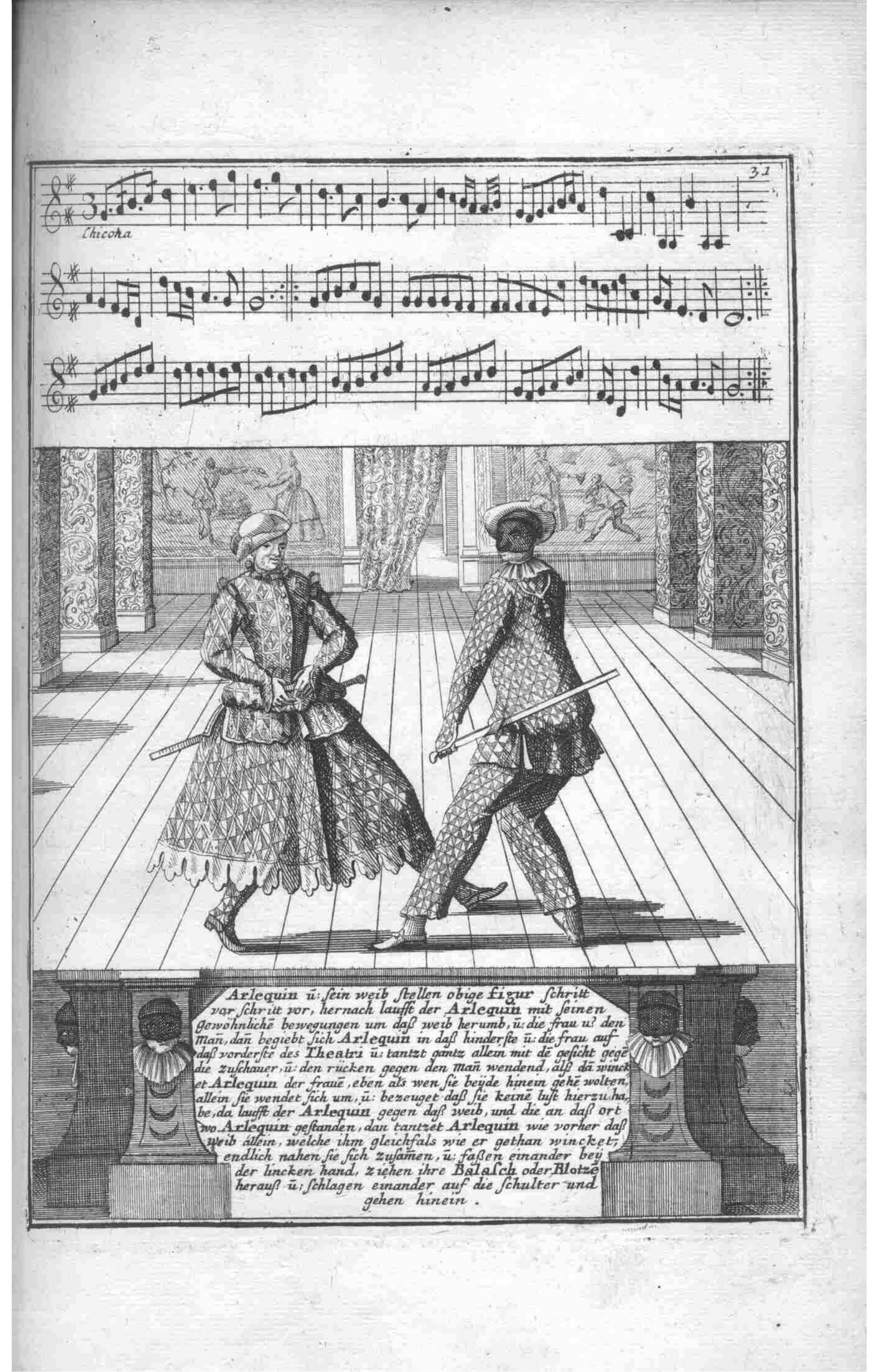
Courtly Couple — Plate 30
Gregorio Lambranzi
- Medium:
- Copper-plate engraving
- Dance:
- Notation/Choreography
- Era:
- 1700s (Enlightenment/Minuet Era)
- Collection:
- Nuova e curiosa scuola de' balli theatrali (1716)
- Source:
- Library of Congress
- Rights:
- Public domain — free to use, share and adapt.
- Recorded as:
- Public Domain
This engraving documents the Minuet not as a written rule but as a performed gesture, showing the exact posture, distance, and costume convention that shaped its meaning. For historians of baroque dance, it is among the few reliable visual sources of how the technique actually looked; for dancers, it demonstrates how fully the dance was integrated with fashion, music, and theatrical practice. Lambranzi's manual is foundational to our knowledge of early 18th-century dance because it combines notation, image, and text—the visual record matters because notation alone cannot convey timing, weight transfer, or the social negotiation visible in the couple's careful positioning.
What you are looking at
A man and woman face each other on a wooden-floored stage framed by ornate curtains and classical columns. Both wear richly patterned garments in the courtly fashion of the early 18th century: the woman wears a fitted bodice with a full skirt gathered at the waist, while the man wears a coat with decorative details, breeches, and a plumed hat. The woman stands with her weight on one leg, her body angled toward her partner, while the man bends slightly forward in an attentive posture, his hand gesturing with or near his sword. The stage setting is formal and theatrical, with draped fabrics visible in the background and a perspective-drawn floor receding into depth. At the top of the plate, musical notation in treble clef provides the melody for the dance.
The dancing
The couple occupies the space with clear spatial relationship and directional intent toward each other. The man's posture is courteous and forward-leaning, suggesting deference or invitation; the woman's stance is upright and receptive, with her body turned to face him. Both figures are poised rather than in mid-motion, suggesting the moment just before contact or commitment to a step pattern. The engraver has given particular attention to the costume silhouette—the woman's full-skirted profile is emphasized, and the man's upright carriage and extended arm are prominent. No hands appear to be in contact; this is a moment of approach or pause within the dance.
The dance depicted
This is almost certainly a Minuet or Gavotte, the two most common courtly partner dances of the 1710s. The Minuet is the stronger claim: the formal posture, the moment of salutation between partners, the notation, and the theatrical costumes all align with documented Minuet practice. The couple's positioning—facing each other at a social distance with clear deference from the male partner—and the woman's characteristic full skirt and upright carriage are hallmarks of Minuet choreography. The dance would have been performed in aristocratic salons and opera houses, and this engraving documents how it was taught and performed by professional dancers in a theatrical context.
How it was made
This is a copper-plate engraving, a high-relief printmaking technique that allowed detailed reproduction of both image and notation on a single plate. Engraving requires meticulous hand work with a burin to incise fine lines into polished copper; the resulting print shows the even, linear detail characteristic of the medium—particularly visible in the fabric patterns, facial features, and the careful articulation of the stage architecture. This technique was ideal for distributing instructional dance manuals widely and affordably; a single engraved plate could be printed hundreds of times, making Lambranzi's manual accessible to dancing masters across Europe.
About this work
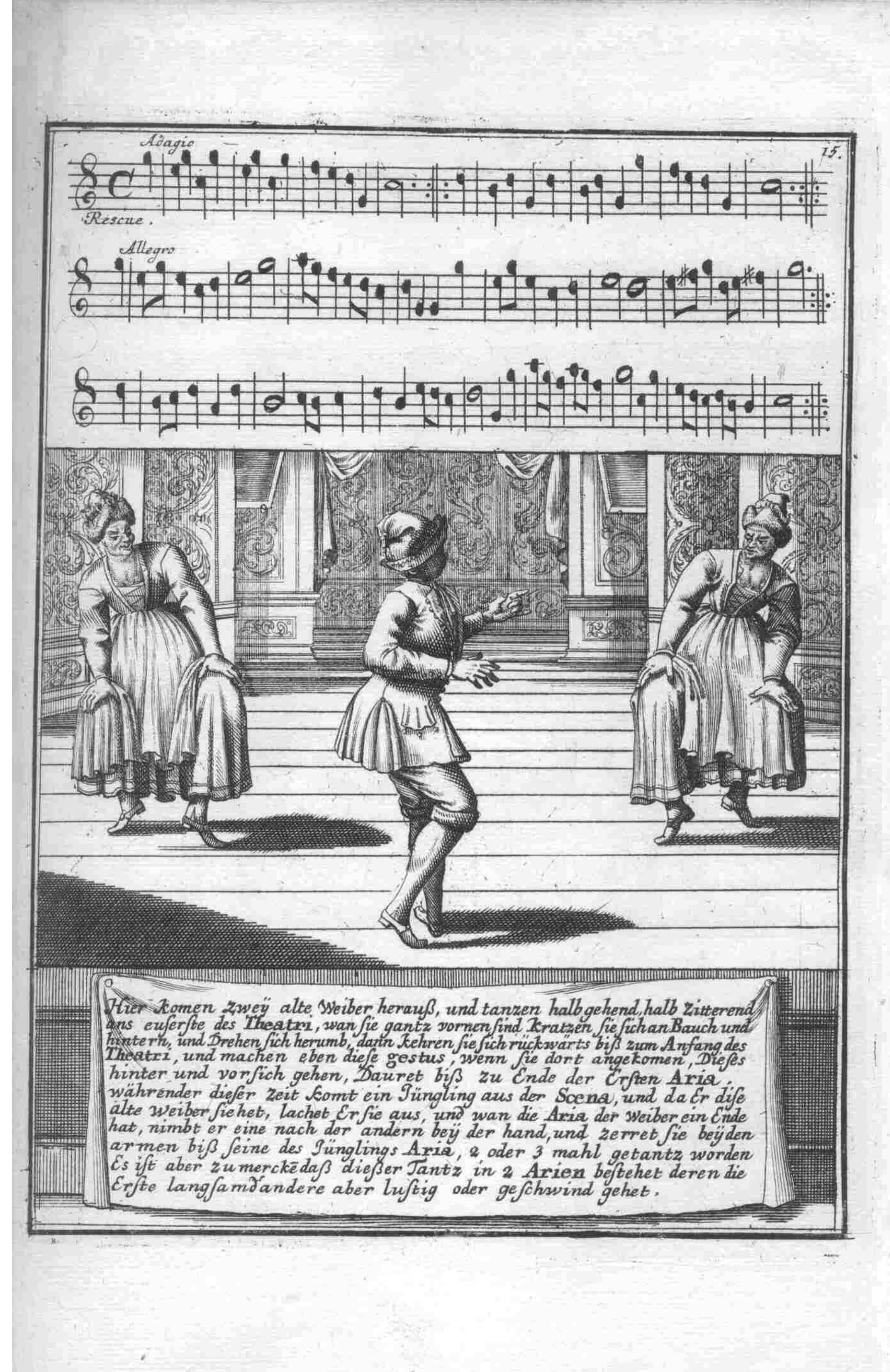
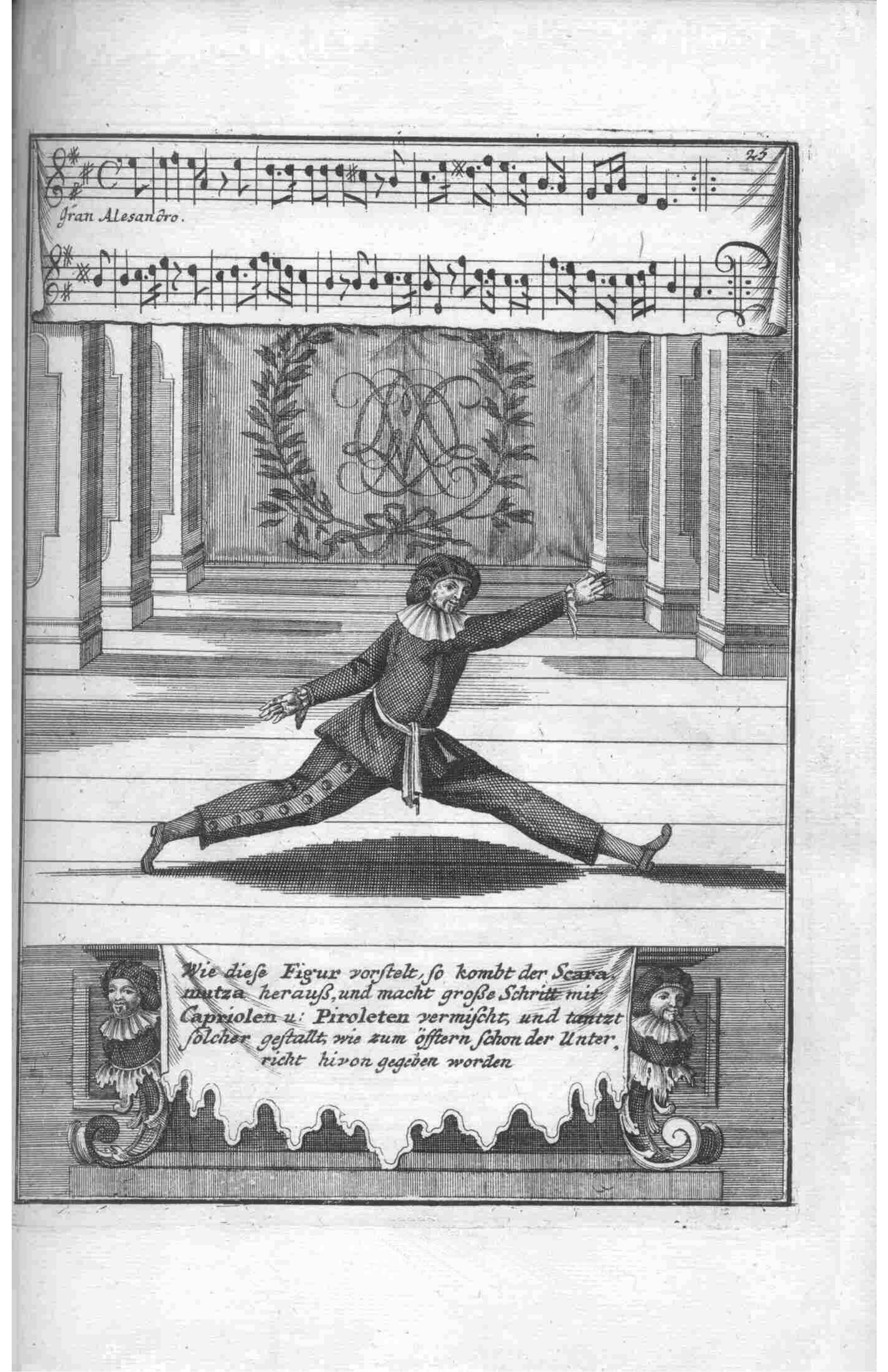
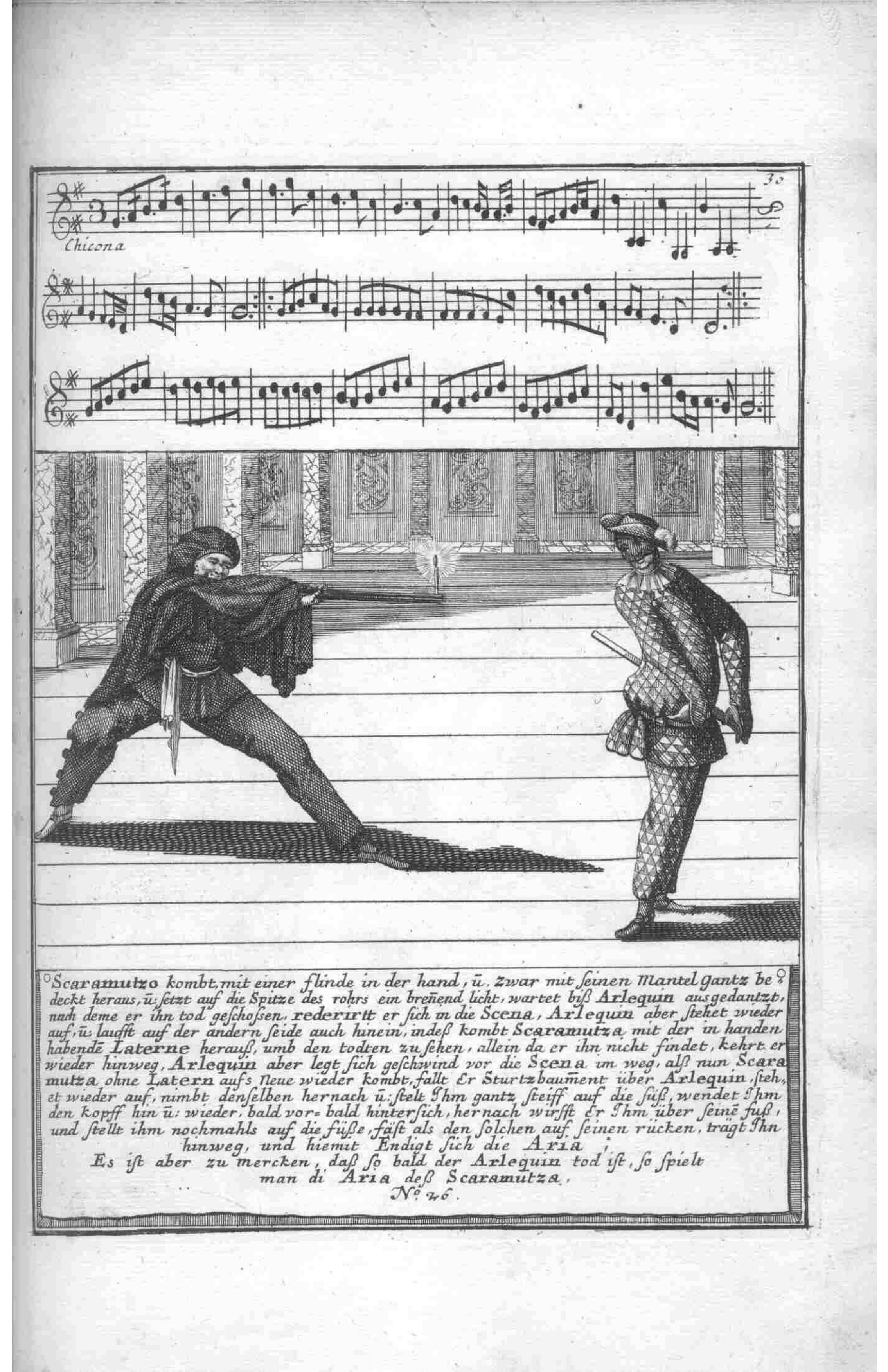
This is one of 52 copper-plate engravings from Gregorio Lambranzi's *Nuova e curiosa scuola de' balli theatrali* (*New and Curious School of Theatrical Dances*, Nuremberg, 1716), an influential manual pairing dance notation with costumed theatrical figures. Each plate shows a single dance type, with musical notation above and often a German verse below describing the steps or dramatic context. Lambranzi's work is a rare visual and notational record of how theatrical and courtly dances were actually performed in the early 18th century, capturing both the movement vocabulary and the elaborate costume convention that framed it.
The manual was designed for professional dancers and dancing masters who could read notation and learn from the engraved figure. It represents a moment when dance was transitioning from primarily courtly to increasingly theatrical—these dances were performed in opera houses and court spectacles, not merely in ballrooms. The high production quality and wide circulation of the book made it one of the era's most authoritative sources on how baroque dances were choreographed and executed.
How to look at it
Look first at the posture and spacing of the couple. The precise distance between them, the angle of the man's body, and the woman's upright stillness encode the social grammar of the Minuet—this is a dance of formal courtesy and carefully modulated proximity, not embrace or weight-sharing. Notice the woman's skirt: its full, bell-like shape is not costume ornament but a functional part of the dance vocabulary; the Minuet was designed to be danced in skirts like this, and the engraver has emphasized its silhouette because it was essential to how the dance read. The musical notation above is not merely decoration but the actual choreographic source; early 18th-century dancers learned steps by counting music, and seeing notation paired with image shows how inseparable the two were. Finally, observe that this is a moment of pause or approach, not a snapshot of travelling steps—the theatrical convention was to show poses and key moments rather than continuous action.
The artist
Gregorio Lambranzi (c. 1681–after 1716) was an Italian choreographer and dance master who worked in Nuremberg in the early 18th century. He is known almost exclusively through this single printed manual; few other records of his life or teaching survive. The *Nuova e curiosa scuola* was published in German and Italian editions, suggesting Lambranzi was addressing both German and Italian-speaking dancing masters. His approach—pairing notation with engraved theatrical figures—was innovative and practical, designed for professionals who needed both choreographic instruction and a template for how the dance should look when performed. The manual's popularity indicates that Lambranzi met a real need in the profession.
The period
In 1716, the Minuet was at the height of its dominance in European court and theatrical dance. It had emerged in France in the 17th century and become the standard showcase for aristocratic dancers by the early 18th; its slow tempo, small steps, and intricate footwork made it ideal for displaying elegance, precision, and refinement. The engraved manual format reflects the professionalization of dance teaching in this period: as dance became more complex and more valued as an art form, there was growing demand for written and visual instruction. Lambranzi's work appeared in the decades just before notation systems became more standardized (Feuillet notation was already in circulation by 1700) and represents a transitional moment when engraved illustration was still the dominant way to distribute choreographic knowledge across distances.
Where it lives
This plate is from the 1716 Nuremberg edition of the *Nuova e curiosa scuola de' balli theatrali*, one of two earliest printed editions (an Italian and a German version). The work is held by the Library of Congress and survives in multiple copies in European libraries and dance archives. It is one of 52 choreographic plates in the manual, each depicting a single dance type with notation and brief text.
Dance in this work
Questions about this work
What is the couple actually doing—are they dancing?
This is a posed moment within a Minuet, showing the courtship or salutation phase. Rather than a snapshot of footwork in progress, it presents the foundational posture and spacing that defined the dance. The musical notation above indicates the music for this section, and a dancing master learning from this plate would understand both the position shown and the steps that the music cued.
Why do they look so still and formal?
The Minuet was a slow, highly controlled dance that emphasized precision, small steps, and courtly decorum over abandon or speed. The stillness in the engraving is accurate to how the dance was supposed to look—it was designed to display elegance and refinement, especially when danced in formal costume. This formality was deliberate and valued.
Is this dance European or theatrical?
It is both. The Minuet originated in France and was danced in courts and ballrooms, but by the early 18th century it was also a standard feature of theatrical spectacle—performed in operas, court ballets, and professional dance performances. This engraving shows it as a theatrical dance, performed by professional dancers in costume on a stage, but the steps and vocabulary came from courtly practice.
How was this manual used?
Dancing masters bought or borrowed copies to study how established choreographers structured dances and taught them. A master learning from Lambranzi would read the notation, study the engraved figure to see the body position and costume, and use the German verse below to understand the dramatic or social context. It was a professional teaching and reference tool, not a book for amateurs.
More Notation/Choreography artwork