49 works in this view — arrow keys or swipe to move between them.
Dance in Art
Courtly Couple — Plate 32
Gregorio Lambranzi
- Medium:
- Copper-plate engraving
- Dance:
- Notation/Choreography
- Era:
- 1700s (Enlightenment/Minuet Era)
- Collection:
- Nuova e curiosa scuola de' balli theatrali (1716)
- Source:
- Library of Congress
- Rights:
- Public domain — free to use, share and adapt.
- Recorded as:
- Public Domain
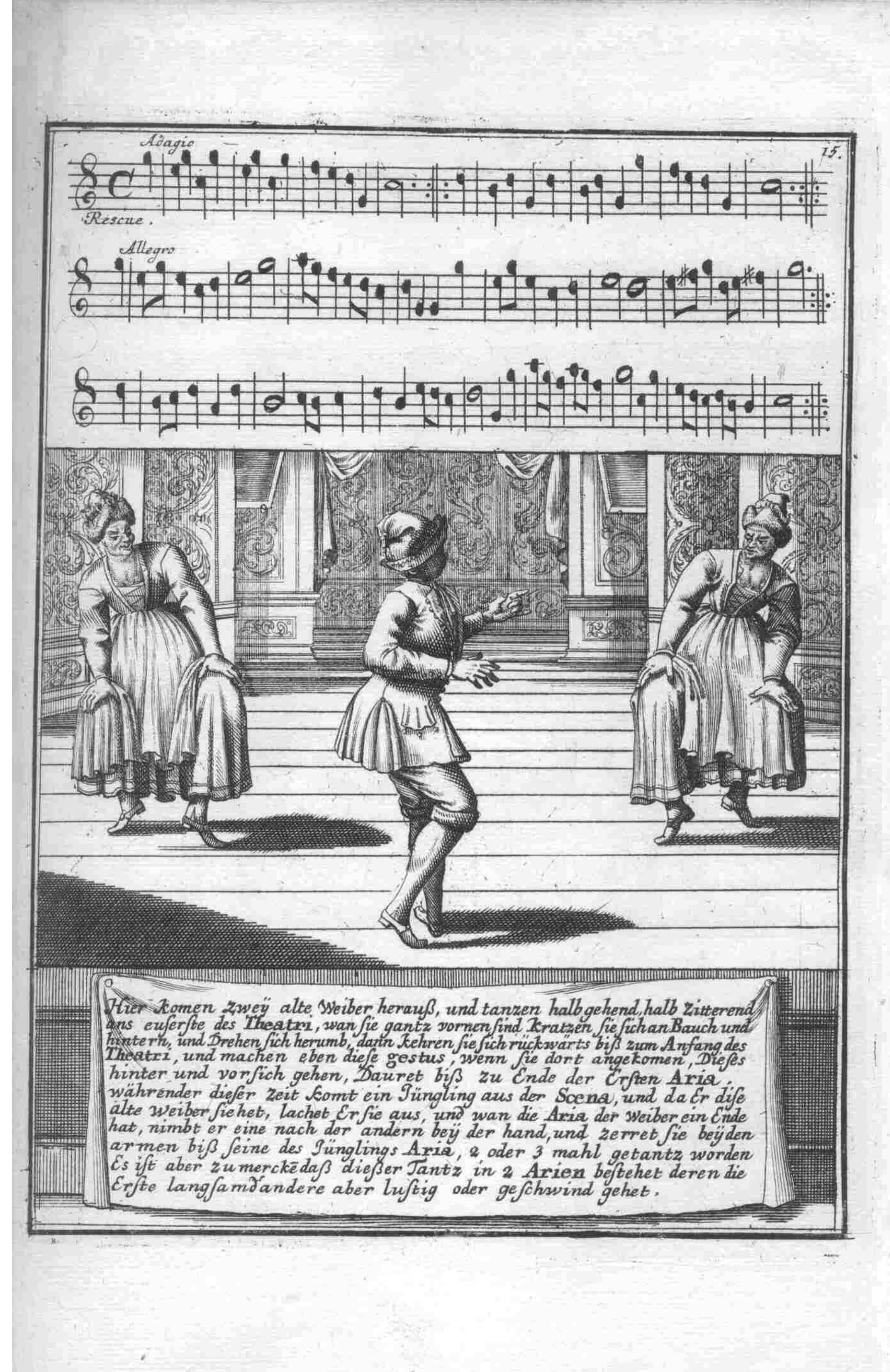
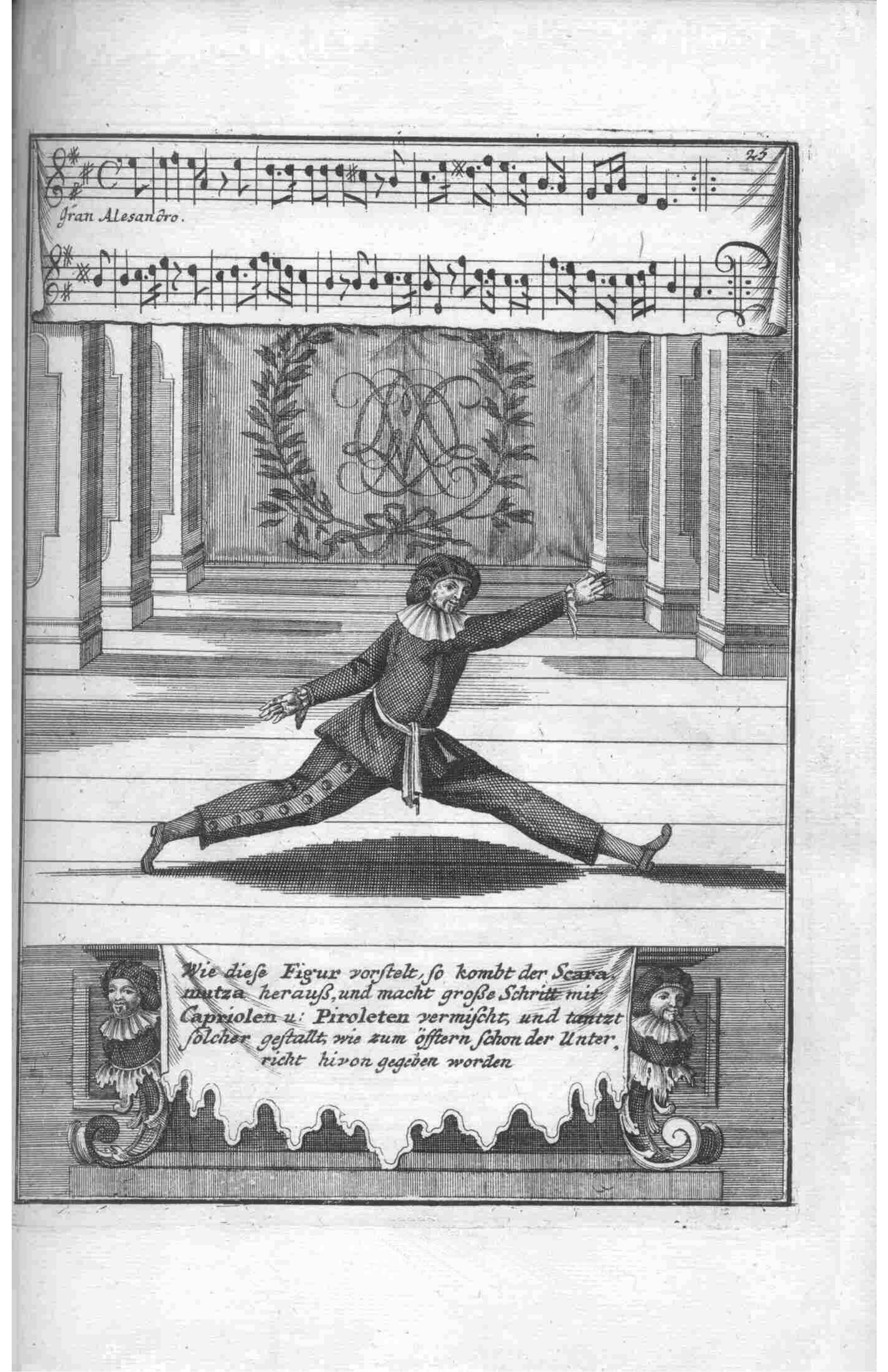
Lambranzi's manual is one of the few surviving visual records of how Baroque theatrical dance was actually performed and staged—the notation, costumes, and architectural settings provide rare documentary evidence of dance technique, partnering conventions, and production design from the early 18th century. For historians of dance notation and for performers interested in reconstructing historical choreography, this plate offers concrete information about the Rigaudon's performance context that cannot be inferred from written treatises alone.
What you are looking at
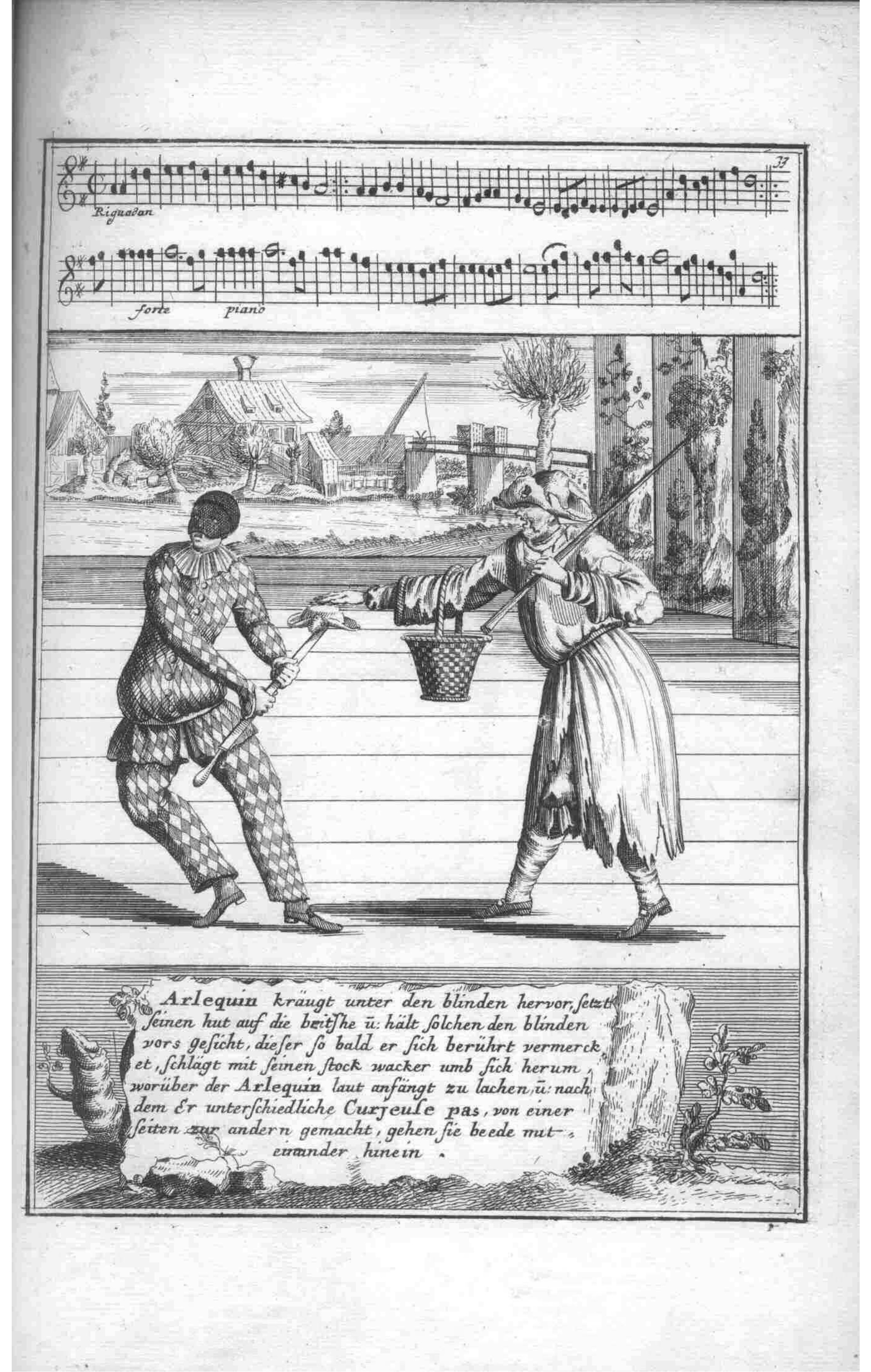
A man and woman in theatrical Baroque costume perform a paired dance on a wooden stage set. The woman wears a full-skirted dress with long sleeves and an ornate headdress; the man wears a diamond-patterned doublet and hose. Both are in dynamic poses suggesting movement—the woman's body angles away while the man leans toward her, his arm extended with apparent gallantry. Behind them, a painted backdrop depicts a Dutch or Flemish landscape with a bridge, windmill, formal gardens, and distant architecture rendered in fine linear perspective. The foreground stage is bare except for a single woven basket placed between the dancers. Musical notation appears at the top of the plate in two staves, labeled *Rigaudon* and marked *Forte* and *piano*. Below the scene, a German verse in italic script provides commentary on the dance. The engraving technique produces fine cross-hatching that renders fabric texture, shadow, and the illusion of depth.
The dancing
The male dancer's body is upright and presenting, weight appearing forward on the balls of his feet, with one arm extended toward his partner in invitation or support. The female dancer's posture is more withdrawn, her torso angled away, her face turned toward him—a pose of demure or coquettish hesitation. Neither dancer is in a closed hold; the interaction is at a distance, mediated by gesture. The poses suggest a moment of courtship or formal salutation rather than physical contact. Both figures display the turned-out leg positions characteristic of the period.
The dance depicted
The notation identifies this as a *Rigaudon* (also spelled Rigaudoon), a French Baroque dance in moderate duple time that was popular in both social and theatrical contexts from the late 17th through 18th centuries. The Rigaudon was characterized by sprightly, bouncing movements and often performed by couples. The image captures a moment of the introductory stance or opening salutation rather than the rapid footwork for which the dance was famous. The theatrical dress, painted backdrop, and the plate's inclusion in a dance manual suggest this represents the stylized version of the Rigaudon performed on stage rather than in ballroom practice.
How it was made
This is a copper-plate engraving, a technique that produces sharp lines and fine detail through incised marks on a metal plate. The artist has used parallel line-work and cross-hatching to create tone, shadow, and texture—visible in the rendering of the dancers' garments, the basket, and especially in the receding architectural forms of the background landscape. Engraving allowed for precise reproduction and relatively inexpensive circulation of multiple impressions, making this an ideal medium for instructional dance manuals intended for a broad audience of dancing masters and noble practitioners. The technical precision also conveys the formality and refinement associated with court dance.
About this work
This is a single plate from Gregorio Lambranzi's *Nuova e curiosa scuola de' balli theatrali* (Nuremberg, 1716), one of the era's most influential illustrated guides to theatrical dance. Each plate pairs notated music with a costumed couple or solo dancer in a staged moment, creating a visual-musical archive of Baroque theatrical choreography. The work documents the Rigaudon—a dance that bridged social and stage practice—at a moment when such dances were being codified and disseminated across the German-speaking courts. The engraved format and the dual address to both musicians (via notation) and dancers (via figure) made Lambranzi's manual a foundational teaching tool that shaped dance practice across northern Europe.
How to look at it
Attend first to the moment the artist chose: not the rapid springing steps for which the Rigaudon was known, but the formal opening stance—the moment of approach, invitation, and acknowledgment between partners. The woman's withdrawal and the man's forward energy suggest the social choreography of courtship as much as the physical choreography of the dance. Notice the precision of the costume detail and the refined proportions of the figures: this conveys the dignity and formality of court dance. The landscape backdrop is not incidental; it establishes the fiction of an elegant outdoor or garden setting, a convention of theatrical Baroque design that framed dance as a courtly spectacle.
The artist
Gregorio Lambranzi (c. 1665–after 1730) was an Italian dancer and choreographer active in the German-speaking courts, particularly Nuremberg. His *Nuova e curiosa scuola de' balli theatrali* (New and Curious School of Theatrical Dances), first published in 1716 with a second edition in 1728, was the most comprehensive illustrated dance manual of the period. Lambranzi combined Italian dance vocabulary and technique with French court conventions and theatrical spectacle, positioning himself as a conduit between Italian and Northern European dance cultures. The manual's success lay in its practical focus: each plate could serve as a teaching aid, and the inclusion of musical notation made it useful for musicians as well as dancers.
The period
In the early 18th century, Baroque dance was undergoing standardization and documentation. The Rigaudon had emerged in France in the 1680s and quickly became a staple of court ballet and social dancing across Europe. At the moment Lambranzi published his manual (1716), the Rigaudon was still fashionable but codified enough that its steps and style could be illustrated for instruction. Theatrically, the period saw increased investment in spectacle, scenery, and the visual framing of dance—reflected here in the perspective backdrop and the careful costume design. Lambranzi's manual appeared at the intersection of oral tradition and written/visual documentation, serving a culture in which dance knowledge was beginning to be systematized for wider circulation.
Where it lives
This plate belongs to the complete two-volume *Nuova e curiosa scuola de' balli theatrali* published in Nuremberg by the printer Christoph Weigel. The work was designed as a comprehensive instructional manual for dancing masters and courtly practitioners, with 116 plates illustrating individual and partnered dances, steps, and postures. The Library of Congress holds copies of this historically significant manual.
Dance in this work
Questions about this work
What does the music notation tell us?
The notation identifies the dance as a Rigaudon and provides the rhythmic and melodic framework that a musician would have used to accompany the dancer. The marking *Forte* and *piano* indicate dynamic variation—a feature of refined Baroque performance. This coupling of image and notation is what makes Lambranzi's manual so valuable: dancers and musicians could coordinate their practice.
Was the Rigaudon danced socially or only on stage?
Both. The Rigaudon began as a social court dance in France but was quickly adopted for theatrical performance. Lambranzi's manual documents the theatrical version, with stylized gesture and formal costume, but the basic vocabulary and character would have been familiar to anyone dancing in a noble household. This plate shows the theatrical elevation of a dance that had currency in both contexts.
Why is there a basket on the stage?
Props were a common feature of Baroque theatrical dance, and baskets or other objects often served as points of interaction or focus. In some Rigaudon choreography, dancers manipulated or moved around such objects. The basket here may be part of the narrative or scenic fiction, or it may simply mark a spatial reference point for the choreography.
How would a modern dancer use this image?
By combining the visual evidence of body position, the notated music, and the descriptions in Lambranzi's text (which accompanies each plate), a historical dance specialist or reconstructor can approximate the steps, timing, and character of the Rigaudon as it was performed in the early 18th century. This is one of the most concrete surviving records of Baroque theatrical choreography.
More Notation/Choreography artwork