49 works in this view — arrow keys or swipe to move between them.
Dance in Art
Comic Character — Plate 36
Gregorio Lambranzi
- Medium:
- Copper-plate engraving
- Dance:
- Notation/Choreography
- Era:
- 1700s (Enlightenment/Minuet Era)
- Collection:
- Nuova e curiosa scuola de' balli theatrali (1716)
- Source:
- Library of Congress
- Rights:
- Public domain — free to use, share and adapt.
- Recorded as:
- Public Domain
Lambranzi's work is one of the earliest and most detailed surviving records of choreographed theater dance from the German-speaking world, and character dances like this one are particularly rare in visual documentation. For historians and dancers, the combination of musical notation and precise engraved image allows reconstruction of movement vocabularies that are otherwise lost to oral tradition. This specific plate shows how comic physicality and grotesque posture were coded and transmitted as skilled performance, not mere buffoonery.
What you are looking at
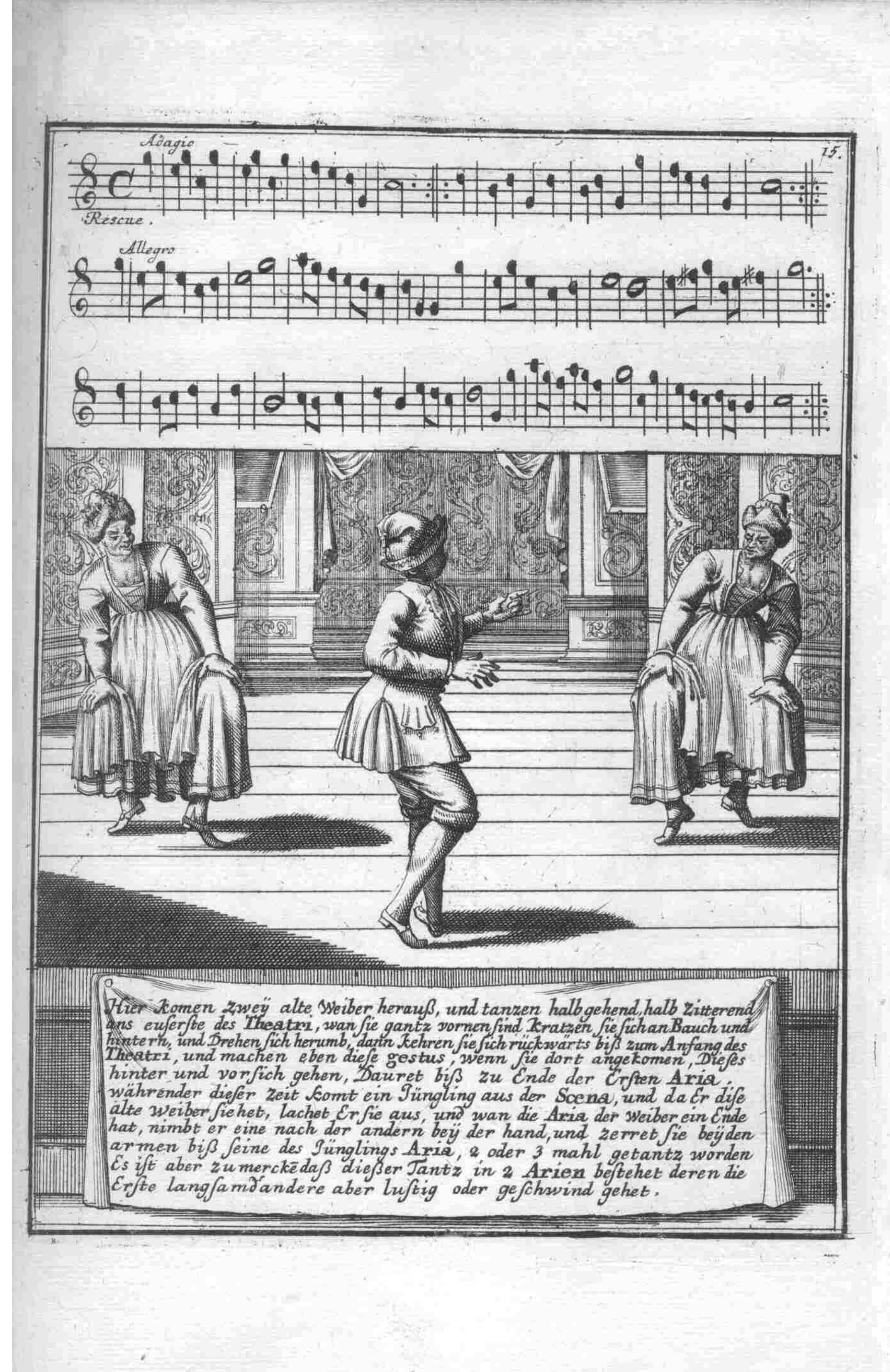
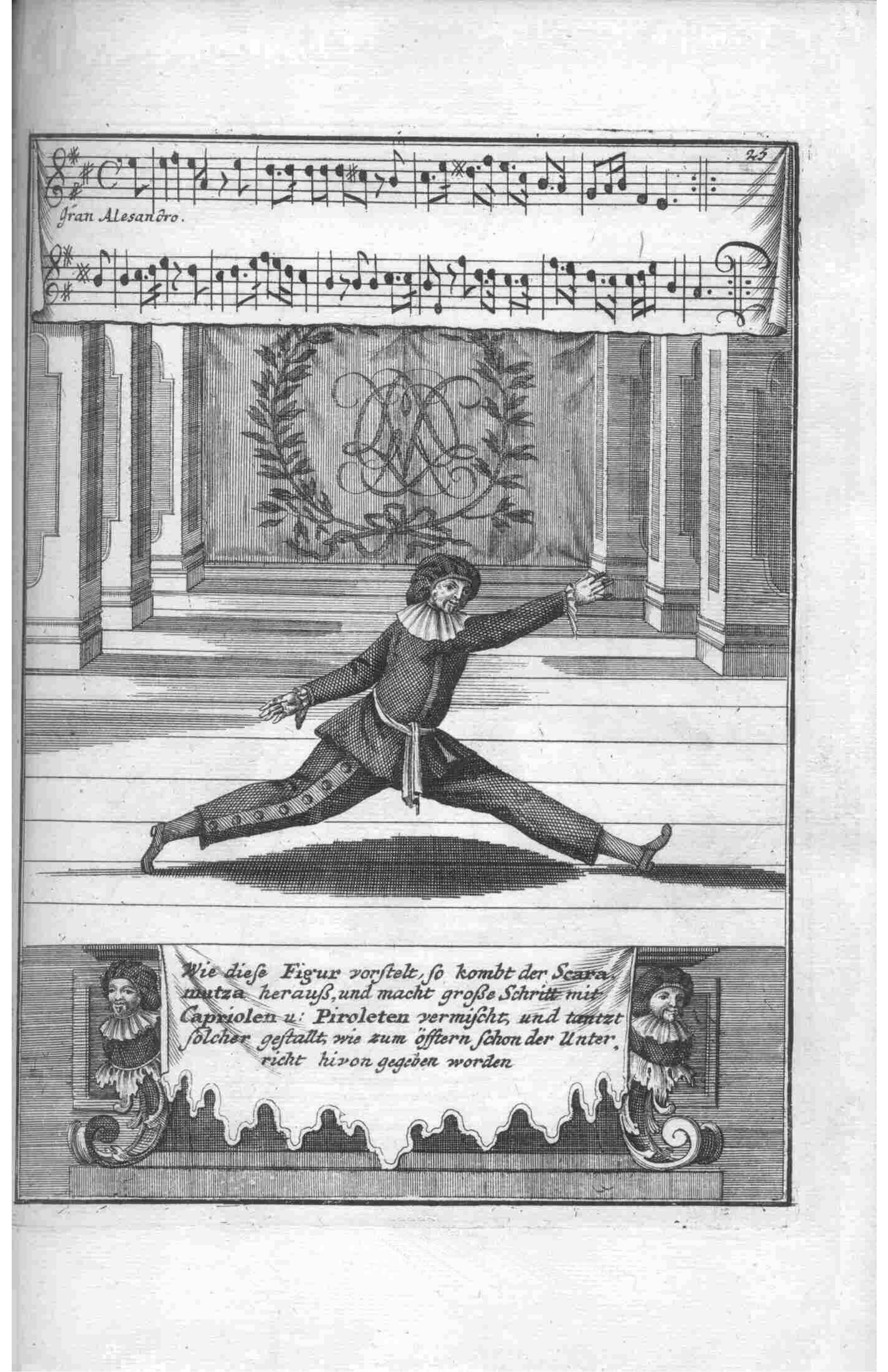
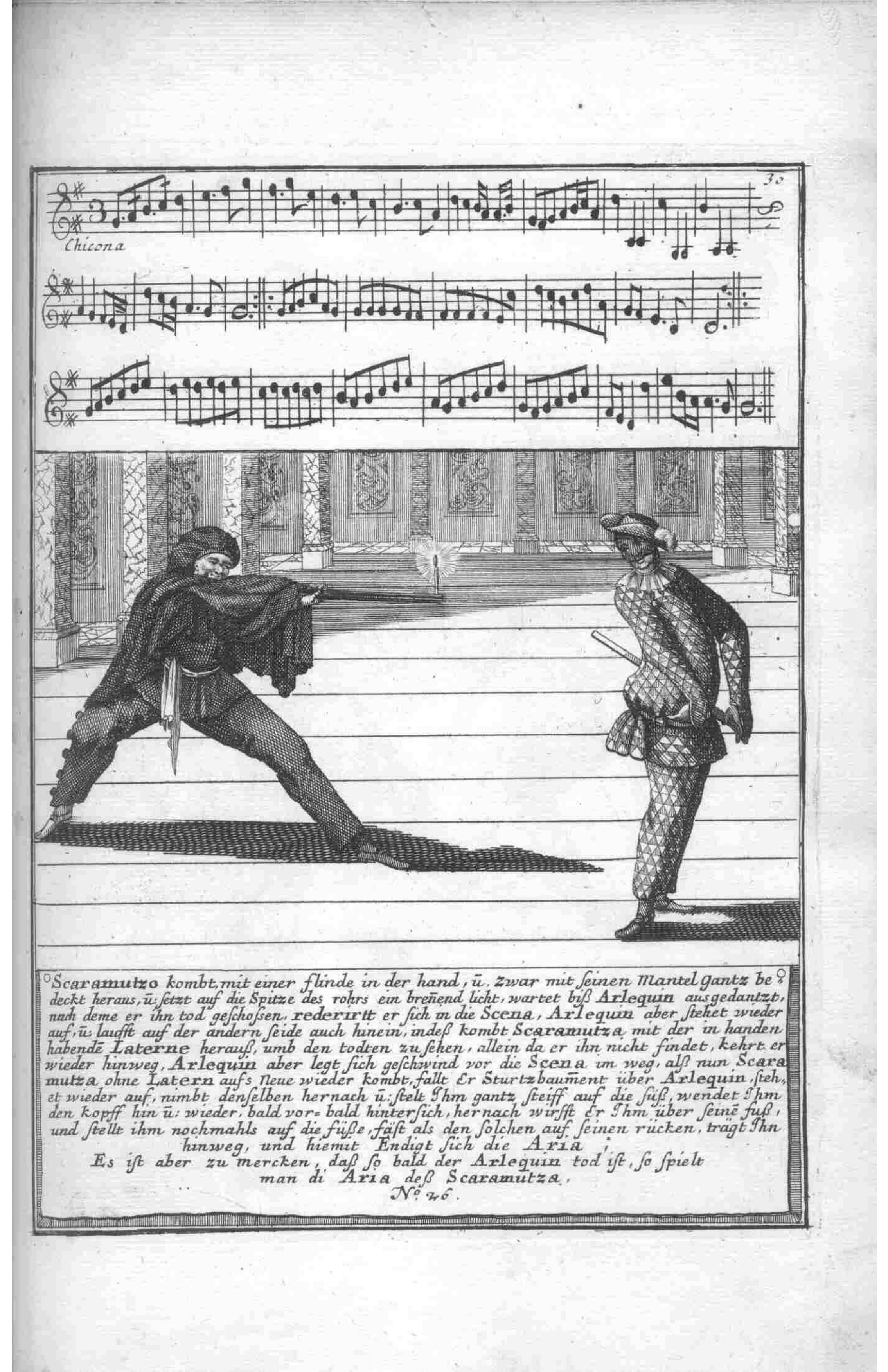
A single male dancer in ornate costume occupies the center of a bare wooden-floored stage framed by classical columns and draped curtains. He wears a richly patterned doublet with jeweled or embroidered decoration, paired with voluminous breeches gathered at the knee, and has curled shoulder-length hair in the fashion of the early 18th century. His body is bent dramatically forward at the waist in an exaggerated comic posture, with one leg extended behind him and arms gesturing expansively—the attitude is burlesque and deliberately grotesque rather than graceful. The stage itself is a sophisticated architectural interior rendered in perspective, with ornamental vases and potted plants visible in the background niches, suggesting a noble or princely court. Above the scene, two staves of musical notation indicate this is a choreographed piece with an accompanying score. At the base, a German-language caption in an ornamental cartouche frames the image. The entire composition is rendered as a copper-plate engraving in fine black lines with careful cross-hatching for shadow and depth.
The dancing
A single dancer occupies the stage. His weight is thrown dramatically forward, the torso bent nearly horizontal at the hips while the legs remain relatively straight, creating a comic inverted angle—this is not a position of classical grace but of exaggerated physical comedy. One leg is extended behind the body, the other bears weight or bends slightly. The arms are spread wide in a gesture of abandon or mock distress, palms open. The head follows the forward bend of the torso. The stance conveys instability and physical humor rather than balletic control; this appears to be a character dance built on caricature and the violation of formal courtly movement codes.
The dance depicted
This is a theatrical dance from the early 18th-century German court or princely stage, intended as comic or burlesque entertainment—what the catalogue calls a 'comic character.' The posture and gesture signal a character type, likely a stock comic servant or fool figure from commedia dell'arte or its derivatives, known to have been frequently performed in German court theaters of the period. The extreme forward bend and spread-armed gesture are signatures of physical comedy and grotesquerie rather than courtly or balletic movement. No standard social or theatrical dance form is being depicted; instead, this is an example of character or comic mime-dance, where body language and exaggeration convey character and emotion. The musical notation above suggests the movement was composed and notated, not improvised.
How it was made
This is a copper-plate engraving, a precise and labor-intensive printmaking technique that required the artist to incise the design directly into a polished copper plate, which was then inked and printed. The fine parallel lines (hatching) create tone and shadow, and the careful perspective grid of the floor demonstrates the engraver's skill in spatial representation. As one of the plates from Lambranzi's *Nuova e curiosa scuola de' balli theatrali*, it was produced to be printed in quantity, making it a publishable instructional or documentary image. Engravings were the premium medium for disseminating dance knowledge in the early 18th century—more durable and sharper than woodcuts, more prestigious than etchings—and this technical sophistication signals that the work was intended for an educated, courtly, or professional audience capable of reading both notation and image.
About this work
This engraving is plate 36 from Gregorio Lambranzi's *Nuova e curiosa scuola de' balli theatrali* (Nuremberg, 1716), one of the most significant illustrated dance manuals of the early 18th century. Each plate in the collection pairs a musical composition (shown in staff notation above) with a costumed dancer performing a specific choreographed role or character on a stage. This plate depicts a comic or burlesque male character in an exaggerated forward-bent posture, arms spread wide in a gesture of physical comedy. Unlike the formal courtly minuets and contredanses that dominate the collection, this image documents theatrical character dance—the comedic, caricatured movement that entertained princely courts and professional stages of the German and Italian baroque and early rococo periods. Lambranzi's manual is a rare surviving record of how these character dances looked in performance, made all the more valuable because it combines notation with precise visual documentation.
How to look at it
Look first at the extreme angle of the body: the forward bend is frozen at a moment of comic vulnerability or distress, not at a moment of balletic equilibrium. The spread arms and open palms are gestures of emotion—surprise, exasperation, or physical comedy—rather than formal port de bras. The costume and curled hair place this in the early 18th century, but the exaggerated posture and character-type appearance (rather than the noble or generic look of courtly dancers) signal that this is a role, a persona. The careful rendering of the stage architecture and perspective, and the presence of the musical score above, tell us this is not a casual record but a precise documentation of a composed and notated choreographic work meant to be learned and transmitted.
The artist
Gregorio Lambranzi (c. 1680–1730) was a dance master and choreographer active in Nuremberg and the German-speaking courts of the Holy Roman Empire. His *Nuova e curiosa scuola de' balli theatrali* (New and Curious School of Theatrical Dances), first published in Nuremberg in 1716 with engravings by the artist Weigel, comprises 48 plates documenting theatrical dances, character roles, and social dances of the period. The work is both a practical manual—aimed at dance masters and performers—and a prestige publication demonstrating the artistic legitimacy of dance as a courtly and theatrical discipline. Lambranzi was among the first to systematically document theatrical dance through the combination of notation and illustration, influencing later dance notation systems and establishing a model for dance manuals that persisted into the 19th century.
The period
In the early 18th century, European court dance was divided between formal social dances (minuets, contredanses, rigaudons) performed by courtiers and their guests, and theatrical or character dances performed by professional and semi-professional dancers on stages within palaces and princely theaters. Character dances drew heavily on commedia dell'arte—the improvised Italian comedic tradition that had circulated through European courts since the 16th century—and on folk or peasant movement. These theatrical pieces often featured stock characters (servants, lovers, old men, rustics) performed with exaggeration and physical comedy. Lambranzi's decision to document these character dances alongside courtly social forms reflects the period's recognition that theatrical movement was a legitimate branch of the dance art and worthy of preservation and instruction. The publication in 1716 also marks the early phase of the rococo, when playfulness, lightness, and theatrical wit were increasingly valued in courtly culture.
Where it lives
This plate is from the 1716 Nuremberg edition of *Nuova e curiosa scuola de' balli theatrali*, an illustrated dance manual comprising 48 copper-plate engravings documenting theatrical and social dances. The work was designed as a practical instructional text for dance masters and performers, with each plate pairing musical notation (in staff notation at the top) with a costumed dancer performing a specific choreographed character or role.
Dance in this work
Questions about this work
Is this the same book that has the famous jumping dance pictures?
Yes. Lambranzi's *Nuova e curiosa scuola de' balli theatrali* is the only illustrated source that contains all 48 choreographed dances. The collection includes character dances, social dances, and theatrical pieces. This particular plate is one of the character or comic dances, rendered as a forward-bent burlesque figure. The book is held in several major libraries and has been reproduced in modern facsimile editions.
What does the music notation at the top mean?
The two staves of music at the top show the musical composition that accompanied this choreographed dance. In early 18th-century practice, dances were performed to composed music, and Lambranzi's system pairs each notated tune with a choreographed movement sequence. The notation is in the staff system common to the period; while we can see the pitches and rhythmic values, full reconstruction of the melody would require musical expertise.
Why is he bent over like that? Is that how people danced?
Yes, but only in comic or character dances performed by professional dancers on stage. This is not how courtiers would dance at a ball. This extreme forward bend and the spread-armed gesture are conventions of theatrical burlesque or comedy, likely derived from commedia dell'arte. They signal a comedic character type—perhaps a foolish servant or rustic—rather than a noble or romantic role. The exaggeration is intentional and skilled.
Who would have danced this?
Professional or semi-professional dancers employed in German princely courts and theaters, not courtly amateurs. These character dances were performed as entertainment in court theaters, banquets, and carnival celebrations. Lambranzi's manual was intended to teach dance masters how to teach and choreograph such roles, implying a market for trained performers who could execute both courtly dances and comic characters.
More Notation/Choreography artwork