49 works in this view — arrow keys or swipe to move between them.
Dance in Art
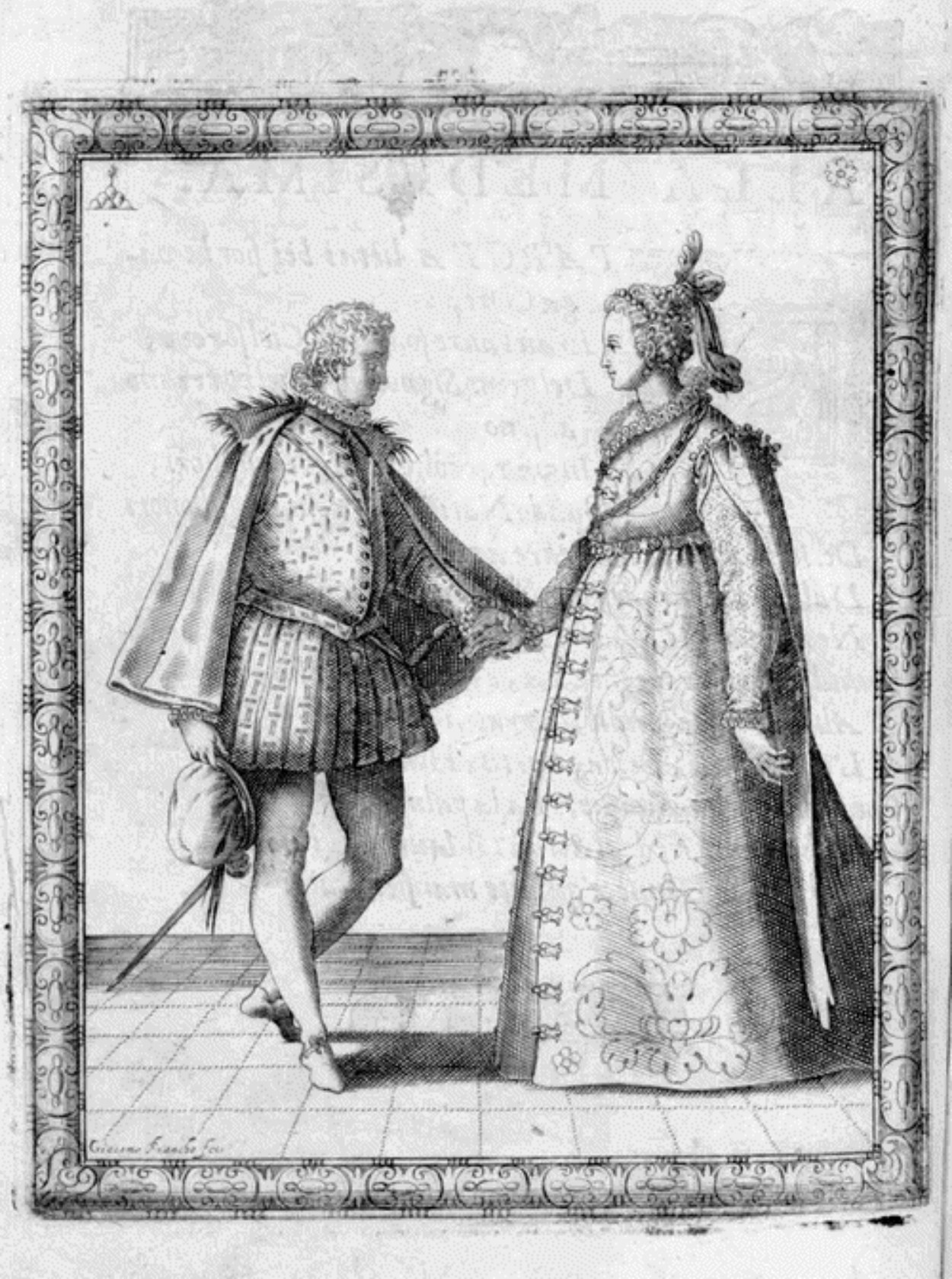
Caroso — Dance Plate (plate 22)
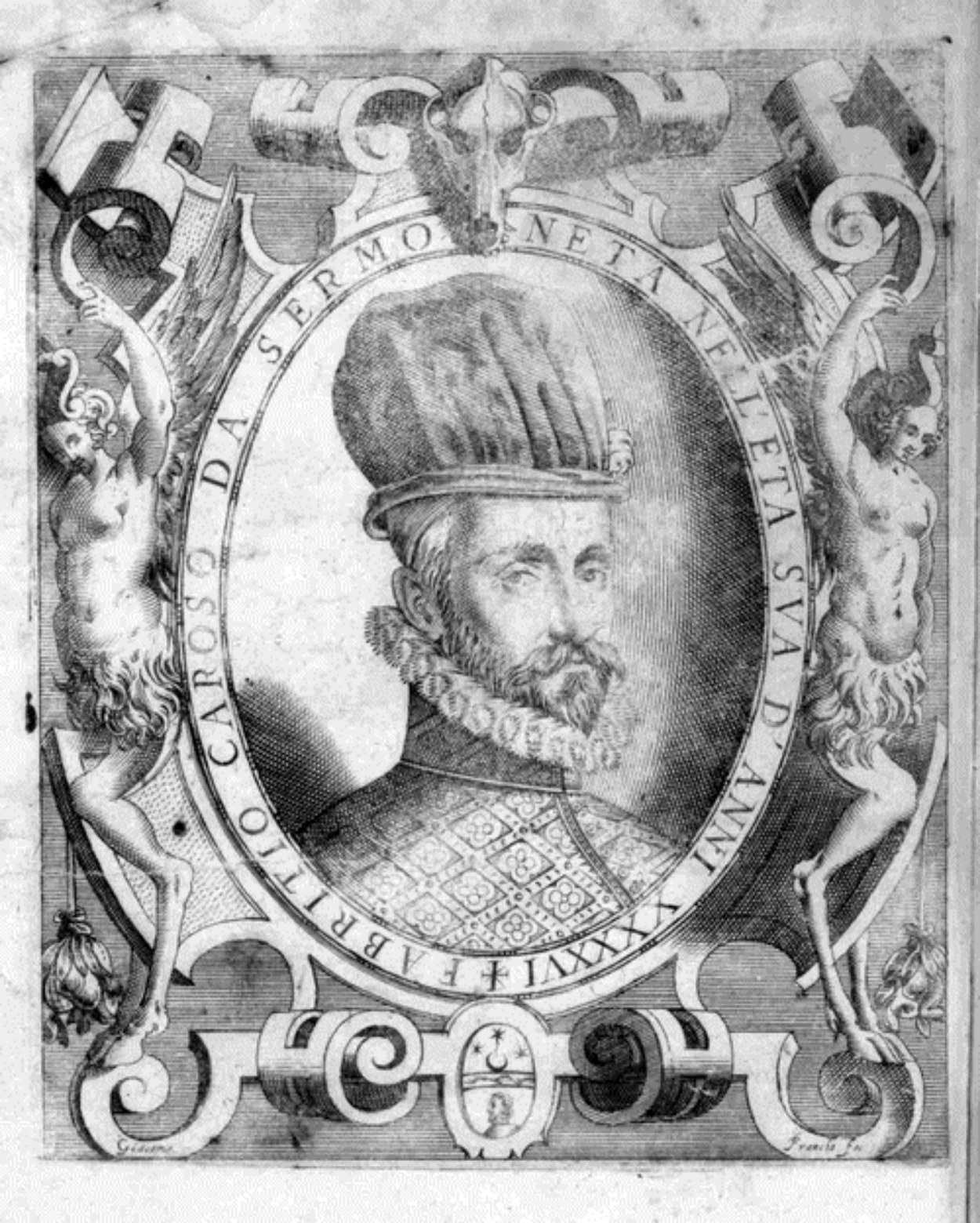
Fabritio Caroso da Sermoneta
- Medium:
- Woodcut
- Dance:
- Notation/Choreography
- Era:
- Pre-1700 (Renaissance/Baroque)
- Collection:
- Il Ballarino (1581)
- Source:
- Library of Congress
- Rights:
- Public domain — free to use, share and adapt.
- Recorded as:
- Public Domain
This plate is one of only a handful of surviving images that shows exactly how Renaissance court dancers held their bodies, positioned their limbs, and connected with their partners—information that exists nowhere else with comparable authority. For dance historians and reconstructors, Caroso's plates are primary sources of the same weight as surviving notation; for art historians, they document the material culture and aesthetic ideals of the late-16th-century Venetian elite.
What you are looking at
A man and woman in elaborate Renaissance court dress stand facing each other in a formal architectural setting with a tiled floor. Both figures are posed with one hand clasped together between them while their free arms extend outward in the measured elegance characteristic of courtly dance. The man, on the left, wears a jeweled doublet with puffed sleeves, a decorative cape draped from his shoulders, and holds a sword. His posture is upright and his legs are extended in a graceful line. The woman, on the right, wears an ornately embroidered gown with a fitted bodice and full skirt, her hair pinned up with an elaborate jeweled ornament, and she stands with equal formality. Both dancers face each other in profile to the viewer, their connected hands at approximately waist height. The wooden frame is decorated with an ornamental Renaissance border of scrolls and rosettes, the hallmark of Venetian printing of the late 16th century.
The dancing
Two figures stand in a closed hand-hold position with their outside arms raised at shoulder height and slightly back, a frame characteristic of formal Renaissance partner dance. Their bodies maintain an upright carriage with heads held high and turned slightly toward each other. The man's weight appears anchored on his back leg while his front leg extends in a relaxed line; the woman mirrors this stance. The connection between them is intimate but restrained—a single clasped hand rather than an embrace—and the symmetry of their pose and arm placement suggests a precisely codified movement vocabulary rather than improvisation.
The dance depicted
This is a demonstration of a bassadanza or pavane, the foundational social dances of the Renaissance Italian court as documented in Caroso's *Il Ballarino*. The handbook, published in Venice in 1581, catalogued and notated the dances of late-16th-century Italian nobility, and each of its woodcut plates showed a couple in the formal dress of performance positioned mid-movement. The particular hold—the closed hand-grasp with elevated arms—and the upright posture and extended line of the legs are consistent with the measured, processional style of the pavane or the more complex variations Caroso taught. The dancers' dress indicates these were social dances performed at court by the nobility themselves, not professional entertainers.
How it was made
This is a woodcut, a relief printing technique in which an image is carved into the surface of a wooden block, inked, and impressed onto paper. Woodcut allows crisp, bold lines and clear areas of tone, making it ideal for reproducing the precise detail of embroidered fabric, jeweled ornaments, and the architectural setting. The medium was the standard for book illustration in Renaissance Venice and allowed Caroso's *Il Ballarino* to circulate widely among the literate, prosperous class that patronized dance masters. The decorative border frame is integral to the block and marks this as a printed book page rather than a standalone print.
About this work
This is one of twenty-three woodcut plates from Fabritio Caroso's *Il Ballarino*, the most celebrated dance manual of the Renaissance and the primary surviving record of how Italian court dances were performed in the 1580s. Caroso was the leading dance master of Venice, and his book was addressed to nobles and their children who danced socially at court. Each plate shows two dancers—most often a man and woman—in the moment of a specific dance, wearing the costly, elaborate court dress in which they actually danced. The book was printed in Venice in 1581 and circulated among the educated elite of Italy and beyond; it is foundational to our understanding of Renaissance dance and was reprinted and translated throughout Europe.
Caroso's dance plates are among the most historically precise images of Renaissance dance we possess because they were created by someone who both danced and taught, and his notation system (described in the text) was precise enough that scholars can reconstruct the dances from the written descriptions. The woodcuts themselves are documents of fashion, social custom, and the physical technique of a lost performance tradition.
How to look at it
Look first at the hand-hold and arm position—the connection between the dancers is formal and controlled, not intimate, and their arms make precise angles rather than flowing lines. Notice the extended line of the legs, the upright head carriage, and the symmetry of the pose: these are not spontaneous gestures but the products of careful training. The man's cape and the woman's embroidered skirt suggest movement, but both figures are in a held position rather than caught mid-step; they are posed to show the shape and carriage expected of a court dancer. The ornamental border frames this as a teaching image—a visual notation of how a trained dancer should look.
The artist
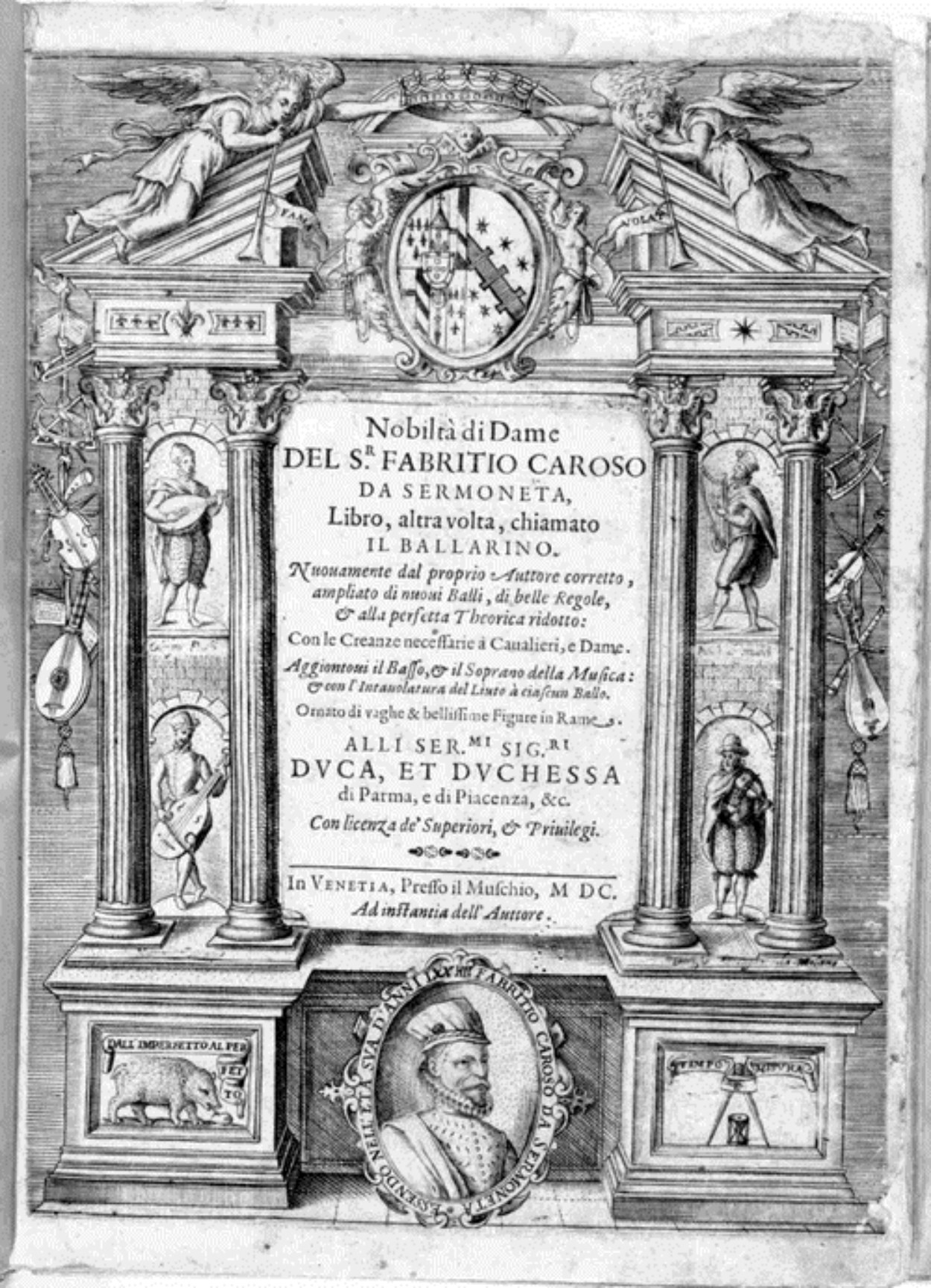
Fabritio Caroso da Sermoneta (c. 1535–c. 1605) was the most celebrated dance master of late-Renaissance Italy, based in Venice. He wrote *Il Ballarino* (1581) and a revised and expanded edition, *Nobiltà di Dame* (1600), the two most influential dance manuals of the period. Unlike many dance masters, Caroso documented his practice in detail and had the resources to publish his work with woodcut illustrations. His books were addressed to the nobility and aimed at teaching the dances of the Venetian and broader Italian courts. Caroso's notation system—a combination of written description, step vocabulary, and imagery—set a standard for dance documentation that influenced pedagogical practice for centuries.
The period
In the 1580s, social dance at the European courts was a essential accomplishment for the nobility and a marker of refinement, status, and courtship. The Renaissance ideal of *sprezzatura*—studied, controlled elegance—is visible in the upright carriage, measured arm placement, and formal hand-hold that Caroso's plates show. The dances themselves (pavane, galliard, volta, etc.) were performed in the elaborate, restrictive clothing of the period: jeweled doublets, full skirts, and high heels that required significant physical control. Venice in the 1580s was the printing center of Europe, and the technological sophistication of Venetian printing allowed Caroso to produce a book of unusual visual and textual precision. The woodcut medium itself was the cutting-edge technology for circulating images at the time.
Where it lives
This plate is from *Il Ballarino*, Fabritio Caroso's dance manual published in Venice in 1581 by the printer Ziletti. The record indicates the holding is the Library of Congress. The book was one of the most widely owned dance manuals of the Renaissance and many copies survive in institutional and private collections across Europe and North America.
Dance in this work
Questions about this work
Is this a real moment in a dance, or a posed image?
It is a posed image designed to teach. Caroso positioned couples to show the carriage, arm placement, and hand-hold expected in a specific dance or moment within a dance. The position is held and symmetrical, not captured mid-movement, so that a student could study the alignment of the body and the spatial relationship between partners.
What is Caroso's *Il Ballarino*?
*Il Ballarino* is a dance manual and instruction book published in Venice in 1581 by the renowned dance master Fabritio Caroso. It documents the court dances of Renaissance Italy through text, a system of notation, and woodcut illustrations like this one. It is one of the most important primary sources for Renaissance dance and was reprinted and translated widely throughout Europe.
What dance is this showing?
The catalogue record identifies this as Plate 22 from *Il Ballarino*, but does not name the specific dance. Based on the formal hand-hold, upright carriage, and measured arm placement, it is likely a bassadanza or pavane, both foundational court dances of the period. A scholar would need to consult Caroso's text descriptions to identify the exact choreography and sequence of steps.
Who were these dancers?
The book was addressed to the nobility—courtiers, merchants' families, and their children. These were not professional performers but members of the social elite for whom dancing was an essential social accomplishment and a display of courtly refinement.
More Notation/Choreography artwork