49 works in this view — arrow keys or swipe to move between them.
Dance in Art
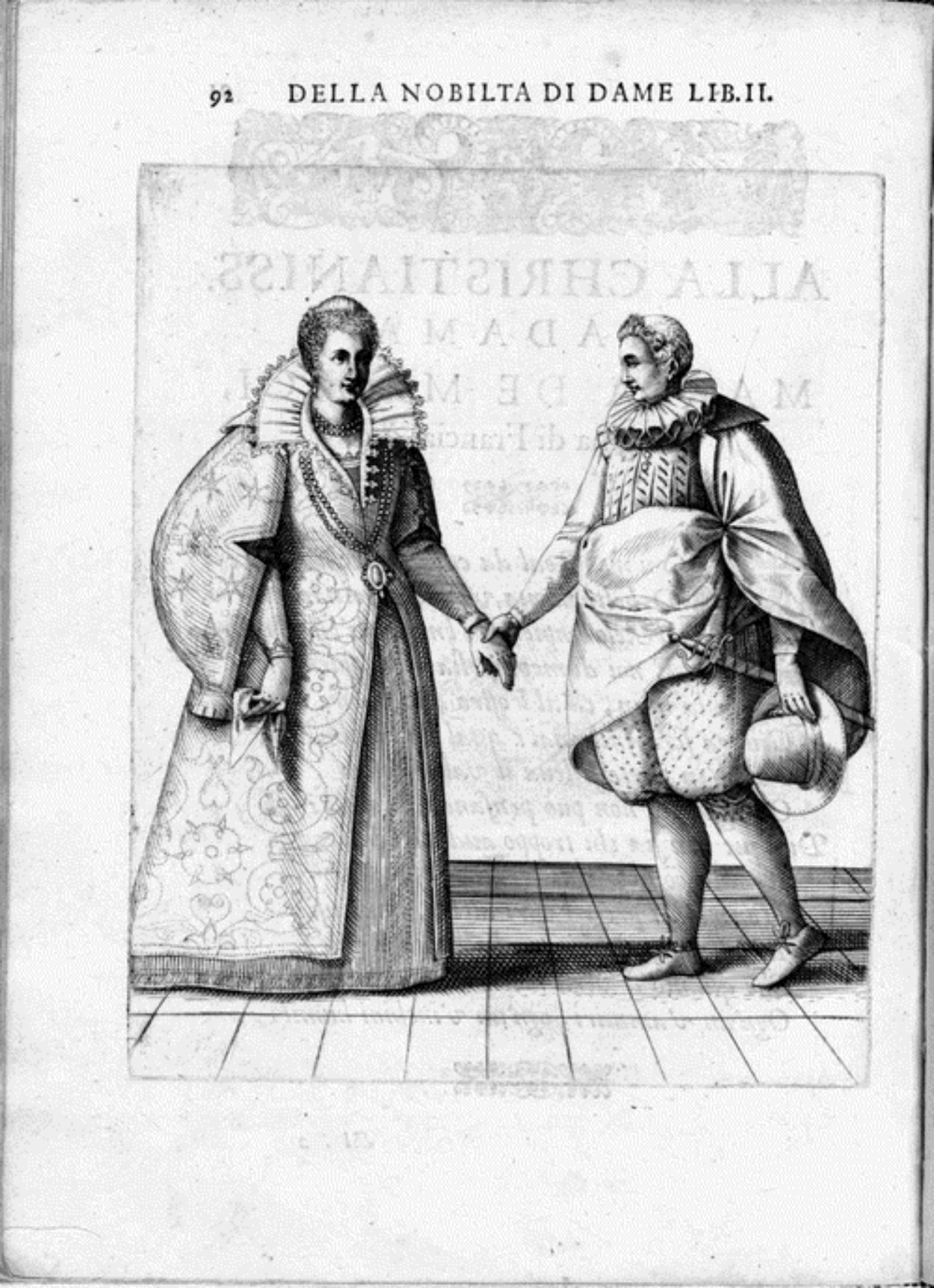
Caroso Nobiltà — Dance Plate (plate 3)
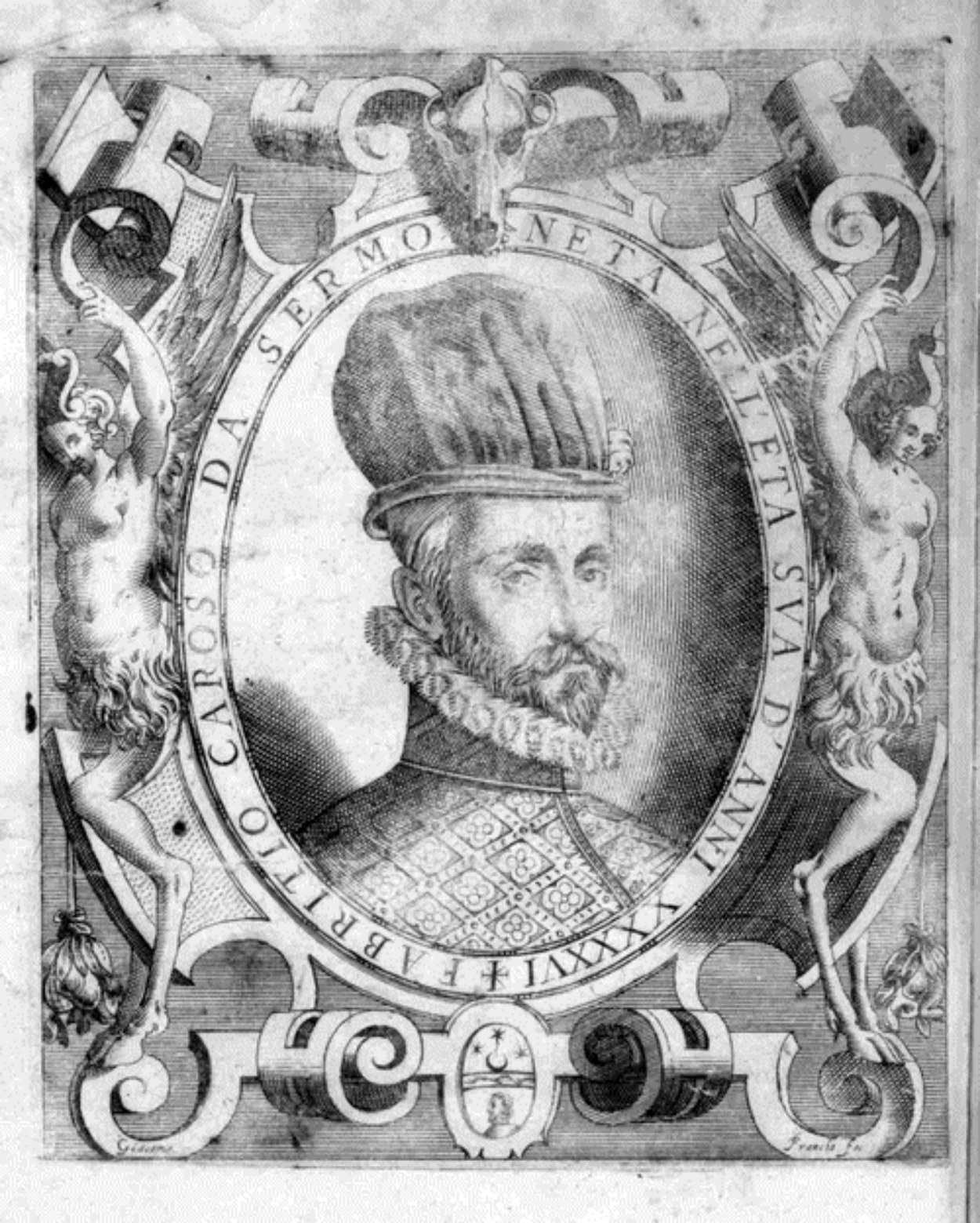
Fabritio Caroso da Sermoneta
- Medium:
- Woodcut
- Dance:
- Notation/Choreography
- Era:
- Pre-1700 (Renaissance/Baroque)
- Collection:
- Nobiltà di Dame (1600)
- Source:
- Library of Congress
- Rights:
- Public domain — free to use, share and adapt.
- Recorded as:
- Public Domain
Caroso's *Nobiltà di Dame* is the most authoritative surviving record of how Italian nobility actually danced at the turn of the 17th century. This plate is not theatrical spectacle or artistic fantasy but prescriptive documentation: it shows us the correct way two courtiers were expected to begin a formal dance together, what they wore, how they held their bodies, and how they addressed each other. For dancers and choreographers today, these images are the closest thing we have to a video recording—they anchor our understanding of Renaissance court dance in specific visual and kinesthetic evidence.
What you are looking at
A woodcut illustration depicting a noble couple in formal Renaissance Italian court dress, standing face-to-face and holding hands in what appears to be a formal greeting or opening position. The woman on the left wears an elaborate gown with a decorative patterned cloak or overdress lined with fur, a high ruffled collar, and a jeweled pendant at her waist. The man on the right wears fitted breeches, a quilted doublet, a decorative cape or cloak draped asymmetrically across one shoulder, and a ruffled collar. Both figures stand with upright posture on a tiled floor. The setting is austere—a plain background with faint text visible above suggests this is a plate from a printed instructional work. The composition is symmetrical and didactic, presenting the two figures as formal demonstration of courtly position and decorum rather than captured mid-movement.
The dancing
Both dancers are shown in an upright, formal stance with turned-out legs. They face each other directly at a slight angle, with arms extended downward and hands joined at approximately waist height in what appears to be a basic coupled position. Their posture is stiff and ceremonial rather than relaxed—the weight appears evenly distributed on both feet, with no indication of forward momentum or dynamic weight shift. The man's free arm hangs naturally at his side, while the woman's opposite arm is held high, draped with her cloak fabric. The hold and positioning suggest an opening formation or 'pairing' moment in a formal dance rather than mid-figure choreography.
The dance depicted
This is most likely a plate from Caroso's instructional notation for Italian Renaissance court dance, specifically demonstrating the initial positioning for a paired dance such as a pavane, galliard, or branle—dances central to late 16th and early 17th-century aristocratic practice. Caroso's *Nobiltà di Dame* (1600) was the authoritative manual for Italian court dance of the period, and this plate illustrates not a moment of virtuosity but rather the fundamental courtesy position from which dancers began: two noble persons acknowledging and addressing each other before proceeding into the choreographed sequence. The formality of dress and pose, and the frontal presentation, confirm this is pedagogical content—a demonstration of correct bearing and hand position for the opening of a ballroom dance.
How it was made
This is a woodcut, a relief printing technique in which an image is carved into the surface of a wooden block. Woodcut allowed Caroso's publishers in Venice to mass-produce these instructional plates affordably and distribute them across Europe, making his dance notation accessible to a wide readership of dancing masters and ambitious courtiers. The technique is visible in the bold, simplified linework and the high contrast between black lines and white ground. The woodcut's legibility at small scale made it ideal for book illustration, and its durability in the printing press meant these images could circulate in multiple copies—a crucial advantage for a work intended as a practical teaching tool rather than a precious unique object.
About this work
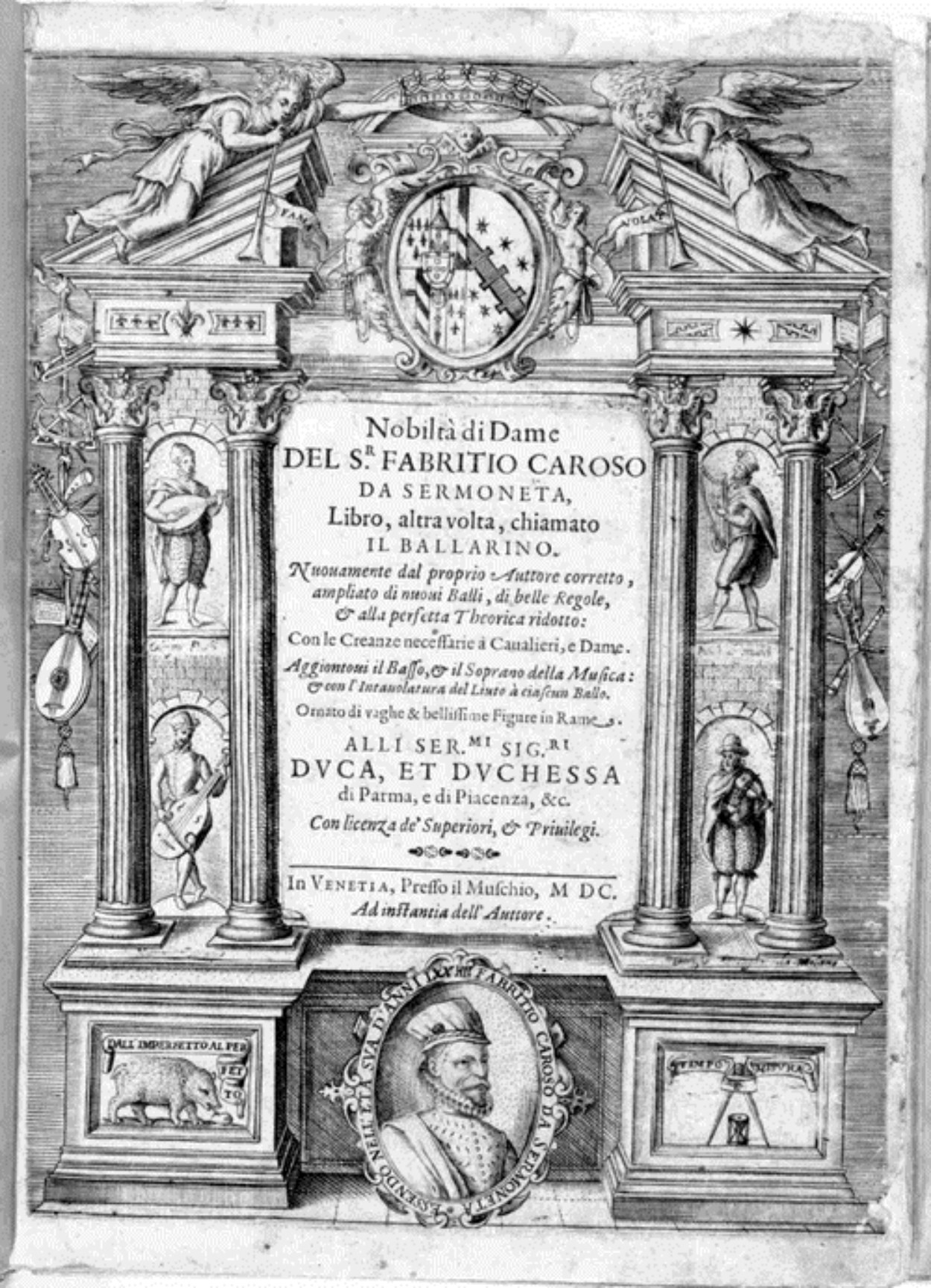
This woodcut plate is part of Fabritio Caroso's *Nobiltà di Dame* (1600), a revised and expanded edition of his earlier dance manual *Il Ballarino* (1581). It demonstrates the opening position for a paired Italian Renaissance court dance, with the two dancers shown in formal dress and correct bearing—upright posture, turned legs, and an extended hand-hold. As an instructional image, it is not a representation of dance in motion but rather a frozen moment of prescribed position, serving dancing masters and nobility who learned choreography from such diagrams and written text. The plate exemplifies how dance knowledge was codified, preserved, and transmitted in Renaissance Europe: through the combination of visual demonstration and written notation, allowing reproducible, teachable forms to standardize practice across courts and distance.
For historians, this image is precious evidence of how Renaissance Italians understood and taught courtship, hierarchy, and bodily discipline through dance. The extreme formality of the pose, the careful attention to costume and adornment, and the symmetrical composition all reinforce that Renaissance court dance was not entertainment but a core social technology—a means of displaying and negotiating noble identity. Caroso's manual was influential and widely copied; the fact that this image survives in print tells us both what he considered essential to teach and how his work shaped European dance practice for generations.
How to look at it
Look first at the hands and the formal distance between the two figures: they are not embracing or in a dynamic partnership, but rather greeting each other with a degree of ceremony and restraint. The hand-hold is light and at waist height, and the woman's body is angled slightly away from the man's despite their facing positions—this is courtship expressed through prescribed distance and formal protocol, not intimacy. Notice the extreme attention to costume detail: the fur-lined cloak, the jeweled belt, the quilted doublet, the ruffled collars. These are not incidental; in a court dance, costume was performance, and Caroso's woodcut records not just the step but the full visual presentation a noble dancer was expected to achieve. Finally, observe that both figures stand absolutely still, with no indication of motion, weight transfer, or approaching steps: this is a teaching plate, a notation of a fixed position from which the dance begins, designed for a student to study and replicate before proceeding to the next figure.
The artist
Fabritio Caroso da Sermoneta (c. 1535–c. 1605) was an Italian dancing master and choreographer active in Rome and Venice. He was among the most celebrated and influential dance pedagogues of his era, serving noble families and holding the position of maestro di ballo at the court of the Medici in Florence. Caroso produced two major dance manuals: *Il Ballarino* (1581), dedicated to the Duchy of Urbino, and the revised, expanded *Nobiltà di Dame* (1600), which he dedicated to Christine of Lorraine, Queen of France. Both were printed in Venice by Girolamo Franzini and achieved wide distribution across European courts. Caroso's work synthesized the Italian tradition of Renaissance dancing, integrating the geometric and courtly values of that tradition with evolving Spanish and French influences. His manuals contain detailed choreographic notation—a combination of verbal instruction, geometric diagrams, and illustrative woodcuts—making them among the most comprehensive dance books of their time. His approach was systematic and didactic, designed to train a student methodically from basic positions to complex multi-person choreography.
The period
This plate dates to 1600, the turn of the century, when Italian court dance was at a critical transition point. The Renaissance tradition of the pavane, galliard, and branle—highly geometric, codified, and hierarchical—was giving way to the more theatrical and virtuosic baroque forms that would dominate the 17th century. At the same time, the authority of Italian dance pedagogy was facing competition from the rising prestige of French court practice, where Louis XIV would soon codify a new vocabulary of aristocratic movement. Caroso's *Nobiltà di Dame* is thus positioned as a final authoritative statement of the Italian Renaissance system: a comprehensive archive of dances "refined and worthy of noble persons," as the title promises. The work was published in 1600—the same year as the first production of opera in Florence, another Italian art form experiencing the transition from Renaissance to Baroque aesthetics. The woodcut medium itself was becoming old-fashioned by 1600, as engraving and etching offered finer detail; the choice to use woodcut for *Nobiltà di Dame* reflects both economy and a deliberate archaism, positioning Caroso's manual as a preservation of established practice rather than an experimental work.
Where it lives
This plate comes from *Nobiltà di Dame*, printed by Girolamo Franzini in Venice in 1600. It is one of approximately 200 numbered woodcut illustrations in that edition, serving as a visual teaching aid integrated with written choreographic text. The work is held by the Library of Congress.
Dance in this work
Questions about this work
Is this actually a dance being performed, or just two people standing?
It is the latter—or rather, it is a prescribed position that *is* the beginning of the dance, captured in stillness for teaching purposes. In Renaissance court dance, the initial greeting and acknowledgment between partners was itself part of the choreographed sequence. This plate teaches students the correct bearing and hand position for that moment. The actual dance—the steps, turns, and spatial patterns—would follow from this starting position according to notation described in the accompanying text.
How do we know what the steps were if the woodcut only shows standing figures?
Caroso's manual combines these woodcuts with written text that describes the choreography using a notation system that names and sequences steps. The steps are identified by Italian names (like *saltarello*, *passo*, *continenza*) and described in relation to musical measures. A trained reader could reconstruct the movement from the text alone; the woodcuts serve as visual confirmation of position, costume, and the formal courtesy that framed the dance.
Why did Caroso dedicate this book to a Frenchwoman if it is about Italian dance?
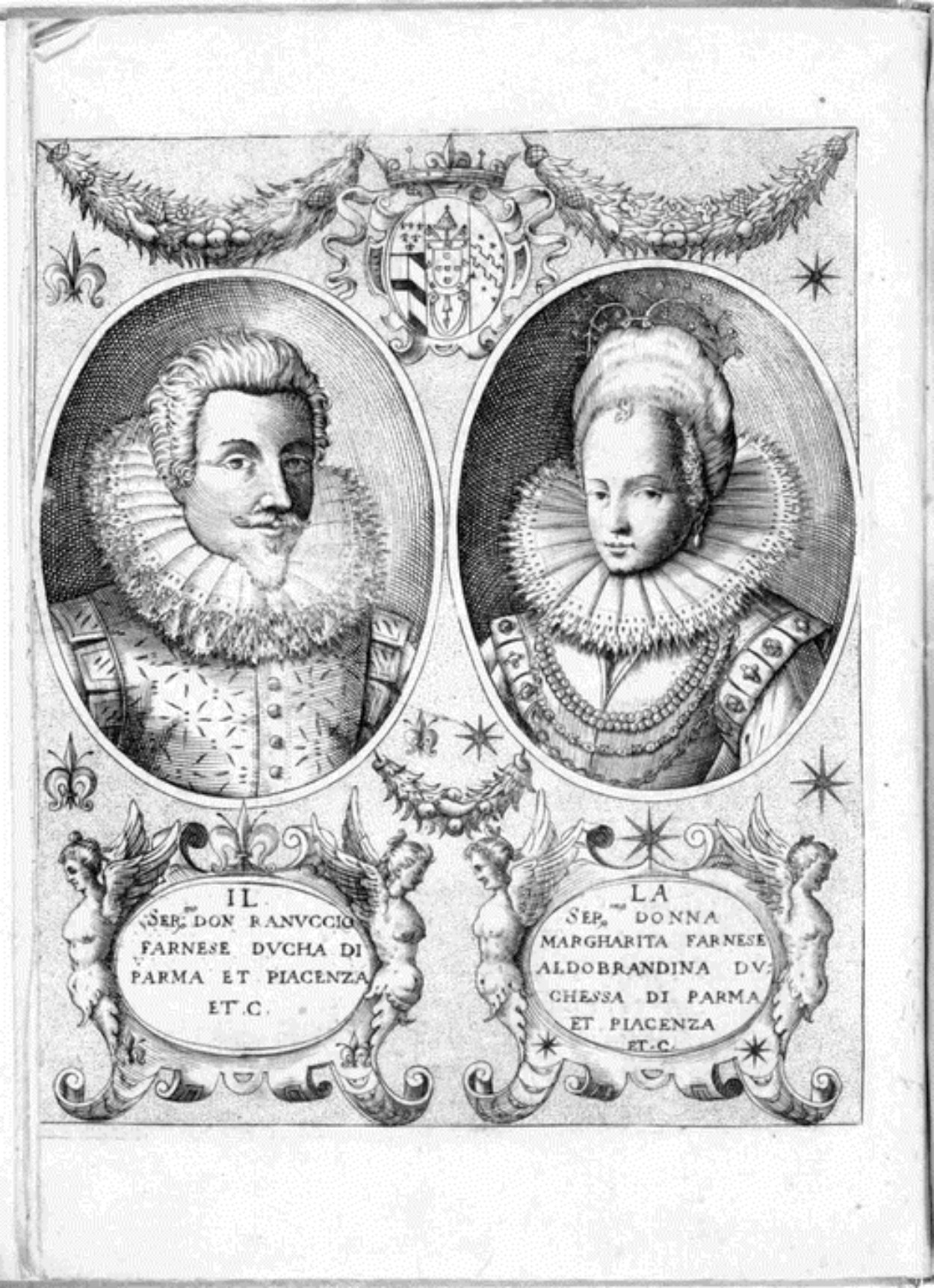
Christine of Lorraine was Queen of France by marriage and grandmother of the future Louis XIV. By the year 1600, Italian court dance was no longer the undisputed center of European aristocratic culture—France was rising in influence. Dedicating the *Nobiltà di Dame* to the French queen was both a courtesy and a claim: it positioned Italian dance practice as sophisticated enough to merit royal French patronage, and it may have been a bid to maintain Italian prestige as French courtly values began to dominate European elite practice.
What happened to this style of dance after 1600?
The formalized Italian Renaissance court dances—pavane, galliard, branle—gradually fell out of fashion in the course of the 17th century as Baroque aesthetics emphasized more virtuosic, theatrical, and emotionally expressive movement. By mid-century, French ballet, with its new technique and a strict vocabulary codified by Louis XIV's Académie Royale de Danse (founded 1661), had become the standard for European court dance. Caroso's manual is treasured by historians today precisely because it was a late record of a practice that was about to become obsolete.
More Notation/Choreography artwork