49 works in this view — arrow keys or swipe to move between them.
Dance in Art
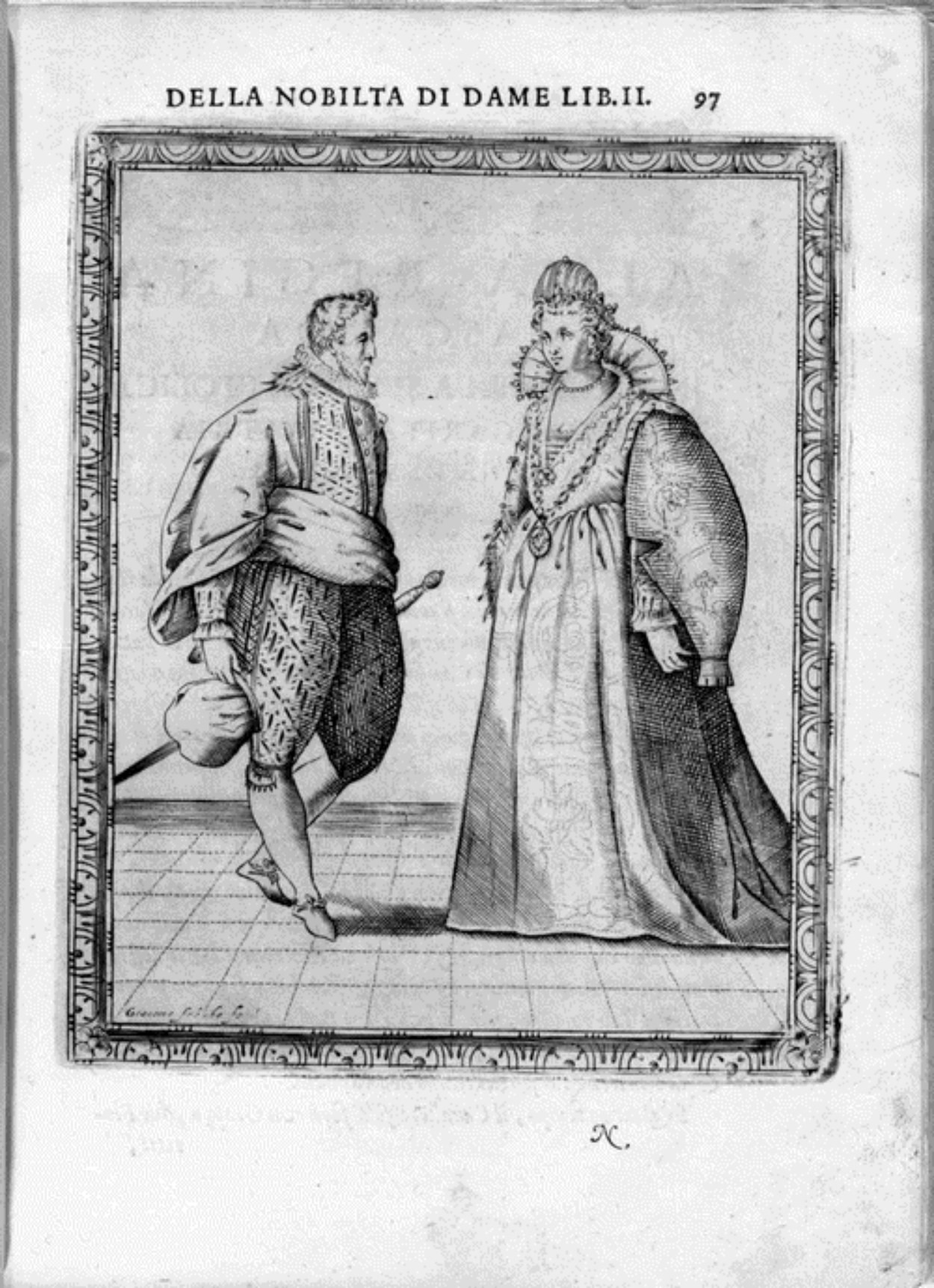
Caroso Nobiltà — Dance Plate (plate 4)
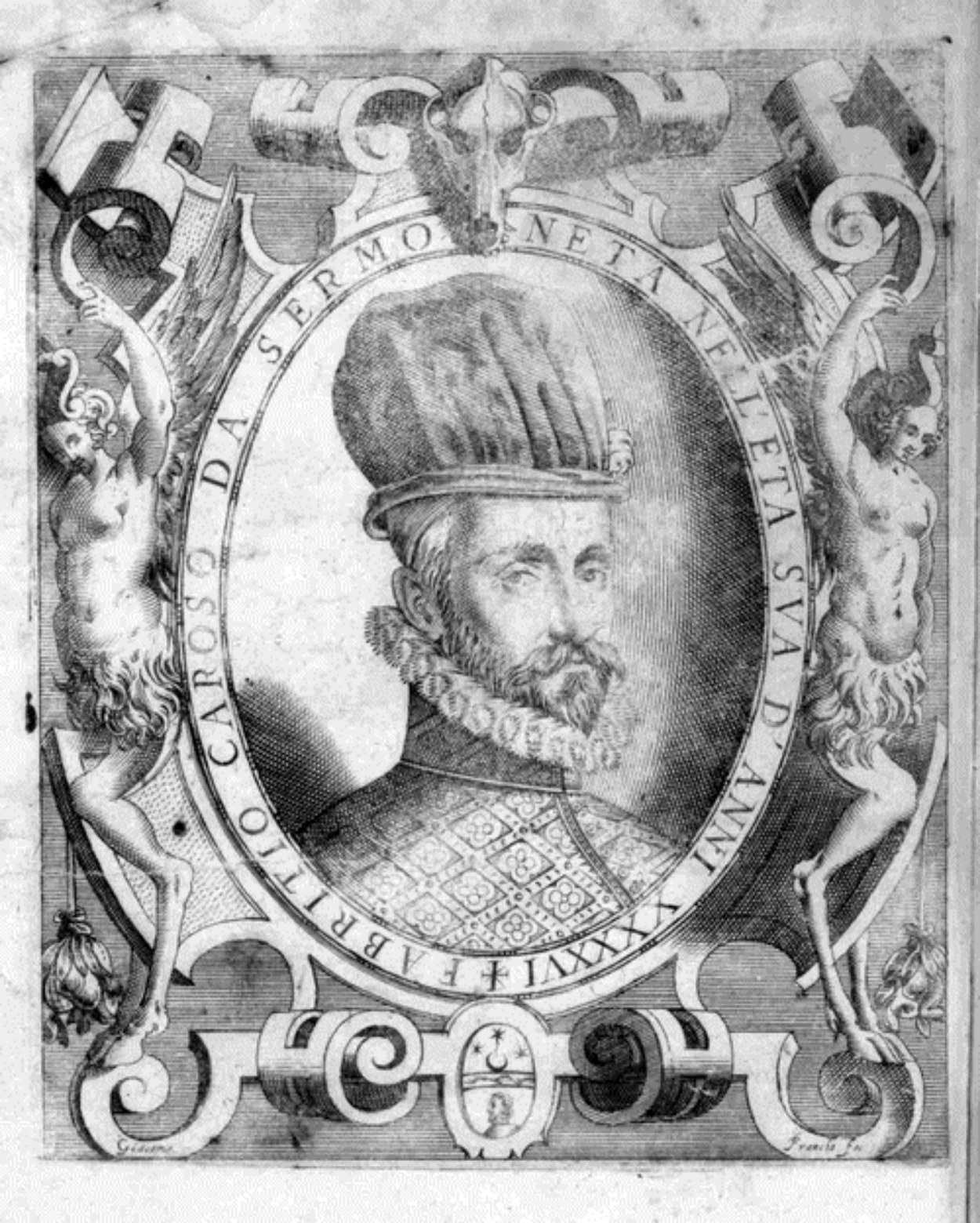
Fabritio Caroso da Sermoneta
- Medium:
- Woodcut
- Dance:
- Notation/Choreography
- Era:
- Pre-1700 (Renaissance/Baroque)
- Collection:
- Nobiltà di Dame (1600)
- Source:
- Library of Congress
- Rights:
- Public domain — free to use, share and adapt.
- Recorded as:
- Public Domain
This plate is one of the most reliable historical evidence we have for how Renaissance Italian nobles actually danced—not imagined or idealized, but recorded by a master choreographer and dancing master for practitioners to learn from. Caroso's notation system and illustrations allow modern scholars and dancers to reconstruct the actual steps, timing, and spatial patterns of Renaissance dance in detail uncommon for earlier periods. For anyone interested in historical reconstruction, body history, or the evolution of partnered dance, this image and its source text are foundational.
What you are looking at
A woodcut depicting a noble couple in Renaissance Italian court dress, positioned facing each other in what appears to be an interior space with a tiled floor. The man, on the left, wears a richly decorated doublet with puffed sleeves and ornate embroidery, a draped cloak over one shoulder, and holds what appears to be a hat or feathered plume in one hand. He stands with one leg extended in a pronounced pose suggesting movement or a dancing position. The woman, on the right, wears an elaborate gown with a high waistline, full skirt, and a wide fur-trimmed stole or mantle draped over her shoulders; her hair is styled in the fashionable manner of the period with an ornate headdress. Both figures are rendered with careful attention to the textile patterns and aristocratic detail characteristic of court portraiture. The decorative border framing the scene is classical in design, emphasizing the formal, instructional nature of the print.
The dancing
The man's pose is distinctly asymmetrical and dynamic: his weight appears shifted onto one leg while the other extends in what may be a gliding or stepping movement, with his torso slightly angled and his arm extended in an open, gestural manner. The woman stands more upright and composed, her posture formal and her arms positioned at her sides or slightly forward. The two figures are separated by space rather than in contact, facing each other directly at roughly eye level, suggesting a formal presentation or greeting appropriate to court dance rather than a close partnered hold. The woodcut's linear technique captures the silhouette and primary contours of movement without fine anatomical detail, but the positioning clearly conveys the ceremonial and measured quality of aristocratic dance.
The dance depicted
This plate illustrates a paired figure from Caroso's choreographic notation system, likely depicting one of the foundational positions or opening movements of the ballo (Italian court dance) that his treatise documents. Caroso's *Nobiltà di Dame* (1600) codified the vocabulary of Renaissance Italian courtly dance—including galliards, pavanes, and branles adapted to Italian practice. The man's extended leg and open arm position suggest either a galliard step or a position within an allemande or branle, dances that featured alternating and facing movements. The formal, non-contact positioning between the dancers indicates this may be illustrating the opening salutation or a figure where partners moved independently in coordinated patterns, characteristic of early 16th-century Italian court practice before the closer partnering of later ballroom forms. The image functions as instructional notation as much as artistic representation.
How it was made
This is a woodcut, a relief printing technique in which an image is carved into the surface of a wooden block, with lines and areas to be printed left raised and inked. Woodcuts allowed for broad distribution of instructional material and were ideal for illustrating dance treatises intended for the literate aristocratic audience who could afford printed books. The medium's linear quality and moderate resolution suited the goal of depicting body positions clearly without excessive anatomical nuance—the viewer needed to understand pose and spatial relationship rather than subtle musculature. As part of Caroso's printed manual, this woodcut served a pedagogical function, enabling dancers across Italian courts to study positions and sequences from a single authoritative text rather than relying solely on oral tradition or private instruction.
About this work
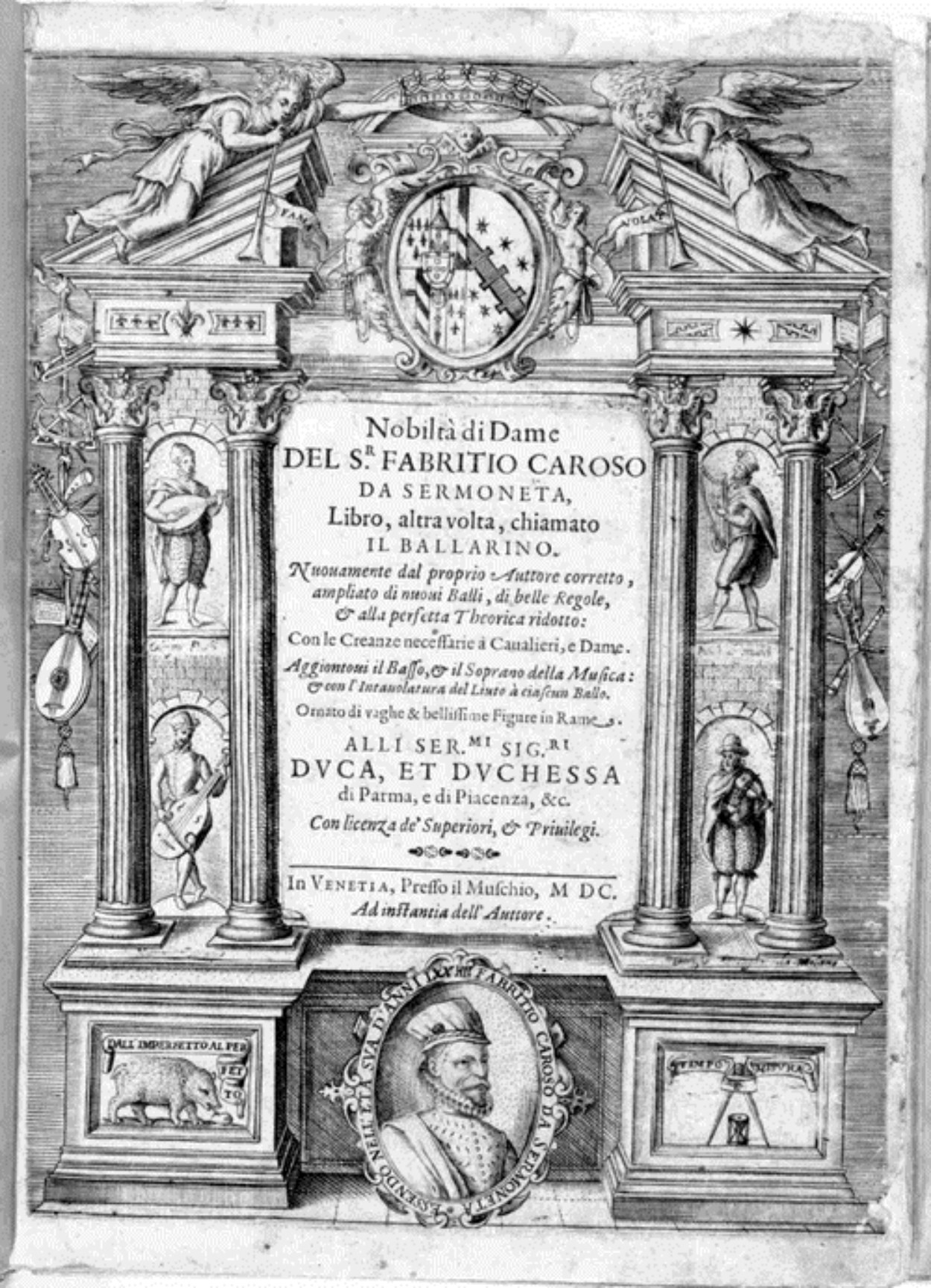
This is an instructional plate from Fabrizio Caroso's *Nobiltà di Dame*, the authoritative treatise on Italian Renaissance court dance. The woodcut depicts a moment in one of the choreographed figures that Caroso documented, showing a noble man and woman in the formal dress and positioning characteristic of late 16th- and early 17th-century aristocratic dance practice. Caroso's work, first published as *Il Ballarino* (1581) and expanded into this 1600 edition dedicated to Christine of Lorraine, represents the peak of codified Italian court dance before the vocabulary began to shift toward the closed partnership and standardized steps of later ballroom forms. The couple's separation, their formal orientation, and the man's pronounced extended leg all signal a dance syntax in which partners often moved in coordinated but independent patterns, alternating or mirroring rather than maintaining sustained contact. This plate survives as one of the primary visual documents of how Renaissance nobility actually moved in formal settings.
Caroso's treatise became the gold standard for court dancers across Europe, defining what cultivated movement looked like at a moment when dance was a required accomplishment of nobility and an important marker of social standing. The *Nobiltà di Dame* remains one of the most complete records of its era's choreographic practice, and its illustrations are among the few detailed depictions of actual period dance steps rather than allegorical or theatrical representations.
How to look at it
Note the man's extended leg and open arm: this is not a moment of stillness but of controlled movement suspended for instruction. The woodcut captures him mid-step or mid-gesture, one of the recognizable positions in the dance vocabulary. The formal spacing between the two figures—they do not touch—reveals a fundamental difference from later ballroom dance: Renaissance court couples often moved in parallel or facing patterns without continuous contact, and this positioning illustrates that spatial relationship. Watch also how the engraver has rendered the rich textures of their clothing with hatching and line work; the fabrics and ornaments matter because they are part of how movement is performed and read. Caroso's figures are not in naturalistic poses but in positions that are meant to be teachable, reproducible, and part of a shared vocabulary.
The artist
Fabrizio Caroso da Sermoneta (c. 1526–after 1600) was the most celebrated and documented dancing master of the Italian Renaissance. Active in Rome and Venice, he served the highest nobility and compiled his *Il Ballarino* (Venice, 1581), the first comprehensive published choreographic manual for court dances. The 1600 edition, *Nobiltà di Dame*, revised and expanded the original, incorporating changes in fashion and style while maintaining its systematic approach to instruction. Caroso's treatise was the standard reference for aristocratic dance across Europe and influenced dance practice far beyond Italy; it remains the most complete surviving record of Renaissance Italian dance and the most cited source for historical dance reconstruction. His reputation as an innovator and codifier was so secure that his work continued to be reprinted and referenced for decades after his death.
The period
The period around 1600 marked a transition in European court dance. The Italian Renaissance dances Caroso documented—galliards, pavanes, branles, and the more complex balli—were reaching the height of their codification even as they were beginning to evolve. In France and England, dance was moving toward the more geometric figures and closed partnering of the Baroque, but Caroso's treatise captured the older vocabulary at the moment it was still the standard of courtly accomplishment. The dedication to Christine of Lorraine, queen mother of France, reflects Caroso's international standing; his work served as a bridge between the Italian tradition and the dance practices emerging across European courts. Printed dance manuals were still a relatively new phenomenon in 1600, and Caroso's was among the most ambitious and influential, establishing the model for instructional dance treatises that would continue through the 18th century.
Where it lives
This plate is from the 1600 Venice edition of *Nobiltà di Dame*, held by the Library of Congress. It is one of approximately 100 woodcut illustrations in the treatise, each depicting a position, figure, or paired arrangement from the documented dances. Caroso's manual circulated widely among the educated nobility of Europe and survives in multiple copies across major collections.
Dance in this work
Questions about this work
What dance is this?
This plate illustrates a specific paired position or figure from one of the balli or court dances that Caroso documented, but the woodcut alone does not name the dance. In context with Caroso's text, this would be keyed to a particular choreography—possibly a galliard, pavane, or branle—with a specific sequence of steps and movements detailed in the written notation. The image shows the pose; the text provides the name and the counts.
Why don't they touch?
In Renaissance Italian court dance, partners did not maintain the continuous hand-hold or closed embrace standard in later ballroom forms. Instead, they often moved in coordinated but independent patterns, facing each other, mirroring movements, or moving in parallel. This open positioning was part of the visual vocabulary of the dance and conveyed a formal, ceremonial quality appropriate to aristocratic settings. Close partnering would have signaled intimacy unsuitable for public court performance.
How was this used?
Caroso's treatise was a teaching manual. Nobles (or their dancing masters) would consult the text and illustrations to learn choreographies. The woodcuts served as visual reference for positions and spatial arrangements, while Caroso's written notation indicated the sequence of steps and the musical timing. A dancer could study this plate to understand the proper posture, arm position, and stance required at this point in the choreography.
Why is Caroso important?
Caroso is the most authoritative source we have for how Renaissance Italian nobles actually danced. His treatises are the most complete and systematic choreographic records of the period, and modern historical dance reconstruction relies heavily on them. No earlier source gives us this level of detail about steps, figures, music, and social context. For historians and practitioners of early dance, Caroso is foundational.
More Notation/Choreography artwork