49 works in this view — arrow keys or swipe to move between them.
Dance in Art
Caroso Nobiltà — Dance Plate (plate 5)
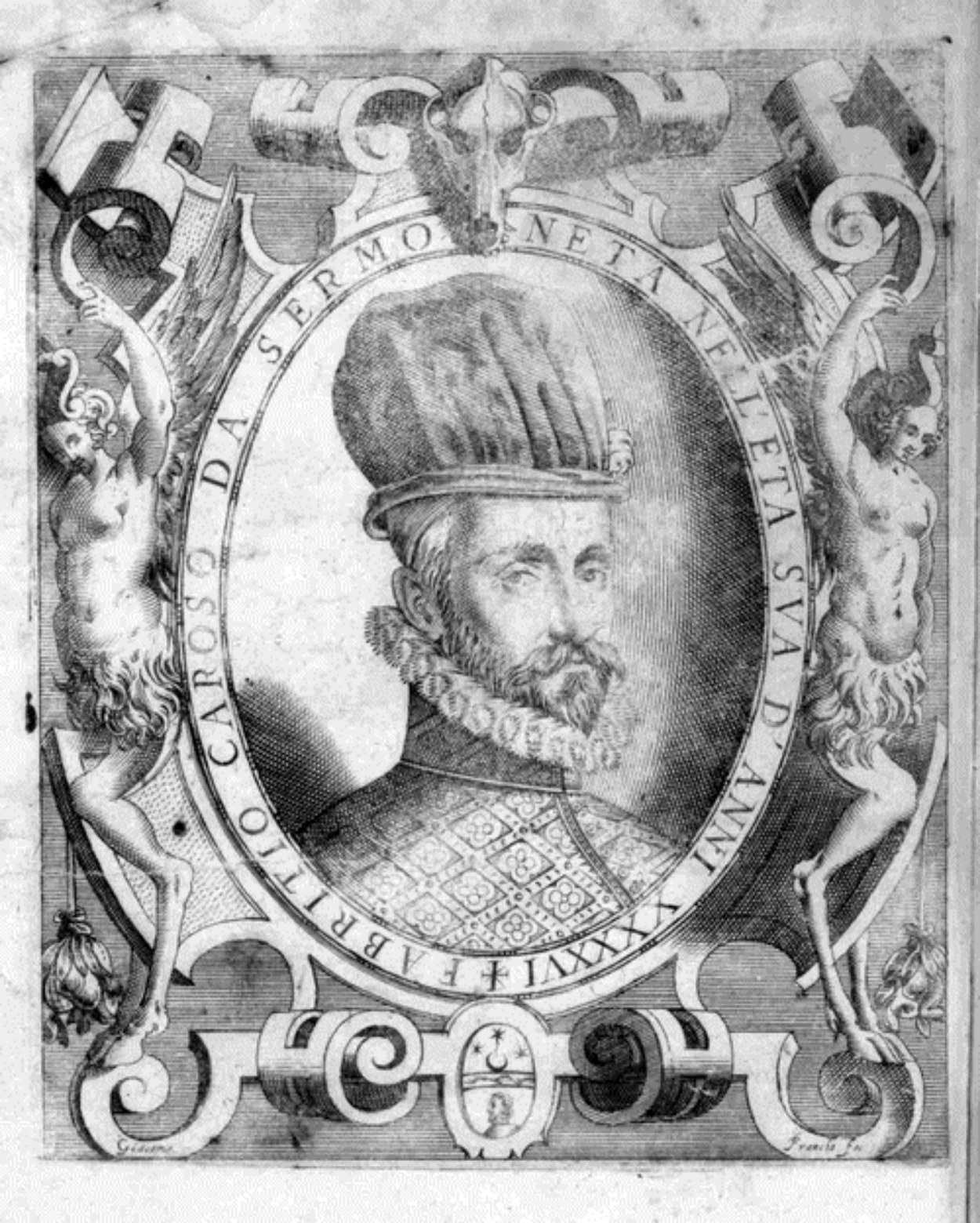
Fabritio Caroso da Sermoneta
- Medium:
- Woodcut
- Dance:
- Notation/Choreography
- Era:
- Pre-1700 (Renaissance/Baroque)
- Collection:
- Nobiltà di Dame (1600)
- Source:
- Library of Congress
- Rights:
- Public domain — free to use, share and adapt.
- Recorded as:
- Public Domain
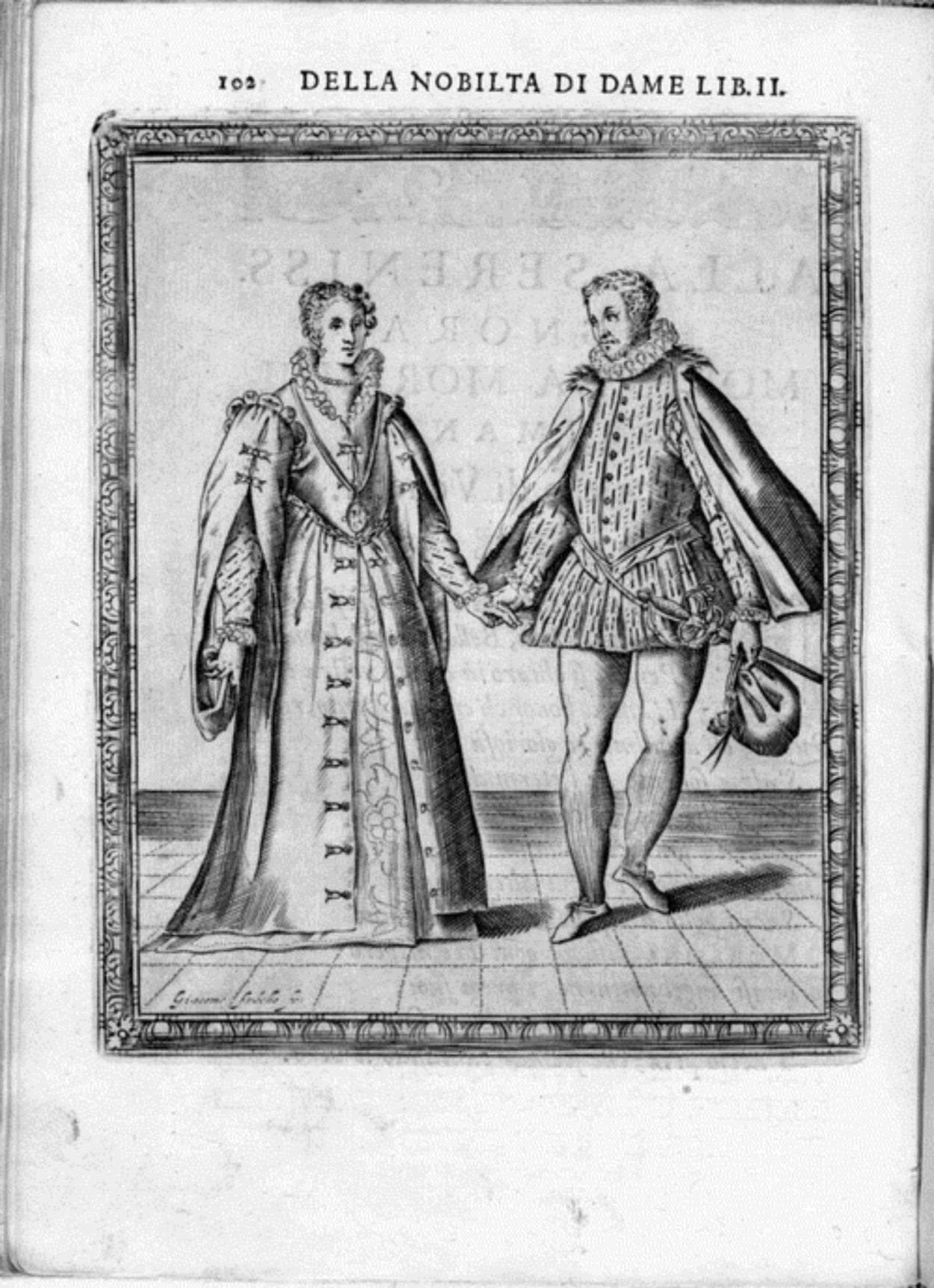
Caroso's treatises are among the most detailed and prescriptive sources we have for how Renaissance dances were actually performed, and they are illustrated throughout with woodcuts like this one showing the positions and figures that made up the choreography. This image is not a scene of dancing in progress but a teaching image: it freezes a moment of formal greeting or dance opening and requires the viewer (a noble learning to dance, or a dancer studying from the book) to imagine the movement that would follow. For historians and dancers, these plates are primary documents of Renaissance technique and courtly culture.
What you are looking at
A woodcut depicting a noble couple in Renaissance Italian court dress, standing face to face in a formal interior space with a checkered floor. The woman on the left wears an elaborate gown with a long train, decorated with embroidered or patterned panels down the front, and a voluminous cloak lined with ermine or fur that drapes from her shoulders. Her hair is dressed in the high style of the period, crowned with jewelry. The man on the right wears a short doublet with slashed sleeves, hose, and a plumed hat; he carries a small sword or dagger and a purse at his waist. Both figures are rendered with careful attention to textile detail and courtly bearing. Their right hands are joined or nearly joined at waist height, and they face each other in a formal, measured stance that suggests the opening moment or a key figure of a court dance. The background is plain, allowing the figures and their dress to dominate. The woodcut line is crisp and assured, with careful cross-hatching used to render fabric texture and depth.
The dancing
Both dancers stand upright with weight evenly distributed, their bodies perpendicular to the picture plane in a formal three-quarter view. Their right hands are extended toward each other at approximately waist height, in the position for a joined-hand greeting or the start of a promenade. The woman's left arm hangs at her side, balanced by the man's left arm which rests on or near his hip. Neither figure shows weight shift or the asymmetry of active movement; the pose is symmetrical and controlled. The distance between them and the formality of their bearing suggest a choreographed opening rather than a moment of social dancing.
The dance depicted
This is almost certainly a depiction from Caroso's system of Renaissance court dances, most likely an Allemande or similar paired dance in which couples move through formal, measured figures with frequent hand changes and turns. The hand-joining and frontal stance are consistent with Caroso's choreographic vocabulary as documented in *Il Ballarino* and *Nobiltà di Dame*. The plate appears in a section of the treatise explaining dance notation or demonstrating the opening position and bearing required of noble dancers. The image teaches by example: it shows not movement itself but the correct posture, alignment, and dress that a well-trained dancer of rank should embody.
How it was made
This is a woodcut, a relief printing technique in which the image is carved into the surface of a block of wood, with printed lines appearing as the raised surface takes ink. Woodcuts were the primary medium for illustrated printed books in the Renaissance and early 17th century, allowing for wide circulation and reproducibility. The technique produces bold, clear lines and areas of strong contrast, well suited to the rendering of textile patterns and architectural space. Caroso's treatise would have been distributed to courts and nobles across Europe, making this image a practical teaching tool as much as a decorative one.
About this work
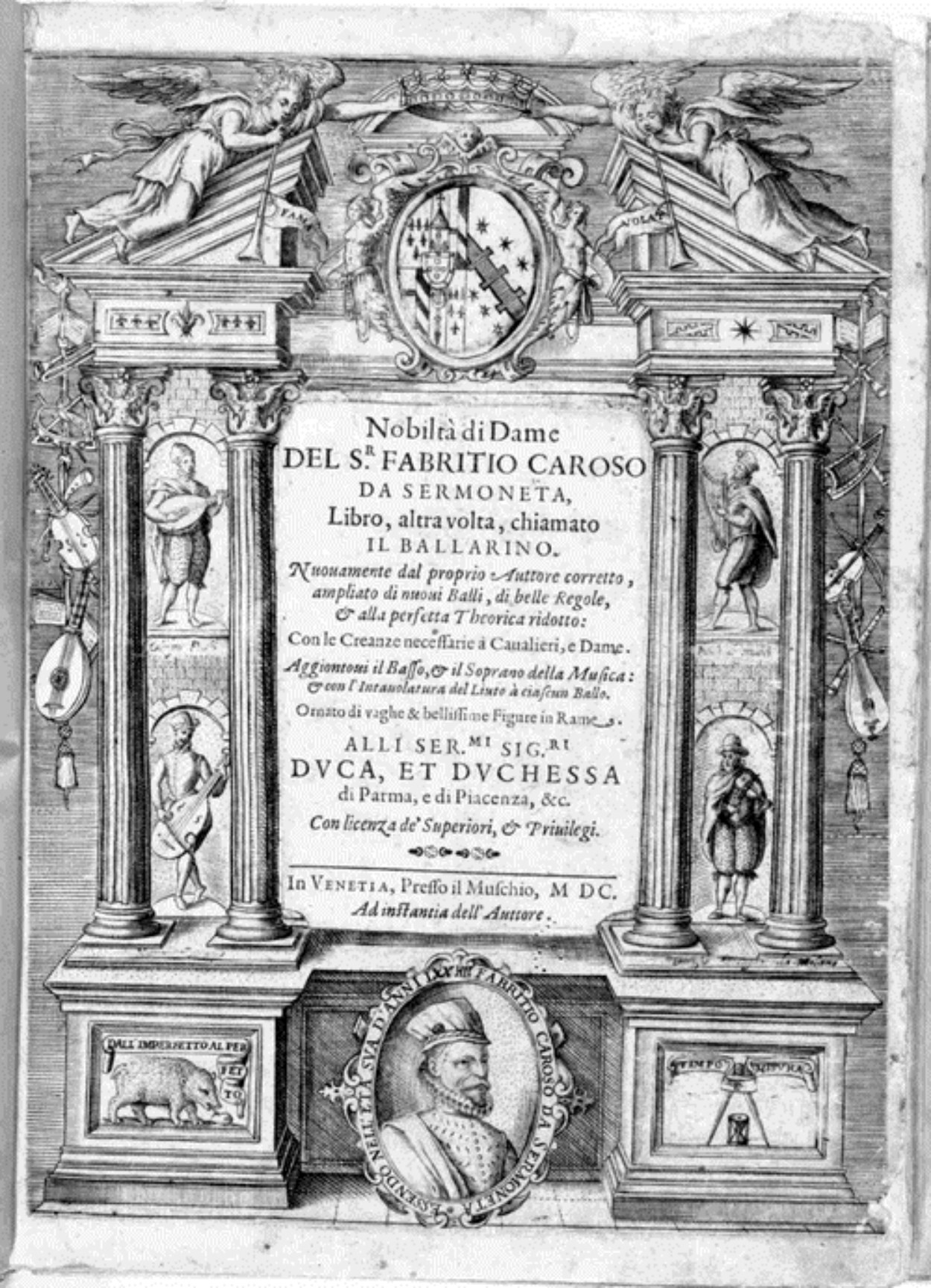
This is a page from Fabritio Caroso's *Nobiltà di Dame* (Venice, 1600), a landmark treatise on Italian court dancing and courtly behavior. Caroso was the most celebrated dancing master of the late Renaissance, and his two major treatises—*Il Ballarino* (1581) and this refined re-edition, dedicated to Christine of Lorraine—codified the dances and the ideals of noble bearing that defined courtly life in Italy at the turn of the century. This particular plate depicts the opening position or a key figure of a paired court dance, with a man and woman in formal dress holding hands in a measured, upright stance. The image serves both as a record of how Renaissance nobles danced and as a visual instruction in the posture and restraint required of dancers of rank. The careful rendering of costume—the woman's embroidered gown and furred cloak, the man's doublet and hose—reinforces the connection between dance, dress, and social status.
How to look at it
The woodcut arrests the dancers at a formal moment of greeting or opening, not in the midst of active movement. The artist has chosen to show the correct posture and bearing—the upright spine, the measured distance, the formal hand position—rather than the energy or dynamism of the dance itself. The viewer should attend to the exactness of the positioning: the way the couple face each other without leaning, the height and angle of the joined hands, the balance of the stance. This reflects a Renaissance conviction that dance was first and foremost about discipline, proportion, and the visible expression of noble rank. The costume details—the patterned embroidery, the furred cloak, the jewels—reinforce that this is a dance of the highest social order, and that to learn it is to learn how to embody nobility itself.
The artist
Fabritio Caroso da Sermoneta (c. 1526/35–1605/10) was an Italian dancer, choreographer, and dancing master based primarily in Rome and the Papal Court. He is known almost exclusively through his two treatises, *Il Ballarino* (1581) and *Nobiltà di Dame* (1600), which together represent the most comprehensive and widely circulated record of late Renaissance dance practice in Italy. *Nobiltà di Dame* was dedicated to Christine of Lorraine, Grand Duchess of Tuscany, and reflects the refinement of Caroso's system over the intervening decades. The treatises contain detailed descriptions of dances—including Pavanes, Galliards, and Allemandes—and instructions on deportment, as well as these woodcut illustrations showing dancers in positions and figures. Caroso's work was influential across Europe and remains a foundational text for historians and reconstructors of Renaissance dance.
The period
In the late 16th and early 17th centuries, dance was an essential accomplishment of nobility and a primary expression of courtly refinement. The Italian court dance tradition, centered on Venice, Florence, and Rome, was the most prestigious in Europe. Caroso's *Nobiltà di Dame* (1600) was published at the very moment when Italian court dance was reaching its height of complexity and when the new French court style (which would dominate the 17th century) was beginning to emerge. The treatise looks backward to the dances Caroso taught throughout his career—Pavanes, Galliards, Allemandes, and Passemezzos—while also reflecting the evolution of those forms and the increasingly elaborate patterns and figures that distinguished the dances of the 1590s from those of earlier decades. The dedication to a French princess and the book's refined presentation suggest Caroso's awareness of the international stakes of court dancing and his desire to preserve and transmit a specifically Italian tradition.
Where it lives
This woodcut is a plate from the 1600 Venice edition of *Nobiltà di Dame*, Caroso's definitive treatise on court dancing. It survives as part of the original printed book, held at the Library of Congress. The plate appears in a section explaining choreography and the proper positions and figures of paired dances.
Dance in this work
Questions about this work
What dance are they doing?
The plate does not show active dancing but rather the opening position or a key figure of a paired court dance—most likely an Allemande, Pavane, or similar form from Caroso's repertory. The image is designed to teach the correct posture and hand position rather than to capture movement in progress. A dancer studying from this book would use the image as a reference for how to stand and hold hands before beginning the choreography described in text.
Why are they just standing there?
The Renaissance court dance treatise is organized like a dance notation system: it shows key positions and figures, and the reader is expected to combine the visual and the written instruction to reconstruct the full dance. This plate is a teaching image, much like a photograph of a ballet position. It shows the dancer what correct posture and alignment should look like, so that when they execute the steps and turns that follow, they do so from a position of noble bearing.
Who was Caroso and why does he matter?
Caroso was the most celebrated dancing master of the late Renaissance Italian courts. His two treatises are the most detailed and prescriptive sources we have for how Renaissance dances were performed. *Nobiltà di Dame*, published in 1600, is considered the definitive record of Italian court dancing at the turn of the 17th century, and it influenced dance practice across Europe.
What do the clothes tell us?
The woman's embroidered gown with its long train, furred cloak, and jeweled headdress, and the man's slashed doublet, plumed hat, and sword all signal high nobility. In Renaissance court culture, learning to dance was inseparable from learning to dress, move, and present oneself as a person of rank. The care Caroso took in depicting costume in these woodcuts reflects his understanding that dance and dress were complementary expressions of the same social ideal.
More Notation/Choreography artwork