49 works in this view — arrow keys or swipe to move between them.
Dance in Art
Caroso Nobiltà — Dance Plate (plate 6)
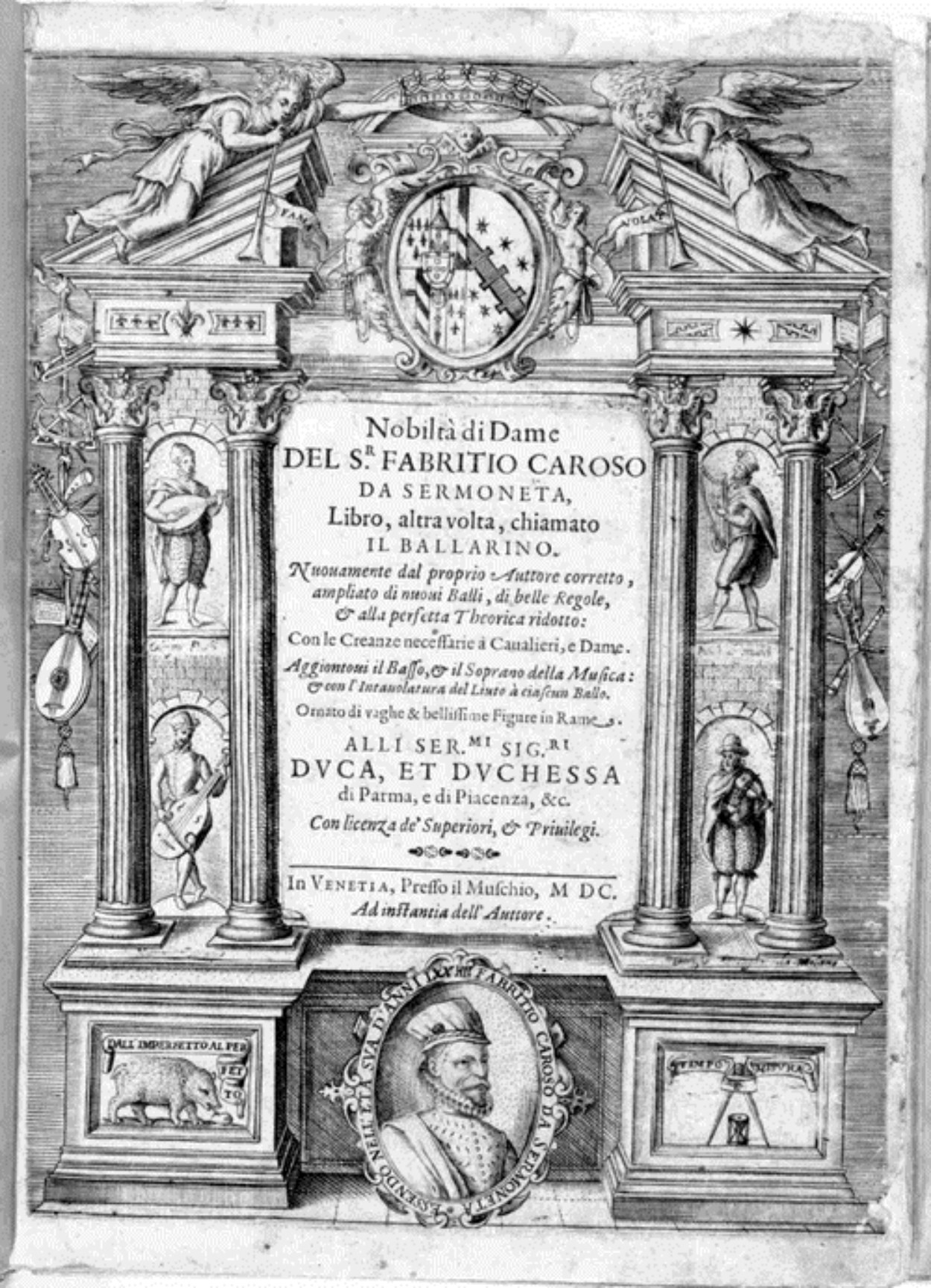
Fabritio Caroso da Sermoneta
- Medium:
- Woodcut
- Dance:
- Notation/Choreography
- Era:
- Pre-1700 (Renaissance/Baroque)
- Collection:
- Nobiltà di Dame (1600)
- Source:
- Library of Congress
- Rights:
- Public domain — free to use, share and adapt.
- Recorded as:
- Public Domain
For historians of Renaissance dance, this image is among the most reliable visual evidence of courtly deportment, costume, and the spatial and social relationship between dancing partners. For artists, it documents how woodcut could convey the fine distinctions of Renaissance fashion and the subtleties of formal bearing through line and hatching alone.
What you are looking at
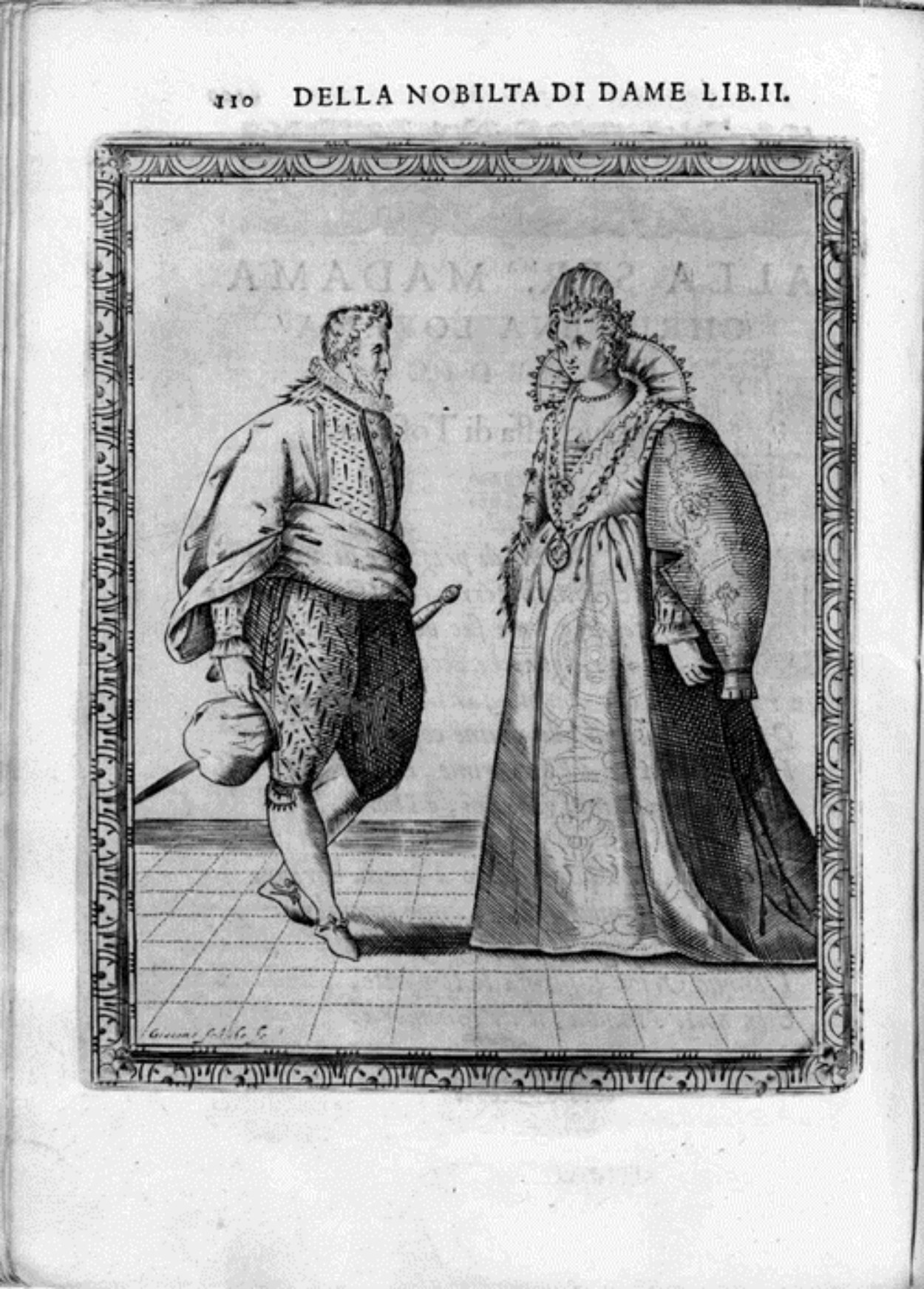
A man and woman stand facing each other in a formal interior, set against a tiled floor rendered in linear perspective. Both wear elaborate Renaissance court dress: the man wears a richly patterned doublet with decorative slashing, a short cloak, and holds a large feathered hat in one hand and a baton or wand in the other; the woman wears a long gown with puffed sleeves, an ornate jeweled collar or ruff, and a headdress. The woman stands with one arm raised slightly, her body angled toward the man in an attitude of engagement. The man inclines toward her, his posture suggesting address or invitation. The woodcut employs fine parallel hatching to distinguish the fabrics and create volume, with particular attention to the ornamental patterns of the male figure's costume. The setting is minimal and formal, emphasizing the figures against a plain background within a decorative printed border.
The dancing
The man and woman occupy a space of formal social negotiation rather than active movement. The man's weight appears to shift forward on one leg, his body angled to address the woman; his free arm and baton suggest gesture or authority in conversation or instruction. The woman's stance is upright and receptive, her raised arm neither in dance hold nor entirely at rest, suggesting readiness or acknowledgment. Both figures are depicted with clear attention to courtly bearing—an upright carriage and composed demeanor rather than the exertion of vigorous dancing. The spatial relationship between them is intimate but not close: they maintain a respectful distance appropriate to formal court address.
The dance depicted
This is most likely a pairing figure from a Renaissance court dance manual, possibly demonstrating the opening salutation or positioning before a dance begins. The baton or wand held by the man suggests he may be a dancing master or partner in the role of guide; the woman's receptive posture and slight arm raise suggest she awaits instruction or mirrors the man's stance. The image captures a moment of formal acknowledgment or instruction rather than active dancing—the kind of preparatory pose that would precede a Pavane, Galliard, or Branle. Caroso's *Nobiltà di Dame* is known for its detailed attention to the geometric orderliness and courtly decorum of Italian court dance, and this plate likely illustrates one such preliminary moment.
How it was made
This is a woodcut, a relief printing technique in which an image is carved into the surface of a wooden block. The dense parallel hatching visible in the fabric patterns and shading is characteristic of Renaissance woodcut practice, allowing the artist to build volume and texture through line alone. Woodcut's relatively forgiving nature made it ideal for the mass production of instructional images in printed books; the technique allowed sharp, readable lines suitable for reproduction across many copies. The clear, bold outlines and high contrast between black line and white paper made these images legible at small scale and suitable for readers consulting the book for practical instruction.
About this work
This woodcut plate comes from Fabritio Caroso da Sermoneta's *Nobiltà di Dame*, a richly illustrated treatise on the dances of the Italian Renaissance court published in Venice in 1600. The image presents a formal pairing of a dancing master (or noble man) and a noblewoman in the moment of greeting or instruction before dance begins. Caroso was the most celebrated dancing master of his era, and his manuals are the principal surviving record of how Renaissance courtly dance looked, how its geometric orderings were constructed, and how men and women were taught to move and position themselves in relation to one another. This particular plate demonstrates the gendered formal address that opened such dances: the man's authority signaled through his gesture and the baton, the woman's dignity through her composed stance and receptive bearing.
How to look at it
Attend to the formal distance and alignment between the figures, which embodies the geometry of Renaissance court dance spacing. Note the man's baton and forward-inclined posture, which signal instruction or authoritative address. Look closely at the costume details—the ornamental patterns of the doublet, the structure of the woman's sleeves and headdress—as documentary evidence of what Renaissance courtiers actually wore to dance. The moment captured here is not a step in motion but a pause in protocol: the greeting and positioning that preceded the dance itself. This restraint is itself instructive—it shows that Renaissance court dance was valued as much for its orderly, composed bearing as for the animation of movement.
The artist
Fabritio Caroso da Sermoneta (c.1526–1605) was the leading Italian dancing master of the late Renaissance and the author of two major dance treatises: *Il Ballarino* (1581) and its revised and expanded edition *Nobiltà di Dame* (1600). His manuals are celebrated for their precision and their rich illustration program, which documents the dances, the costume, and the formal courtly behavior of late sixteenth- and early seventeenth-century Italian courts. Caroso combined practical instruction with a humanist emphasis on the ennobling and civilizing function of dance. His work established the template for dance notation and instruction in print that would influence European court dance for generations.
The period
The *Nobiltà di Dame* was published at the turn of the seventeenth century, at the height of the Italian court's influence on European fashion and comportment. Renaissance court dance had by this time reached a high degree of formalization and geometric precision, with each dance governed by strict rules of spatial and temporal order. The pairing of man and woman in formal relation was a central concern of courtly dance theory, which understood dance as a coded language of social and gender hierarchy. Woodcut illustration of dance instruction was already established practice by this time—Caroso's first edition (1581) had been illustrated—but the 1600 edition represented the fullest and most refined version of his visual and textual system.
Where it lives
This plate is part of the illustrated edition of *Nobiltà di Dame* held in the Library of Congress, the major surviving printed treatise on Italian Renaissance court dance. The woodcut comes from a complete instructional manual designed to be consulted by dancing masters and ambitious courtiers learning the dances and deportment of the Italian court.
Dance in this work
Questions about this work
Is this showing an actual dance, or just people standing?
It is showing the formal pause or greeting that preceded dance—what Caroso called a *riverenza* or salutation. Renaissance court dances were built from a precise sequence of positions and orderings, and this plate documents one such foundational pose. The man's gesture with the baton and the woman's receptive alignment show the kind of spatial negotiation and social protocol that shaped how courtly dances were begun.
How do we know this is a dancing master and not just a couple?
The baton or wand is the key indicator: in Renaissance dance manuals, a dancing master is consistently shown holding such an implement as a sign of authority and as a tool for beating time or indicating spatial positions. The man's forward posture and the woman's attentive stance also suggest instruction rather than mutual equal partnership.
What dance is this from?
We cannot identify a specific named dance from this image alone—it may represent a generic greeting pose that opened multiple dances, or it may illustrate a particular moment that would be clear only to someone consulting the accompanying text. Caroso's dances included Pavanes, Galliards, Branles, and many others, each with prescribed orderings and positions.
Why are Renaissance couple dances always shown at a distance?
Because Renaissance court dance was built on formal spatial geometry and social decorum. Partners often danced in parallel or in relation to one another across space rather than in close physical contact. This distance itself was meaningful—it demonstrated restraint, dignity, and the coded language of courtly social order.
More Notation/Choreography artwork