49 works in this view — arrow keys or swipe to move between them.
Dance in Art
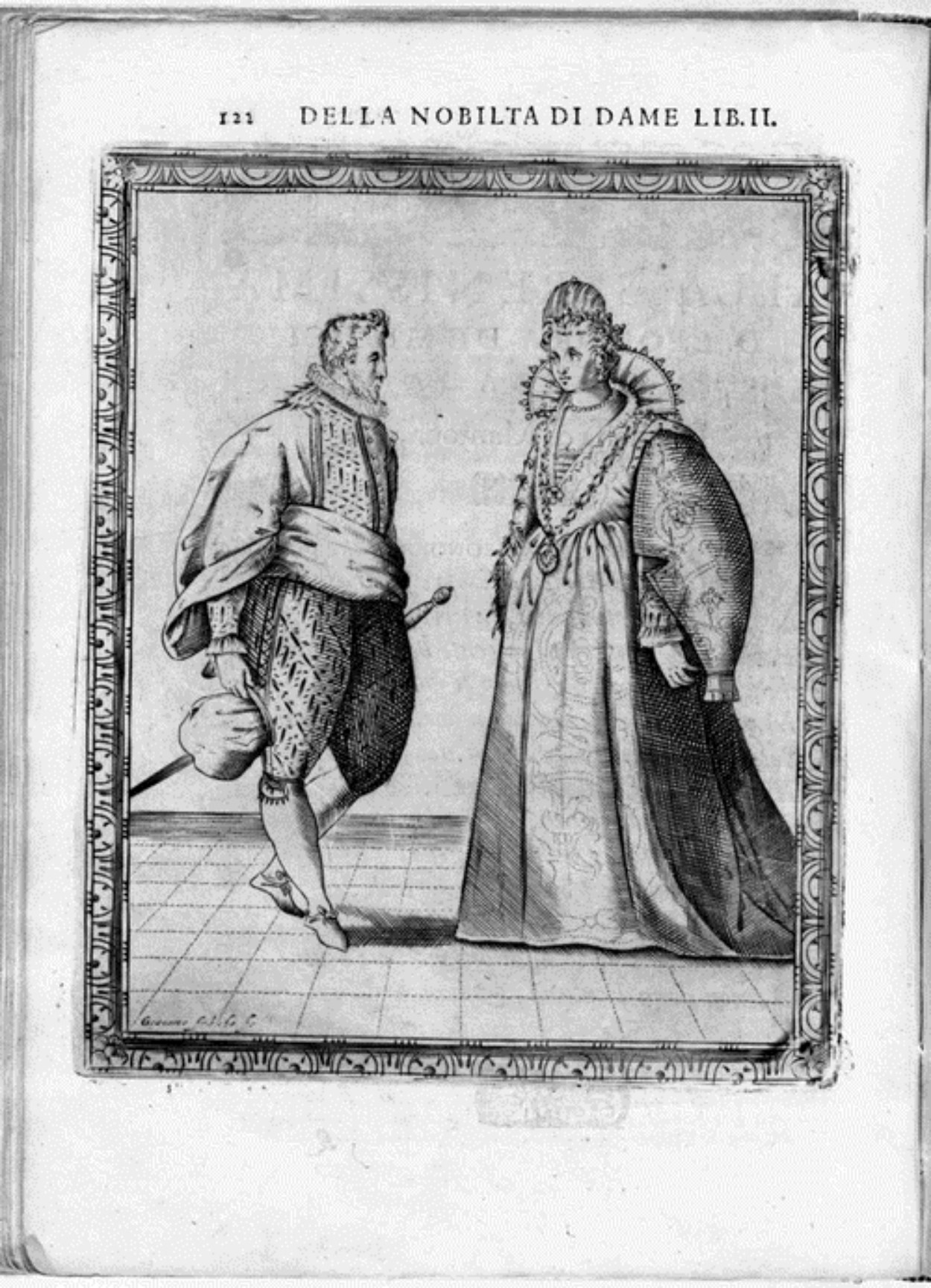
Caroso Nobiltà — Dance Plate (plate 7)
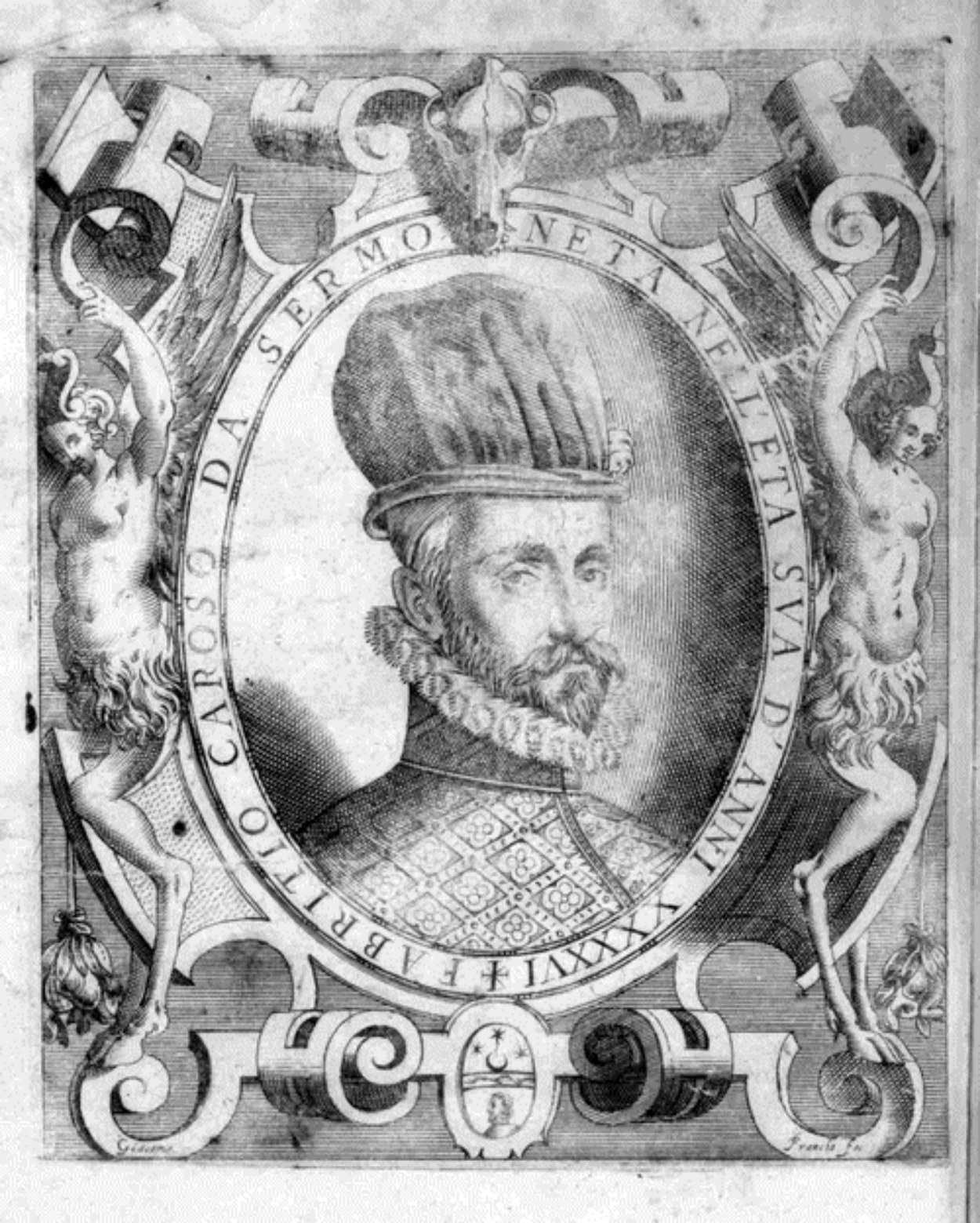
Fabritio Caroso da Sermoneta
- Medium:
- Woodcut
- Dance:
- Notation/Choreography
- Era:
- Pre-1700 (Renaissance/Baroque)
- Collection:
- Nobiltà di Dame (1600)
- Source:
- Library of Congress
- Rights:
- Public domain — free to use, share and adapt.
- Recorded as:
- Public Domain
Caroso's *Nobiltà di Dame* is among the only Renaissance sources that preserve actual choreography in readable form, making these plates invaluable evidence for how court dances were structured, what steps and positions constituted them, and how male and female dancers related to each other in formal settings. The work is also a rare testimony to women as active, educated participants in court culture—the dedication to Christine of Lorraine and the inclusion of named female dancers assert that women learned, performed, and even created dances. Dancers and historians studying early modern movement vocabulary rely on this text as foundational.
What you are looking at
A noble couple in Renaissance Italian court dress stand on a checkered floor, facing one another in conversation or preparation for dance. The man, positioned left, wears a richly patterned doublet with slashed sleeves and hose; his left leg is extended forward in a natural walking stance. He holds a small object (possibly a feathered ornament or prop) in his right hand near his body. The woman, right, wears an elaborate gown with a high collar and puffed sleeves, her hair arranged with period jewelry. She stands with weight balanced, her posture upright and dignified. Between them lies the space of interaction—neither touches the other, but their body angles and gazes suggest mutual attention. The setting is spare: only the tiled floor grounds them, and an ornamental frame suggests this is a formal demonstration or instructional image rather than a theatrical scene.
The dancing
Both figures maintain an open, frontal relationship typical of courtship dances rather than closed-hold partnering. The man's advanced leg and forward torso lean suggest he is either approaching or in mid-movement; the woman's stillness and composed stance imply she receives or awaits his action. Neither figure shows the turned-out turnout or lifted port de bras that would appear in later ballet, but both demonstrate the upright carriage and controlled deportment essential to Renaissance court dancing. The spatial separation is deliberate and measured, not intimate.
The dance depicted
This is almost certainly an illustration of a Renaissance Italian court dance, most likely a pavane, allemande, or branle—dances that featured paired figures in measured procession or geometric patterns. The posture, dress, and compositional clarity match the teaching function Caroso's *Nobiltà di Dame* served: each plate was a choreographic notation aid for dancers learning court figures. The man's position suggests either the opening of an approach pattern or a specific transitional figure in a pavan or galliard. Without inscription or additional context, the exact named dance cannot be determined, but the formality and the printed context indicate this depicts a high-status court dance of the late 16th or early 17th century.
How it was made
Woodcut, a relief-printing technique that allowed for rapid mass production and precise line work. The clean black lines, controlled hatching for volume and fabric texture, and sharp outlines are characteristic of Renaissance woodcut work. This medium was ideal for instructional books: the images could be reproduced cheaply and distributed widely, making choreographic knowledge accessible beyond the court. Woodcut's linear clarity suited the teaching purpose—each figure's posture and positioning needed to be unambiguous. The ornamental border frames the scene formally, treating the couple as a subject worthy of sustained visual attention rather than as mere illustration.
About this work
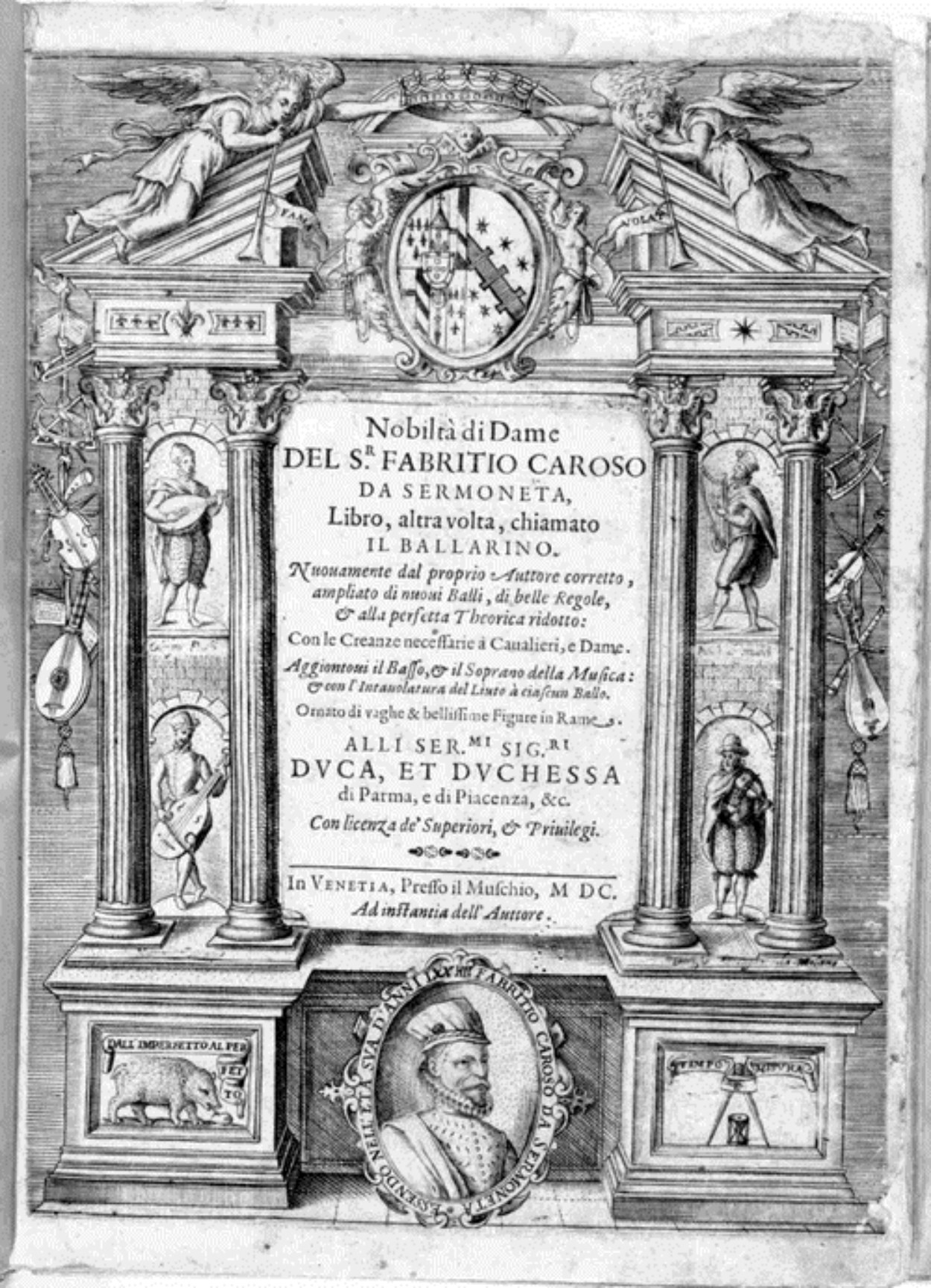
This is plate 7 from Fabritio Caroso's *Nobiltà di Dame* (Venice, 1600), one of the most important surviving documents of Renaissance Italian court dance. The plate shows a noblewoman and nobleman positioned in the formal, measured stance that characterizes courtship and procession dances of the period. Caroso's work was both a performance text and a manual for aspiring dancers: each plate froze a moment in a named choreography, allowing readers to reconstruct steps and patterns. The *Nobiltà di Dame* itself was a refined revision of Caroso's earlier *Il Ballarino* (1581), incorporating fashions and dances current in the courts of late 16th-century Italy and addressing itself to educated elite readers, particularly women of rank. This particular plate exemplifies the book's pedagogical method: it depicts not a spectacle or dramatic moment, but a teaching figure—the precise body angle, separation, and deportment that a pupil would need to replicate.
How to look at it
Look first at the spacing between the two figures: it is measured and formal, not intimate, and tells you immediately that this is a dance of display and courtship, not passion. Notice the man's weight and leg position—the extended left leg and slight forward lean suggest he is mid-transition or mid-approach, the kind of controlled walk-and-turn that structures the pavane. The woman's face is turned slightly toward him, and her posture is composed: she is not reacting dramatically but maintaining the upright carriage required by fashion and decorum. The ornamental frame and the checkered floor establish this as a diagrammatic teaching image, not a narrative scene—the couple are a moving figure to be learned and replicated, not characters in a story. Attend to the hands and arms: both are held simply and without flourish, a key difference from the Baroque period, when arm movements became increasingly elaborate.
The artist
Fabritio Caroso da Sermoneta (c. 1526–after 1605) was a celebrated dance master and choreographer active in Italian courts, particularly Venice and Rome. He is known almost entirely through his two printed treatises, *Il Ballarino* (1581) and its expanded revision, *Nobiltà di Dame* (1600), which together represent the fullest surviving account of late Renaissance Italian court dance. Caroso was not himself a visual artist—the plates were produced by professional woodcut artisans—but he authored the choreographic content and the accompanying text. His books were addressed to elite amateurs and served both as instructional manuals and as displays of courtly refinement; they circulated in royal and aristocratic libraries across Europe. Caroso's stated goal was to preserve and standardize the dances of his time, a project that aligned him with broader Renaissance humanist efforts to document and codify knowledge.
The period
At the turn of the 17th century, court dance in Italy was at a moment of stylistic consolidation and documentation. The galliard, pavane, branle, and allemande had achieved standardized forms across European courts, though regional and individual variations persisted. The print medium allowed choreographers like Caroso to assert authority and reach beyond their immediate circles: a dance master in Rome could now teach dancers in Paris or Vienna through a book. The *Nobiltà di Dame* was printed in Venice, then Europe's leading center of music and dance publishing. At the same time, theatrical spectacle was beginning to draw elite attention away from social courtship dances toward elaborate staged ballets and intermezzi. Caroso's book can be read as both a capstone to Renaissance social-dance culture and an archive created in the knowledge that this world was changing. The presence of detailed depictions of women's roles and dress is also historically significant: female court dancers were increasingly visible and named in this period, though still constrained by conventions of aristocratic femininity that these plates also document.
Where it lives
This plate comes from the Biblioteca Nazionale Centrale in Rome's copy of *Nobiltà di Dame* (Venice: Giacomo Vincenti, 1600). The Library of Congress, which is the source for this record, holds reproductions and facsimiles of Caroso's work. The *Nobiltà di Dame* was produced in a limited edition and circulated among elite readers; surviving copies are held in major libraries including the Biblioteca Marciana (Venice), the British Library, and the Newberry Library.
Dance in this work
Questions about this work
How do we know what Renaissance dances looked like if no video exists?
Caroso's treatises are the most detailed surviving sources. Each plate shows body position and orientation, and the accompanying text (not visible here) describes the steps, music, and sequence. Historians and reconstruction dancers combine these with other period sources—music, poetry, and references in other dance treatises—to reconstruct likely versions of the choreography. The result is not certainty, but an educated and reasoned approximation grounded in the closest contemporary evidence we have.
Why are the man and woman separated? Didn't they dance together?
They did, but Renaissance courtship dances often moved through sequences of positions. A pavane, for example, moved through advancing, retreating, turning, and hand-holding phases. This particular moment may show an approach or a moment of preparation; without the full choreography and text, we cannot say precisely. The spacing itself communicates formality and decorum—not distance, but restraint.
What is the woman's dress called?
Her garment is a late 16th-century Italian noblewoman's gown, characterized by the high, stiffened collar (likely whalebone or buckram), the puffed sleeves gathered at intervals, and the full skirt. The style shows Spanish influence, which was strong in Italian courts of this period. The hairstyle and jewels suggest wealth and rank. The richness of the textiles and the precision of the tailoring would have been immediately readable as markers of aristocratic status.
Was Caroso a dancer himself?
The historical record is sparse, but his titles (he called himself 'Illustrissimo') and his confidence in teaching suggest he held a position of authority in court circles. Some scholars believe he was an active performer, but the primary evidence for his skill comes from his books: their sophistication, detail, and circulation are themselves testimony to his knowledge and reputation.
More Notation/Choreography artwork