49 works in this view — arrow keys or swipe to move between them.
Dance in Art
Comic Character — Plate 39
Gregorio Lambranzi
- Medium:
- Copper-plate engraving
- Dance:
- Notation/Choreography
- Era:
- 1700s (Enlightenment/Minuet Era)
- Collection:
- Nuova e curiosa scuola de' balli theatrali (1716)
- Source:
- Library of Congress
- Rights:
- Public domain — free to use, share and adapt.
- Recorded as:
- Public Domain
This image is a primary source for understanding how comic character and exaggerated gesture were performed and taught in early 18th-century European theater—and how that knowledge was recorded and spread through print. The manual itself was a bestseller across German-speaking lands and beyond, making these engravings among the most widely circulated images of theatrical dance in their era. For historians of dance notation, costume, and theatrical character, this is essential documentation of a moment when choreography and theater were inseparable.
What you are looking at
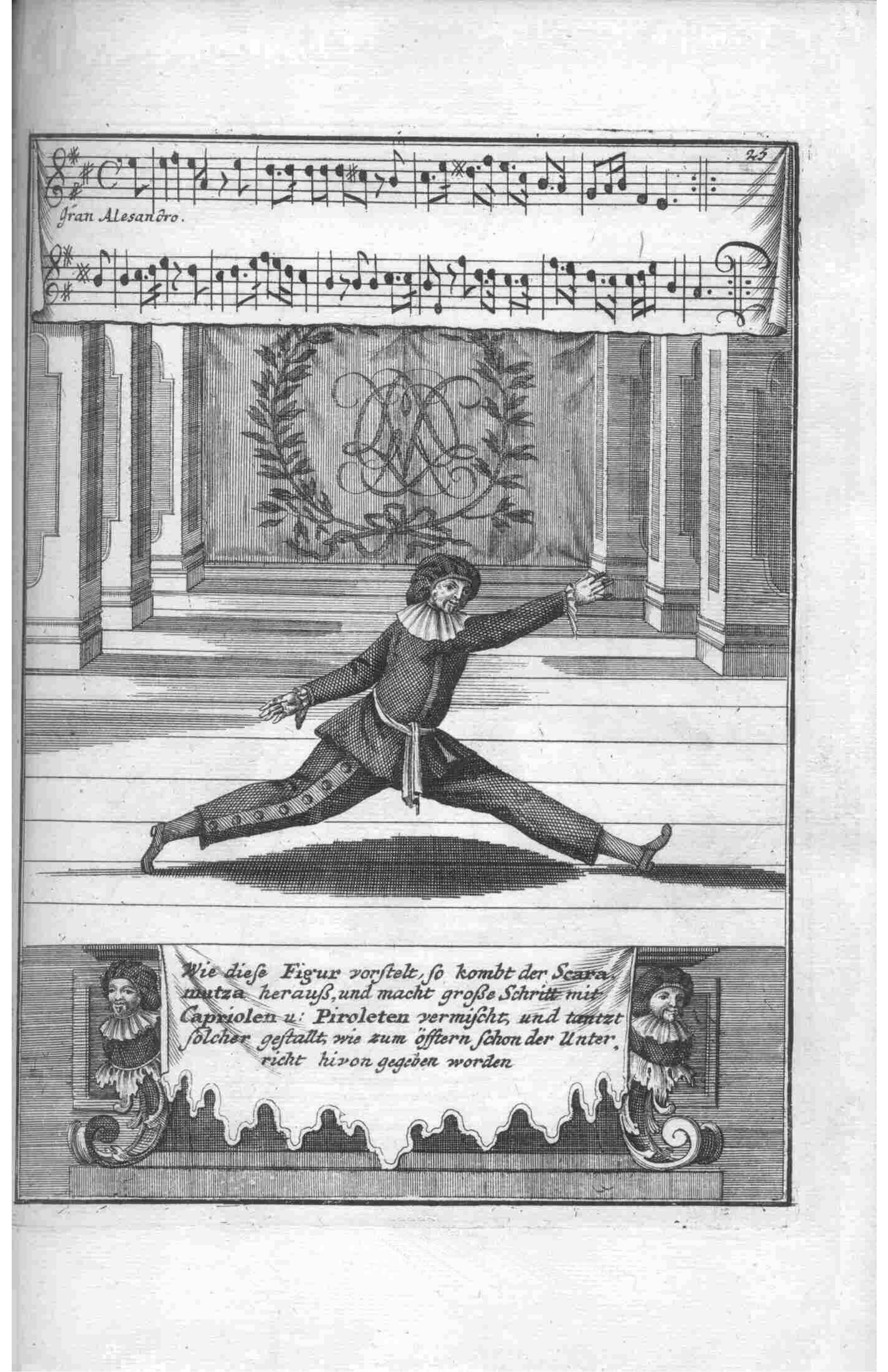
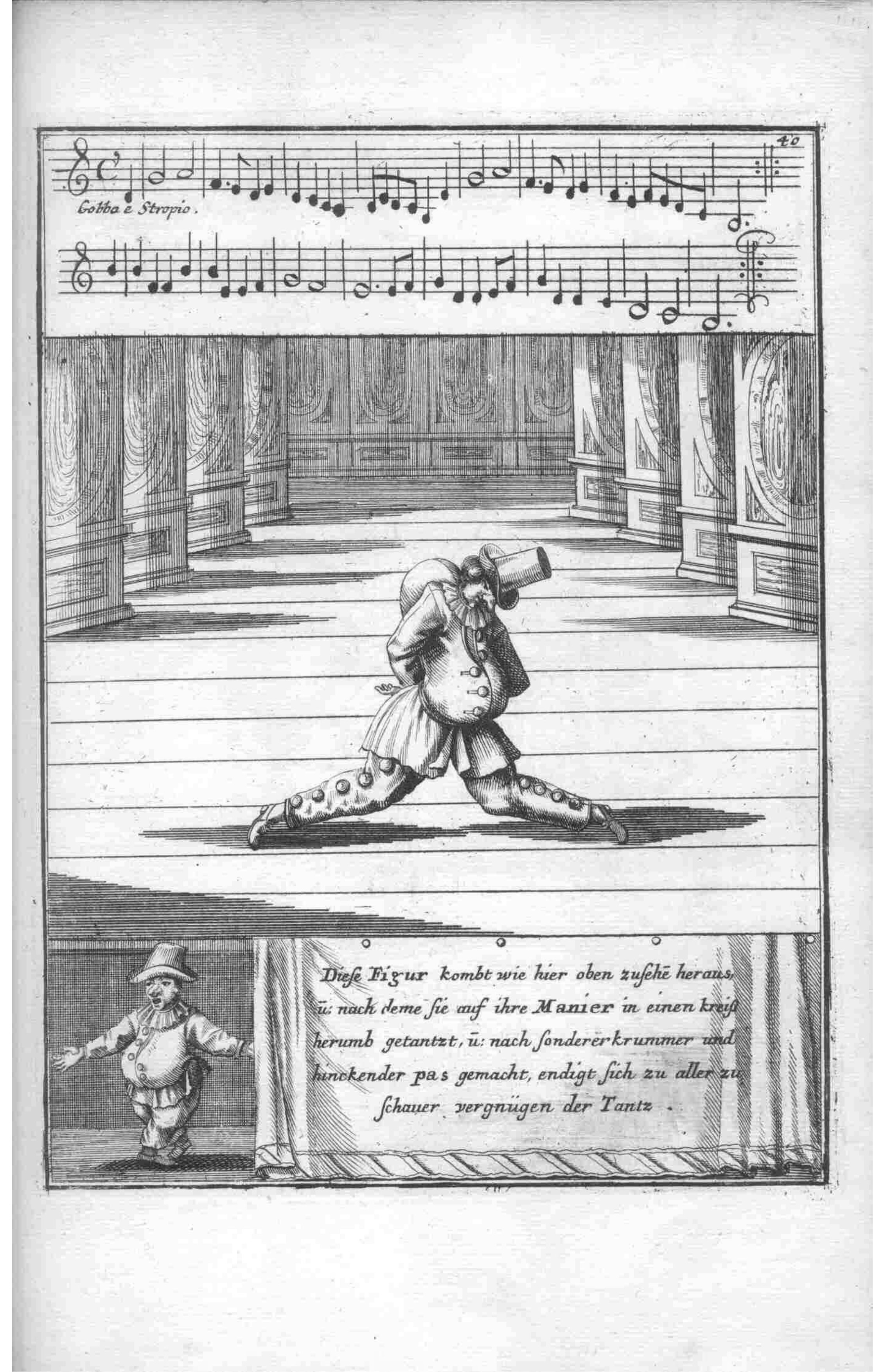
A solo male figure in early 18th-century theatrical costume dominates a stage defined by a classical colonnade and curtains. He is captured mid-movement in a dramatic split or lunge position, leaning far forward with his torso twisted and his left arm extended upward in an exaggerated gesture. He wears a plumed hat, ornate jacket with decorative buttons, knee breeches, and stockings. The figure's pose is deliberately comic or grotesque—his body weight is thrown forward almost recklessly, as if caught in a moment of exaggerated stumbling or theatrical collapse. The wooden stage floor is rendered with strong horizontal lines, grounding the figure in a defined performance space. A notated music line appears above the scene, and a verse in German script below identifies and describes the character's action.
The dancing
A single male dancer in profile, captured in an extreme forward-leaning position that suggests controlled instability. His left arm thrusts upward; his right arm hangs or gestures downward. The split or lunge position shows his legs splayed wide, with weight heavily displaced forward. The pose prioritizes visual impact and comic exaggeration over balanced alignment. There is no partner; this is an entirely solo performance designed to project character and personality rather than partner synchrony.
The dance depicted
This appears to be a theatrical dance character or *entrée* from early 18th-century commedia dell'arte or theatrical spectacle tradition, likely performed by a male dancer or actor-dancer playing a comic or grotesque character. The extreme pose and costume suggest a comic servant, a zany, or a stock character type common to theatrical dance of the period. The musical notation at the top indicates this was a danced scene accompanied by a composed piece. The German caption and notation place this in the Germanic or Holy Roman Empire theatrical tradition, where such commedia-influenced characters were popular in court and public theater.
How it was made
This is a copper-plate engraving, a relief printing process that allowed wide circulation of theatrical imagery throughout the 18th century. The fine cross-hatching and parallel lines defining the drapery, wooden floor, and architectural columns are characteristic of engraving technique. The medium's capacity for fine detail permitted accurate recording of costume (buttons, pluming, seams) and expressive body position. As a printed page from a published choreographic manual or theatrical handbook, it would have circulated among dancers, theater professionals, and educated amateurs across multiple territories, making it a key document of theatrical knowledge transfer.
About this work
This is one of a series of theatrical character studies from Gregorio Lambranzi's *Nuova e curiosa scuola de' balli theatrali* (Nuremberg, 1716), a foundational European dance manual. Each plate pairs notation with a single costumed figure in a character dance or theatrical *entrée*. This particular figure embodies a comic or grotesque theatrical character, likely part of the commedia dell'arte tradition adapted for baroque theatrical dance. The work documents a moment when theatrical dancing, music notation, engraving technique, and character performance converged as a transmissible knowledge system. Lambranzi's manual was among the era's most influential guides to theatrical dance practice, and these character studies remain among the richest visual records of baroque theatrical movement and costume.
How to look at it
Attend to the extreme, almost grotesque quality of the pose: this is not about balance or elegance but about theatrical impact and character projection. The exaggerated forward lean and upflung arm create a sense of dynamic imbalance—he is not standing but gesturing through movement. The costume details (the plumed hat, the decorative buttons, the stockings) are rendered with precision, showing that character identity was conveyed through dress as much as movement. The musical staff above shows that this movement was choreographed to a specific phrase, linking body and music as integral units. The architectural setting (the colonnade and curtains) establishes this as a stage performance, not a social dance.
The artist
Gregorio Lambranzi was an Italian dancer and choreographer active in southern Germany in the early 18th century. His *Nuova e curiosa scuola de' balli theatrali*, published in Nuremberg in 1716 (with a German translation following), was the most comprehensive choreographic manual of its era, featuring 144 plates. Each plate shows a costumed figure in a theatrical dance pose with accompanying music notation. The manual documented both social dances (minuets, bourées, etc.) and theatrical character dances, making it equally valuable as a record of baroque theatrical dancing and as a teaching tool for professionals. Lambranzi was based in Nuremberg and worked within the German cultural sphere; his manual was designed for and widely used among German-speaking theater professionals and dance masters.
The period
In the early 18th century, theatrical dance in German-speaking Europe was dominantly influenced by commedia dell'arte, the Italian improvisational theater tradition. Comic characters, exaggerated gesture, and character-based movement were central to both stage theater and early ballet. The minuet had become the dominant court dance, but theatrical dance remained more fluid and character-driven. Lambranzi's work documents this moment before ballet technique became rigidly codified and before choreography was fully separated from improvisation. The use of notation alongside visual depiction reflects a broader 18th-century project of capturing and systematizing knowledge—the same impulse that produced Enlightenment encyclopedias. The fact that the manual was printed and reprinted in multiple languages signals the high demand for such technical knowledge among European theater professionals.
Where it lives
This plate is from Gregorio Lambranzi's *Nuova e curiosa scuola de' balli theatrali* (Nuremberg: published by the author, 1716). The work consists of 144 engraved plates, each showing a single costumed dancer in character with accompanying musical notation and German-language verse. This example is held in the Library of Congress collection and represents one of the most widely circulated and influential dance manuals of the 18th century.
Dance in this work
Questions about this work
What is this figure supposed to be doing?
He is performing a comic theatrical character—likely a zany, servant, or stock character from commedia dell'arte tradition. The extreme forward lean and exaggerated arm gesture convey physical comedy or grotesque character rather than courtly elegance. This is theatrical dance meant to entertain through character and physical excess.
How do we know this was a real dance people performed?
Lambranzi's manual was a working choreographic text, not a collection of fantasies. Multiple copies circulated among theater professionals and dance masters across German-speaking territories. The inclusion of precise musical notation and the technical detail in costume rendering indicate this was meant as a reproducible model for actual performers.
Is this ballet?
Not in the modern sense. This is theatrical dance from the commedia dell'arte and early baroque theater tradition. While Lambranzi's manual includes social dances (minuets, bourées) that share space with ballet tradition, this particular character dance prioritizes comic gesture and personality over the codified technique that ballet would later emphasize.
What does the music notation tell us?
It shows that this movement was choreographed to a specific musical phrase. Dance and music were not separate but were composed together. The notation indicates the rhythm, tempo, and phrasing to which the dancer would have performed this character action.
More Notation/Choreography artwork