49 works in this view — arrow keys or swipe to move between them.
Dance in Art
Acrobatic — Plate 41
Gregorio Lambranzi
- Medium:
- Copper-plate engraving
- Dance:
- Notation/Choreography
- Era:
- 1700s (Enlightenment/Minuet Era)
- Collection:
- Nuova e curiosa scuola de' balli theatrali (1716)
- Source:
- Library of Congress
- Rights:
- Public domain — free to use, share and adapt.
- Recorded as:
- Public Domain
This image provides direct evidence of how acrobatic entertainment was integrated into formal theatrical practice and how it was notated and transmitted. For historians of dance, it reveals the breadth of what counted as theatre in 1716—not merely steps, but physical control, props, and the body's capacity to create visual spectacle through strength and balance.
What you are looking at
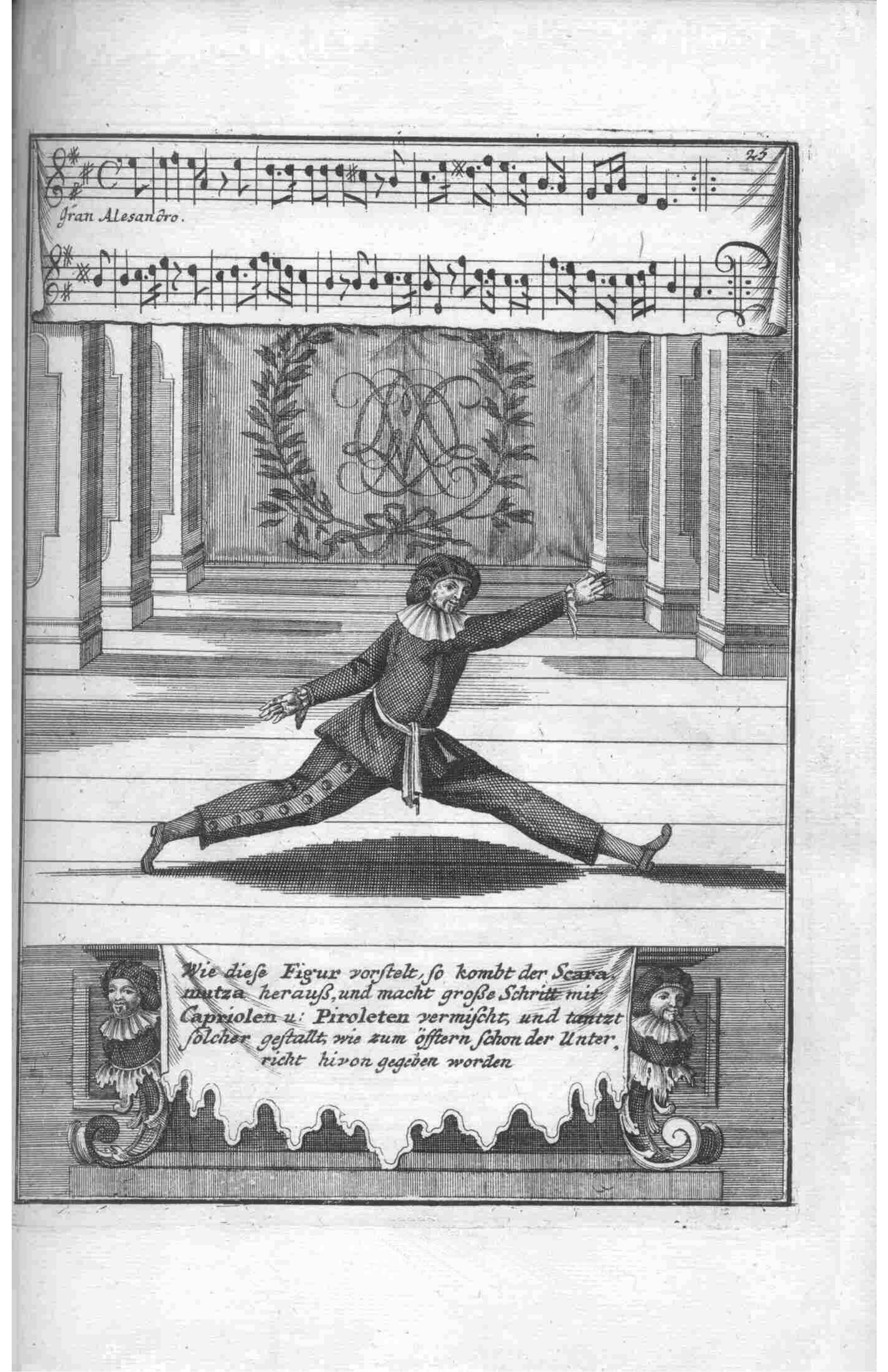
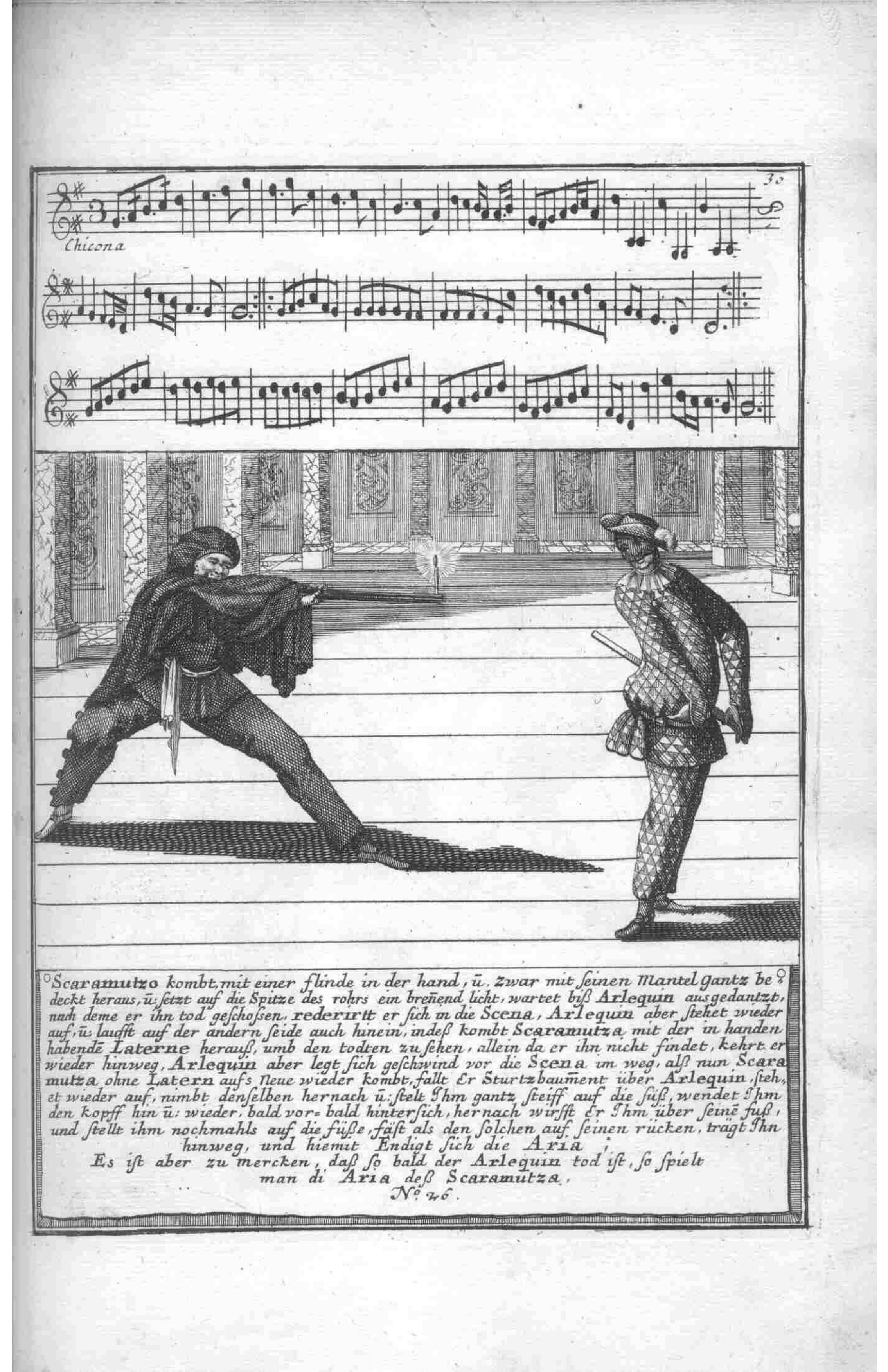
A single figure in theatrical costume performs an acrobatic feat on a curtained stage. The dancer, wearing a coat and breeches in the 18th-century style, stands in a columned pavilion or gallery with draped landscape paintings hung on the walls behind. The floor is rendered in perspective planks. The performer holds or balances a large wheel or circular disc—the primary acrobatic prop—at an angle across the body, suggesting mid-movement. The setting is formal and architectural, establishing this as a staged entertainment rather than a street performance. The engraving is rendered with fine parallel hatching to suggest depth and shadow, typical of copper-plate technique.
The dancing
A single male dancer bears weight through the legs in a braced, athletic stance while managing a large circular prop. The torso is angled to accommodate the wheel; the arms are engaged in controlling it. The posture suggests controlled strength and balance rather than the flowing extension of ballet. The figure is isolated on the stage, making the acrobatic task itself the subject rather than interaction between dancers.
The dance depicted
This is a theatrical acrobatic performance or *gioco scenico* (scenic game) from the early 18th century. The wheel prop—possibly a large wooden hoop or frame—is the focus; the dancer's task is to manage it with apparent ease while maintaining a composed theatrical demeanor. This type of acrobatic act, neither pure dance nor pure gymnastics, was a staple of theatrical intermezzos and ballet d'action. The notation at the top suggests each plate pairs choreographed movement with a musical score, indicating this was a documented, repeatable performance rather than improvisation.
How it was made
Copper-plate engraving, indicated by the fine parallel hatching, consistent line weight, and high detail in costume and architecture. This technique allowed for precise reproduction and circulation in print, making Lambranzi's manual reproducible and teachable. The engraving was the standard medium for dance instruction in this period because it could render anatomical precision and spatial clarity that a woodcut could not achieve. The print survives from the bound volume *Nuova e curiosa scuola de' balli theatrali*, published in Nuremberg, suggesting a professional, educated audience of choreographers and wealthy amateurs.
About this work
This is Plate 41 from Gregorio Lambranzi's influential 1716 dance manual, a copper-plate engraving pairing a musical score with a costumed figure performing an acrobatic wheel-balancing act on a formal stage. The image documents a type of theatrical entertainment—the acrobatic *gioco*—that occupied the space between balletic elegance and street-performance virtuosity in early 18th-century European court and urban theatres. Lambranzi's manual stands as one of the most detailed records of non-balletic theatrical movement of the era, and this plate exemplifies his method: music, figure, costume, setting, and prop aligned to preserve a specific performance tradition for repetition and study.
How to look at it
Attend to the stillness and control in the figure's posture: this is not a moment of explosive movement, but of balance maintained and weight managed. The wheel is angled, not vertical, suggesting a dynamic instant rather than a static pose. The architectural setting and formal dress indicate that acrobatics in this context are a theatrical display, governed by rules of decorum, not a street performance. The notation at the top grounds the image in a specific musical time, reminding us that this moment is choreographed and repeatable.
The artist
Gregorio Lambranzi was a Nuremberg-based dancing master and choreographer active in the early 18th century. He is known almost exclusively through this single publication, *Nuova e curiosa scuola de' balli theatrali* (New and Curious School of Theatrical Dances), issued in 1716 in Italian and in a German edition the same year. The work is a systematic compendium of theatrical dance types, combining musical notation with engraved figures in costume, each plate representing a distinct choreography or entertainment form. Lambranzi's approach was pedagogical and preservationist: he documented practices that might otherwise vanish, using the copper plate as a teaching tool for professional dancers and wealthy amateurs across Europe.
The period
The early 18th century saw the professionalization and theatricalization of dance across Europe. Ballet was beginning to codify into a formal technique with turnout and verticality; simultaneously, theatrical dance encompassed a wide range of acrobatic, comic, and national-character dances. The period between baroque court ballet and the emergence of Romantic ballet (mid-18th century) was one of high formal experimentation. Print media—particularly the engraved plate—became a vehicle for preserving and teaching choreography, since no notation system yet existed that could capture the subtleties of movement. Lambranzi's manual belongs to this transitional moment when dance was moving from improvisation and oral transmission toward documented practice.
Where it lives
This engraving is one of 52 plates in *Nuova e curiosa scuola de' balli theatrali*, a bound volume published in Nuremberg in 1716 and now held in the Library of Congress. The work was originally printed in both Italian and German editions, indicating a dual-language market among educated European dance practitioners and aristocratic patrons.
Dance in this work
Questions about this work
What is the wheel the dancer is holding?
Likely a large wooden hoop or circular frame used as a prop to demonstrate control and balance. In early 18th-century theatrical performance, such props were common in acrobatic scenes (*giochi scenici*) and helped define the spectacle of the act. The specific mechanics of how it was used—whether balanced, spun, or manipulated—would have been understood by the manual's trained audience.
Is this ballet?
No. This is a theatrical acrobatic act, a *gioco scenico* or scenic game. It shares the theatrical stage with ballet, but belongs to a different tradition emphasizing physical strength, balance, and often comic effect. Ballet in this period was developing its own aesthetic of turnout, verticality, and flowing movement; acrobatic entertainment drew on different skills and traditions.
Why does Lambranzi's book matter?
It is one of the most detailed surviving documents of early 18th-century theatrical dance practice. Because notation systems for dance did not yet exist, Lambranzi used the copper plate to preserve movements, costumes, music, and staging that would otherwise be lost. The manual was circulated and used across Europe, making it a primary source for what theatres actually performed.
How was this engraving used?
As a teaching and reference tool. A choreographer or dancer would consult the plate alongside the musical notation, studying the figure's posture and costume, then work with musicians to recreate the performance. The bound volume functioned as both an archive and a how-to manual for professional theatre practitioners.
More Notation/Choreography artwork