49 works in this view — arrow keys or swipe to move between them.
Dance in Art
Solo Dancer — Plate 42
Gregorio Lambranzi
- Medium:
- Copper-plate engraving
- Dance:
- Notation/Choreography
- Era:
- 1700s (Enlightenment/Minuet Era)
- Collection:
- Nuova e curiosa scuola de' balli theatrali (1716)
- Source:
- Library of Congress
- Rights:
- Public domain — free to use, share and adapt.
- Recorded as:
- Public Domain
Lambranzi's engravings are the only surviving images that show the body position, arm carriage, and dynamic intention of early theatrical dance in anatomical detail. For dancers and choreographers seeking to understand or reconstruct the Baroque vocabulary, this plate is irreplaceable evidence of how the period understood posture, weight, and ornamental movement. For art historians and cultural historians, it documents the moment when theatrical dance began to be treated as a subject worthy of technical and artistic documentation in the same manner as painting or sculpture.
What you are looking at
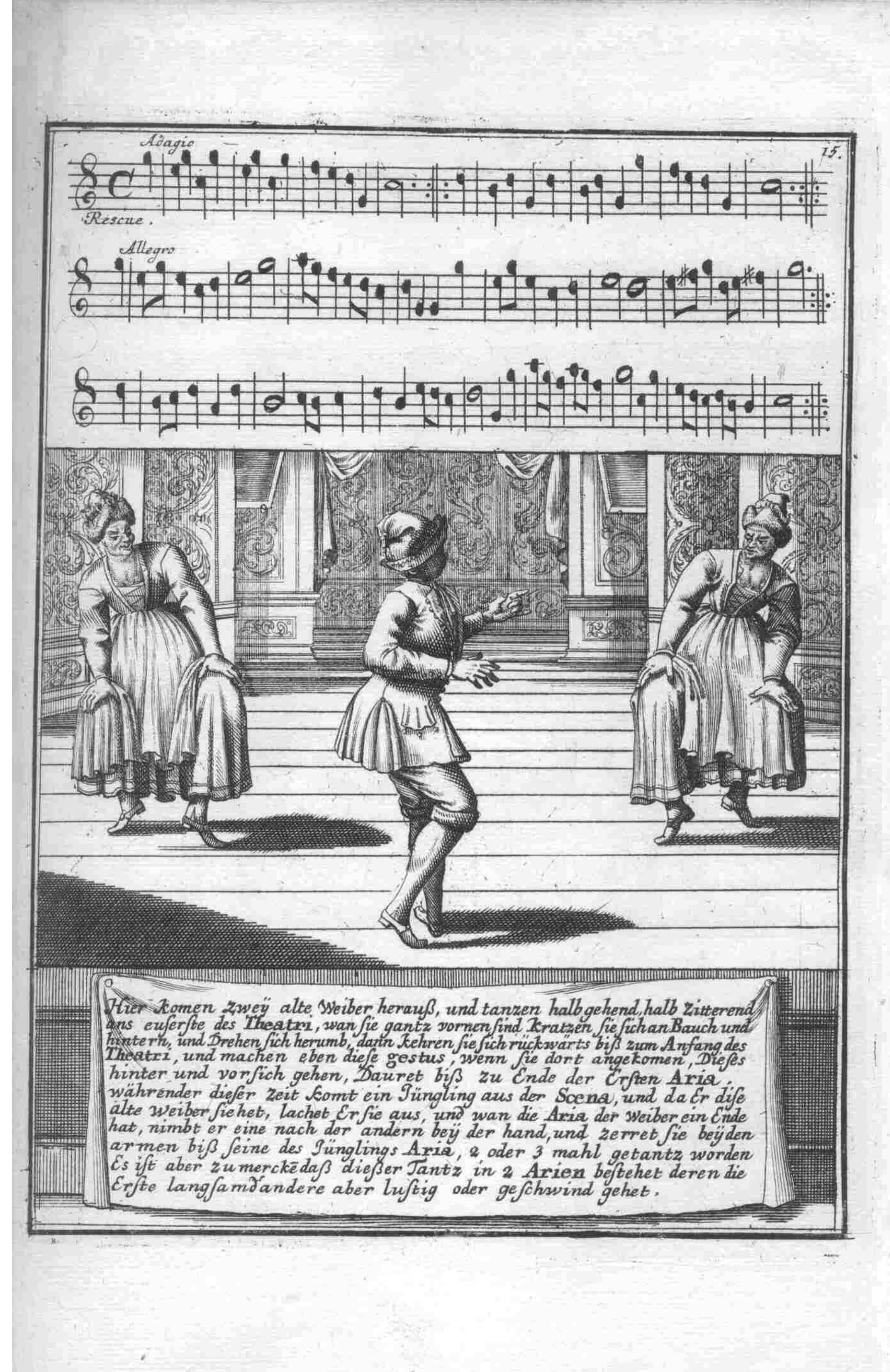
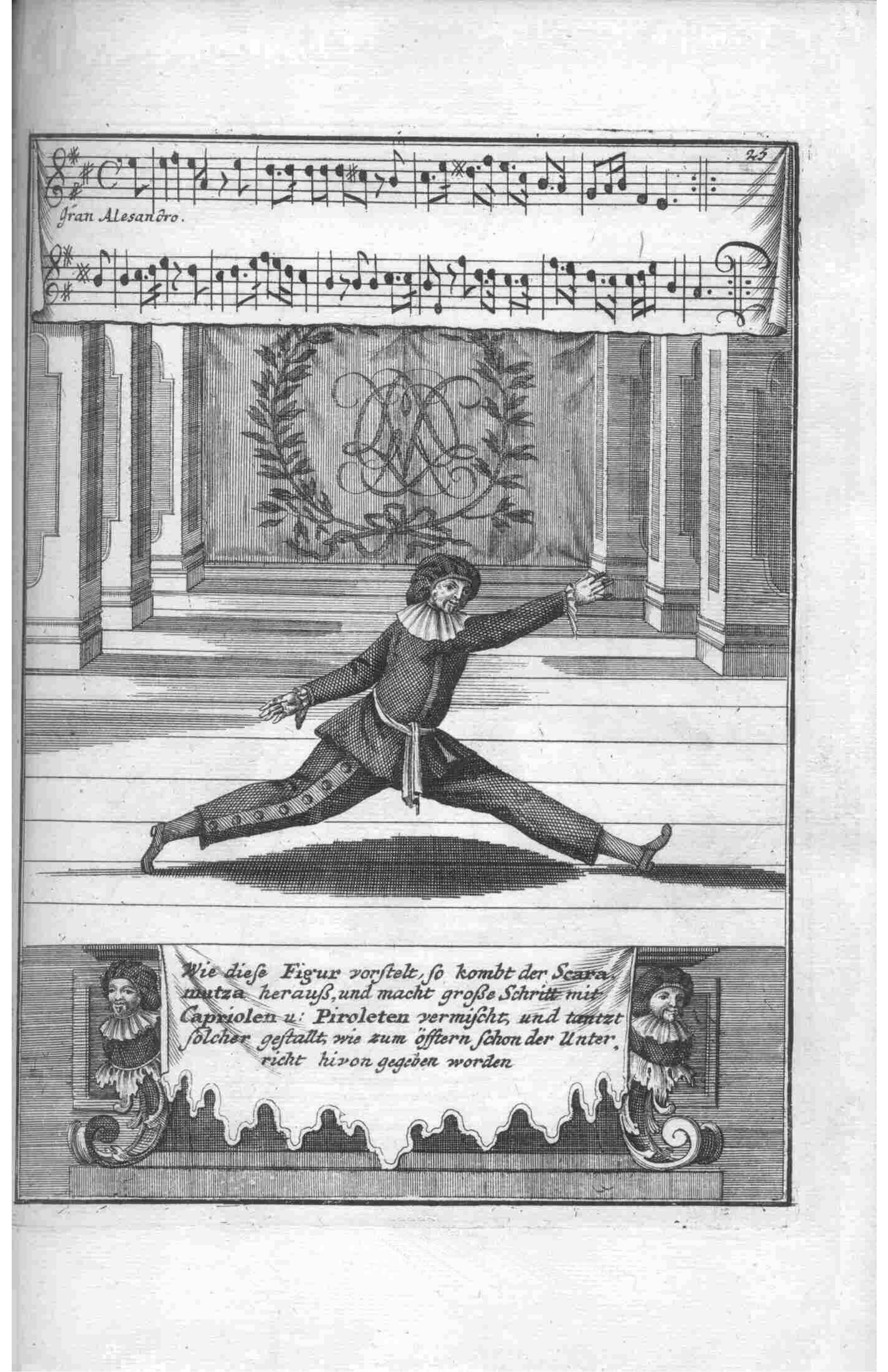
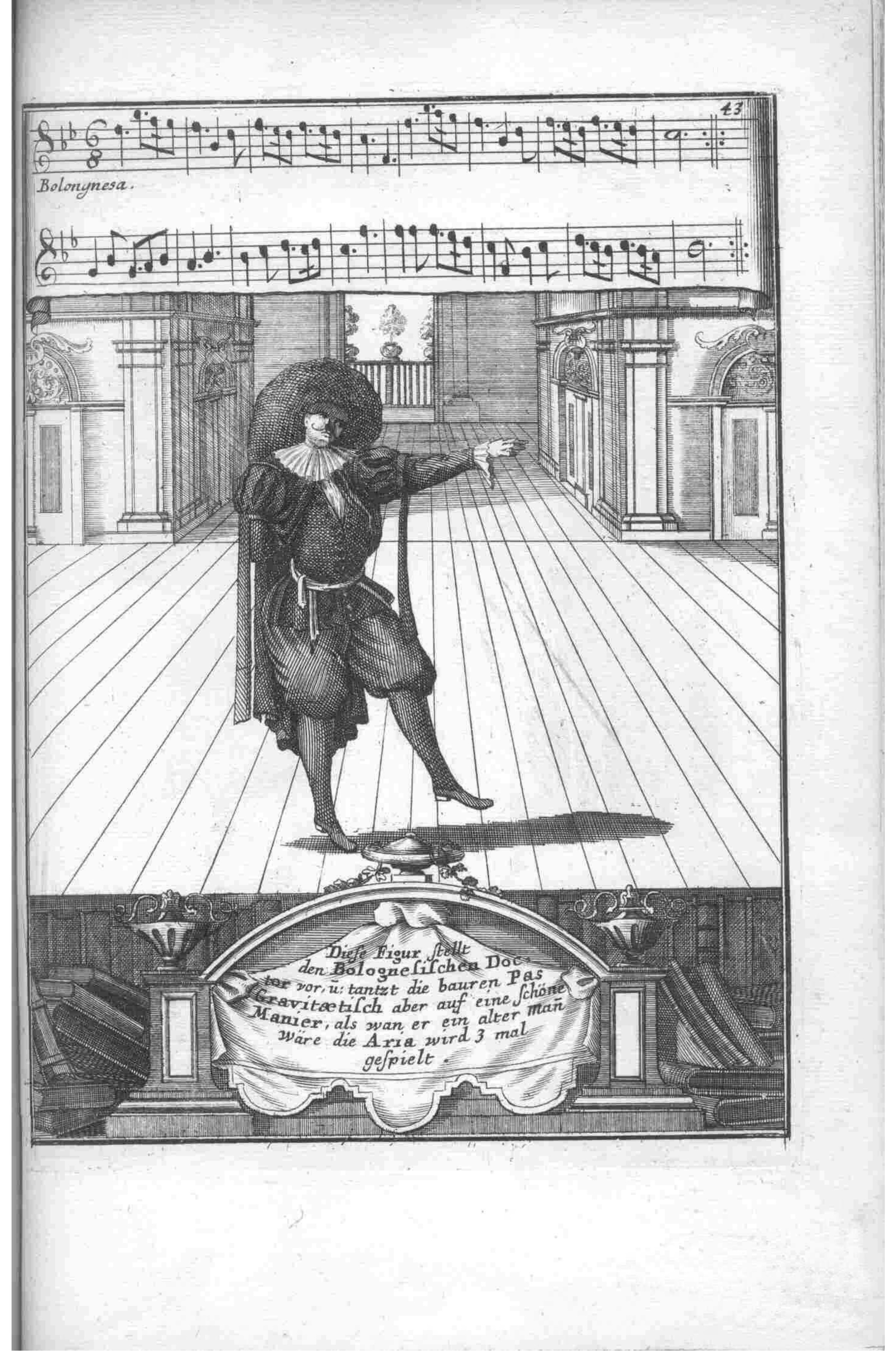
A male dancer occupies the center of a formal theatrical stage, dressed in fashionable early 18th-century costume: dark brocaded coat, white collar and cuffs, and pale breeches. He stands in profile or three-quarter view, his left arm extended in an elegant gesture while his right arm hangs naturally. His weight appears to rest on his right leg, the left slightly advanced and bent. The stage recedes behind him in careful perspective, framed by classical columns and a draped curtain, with architectural details suggesting an indoor court or theatre setting of considerable formality. Above the engraved scene appear two staves of musical notation labeled *Bolognesa*, indicating the specific melody to which this choreography was intended. Below the figure runs a German inscription describing the dance. The entire composition is executed with fine crosshatching and careful line work characteristic of copper-plate engraving.
The dancing
The dancer exhibits the upright carriage and turned-out positions foundational to Baroque court dance. His arms are shaped with the soft curve and lift typical of the period—no sharp angles, no tension. The stance suggests a moment of transition between steps: the body centered, the gesture leisurely and controlled. The extended arm reaches outward in a manner consistent with either a reverence (formal greeting) or a passé position moving into a subsequent figure. There is a single dancer shown solo on stage.
The dance depicted
This plate documents a solo theatrical dance from the early 18th-century Italian tradition of balletto, as codified in Lambranzi's manual. The *Bolognesa* was a popular social and theatrical dance of the period. The figure's posture and arm carriage are consistent with the minuet or a related Baroque court form—dances emphasizing gentle, measured movement, precise turnout, and ornamental arm work. The inscription and notation tie movement directly to music, which was essential to the period's pedagogical approach. Lambranzi's book served dancers and choreographers as a visual-musical curriculum, and this plate would have been studied for technique as well as theatrical performance.
How it was made
This is a copper-plate engraving, a medium that allowed for fine, precise detail and wide circulation in printed form. Engraving required a skilled burin hand and careful planning; the composition, notation, and text were all incised into the plate surface in reverse, then inked and pressed. The technique's precision made it ideal for technical documentation—the dancer's posture and the musical staff had to read clearly to be useful to practitioners. The use of engraving (rather than cruder woodcut) signals a work aimed at educated, invested audiences: dancers, choreographers, and aristocratic patrons who could afford illustrated books.
About this work
This is one of approximately 50 plates from Gregorio Lambranzi's *Nuova e curiosa scuola de' balli theatrali* (New and Curious School of Theatrical Dances), published in Nuremberg in 1716. Each plate pairs a notated melody with a costumed male dancer performing a solo choreography on a formal stage, presented as both artistic composition and instructional record. The work is among the most important surviving visual documents of early 18th-century theatrical dance technique and aesthetic—the dress, carriage, and ornamental gesture all express the ideals of the Baroque court and the emerging theatrical profession.
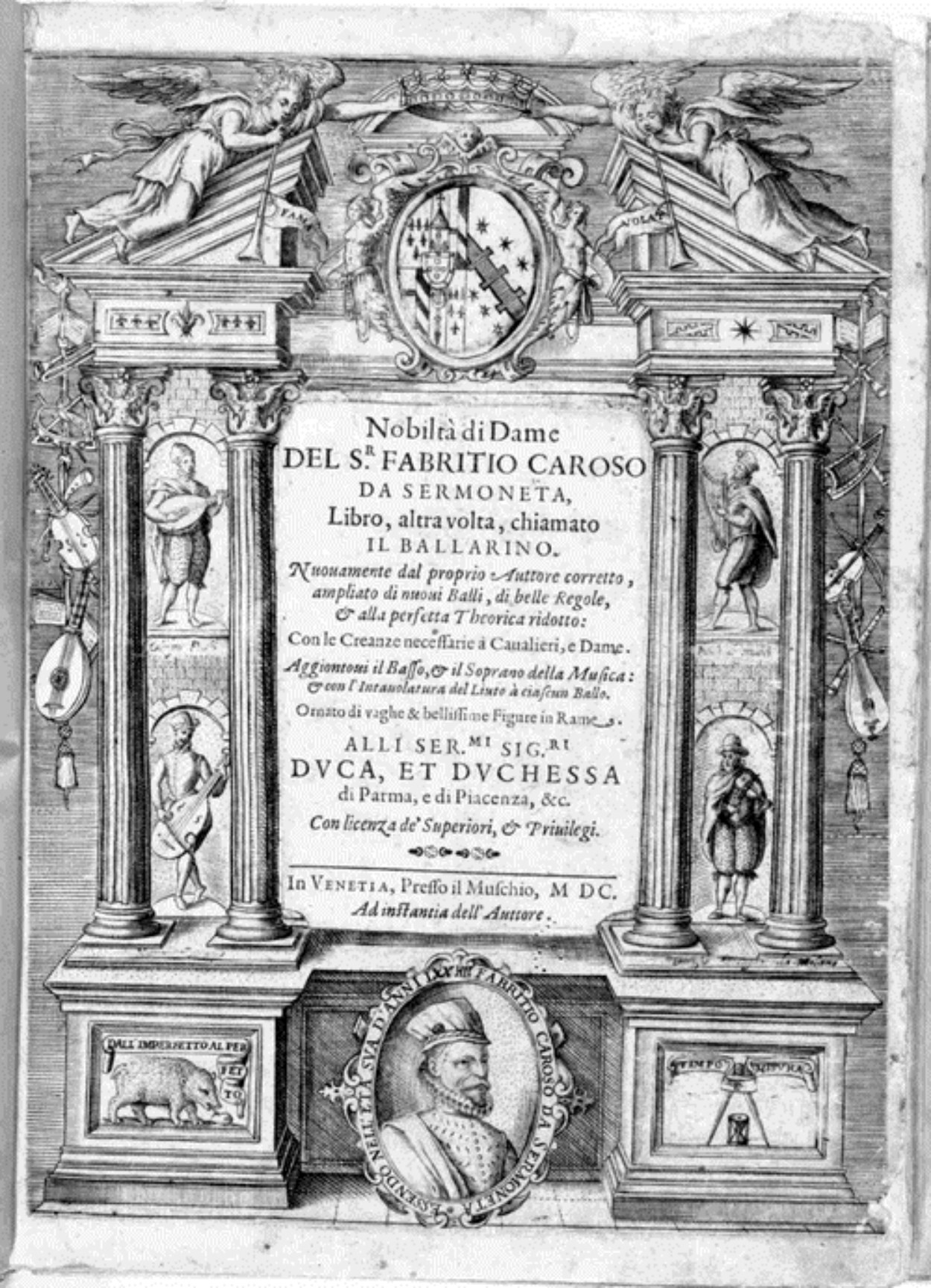
Lambranzi's manual occupies a unique position in dance history: it bridges the Italian Renaissance dance tradition (represented by Cesare Negri and Fabrizio Caroso) and the codification of French court technique that would dominate the later 18th century. Unlike earlier printed dances, which gave only text and geometric floor patterns, Lambranzi's engravings provide the first systematic visual record of how a trained dancer actually stood and moved. This plate is a primary source for reconstructing the physical vocabulary of Baroque theatrical dance.
How to look at it
Observe the dancer's arms first: they are not rigid or held in front of the body, but shaped with gentle curves and positioned to frame the figure in space. This is not the turned-out extension of later ballet, but the courtly elegance of the early Baroque. Notice the position of the feet: the back foot appears to be supporting weight while the front foot is extended or about to step—a moment of poise and control rather than effort. The musical staff above indicates that this is not a frozen moment but a specific phrase within a longer melody: the engraver has chosen the instant that best demonstrates the posture and style the text describes. The formal stage, the classical columns, and the careful perspective all signal that this is theatrical dance, not social dancing, but the movement vocabulary belongs to the same world.
The artist
Gregorio Lambranzi (dates unknown, active early 18th century) was an Italian dancing master and choreographer, likely based in or connected to Nuremberg, where his manual was published. Almost nothing is known of his life or training. His significance rests entirely on the *Nuova e curiosa scuola*, which suggests he was either a master of considerable reputation or had the patronage and technical skill to commission the engravings necessary to produce such a work. The manual's existence and circulation indicate that Lambranzi understood dance as something that could and should be preserved visually and musically for future study—a radical proposition at the time.
The period
In 1716, theatrical dance was in transition. The Italian tradition of elaborate court dances and intermezzi was giving way to French courtly dominance, but the theatrical forms that would develop into ballet were still local and varied. Lambranzi's manual preserves a moment when theatrical dance remained closely tied to music, social dance codes, and the aesthetics of noble bearing rather than the virtuosic technique that would define the later 18th century. The publication of *Nuova e curiosa scuola* reflects growing interest in documenting and systematizing dance knowledge—a trend that would accelerate with the development of dance notation systems (Raoul-Auger Feuillet's notation was already in use by 1700 in France). The work sits at the intersection of manuscript culture (older tradition) and print culture (newer practice); it is one of the first and finest examples of dance instruction in printed, illustrated form.
Where it lives
This plate is from the 1716 first edition of *Nuova e curiosa scuola de' balli theatrali*, published in Nuremberg. The work survives in multiple copies in libraries and collections across Europe and North America, indicating that it had reasonable circulation among the educated and artistic classes of the 18th century. The Library of Congress holding reflects the work's status as a primary source for the history of dance and European theatrical culture.
Dance in this work
Questions about this work
Is this a real dance or did Lambranzi make it up?
The *Bolognesa* was a known dance form of the period, named for Bologna, but Lambranzi's choreography for this melody is his own composition, presented as a model for dancers to learn and adapt. The manual is not a record of existing dances but a curriculum in how to choreograph and perform dances according to the rules and aesthetics of the period. Dancers would have studied these plates to understand technique and to acquire a repertoire of movements they could apply to other compositions.
How would a dancer have used this book?
A dancer or dance master would have used *Nuova e curiosa scuola* as a study manual and a record. The combination of engraving and notation allowed the reader to see the posture and movement suggested by the music, then practice matching their own body to the image. Because the figures are in elegant costume and theatrical setting, the manual also served an aspirational function: it showed what trained, courtly dance looked like, holding up a standard of refinement and technique. Wealthy amateurs and professional dancers alike would have owned or had access to such manuals.
What does the German text say?
The inscription (visible in a decorative cartouche below) provides the dancer's name or a description of the dance, and often includes notes on execution or style. German was the language of publication (Nuremberg), though the dances themselves are Italian in origin and the musical notation was universal. The use of German, rather than Italian or French, is one reason Lambranzi's manual was particularly influential in Central Europe.
How does this compare to modern ballet?
The posture and arm carriage here are the foundations of later ballet, but they are still closely tied to social dance, aristocratic bearing, and musical phrasing rather than the extended line, turnout, and lifted verticality of 19th-century ballet. There is no pointe work, no dramatic storytelling, and the goal is elegance and courtesy rather than virtuosity. However, the five positions of the feet and the principle of turnout are already present in this tradition, and they pass through Lambranzi's work into the ballet vocabulary that follows.
More Notation/Choreography artwork