49 works in this view — arrow keys or swipe to move between them.
Dance in Art
Courtly Couple — Plate 47
Gregorio Lambranzi
- Medium:
- Copper-plate engraving
- Dance:
- Notation/Choreography
- Era:
- 1700s (Enlightenment/Minuet Era)
- Collection:
- Nuova e curiosa scuola de' balli theatrali (1716)
- Source:
- Library of Congress
- Rights:
- Public domain — free to use, share and adapt.
- Recorded as:
- Public Domain
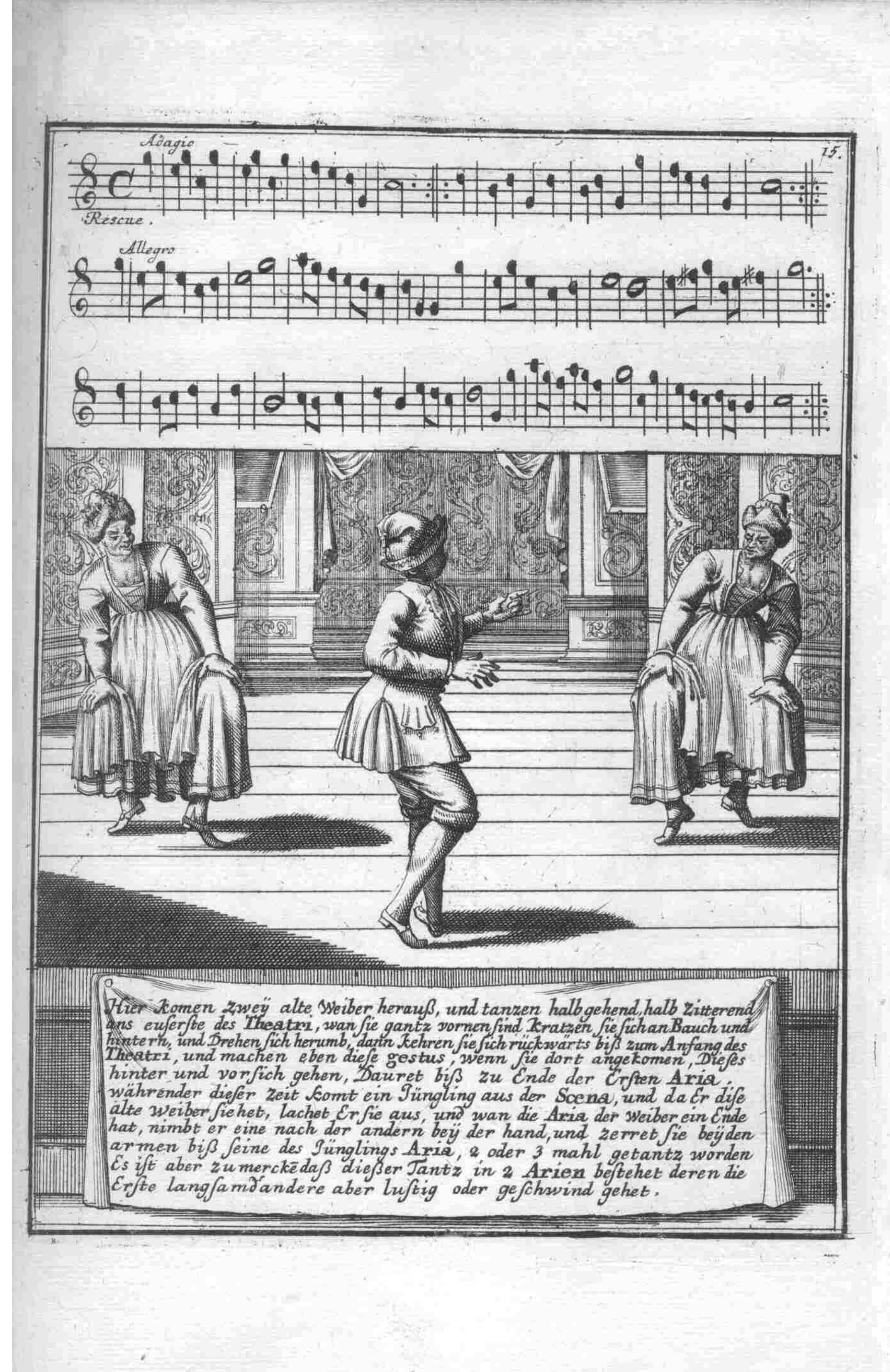
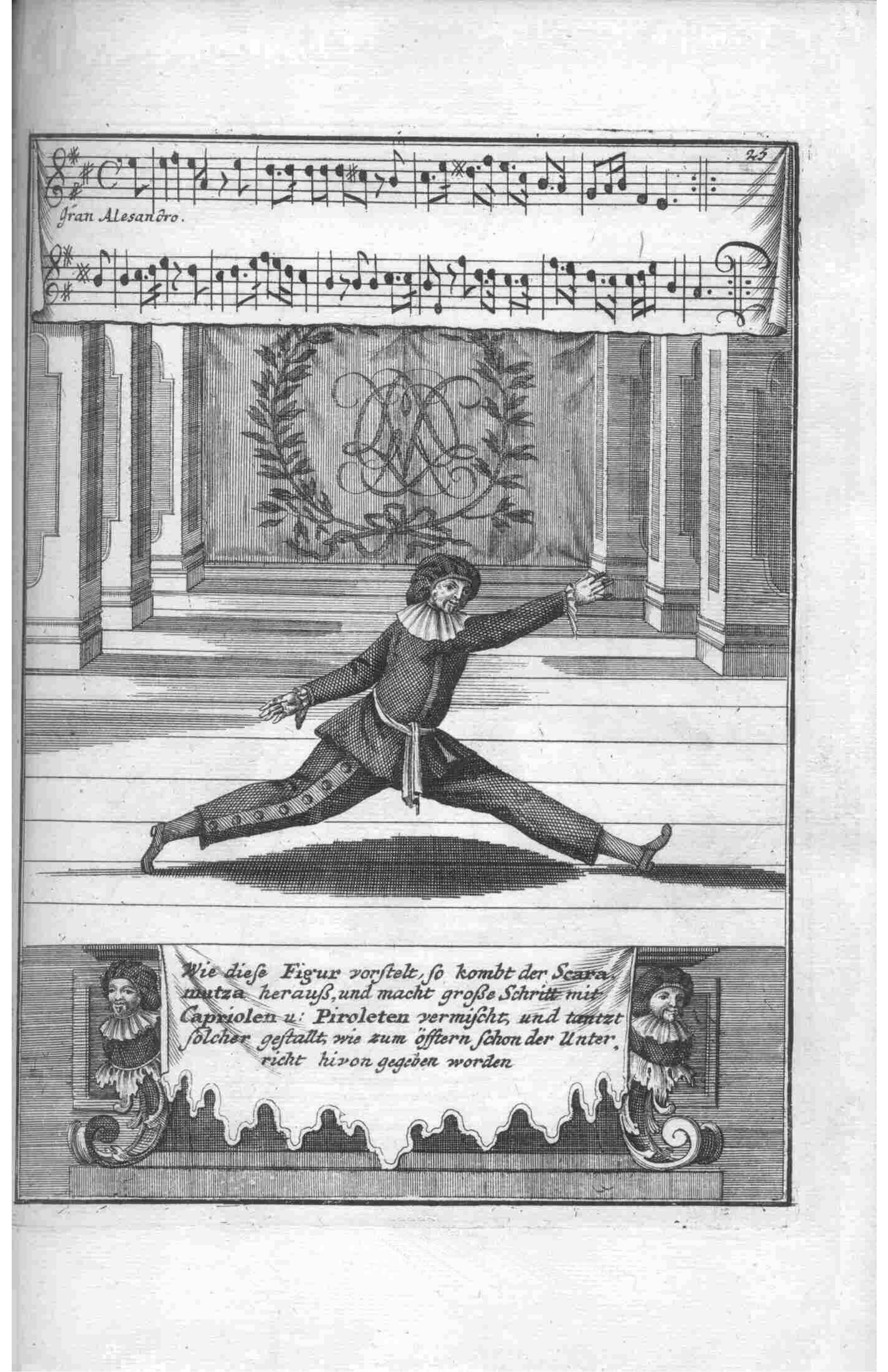
Lambranzi's manual is one of the earliest and most detailed surviving records of how court dances were actually performed—not described in words, but shown in engraved figures paired with their musical notation. For historians and dancers, this image is direct evidence of body carriage, costume, spatial relationships, and the integration of music and movement in early 18th-century theater. The work also documents a vanished world of aristocratic performance in which dance was a primary medium of courtly display and social instruction.
What you are looking at
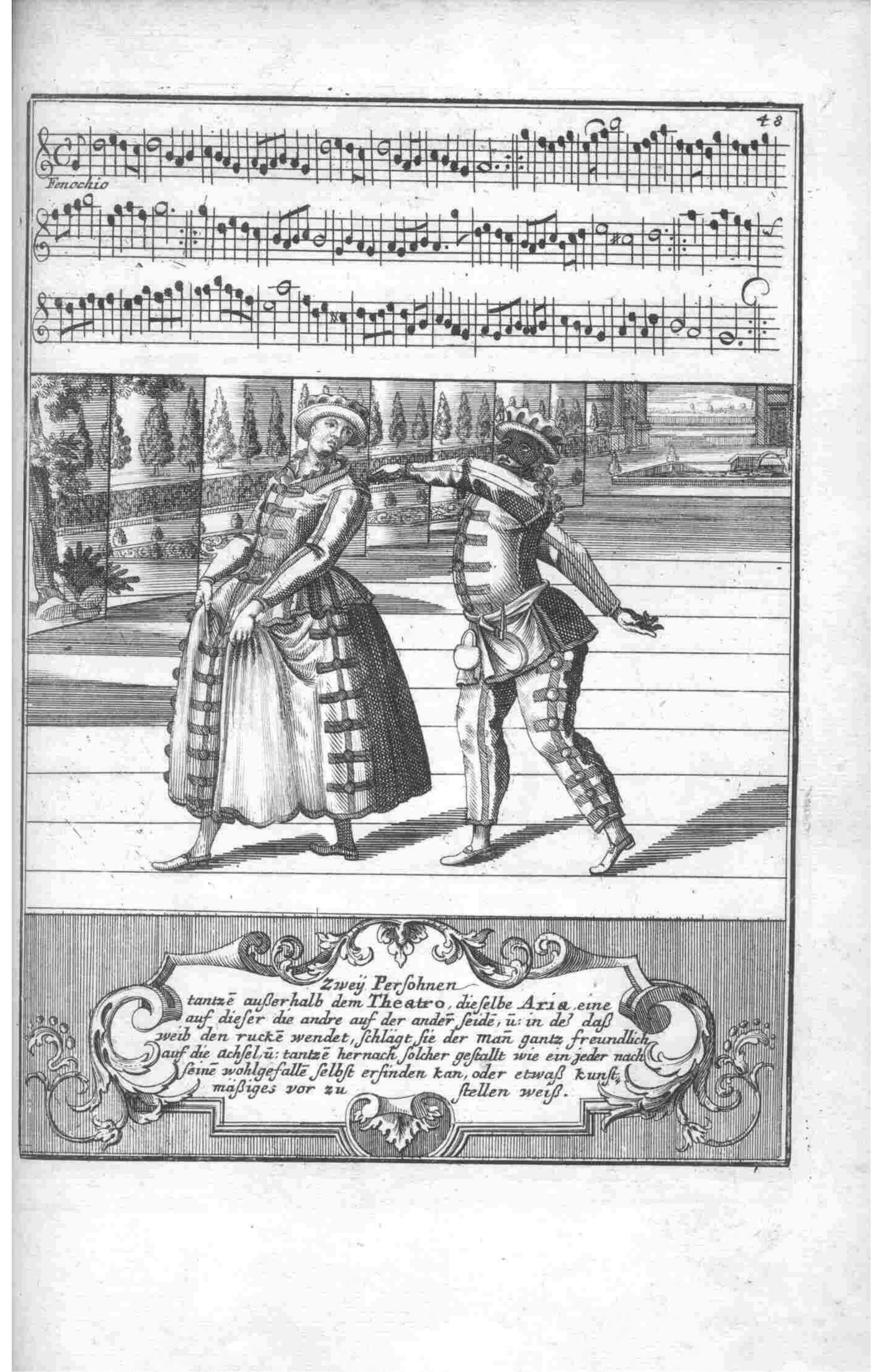
This copper-plate engraving shows a single couple on a low wooden platform stage, set within a classical landscape of cypress trees and a distant water view. The man wears richly patterned hose with decorative cross-hatching, a short doublet with slashed sleeves, and a feathered hat; the woman wears an elaborate gown with a full skirt featuring bold vertical striping and a brocaded bodice, also topped with a feathered hat. Both are caught mid-movement in formal posture, the man's left leg extended and weight shifted, the woman standing upright with arms composed. The stage is framed by a heavy curtain at the back, and the entire scene is rendered in fine hatching and line work characteristic of 16th-century printmaking. Above the stage is a three-line musical notation labeled "Piomella"; below runs a caption in German verse describing the performance.
The dancing
The man leads from his right side with his body angled into the movement, his left leg stepping forward or out while his trunk remains upright and his arms hang naturally at his sides. The woman faces the man with a composed, vertical frame, her weight centered and her arms in a natural position. Both maintain the formal bearing of trained courtiers; there is no extravagant arm gesture or convulsive footwork, but rather a measured stride and controlled carriage. The spatial relationship is intimate but decorous—they occupy the same platform but do not touch.
The dance depicted
This is a theatrical dance from the early 18th-century German court tradition, most likely a minuet or similar processional court dance. The notation and paired figures suggest this comes from a choreographic manual designed to teach fashionable steps to educated amateurs and performers. The dress—German Renaissance revival style with feathered hats and rich textiles—reflects theatrical convention rather than street wear, and the low platform and curtained setting confirm this is a staged entertainment for an aristocratic or court audience. The measured stride and vertical alignment of both figures are consistent with the minuet's characteristic restraint and formality.
How it was made
This is a copper-plate engraving, a labor-intensive printmaking process that produces fine detail through incised lines filled with ink and transferred to paper under pressure. The technique allows Lambranzi to render the intricate pattern-work of the dancers' costumes and the subtle modeling of their bodies through parallel hatching lines. As an engraving, it was designed for circulation among the educated and wealthy—cheaper than a painted original, but far more durable and reproducible than a woodcut. This image is one of many in a bound instructional volume, making it part of a comprehensive choreographic record intended to preserve and disseminate court dancing practices.
About this work
This is Plate 47 from Gregorio Lambranzi's *Nuova e curiosa scuola de' balli theatrali* (Nuremberg, 1716), one of the era's most systematic records of theatrical dance technique and choreography. The plate pairs a three-part musical notation with an engraved scene showing two richly costumed dancers on a stage, capturing a single moment from a formal court or ballroom dance. The image belongs to the long tradition of dance notation and illustration that stretches back to the Renaissance; Lambranzi's manual was designed to teach and preserve dances that might otherwise vanish with their performers, and each engraving serves as both visual record and practical guide. The work is a landmark document of early 18th-century courtly performance practice, combining music, costume, setting, and figured movement into a single coherent pedagogical object.
How to look at it
Attend to the moment chosen: the man is caught mid-step, his weight transferring forward, while the woman holds a more stationary pose—this reflects the gendered roles of minuet dancing, in which the male dancer led and the female followed or held her ground. Notice how the engraver has rendered the dancers' costumes in obsessive detail—the cross-hatched hose, the vertical striping of the skirt—which was as much a part of courtly dance performance as the movement itself. The low platform and theatrical framing emphasize that this is not a snapshot of spontaneous movement, but a carefully staged and repeated choreographic figure, meant to be learned from the image.
The artist
Gregorio Lambranzi was an Italian choreographer and dance master active in early 18th-century Germany. He is known almost entirely through his *Nuova e curiosa scuola de' balli theatrali*, a two-volume instructional manual published in Nuremberg in 1716 and reprinted several times thereafter. The work represents a systematic attempt to notate and preserve theatrical dances through the marriage of choreographic description, musical notation, and engraved illustration. Lambranzi's manual stands alongside Raoul Auger Feuillet's *Chorégraphie* (1700) as a foundational document of early modern dance notation and pedagogy.
The period
The early 18th century saw an intense effort across Europe to codify and standardize dance notation, driven by the rapid professionalization of theater and the need to preserve complex choreographic works that depended on trained memory and live transmission. The minuet was the dominant courtly form during this period, associated with refinement, control, and aristocratic status. At the same time, the rise of commercial printing and engraving made it possible to circulate dance instruction in bound volumes to a wider audience of nobles, bourgeois amateurs, and professional dancers. Lambranzi's manual was published during the peak of Baroque court culture in German-speaking lands, capturing practices that were already beginning to shift toward the lighter, more mobile styles of the Rococo.
Where it lives
This plate is from Lambranzi's *Nuova e curiosa scuola de' balli theatrali*, published in two volumes in Nuremberg in 1716. The work is housed in the Library of Congress as part of its collection of early modern instructional and theatrical materials. Each plate in the manual pairs a musical notation with a costumed figure or couple, creating a portable visual record of dances that could be studied, copied, and performed by anyone with access to the book.
Dance in this work
Questions about this work
What is Lambranzi's manual, and why does it matter?
The *Nuova e curiosa scuola de' balli theatrali* (1716) is one of the first comprehensive visual records of theatrical dance technique, combining engraved figures with musical notation and German verse descriptions. It was designed both as an instructional manual for dancers and performers, and as a record for preservation—a way to capture dances that might otherwise vanish when their creators died. For historians and practitioners, it is direct evidence of how courtly and theatrical dances were actually performed in early 18th-century Germany.
What dance is shown in this plate?
The notation and paired figures suggest a minuet or similar formal courtly dance. The musical notation at the top (labeled "Piomella") would have been legible to trained musicians of the period, and the engraved figures show the characteristic restraint, vertical alignment, and measured stride of minuet technique. The man leads with a forward step while the woman maintains a composed, stationary frame.
What do the costumes tell us?
The elaborate dress—feathered hats, slashed sleeves, richly patterned hose, and vertically striped skirts—reflects theatrical convention and aristocratic fashion of the early 18th century. In courtly dance, costume was inseparable from choreography; the weight and volume of the skirt, the visibility of the footwork through patterned hose, and the decorative hat all shaped how the dancer moved and how the audience understood the performance. Lambranzi's careful engraving of textile details underscores their importance.
How was this image used?
As a bound engraving in an instructional manual, this image would have been studied by dancers, music masters, nobles learning courtly etiquette, and professionals in theater. The combination of notation, figure, and verse caption made it possible for someone with training to learn or reconstruct the dance from the book alone. Multiple copies of the manual circulated throughout German-speaking lands and beyond, making this one of the most widely distributed dance instruction texts of its era.
More Notation/Choreography artwork