49 works in this view — arrow keys or swipe to move between them.
Dance in Art
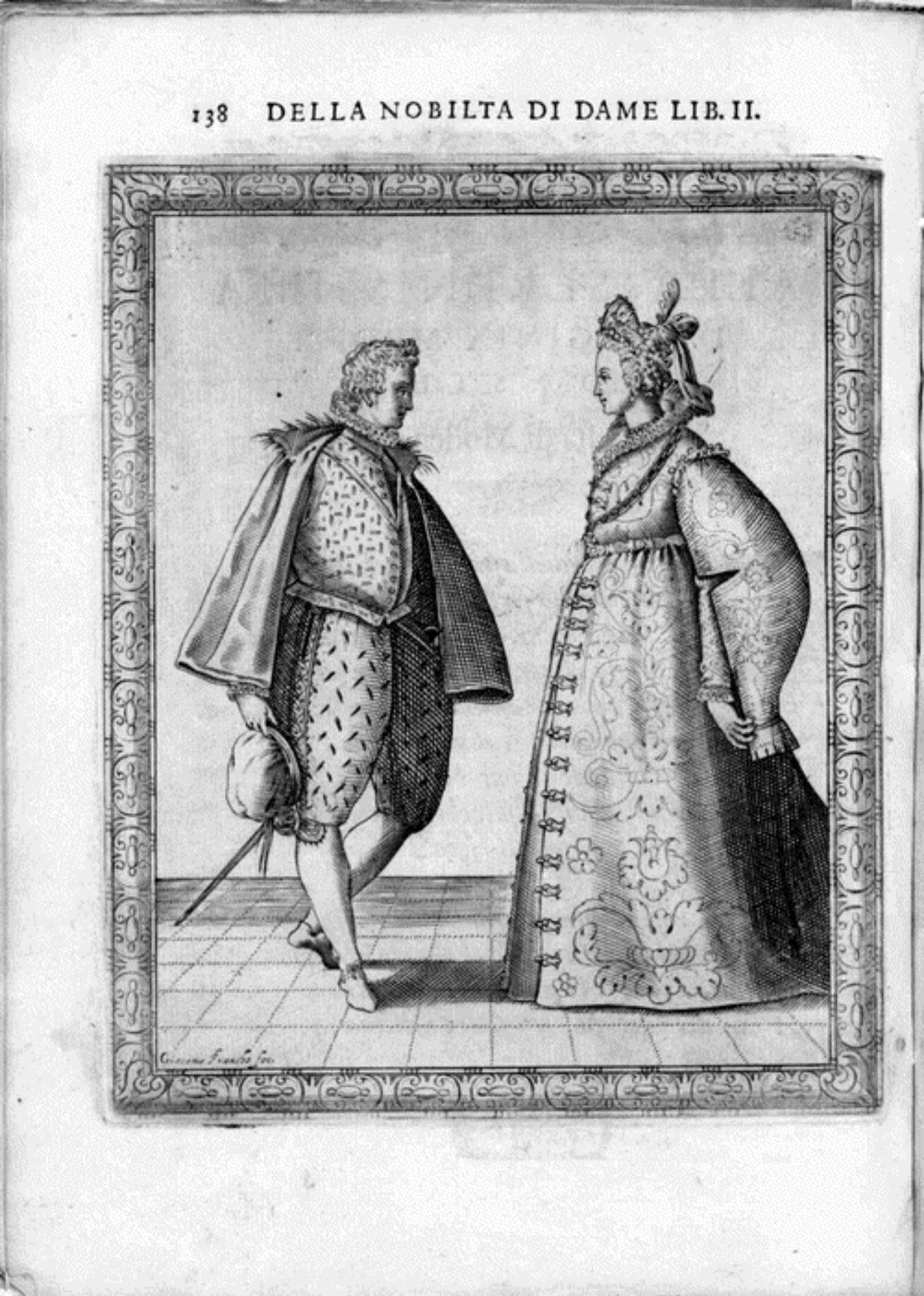
Caroso Nobiltà — Dance Plate (plate 9)
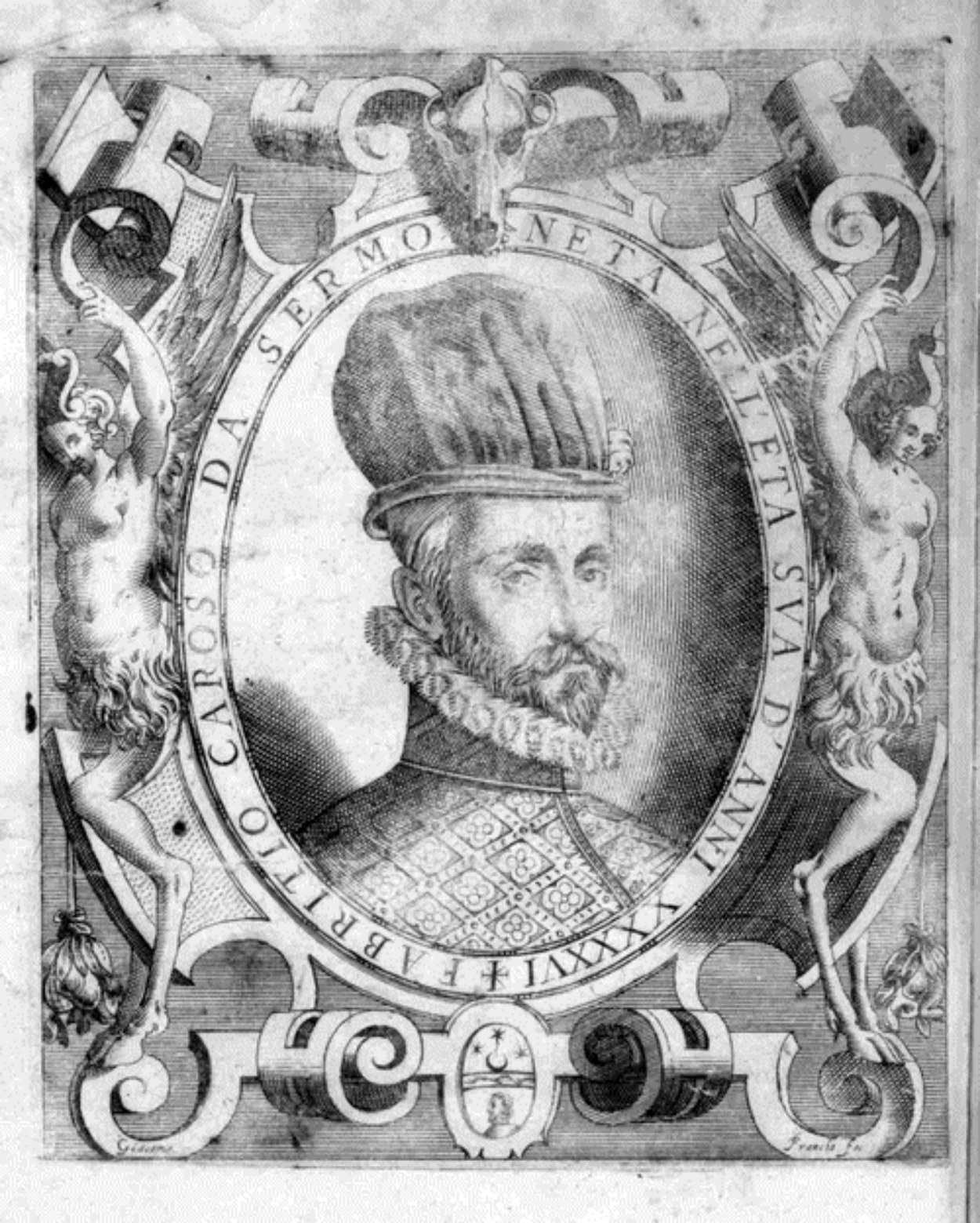
Fabritio Caroso da Sermoneta
- Medium:
- Woodcut
- Dance:
- Notation/Choreography
- Era:
- Pre-1700 (Renaissance/Baroque)
- Collection:
- Nobiltà di Dame (1600)
- Source:
- Library of Congress
- Rights:
- Public domain — free to use, share and adapt.
- Recorded as:
- Public Domain
This image is essential to understanding how Renaissance elites moved and why they danced. It shows that courtly dance was not entertainment but a form of non-verbal communication about power, grace, and legitimacy—a language that nobles had to master. It also documents the specific costumes, bearing, and spatial protocols of that language, making it invaluable to historians of dress, court ritual, and the embodied performance of rank.
What you are looking at
A noble couple stands face-to-face in a palatial interior defined by a checkered floor and ornamental frame. The man, on the left, wears elaborate Renaissance court dress: a richly patterned doublet with small repeated motifs, fitted breeches, and a short cape lined with dark fur draped across one shoulder. He holds a feathered hat in his left hand and a sword at his side, striking a pose with his weight shifted and his body angled toward his partner. The woman, on the right, is dressed in a formal gown with decorative embroidery down the front, puffed sleeves, and an ornate headdress with jewels and ribbons. Both figures are poised as if in the midst of a social dance or formal courtship ritual. The composition captures a moment of presentation and interaction rather than vigorous movement—a freeze-frame of courtly decorum.
The dancing
The man's posture is open and animated, with one leg forward and his torso turned to address the woman directly; his free arm is positioned with a gesture of courtesy or invitation. The woman stands more formally upright, her body nearly frontal, her arms at her sides with hands visible. Both dancers maintain an upright frame characteristic of Renaissance court dance, with no hand-holding or close contact visible. The spatial relationship between them suggests a prescribed distance appropriate to formal court etiquette—close enough for social interaction but respecting decorum.
The dance depicted
This is almost certainly a pavane or galliard, the dominant couple dances of the Italian Renaissance court, though the frozen moment does not reveal the specific footwork or progression. The image captures the presentation phase rather than active choreography—a moment when dancers would acknowledge each other or prepare for the dance proper. Caroso's treatises document both pavane (a slow, stately processional dance) and galliard (an energetic jumping dance with complex footwork), and this engraving likely illustrates one of the opening positions or a moment of formal salutation that preceded the kinetic phase. The dress and setting confirm this is courtly dance, not popular or theatrical.
How it was made
This is a woodcut, a relief-printing technique that allowed rapid circulation and multiple impressions. The bold lines and strong contrasts suit the formal, heraldic quality of the image; the ornamental border frames the scene like a portrait or coat of arms, elevating the dancers to emblematic status. Woodcut's accessibility made it ideal for a practical dance manual intended for court instruction—each plate could be reprinted easily as copies of Caroso's treatise spread through European courts. The technique emphasizes outline and silhouette, making costume detail and posture instantly legible.
About this work
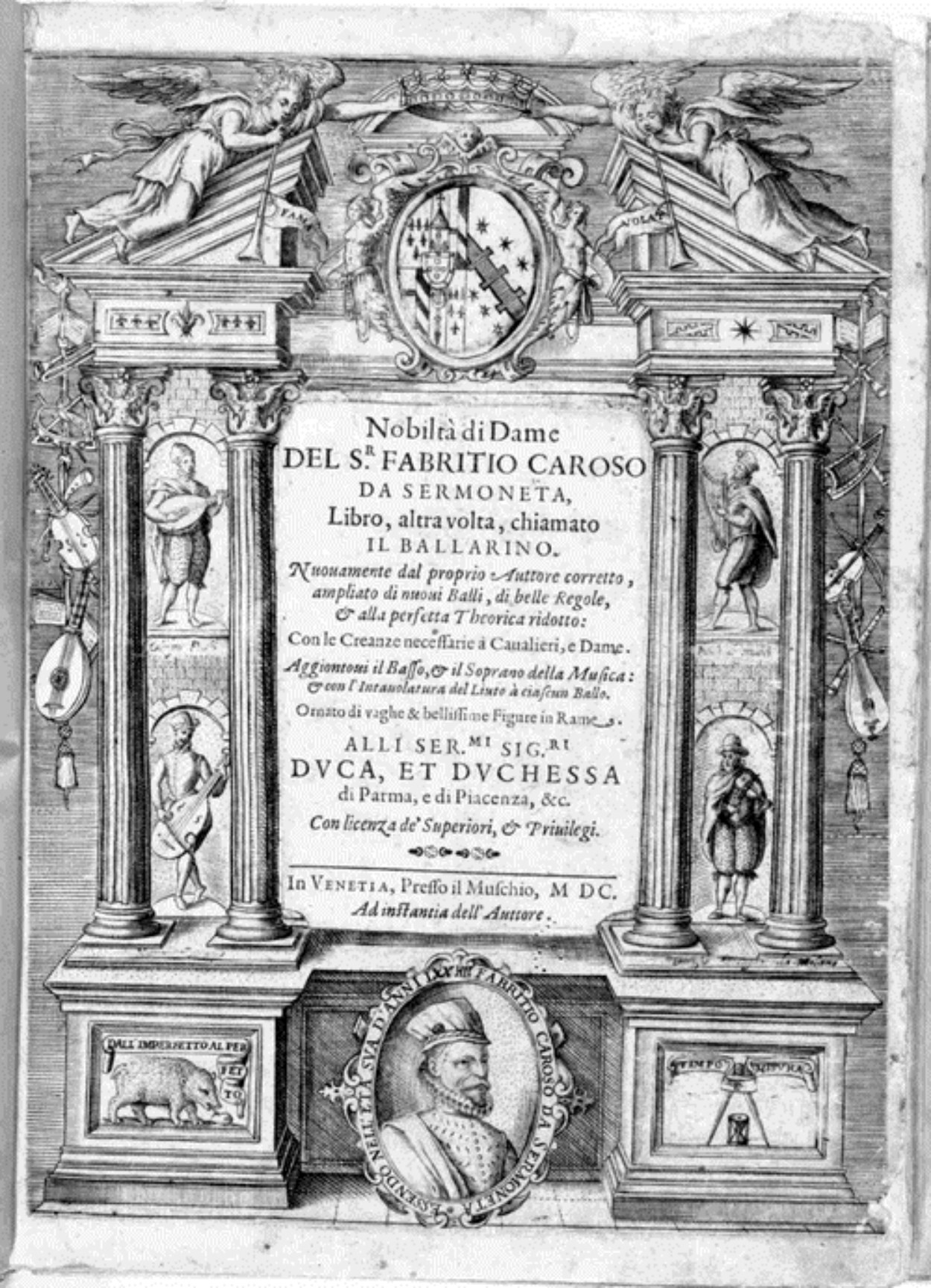
This is a pedagogical plate from Fabritio Caroso's *Nobiltà di Dame* (Venice, 1600), a refined and expanded revision of his earlier *Il Ballarino* (1581). The work documents the dances of the late Renaissance Italian court, capturing both the choreography and the ideals of nobility and grace that those dances embodied. The plate presents a couple in formal court dress executing or preparing to execute one of the period's most prestigious dances—almost certainly either the pavane or the galliard, both of which required years of study and marked the dancer as educated and refined. Caroso's treatises were widely circulated and translated, making them the most influential dance manuals of the period and this image a canonical document of how nobility moved, dressed, and displayed status through choreography.
How to look at it
Attend to the posture and the distance between the figures. This is not a moment of climactic movement but of formal salutation—the ritualized greeting that preceded the actual dance. The man's forward-facing stance and the woman's composed uprightness show the decorum required of noble dancers. Notice also the costume: every detail—the fur, the embroidery, the jeweled headdress—is part of the meaning of the dance. In Renaissance court dance, what you wore and how you carried yourself were inseparable from the dance itself. The ornamental frame around the couple signals that they are being presented as exemplars, ideal nobles executing an ideal dance.
The artist
Fabritio Caroso da Sermoneta (c. 1535–1605) was the preeminent dance master of the late Italian Renaissance and the author of the two most influential dance manuals of the era. *Il Ballarino* (1581) was already a standard work used in courts across Italy and beyond; *Nobiltà di Dame* (1600) refined, expanded, and updated it for the tastes and practices of the turn of the century, reflecting evolved technique and fashion. Caroso was not merely a chronicler but an innovator who codified the vocabulary of Renaissance court dance and raised the status of dance instruction from craft to a form of courtly knowledge comparable to music, rhetoric, or literature. His treatises are illustrated with woodcuts showing couples in formal dress executing specific figures and positions, making them visual as well as textual documents.
The period
The late 16th and early 17th centuries saw dance elevated to unprecedented status in European courts, particularly in Italy and France. The pavane and galliard dominated courtly dance culture; the pavane was a slow, processional dance that showcased elegance and costume, while the galliard was a virtuosic display of agility and strength. Both required extensive training and were marks of courtly education. Caroso's work appeared at the moment when Italian court dance was most influential and most codified—the publication of *Nobiltà di Dame* in 1600 was also the moment when French court ballet was beginning to develop a rival system. The book was dedicated to Christine of Lorraine, a French princess who had married into the Medici family, reflecting the cross-pollination of Italian and French court culture through dynastic marriage.
Where it lives
This is a woodcut plate from Caroso's *Nobiltà di Dame* published in Venice in 1600. The work is held in the Library of Congress; this image was accessed through LOC.
Dance in this work
Questions about this work
What dance are they doing?
The image shows a moment of formal presentation that likely precedes either a pavane or a galliard, the two dominant dances of the Italian Renaissance court. The frozen posture does not show the footwork or progression characteristic of either dance, so the specific identity cannot be certain from the image alone—but the costume, setting, and courtly context confirm it is one of these two. Caroso's treatise documents both extensively.
Was this used as a dance instruction manual?
Yes. Caroso's *Nobiltà di Dame* was a practical manual for court dancers and dance masters, not merely a commemorative record. The woodcuts illustrated specific figures, positions, and moments within choreographed dances, and readers would have used them alongside the text to learn the dances themselves. Multiple copies circulated in court libraries across Italy and Europe.
What is the significance of their clothing?
Costume was integral to Renaissance court dance. The rich fabrics, jewels, embroidery, and fur signaled not only wealth but also rank, taste, and mastery of courtly aesthetics. A noble dancer had to move in a way that displayed—rather than concealed—their garments; the dance and the costume were choreographed together. This image preserves evidence of both.
Why is the woman standing still while the man gestures?
This likely reflects the gender conventions of court dance at the time: the man was often the active or dominant figure in the spatial and gestural choreography, while the woman maintained a composed, frontal bearing. That said, both figures are part of the choreography, and women's dances in Caroso's treatises include complex footwork and patterns—this image simply captures one formal moment of greeting rather than the movement phases.
More Notation/Choreography artwork