49 works in this view — arrow keys or swipe to move between them.
Dance in Art
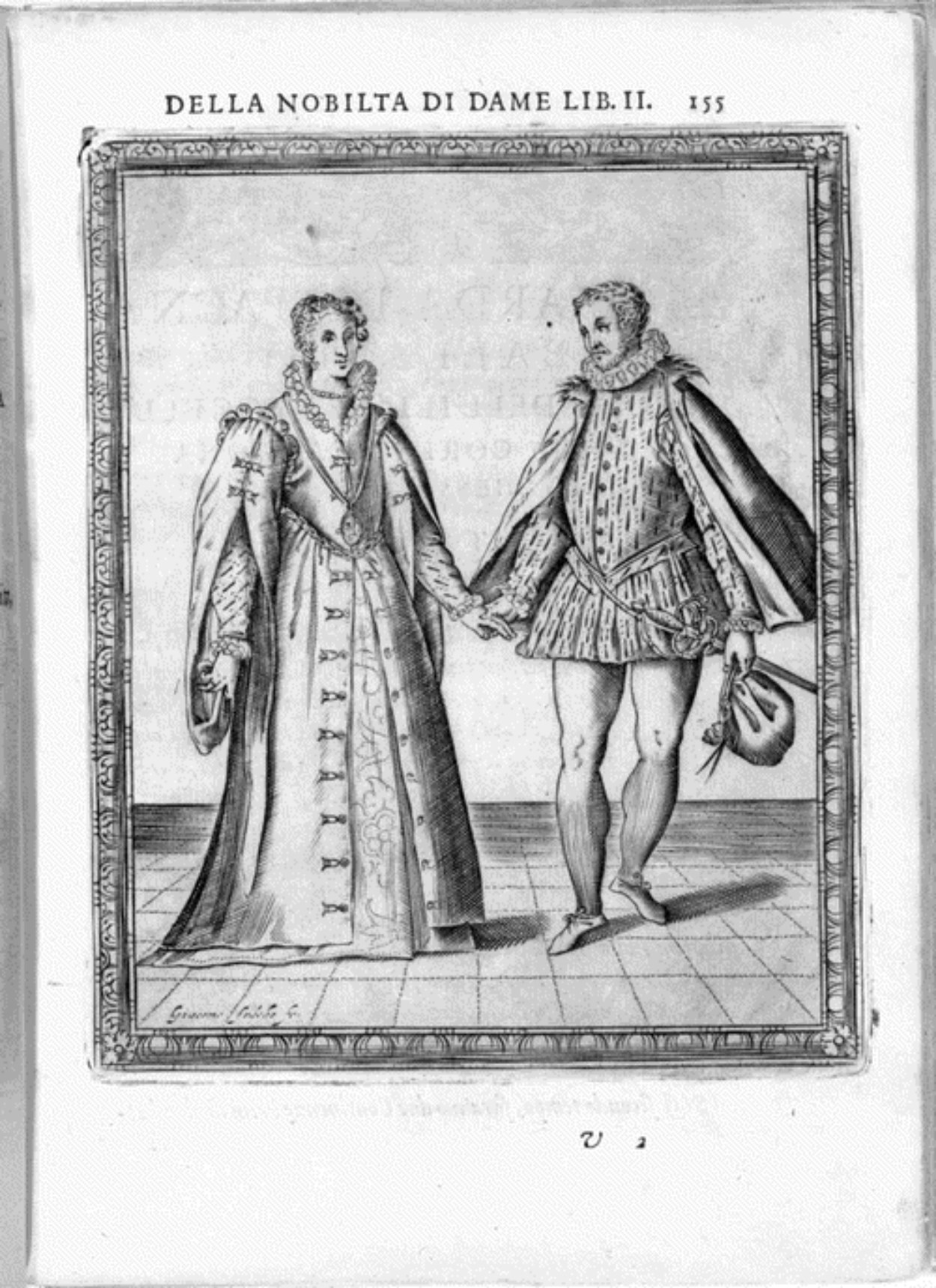
Caroso Nobiltà — Dance Plate (plate 11)
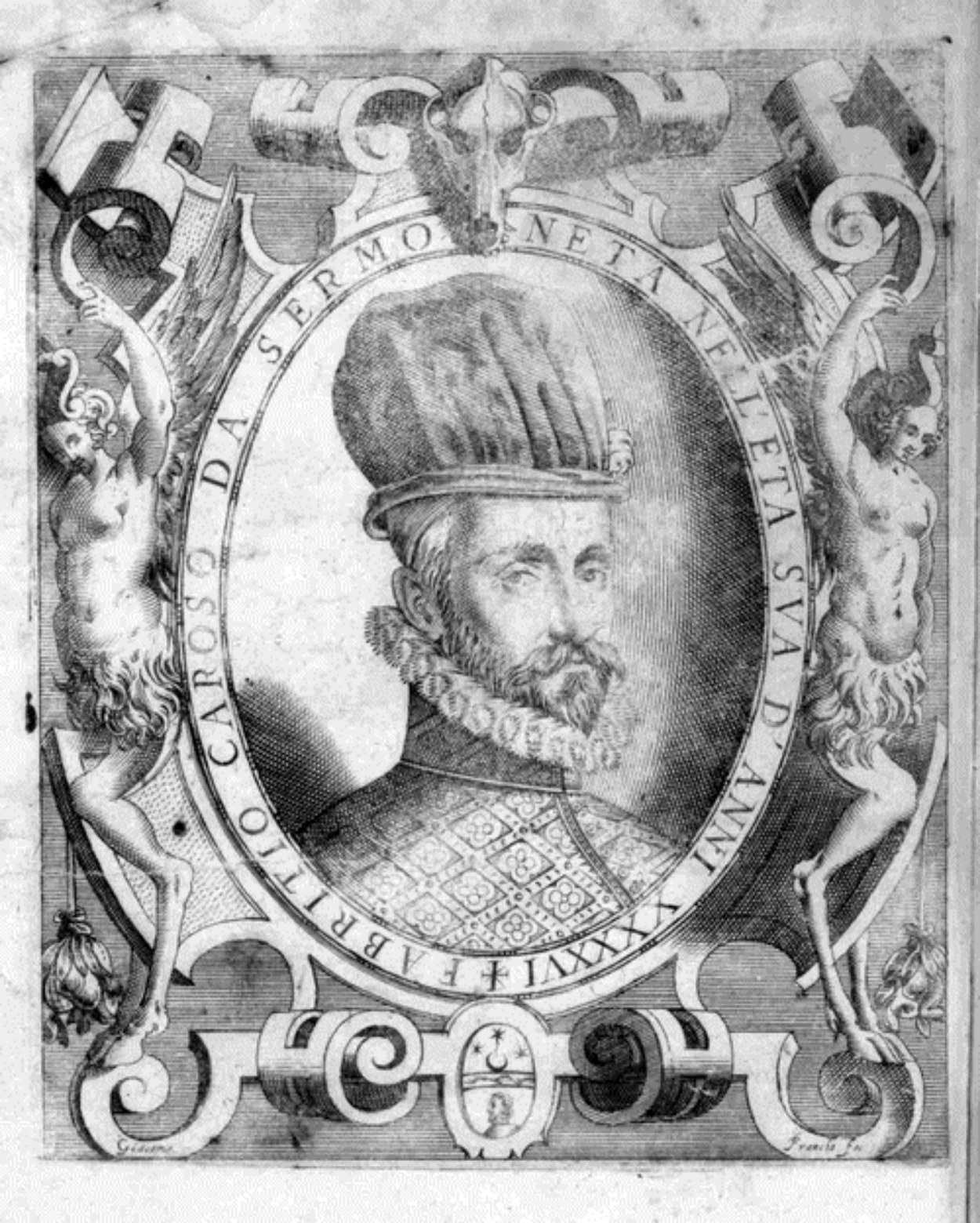
Fabritio Caroso da Sermoneta
- Medium:
- Woodcut
- Dance:
- Notation/Choreography
- Era:
- Pre-1700 (Renaissance/Baroque)
- Collection:
- Nobiltà di Dame (1600)
- Source:
- Library of Congress
- Rights:
- Public domain — free to use, share and adapt.
- Recorded as:
- Public Domain
This image is one of the very few surviving visual records of how Renaissance court dances were actually performed, created by one of the era's most influential dance masters. For historians and dancers, Caroso's plates are invaluable evidence of costume, posture, hand position, and the formal decorum that governed courtly movement — without such sources, these dances would be almost invisible. The combination of text and image in Caroso's manual established the template for dance instruction that would persist for centuries.
What you are looking at
A woodcut illustration shows a noble couple in formal Renaissance Italian court dress, standing in a paired dance posture on a tiled floor. The woman on the left wears an elaborate long gown with vertical decorative buttons or fastenings down the front, puffed sleeves with small cross emblems, and a high standing collar; her hair is styled in an upswept arrangement. The man on the right wears a short doublet with horizontal pleating or ridging, exposed legs, and a large draped cloak lined with a patterned fabric fastened at the shoulder. Both figures hold hands at roughly waist height, and both gaze toward each other or downward in a composed, formal manner. The setting is minimal — just the tiled floor line suggesting an interior space — allowing focus on the figures and their dress. The image is surrounded by an ornamental rectangular border typical of woodcut title pages and instructional plates.
The dancing
The couple stands in a side-by-side formation with hands clasped at the center. The woman's posture is upright with her weight centered; the man turns slightly toward her. Both bodies are elongated and formal, showing the stiffness typical of Renaissance court dance rather than the fluidity of later periods. Their joined hands at mid-body and the gentle turning of the male figure suggest a moment of promenade or processional contact rather than a closed ballroom hold. The dress silhouettes — her gown falling to the ground, his legs fully exposed to the calf — mark this as formal court wear, not theatrical costume.
The dance depicted
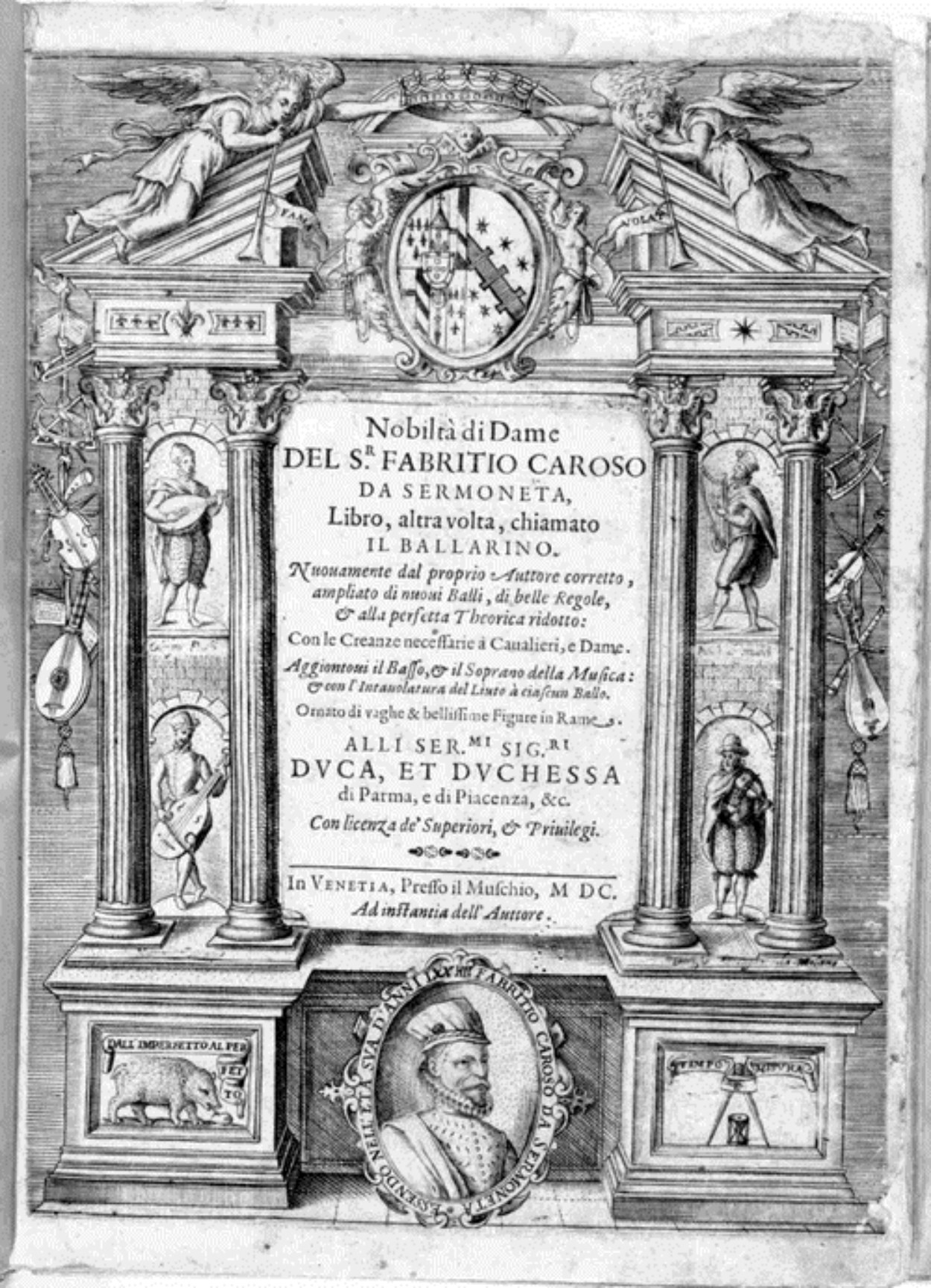
This is a plate from Fabritio Caroso's dance manual *Nobiltà di Dame* (Venice, 1600), illustrating a paired court dance of the late Renaissance. Caroso's work codified the refined ballo italiano practiced in Italian courts at the turn of the 17th century. The image most likely depicts a moment from a *pavane*, *almain*, or similar processional paired dance in which nobility demonstrated grace and propriety through controlled, measured steps and formal hand contact. The couple's direct gaze, composed bearing, and the emphasis on their dress over dynamic movement all reflect the decorum expected of such court dances, which functioned as social ritual and display of status as much as entertainment.
How it was made
This is a woodcut, a relief printing technique in which an image is carved into the surface of a wooden block. Woodcut allows for bold, clear lines and strong contrasts suited to instructional reproduction — the plate could be printed repeatedly in copies of the manual. The technique creates the fine parallel lines visible in the fabric textures and the clear silhouettes of the figures. Caroso's *Nobiltà di Dame* was printed in Venice, a major center of Renaissance woodcut production, and this plate represents how dance instruction was disseminated to a literate, wealthy European audience through the combination of text (not visible in this cropped detail) and engraved or woodcut demonstration figures.
About this work
This is a woodcut demonstration plate from Fabritio Caroso's 1600 dance manual *Nobiltà di Dame*, showing a noble couple in formal Renaissance Italian court dress in a paired dance position. The image serves as both a fashion document and a record of how late Renaissance court dance was taught and understood — through clear visual presentation of proper dress, posture, and hand contact. The manual was a refined reissue of Caroso's earlier *Il Ballarino* (1581) and reflects the most fashionable Italian court practice at the turn of the century. Such manuals were rare and precious objects owned by the nobility and dance masters of Renaissance and Baroque Europe, and this plate is one of the primary visual records of how actual court dances looked and were performed.
How to look at it
Attend to the formal restraint of the pose: there is no leap, no turn, no dramatic gesture. The couple's gaze is inward or downward, not toward an audience, and their bodies are elongated and composed. This is a moment of stately progression, not performance climax. Note too the meticulous rendering of dress — Caroso's manuals were as much fashion plates as dance documents, and the woman's puffed sleeves, the man's pleated doublet, and the ornamental fastenings are rendered with precision. The woodcut's bold line work makes these silhouettes unmistakable: this is instruction in how a noble person should move and dress, not a spontaneous moment but a prescribed form.
The artist
Fabritio Caroso da Sermoneta (c. 1526–after 1605) was one of the two most celebrated dance masters of the late Renaissance, active primarily in Rome and Venice. He authored two major dance manuals: *Il Ballarino* (1581), which contained detailed choreographies and instruction in the ballo (the primary courtly dance form), and the revised and expanded *Nobiltà di Dame* (1600), dedicated to Christine of Lorraine. Caroso's work was systematic and detailed — his manuals included not only choreographic notation (a form of figure-mapping rather than the later Labanotation) but also practical advice on deportment, music, dress, and the social role of dance. His rival and contemporary Cesare Negri produced a similarly influential manual, *Le Gratie d'Amore* (1602), but Caroso's work is considered the more comprehensive and the standard reference for Renaissance courtly dance.
The period
By 1600, the ballo italiano had been the dominant courtly dance form across Italy and much of Europe for over a century. It had evolved from 15th-century processional forms into an intricate art combining choreographed figures, social dancing, and elaborate dress display. The Renaissance court, especially in Venice and Rome where Caroso taught, was the setting for an intense culture of dance as both courtship ritual and artistic performance. However, by 1600, tastes were beginning to shift; the baroque period was dawning, and new forms — faster, more virtuosic, more theatrical — would soon emerge. Caroso's manuals are thus snapshots of a refinement at its height, even as it was being superseded. The *Nobiltà di Dame* was his last major work, published when he was elderly, and represents a final codification of the Renaissance ballo before the form gave way to baroque court dance and ballet.
Where it lives
This plate is from a copy of *Nobiltà di Dame* (Venice, 1600), held in the Library of Congress. *Nobiltà di Dame* was an expensive, precious object — a large folio containing woodcut plates, musical notation, and detailed dance choreographies in Italian. Very few copies survive, and the work is one of the primary sources for all later study of Renaissance dance.
Dance in this work
Questions about this work
Why is the man's body so different from the woman's?
In Renaissance court dress, women wore full-length gowns that masked their legs and emphasized the torso and arms, while men wore doublets with exposed hose or bare legs up to the knee, displaying the male leg as a sign of status and activity. This contrast reflects not the dance itself but the strict gender conventions of 16th-century fashion. However, in the actual dance, both would have been moving in similar measured steps — the man's exposed legs allowed him to demonstrate control and precision of footwork, which was essential to the ballo.
Is this a waltz, or what exactly is this dance?
No — this is a ballo, the primary courtly dance of the Renaissance. It is not a ballroom dance in the modern sense. Caroso's choreographies typically combined a processional opening (like what might be depicted here) with more complex figured sections, often danced by groups rather than couples alone. The paired hand-hold was formal and decorous, not the intimate closed hold of later ballroom dancing. Without seeing the full text and choreography from the manual, we can say only that it is likely a pavane, almain, or similar processional opening figure.
How was this used as a dance manual?
Dance masters and nobles would own or consult Caroso's manual as both reference and instruction. The text beside each plate described the choreography, music, and proper deportment. A noble learning to dance would study these images to understand how to hold the body, where to place the hands, and how to dress. The manual was expensive and not mass-produced; it was a luxury object for the elite. This particular plate, labeled as plate 11, was one of many used to walk a reader (or a student with a master) through the elements of courtly dance.
Was dance really this formal and stiff?
Yes and no. Renaissance court dance was indeed governed by strict rules of posture and propriety — the body was to be upright, the movements controlled, the emotion restrained. However, within those constraints, there was considerable elegance and variety, especially in the use of arms, turns, and rhythmic variations. The woodcut's flat, linear style also makes the dance look stiffer than it may have felt in performance. Dancers of the period were trained to appear composed and dignified, especially in formal, public settings like the ones Caroso's manual describes.
More Notation/Choreography artwork