49 works in this view — arrow keys or swipe to move between them.
Dance in Art
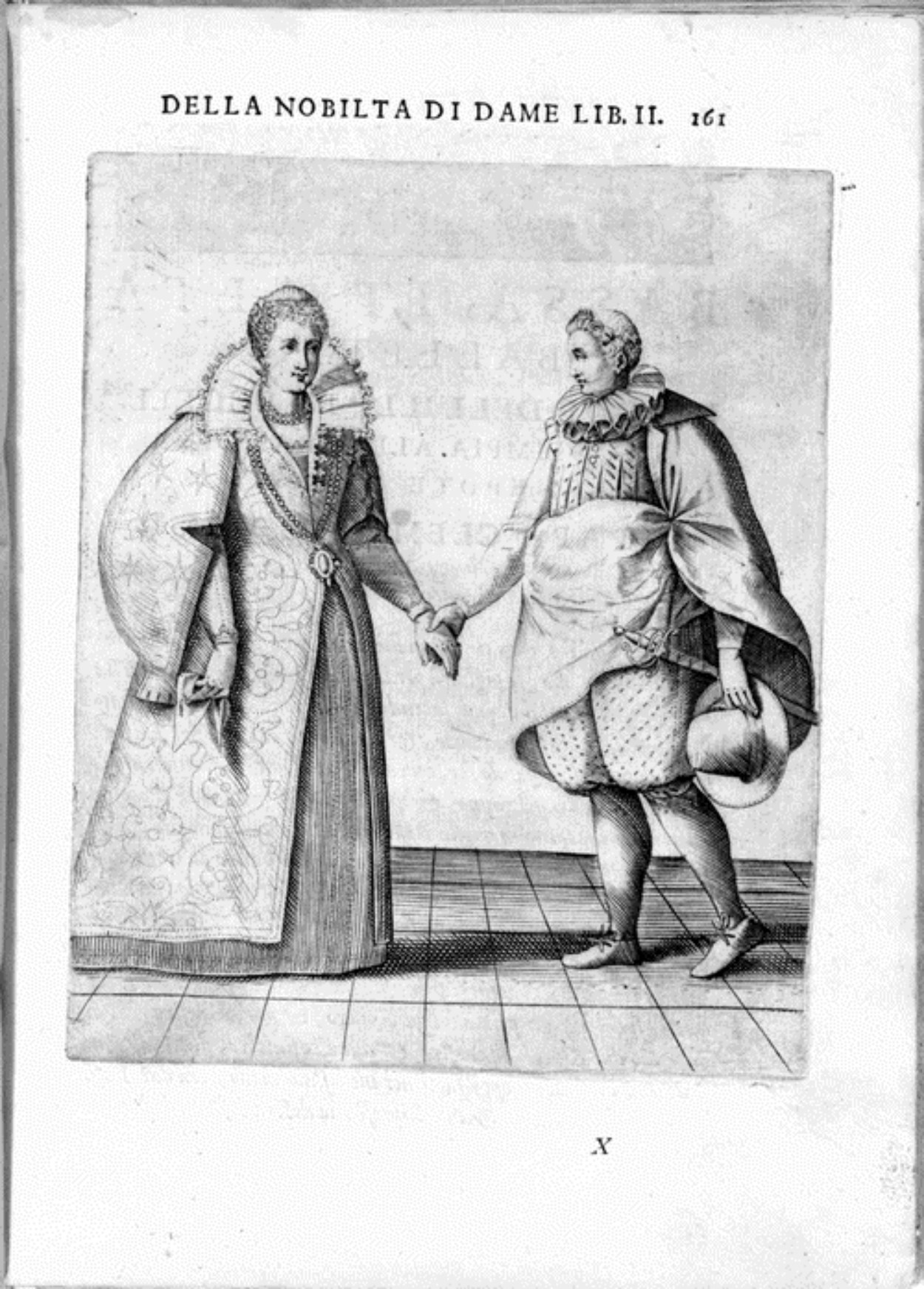
Caroso Nobiltà — Dance Plate (plate 12)
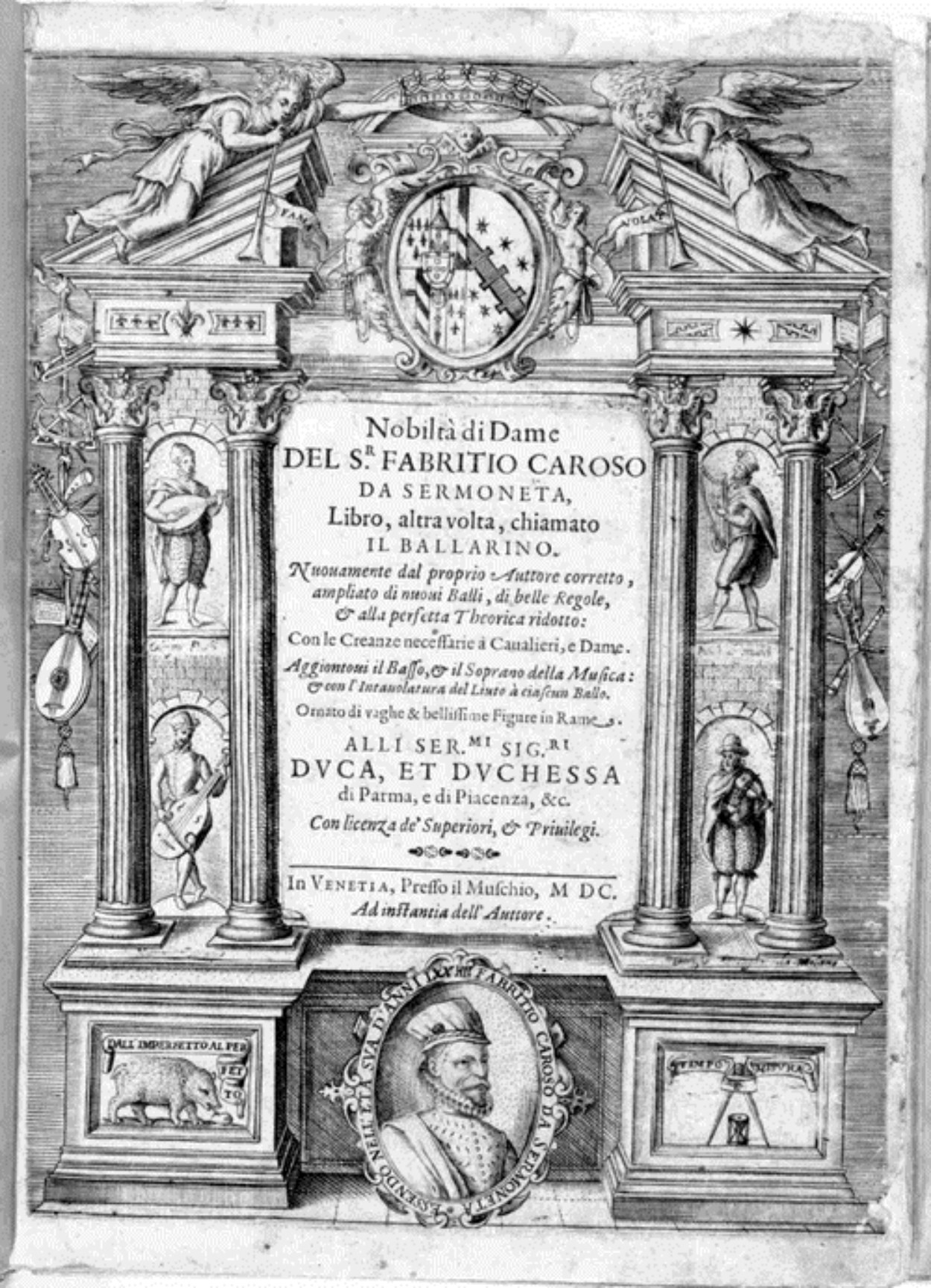
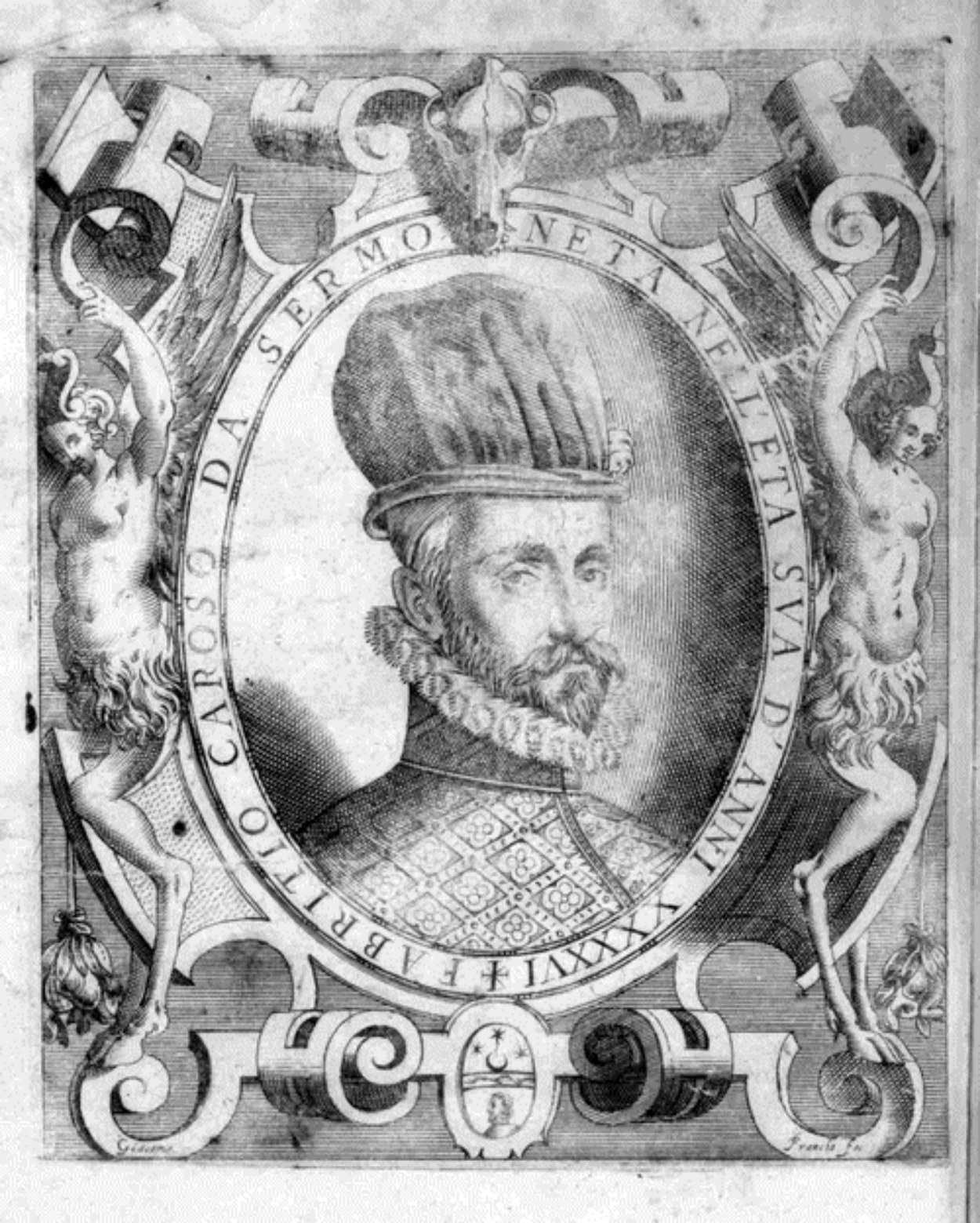
Fabritio Caroso da Sermoneta
- Medium:
- Woodcut
- Dance:
- Notation/Choreography
- Era:
- Pre-1700 (Renaissance/Baroque)
- Collection:
- Nobiltà di Dame (1600)
- Source:
- Library of Congress
- Rights:
- Public domain — free to use, share and adapt.
- Recorded as:
- Public Domain
For dancers and dance historians, this plate is a rare window into how Renaissance court dances were actually performed: the posture, the hand contact, the spatial relationship between partners. Caroso's treatise is one of only a handful of surviving detailed accounts of pre-modern social dance, making every plate a primary source for understanding how bodies moved and interacted in Renaissance courts.
What you are looking at
Two figures in Renaissance Italian court dress stand facing each other on a tiled floor, their right hands clasped in a formal greeting or dance position. The figure on the left wears an elaborate gown with a high ruff collar, puffed sleeves, and a floor-length skirt decorated with intricate patterns; a large semicircular cloak or mantle lined with fur drapes from the shoulders. The figure on the right, in shorter hose and a doublet with a matching ruff and puffed sleeves, holds a plumed hat and gestures with the left hand in a courtly manner. Both figures are shown in three-quarter view, their bodies aligned in a formal, symmetrical composition against a plain background with a simple gridded floor that suggests depth. The woodcut technique renders the rich fabrics in fine parallel lines and cross-hatching, emphasizing the texture and weight of the garments.
The dancing
Both figures stand upright with weight evenly distributed, their posture formal and dignified. The hand-clasp between them is a gentle contact rather than a grip—characteristic of court dance etiquette. The woman's right arm extends horizontally at shoulder height; the man's left arm is bent with the hand raised in a courtly flourish. Both heads are turned toward each other in a gesture of attention and mutual regard. The positioning suggests they are either about to begin a dance or are captured in a moment of formal acknowledgment between partners.
The dance depicted
This is a plate from Fabritio Caroso's choreographic treatise *Nobiltà di Dame*, which documented the refined court dances of late-Renaissance Italy. The image depicts the opening position of a paired dance, most likely a pavane or similar processional court dance of the period. The careful symmetry, formal dress, and hand-clasp are signature elements of Renaissance court dancing, where dance was a social ritual governing courtship and rank. The woman's elaborate gown and the man's formal attire confirm this as elite courtly practice rather than folk or theatrical dance.
How it was made
This is a woodcut, a relief-printing technique that allowed for mass reproduction and circulation of dance notation and instruction across Europe. The medium's capacity to render fine detail is evident in the parallel-line hatching used to suggest the pattern and sheen of expensive fabrics—damasks, silks, and furs—which would have been the actual materials worn by dancers of rank. Woodcuts were the standard vehicle for illustrated dance manuals of the period and made these texts accessible to a broader educated audience than manuscript copies alone could reach.
About this work
This is one of sixty woodcut plates from Caroso's *Nobiltà di Dame* (Venice, 1600), a definitive compendium of Italian court dances at the turn of the seventeenth century. The work is both a dance notation and a fashion document, capturing the choreography and material culture of the most prestigious court dancing practice in Europe. The plates served as a visual guide for dancers learning steps and partnering protocols, but also as an aspirational image of courtly refinement for readers who might never dance themselves. In the history of dance literacy, these plates are foundational: they represent one of the earliest systematic efforts to capture social dance in a reproducible visual form.
How to look at it
Attend to the formality of the hand-clasp and the precise spacing between the figures: this is not an embrace, but a measured contact governed by rules. Notice the difference in costume between the two figures—the woman's heavy, voluminous skirt and the man's shorter hose and fitted doublet—and how the artist has rendered the weight and drape of each. The alignment of their bodies and the direction of their gaze suggest they are moving in parallel or in opposition, a characteristic structure of Renaissance paired dances. The gridded floor grounds them in a specific space and implies the geometric patterns of courtly dance floors.
The artist
Fabritio Caroso da Sermoneta (c. 1526–c. 1600) was a celebrated dancing master at the courts of Rome and other Italian cities. He published *Il Ballarino* in 1581, a foundational dance manual, and revised and expanded it as *Nobiltà di Dame* in 1600, dedicated to Christine of Lorraine. Caroso was among the most influential dance theorists of the Renaissance; his treatises codified the vocabulary and etiquette of Italian court dance and established a model for dance instruction that influenced practice across Europe. His work is distinguished by precise description of steps, timing, and partnering, combined with high-quality woodcut illustrations.
The period
In the late sixteenth and early seventeenth centuries, social dance was a central accomplishment of courtly education and a primary mode of courtship, alliance-making, and the display of rank. The pavane and galliard, which Caroso taught, were the dominant dance forms of the era. Dance manuals were a growing genre, reflecting both the codification of court culture and the rise of printing: the ability to capture and circulate choreography in fixed form was itself new. Italy, particularly Venice where this was printed, was the center of dance innovation and dance publishing; Italian court dances were emulated throughout Europe.
Where it lives
This plate is part of the copy of *Nobiltà di Dame* (Venice, 1600) held by the Library of Congress, which acquired it as part of the Lessing J. Rosenwald Collection. The work is a printed book, not a unique object, and this particular copy is one of several surviving editions.
Dance in this work
Questions about this work
What dance are these two people doing?
The image shows the opening position of a paired court dance from late-Renaissance Italy, most likely a pavane or similar dance of formal character. We cannot identify the specific choreography from a single still image, but the hand position, upright posture, and formal dress are characteristic of dances Caroso taught. The plate is from his manual, which documented these dances step by step.
Why is one person dressed so differently from the other?
The differences in dress reflect the social roles of men and women in Renaissance courts. The woman wears an elaborate gown with a long skirt, high ruff, and expensive fabrics—a display of rank and courtly status. The man wears shorter hose and a fitted doublet, which allowed greater freedom of movement for the active footwork that male dancers performed. Both were fashionable courtly dress, and the contrast between them was part of the dance's visual language.
Is this a real photograph or a drawing?
This is a woodcut, a relief-printing technique. It is not a photograph and not a unique drawing; it is a print made from a carved wooden block, which allowed thousands of copies to be made. The fine lines you see were created by the spaces between the carved areas of the block.
Who was Fabritio Caroso?
Caroso was an Italian dancing master active in the sixteenth and early seventeenth centuries. He wrote the most influential dance manuals of the Renaissance, documenting the steps, timing, and partnering protocols of Italian court dances. His books were widely copied and translated, making him one of the most important figures in the history of European dance.
More Notation/Choreography artwork