49 works in this view — arrow keys or swipe to move between them.
Dance in Art
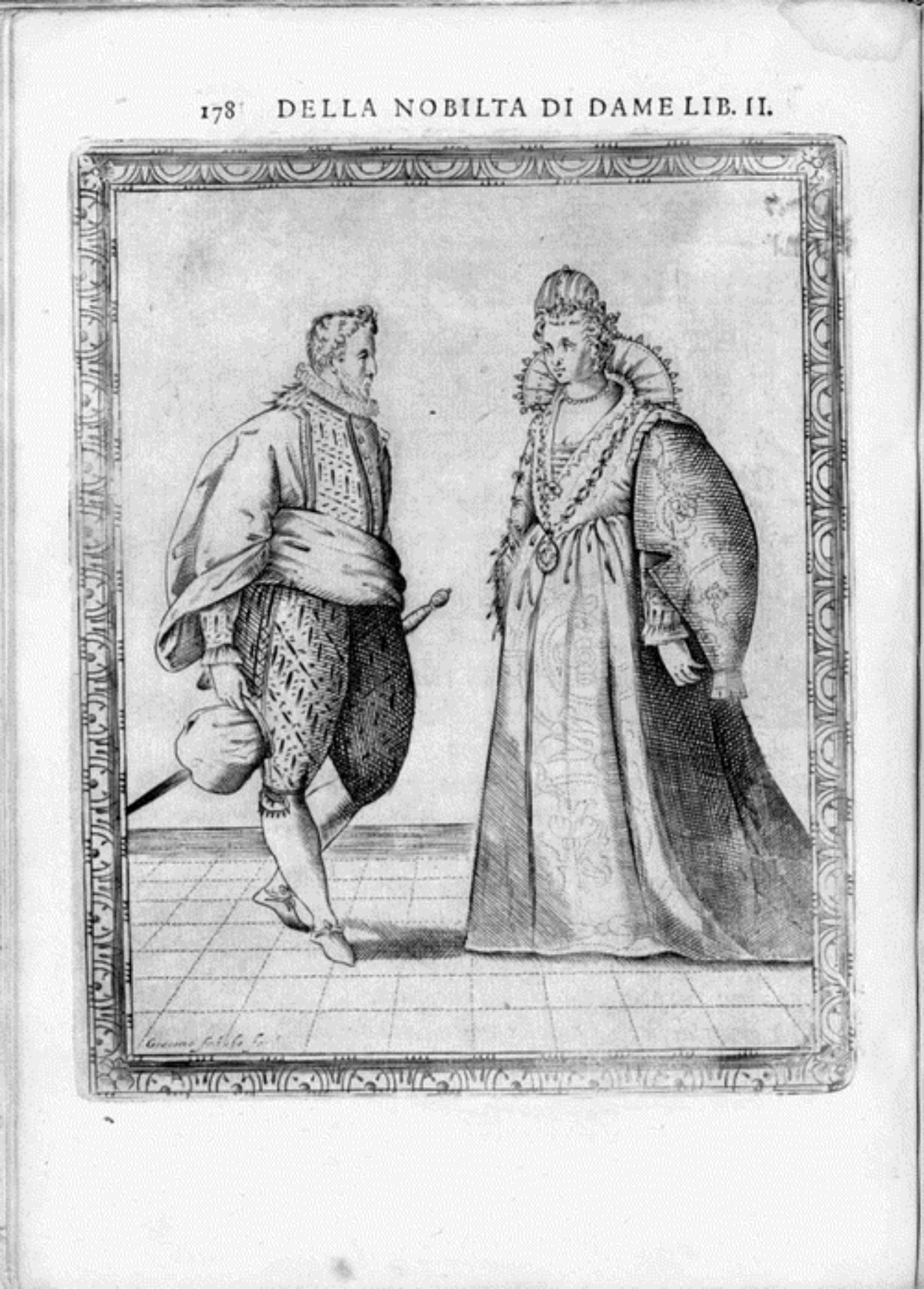
Caroso Nobiltà — Dance Plate (plate 14)
Fabritio Caroso da Sermoneta
- Medium:
- Woodcut
- Dance:
- Notation/Choreography
- Era:
- Pre-1700 (Renaissance/Baroque)
- Collection:
- Nobiltà di Dame (1600)
- Source:
- Library of Congress
- Rights:
- Public domain — free to use, share and adapt.
- Recorded as:
- Public Domain
Caroso's *Nobiltà di Dame* is the most comprehensive surviving source for Italian Renaissance court dance, and its woodcuts are among the very few visual records showing how nobles actually dressed while dancing in the early 1600s. This plate's careful rendering of costume, posture, and social distance between partners reveals that Renaissance court dancing was fundamentally about the display of nobility, refinement, and mastery of courtly codes—not technical virtuosity. For dancers and historians, it shows that the history of social dance is inseparable from the history of fashion and courtly ritual.
What you are looking at
A woodcut showing a nobleman and noblewoman in Italian Renaissance court dress, positioned as if in conversation or about to dance. The man, at left, wears a richly patterned doublet with slashed sleeves, ornate hose, and holds a feathered hat; he stands in a relaxed contrapposto with one leg extended. The woman, at right, wears an elaborate gown with a high waistline, full skirt, and sleeves decorated with intricate patterns; she is adorned with multiple strands of pearls and jewels. Both figures are rendered with careful attention to textile detail—embroidery, brocade, and the play of fabric weight. The setting is minimal: a simple tiled floor recedes into space, and an ornamental border frames the composition. The couple occupy a genteel, intimate space rather than a dance floor, suggesting this is documentation of courtly bearing and fashion as much as choreographic instruction.
The dancing
Both figures stand upright with good posture and turned-out positioning of the lower body. The man's weight appears to rest lightly on the forward leg, his torso relaxed but dignified; the woman faces toward him with her body in gentle contrapposto. Neither figure shows active weight shift or the sprung, rising movement characteristic of energetic Renaissance dances. The distance between them is formal and measured—close enough for discourse but preserving courtly decorum. The man's arm gestures are open and engaging; the woman's arms rest naturally at her sides. This is pose rather than captured motion.
The dance depicted
This plate illustrates the paired dances of the Italian Renaissance court, specifically the stylized processional and conversational dances—likely a *pavane* or *almain*—that formed the foundation of nobility's social dancing. Caroso's *Nobiltà di Dame* systematically documented the choreography of such dances with both written notation and woodcut figures showing the dancers' costume, deportment, and relative positions. The plate serves as a visual aid to the text: the couple demonstrates the refined, measured bearing required of noble dancers rather than the specific footwork of any single piece. Their dress is authentic to Venice circa 1600 and represents the height of courtly fashion, signaling that this dancing was an art of display as much as movement.
How it was made
This is a woodcut, a relief printing technique in which the image is carved into the surface of a wood block and inked for printing. Woodcut allowed for wide circulation of instructional images: pages could be printed in quantity and bound into books. The technique favors bold outlines and areas of solid black or white, which Caroso used effectively to define the silhouettes of the figures and the intricate patterns of their embroidered clothing through hatching and cross-hatching. The decorative border—a series of geometric and floral ornaments—is characteristic of Italian printed books of the period and frames the figures as specimens worthy of close study.
About this work
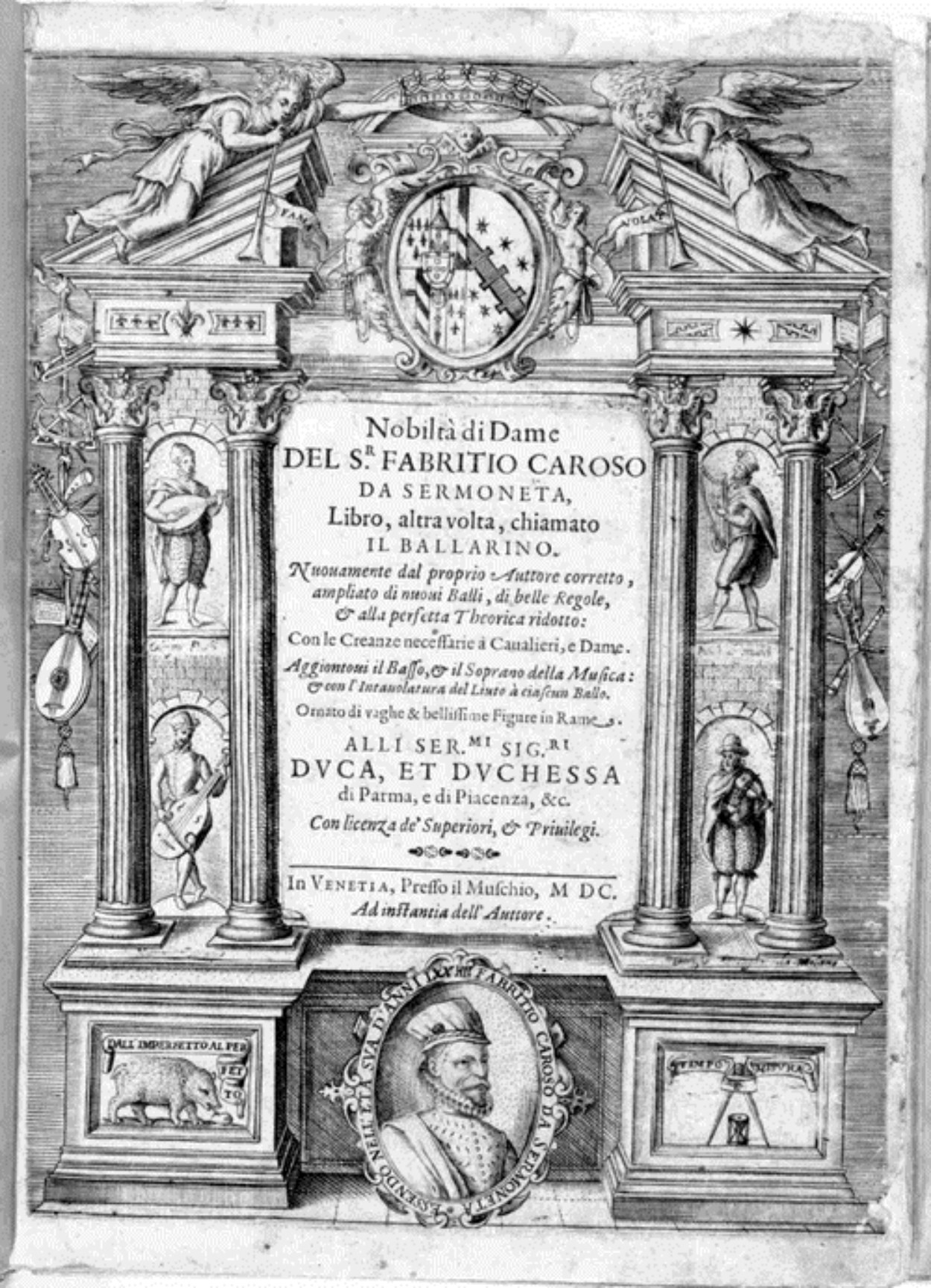
This is a teaching plate from Fabritio Caroso's *Nobiltà di Dame* (Venice, 1600), the authoritative manual of Italian Renaissance court dance. It presents a noble couple in the formal dress and bearing required for courtly dancing, positioned to show the refined deportment that accompanied the paired dances of the period. The woodcut format allowed the book to circulate widely among noble households and dancing masters, making visible the standards of movement and fashion that defined elite social practice. For a modern viewer, it documents both the aesthetic ideals and the actual dress conventions that shaped Renaissance dance, and demonstrates how a dance manual married written notation with visual instruction.
How to look at it
Attend to the stillness of the figures and the formality of their posture: this is not a moment of dynamic movement but a static display of courtly bearing. Notice the meticulous rendering of the woman's gown—the layering of the skirt, the pattern of the sleeves, the repeated pearl strands—which conveys the sheer expense of noble dress and its role in courtship and display. The man's contrapposto stance and the measured distance between the couple show Caroso's understanding of Renaissance ideals of masculine and feminine presence. The minimal setting—just a tiled floor and border—focuses attention entirely on the figures and their dress, treating the couple as exemplars rather than as actors in a narrative. The woodcut's bold lines make the costume details legible even in copies and at a distance, which was essential for a practical teaching manual.
The artist
Fabritio Caroso da Sermoneta (c. 1526–c. 1605) was a celebrated Roman dancing master and the author of two major treatises: *Il Ballarino* (Venice, 1581) and its revised, expanded edition *Nobiltà di Dame* (Venice, 1600). He worked in the circle of the Roman papal court and taught the nobility of central Italy. His treatises are among the most influential sources for Renaissance dance technique and choreography, combining detailed written descriptions of steps and figures with woodcut illustrations showing dancers in appropriate dress. Caroso's work was practical rather than theoretical: he designed his books as working manuals for dancing masters and ambitious nobles, blending instruction in technique with guidance on courtly behavior and fashion. The success of his publications across multiple editions and in French and English translations demonstrates his authority and the sustained appetite for his method.
The period
In the Italian Renaissance court of the late 16th and early 17th centuries, dancing was a essential accomplishment for the nobility, as documented in Baldassare Castiglione's *Il Cortegiano* (1528). By the time Caroso published *Nobiltà di Dame* in 1600, the Italian court dances—the pavane, galliard, volta, and almain—were becoming formalized and standardized across Europe. Yet Venice and Rome remained centers of innovation. The early 1600s saw a transitional moment: the measured, processional pavane was yielding to more energetic and theatrical forms, and court dance was beginning to separate from social dance. Caroso's book captured the mature tradition of the Italian Renaissance dance at the moment it was being superseded by the new Baroque aesthetic. Visually, the ornate costumes and careful attention to textile detail reflect the height of late Renaissance fashion and the role that clothing played in the display of rank and refinement.
Where it lives
This plate is from *Nobiltà di Dame*, a bound treatise on dance and courtly behavior published in Venice in 1600 by Fabritio Caroso. The work survives in multiple contemporary copies and later editions, held in libraries and collections across Europe and North America. This particular plate is identified as plate 14 and is part of a sequence of woodcuts illustrating paired dances and the dress appropriate to them.
Dance in this work
Questions about this work
How do I know what dance this couple is doing?
You cannot tell from the static pose alone. Caroso's book paired each woodcut with detailed written descriptions of the steps and musical timing. The plate serves to show the dancer's deportment and costume rather than the specific choreography. Without the accompanying text, the image demonstrates the refined bearing and fashion required for noble dancing, not any single dance.
Was this book actually used to teach dance?
Yes. Caroso designed *Nobiltà di Dame* for dancing masters and ambitious nobles who wanted to learn the fashionable dances of the Italian court. The combination of written description and visual illustration was innovative for its time. Copies circulated in noble households and among professional teachers, making it one of the most influential dance manuals of the Renaissance.
Why is the woman wearing so many jewels?
Pearl strands and jeweled ornaments were a mark of nobility and wealth in the Renaissance court. The cost of such decoration was enormous, and its display was part of the social function of courtly dancing. The careful rendering of these jewels in the woodcut would have signaled to readers that they were looking at noble dress—costume that only the very wealthy could afford.
What happened to Italian court dance after 1600?
By the early 1600s, the Italian Renaissance dances were becoming less central to court life as French and Spanish court dances gained influence. The measured pavane and galliard gradually gave way to more theatrical forms associated with the court ballet that was developing in France. Caroso's *Nobiltà di Dame* captured the tradition at its mature moment, just as it was beginning to be superseded.
More Notation/Choreography artwork