49 works in this view — arrow keys or swipe to move between them.
Dance in Art
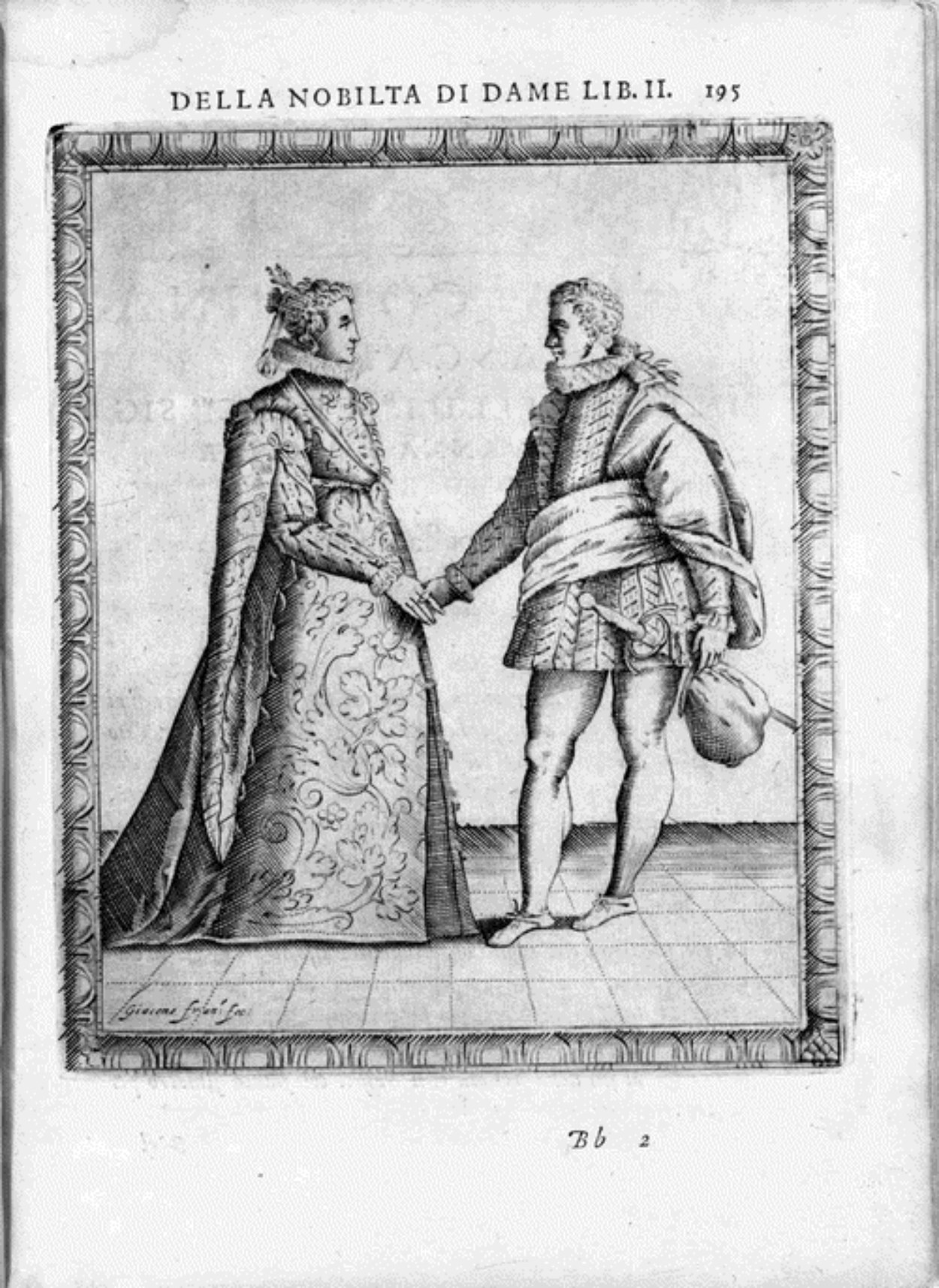
Caroso Nobiltà — Dance Plate (plate 17)
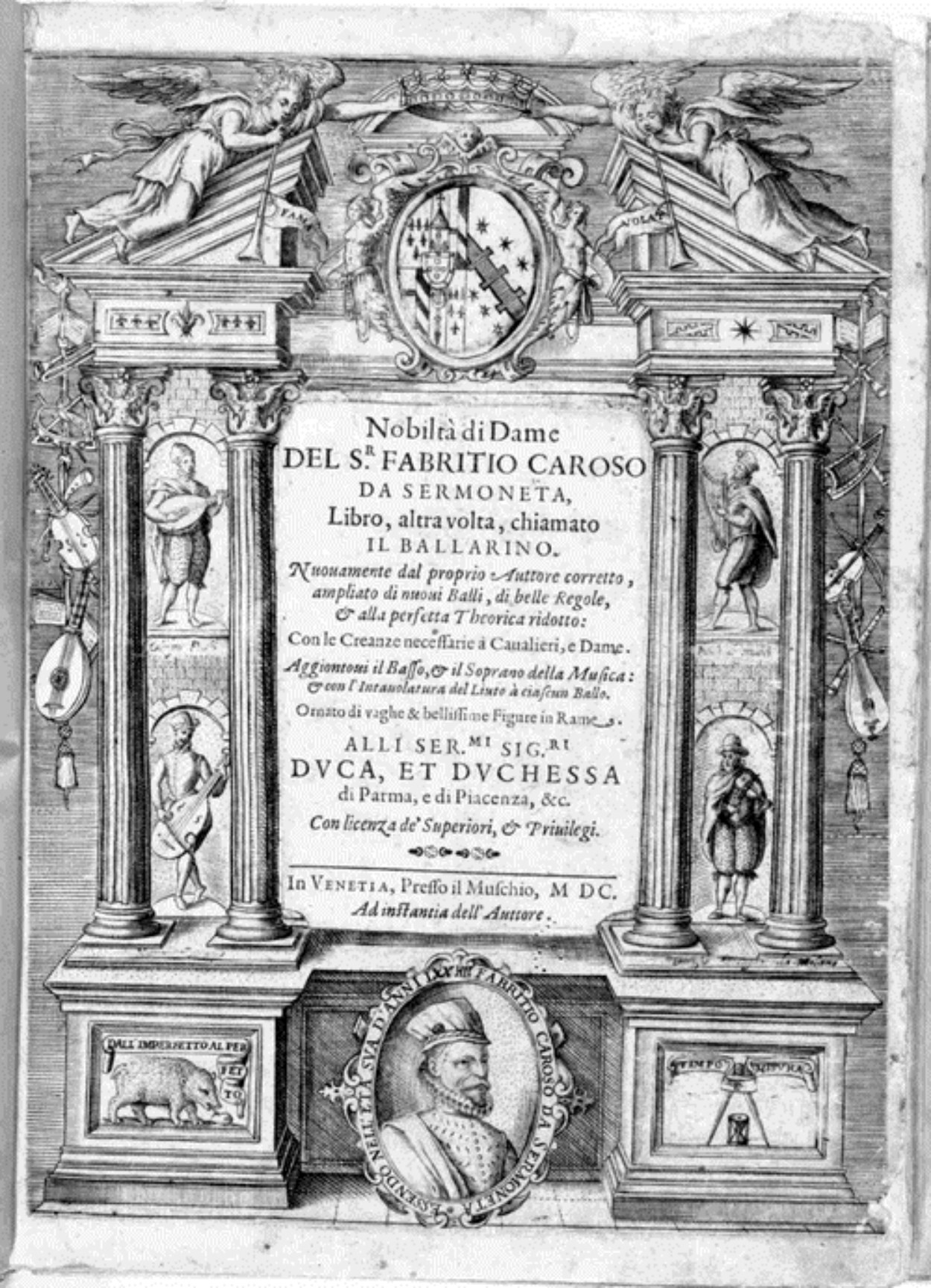
Fabritio Caroso da Sermoneta
- Medium:
- Woodcut
- Dance:
- Notation/Choreography
- Era:
- Pre-1700 (Renaissance/Baroque)
- Collection:
- Nobiltà di Dame (1600)
- Source:
- Library of Congress
- Rights:
- Public domain — free to use, share and adapt.
- Recorded as:
- Public Domain
This image documents a moment of transition in European dance history—the codification and publication of courtly dance at the precise moment when printed manuals began to standardize and spread aristocratic movement practice. Caroso's work is among the most detailed choreographic documents we have from the Renaissance, and this plate exemplifies the visual strategy he used to teach distant readers the proportions, bearing, and formal gestures that distinguished the nobility. For historians of dance, costume, gender, and courtly culture, this single image opens questions about how movement was learned, valued, and transmitted in early modern society.
What you are looking at
A noble couple stands facing each other in what appears to be an interior courtly space, hands joined in a formal greeting or opening position. The woman on the left wears an elaborate gown of Italian Renaissance fashion: a long, richly patterned damask or brocade dress with decorative embroidery, a fitted bodice, and a floor-length skirt with a long trailing train. Her hair is arranged in an elaborate coiffure typical of early 1600s court fashion, adorned with what appears to be jeweled ornaments or ribbons. The man on the right is dressed in fashionable doublet and hose, with a short padded jacket decorated with vertical ribbing or quilting, a broad collar, and fitted legs in what appears to be dark cloth. Both figures stand with formal posture in a tiled or paved floor space, isolated against a plain background, suggesting this is a demonstration or instructional image rather than a narrative scene.
The dancing
The pair stand at conversational distance with arms extended toward each other, hands meeting in a light, formal clasp at waist height. Both figures maintain upright, dignified posture with weight distributed evenly on both feet—no sense of dynamic movement or turn is captured. The woman's left arm extends gracefully to the man's right hand, while his left arm hangs naturally at his side. Their bodies are presented in profile or three-quarter view, allowing the viewer to see the full silhouette of the woman's elaborate skirts and the man's leg line. The gesture suggests a moment of courtly greeting or the opening position of a paired dance.
The dance depicted
This is an instructional illustration of Renaissance Italian court dance, most likely showing the opening of a bassa danza (basse danse) or a similar high-status courtly dance from the Cinquecento tradition. The hand-joined position and formal stance are consistent with documented opening positions in Caroso's own dance manuals. The image serves a pedagogical function—Caroso's *Nobiltà di Dame* was a printed guide to courtly dancing for the aristocracy, and individual plates like this one isolated specific positions or figures that dancers would learn and reproduce. The dance here is not about virtuosity or speed but about grace, proportion, and the demonstration of noble status through formal, controlled movement.
How it was made
This is a woodcut, a relief printing technique in which an image is carved into the surface of a wooden block, with ink applied to the raised portions. Woodcut allowed for relatively quick and economical production of multiple copies, making it ideal for the pages of a bound instructional manual circulating in early modern Venice and beyond. The fine lines of the clothing detail and the precise rendering of body position show the skill of the woodcut artist—likely someone trained to translate Caroso's choreographic notation and understanding into readable visual form. The technique's capacity for clear, bold lines and strong contrast made complex costume and gesture legible to a wide courtly audience learning from the printed page.
About this work
This plate from Caroso's *Nobiltà di Dame* (Venice, 1600) documents the opening position of an Italian Renaissance court dance as it was taught and performed among the Venetian aristocracy at the turn of the seventeenth century. It is not a portrait of a specific performance, nor does it capture movement in progress; instead, it freezes a discrete moment—the formal greeting between dance partners—as part of a larger pedagogical sequence. The work belongs to a rich tradition of European dance notation and instruction that predates modern Labanotation by centuries, using the woodcut medium to distribute courtly knowledge through print. Caroso's *Nobiltà di Dame* was itself a revised and expanded edition of his earlier *Il Ballarino* (1581), refined to reflect the most current fashionable practice at the Venetian court, and dedicated to Christine of Lorraine. This plate, one of many similar instructional figures in the volume, shows how dance was codified, disseminated, and preserved in the Renaissance: through the marriage of visual representation and printed word, making elite courtly practice available to readers across Europe.
How to look at it
Look first at the hands: they are the focal point of the composition and the site where the dance begins. The light clasp, the arm extension, and the formal distance between the bodies all communicate the restrained elegance of Renaissance court dance. Observe the absolute verticality of both figures' spines and the way their weight is distributed evenly between both feet—there is no sense of momentum, turn, or weight shift, which distinguishes this from dynamic movement. The costume detail is not decorative excess but instructional: the woman's dress shows the volume and weight of fabric that would move through the space as she danced, and her posture demonstrates how a noble woman carried herself. Finally, note the isolation of the couple on an empty floor against a blank background. This compositional choice strips away narrative or social context and presents the dancers as if they were carved stone or sculptural models—the dance itself, reduced to essential form, is the subject of study.
The artist
Fabrizio Caroso da Sermoneta (c. 1526–after 1605) was a celebrated dancing master, choreographer, and author based in Venice and Rome. He is known today almost entirely through his two treatises: *Il Ballarino* (Venice, 1581) and its revised, expanded version *Nobiltà di Dame* (Venice, 1600), dedicated to Christine of Lorraine. These volumes represent the most comprehensive surviving documentation of Cinquecento and early Seicento Italian court dance, with detailed written descriptions of dances and a parallel series of woodcut plates showing positions, figures, and the formal dress of dancing couples. Caroso's approach was systematic and pedagogical: he aimed to preserve and spread the refined movements of the Venetian and Roman courts to a reading audience of nobility, dancing masters, and aspiring courtiers. His influence on the codification of Renaissance dance practice was profound, and his manuals remained in circulation and were copied well into the seventeenth century.
The period
The year 1600 marks the end of the sixteenth century and the early years of the Baroque, a moment when the Italian courts were at the height of their cultural power and when printed books had become the primary vehicle for disseminating courtly knowledge across Europe. Caroso's *Nobiltà di Dame* was produced in Venice, a city whose wealth and cosmopolitan character made it a center for luxury printing and courtly culture. The dances documented here—basse danse, pavane, galliard, volta, and others—were the foundation of aristocratic social life; they were performed at weddings, state occasions, and courtly entertainments, and their mastery was a mark of noble status and education. The use of the woodcut medium reflects both the cost and the prestige of such an undertaking: illustrated dance manuals were expensive, elite objects, aimed at readers who could afford to purchase them and who had the leisure and social position to learn these dances. By 1600, however, the dominance of the bassa danza and the older Renaissance courtly forms was already beginning to yield to newer Baroque dances and movements, making Caroso's volume a kind of crystallization of a tradition just entering its twilight.
Where it lives
This woodcut is one of many instructional plates bound into the printed volume *Nobiltà di Dame*, published in Venice in 1600 and held in the Library of Congress. The plate is numbered (Bb 2) and was part of a sequence of similar figures distributed throughout the volume, each corresponding to a named dance or a specific figure within a dance.
Dance in this work
Questions about this work
How were Renaissance dances taught and learned?
Through a combination of live instruction from a dancing master and, increasingly by the late sixteenth century, through printed manuals like Caroso's *Nobiltà di Dame*. These manuals used written description paired with woodcut plates like this one to show the positions, arm placements, and formal bearing required for each dance. A reader would study the images and text, then practice with a partner or under the guidance of a teacher.
What dance is this showing?
The plate illustrates the opening position of one of the standard Renaissance court dances—most likely a bassa danza (basse danse) or a similar high-status paired dance. The hand position, upright posture, and formal bearing are consistent with the opening of many dances from Caroso's repertory. Without additional context or text from the page opposite, the specific dance cannot be identified with certainty.
Why is this image important for historians?
It is among the most detailed and reliable visual records we have of how Renaissance aristocrats moved, dressed, and related to one another in formal social dance. It documents a specific moment in the codification of European dance—the transition from oral tradition to print culture—and shows how movement knowledge was standardized and spread. For scholars of dance history, gender, costume, and courtly culture, such images are invaluable primary sources.
What can we learn from the clothing in this image?
The woman's elaborate dress—with its decorated bodice, voluminous skirt, and trailing train—tells us that dancing was a form of display for the nobility, and that the dance itself was designed to showcase the costliness and craftsmanship of one's wardrobe. The man's quilted doublet and fitted hose reflect early seventeenth-century men's court fashion. Both outfits demonstrate the wealth and status of the dancers.
More Notation/Choreography artwork